Audi’s updated naming strategy reflects a deliberate effort to enhance clarity and coherence across its vehicle lineup. By standardizing model names and powertrain designations, Audi aims to simplify the consumer experience. The distinctions between sedans and SUVs, alongside performance variants, offer insight into the brand’s commitment to efficiency and high performance. Understanding this structured approach reveals not only the logic behind the names but also the implications for potential buyers. What does this mean for future models?
Key Takeaways
- Audi’s naming strategy standardizes model names, eliminating confusion between electric and combustion models with clear designations like TFSI and e-tron.
- The A Series includes sedans and coupes from A3 to A8, while the Q Series features SUVs from Q3 to Q8, indicating size and luxury.
- S models offer enhanced performance, while RS models represent the highest performance tier with engines exceeding 400 hp and sport-tuned features.
- Customer feedback drove the naming change, aiming for improved clarity and understanding of Audi’s diverse vehicle lineup.
- The next-gen A6 will launch on March 4, 2025, featuring combustion and e-tron variants, reflecting Audi’s commitment to advanced drivetrain technologies.
What Is Audi’s New Naming Strategy?
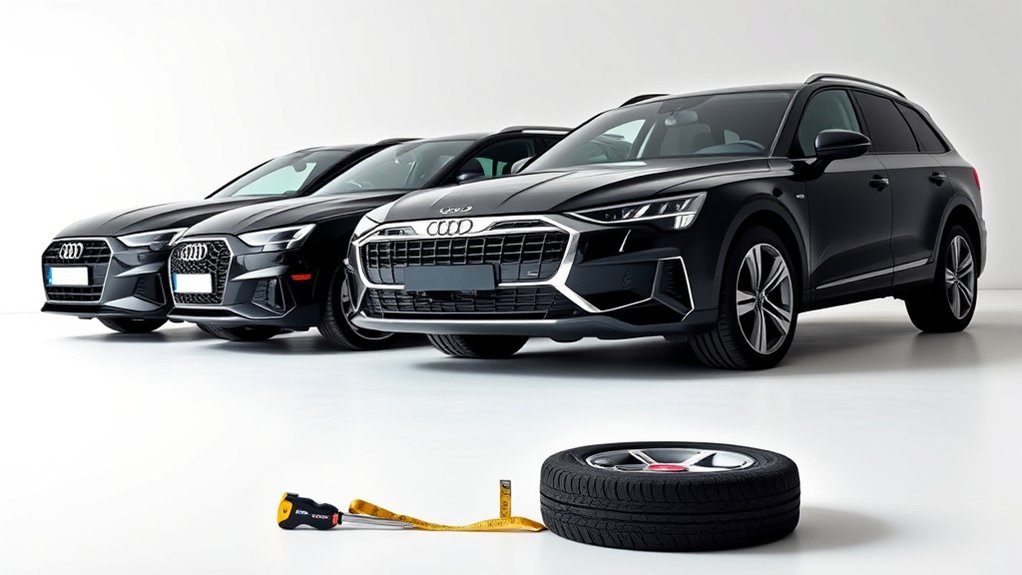
Audi’s new naming strategy marks a significant shift in how the brand categorizes its vehicles, aiming to streamline customer understanding. By standardizing model names, Audi eliminates the confusing odd/even distinction between electric vehicles and internal combustion engine models. The designations “A” and “Q” will continue to differentiate between low-floor and high-floor models, while model numbers range from A1 to A8 and Q3 to Q8, clearly indicating size and positioning. This clarity is further enhanced by the introduction of suffixes that denote powertrain types, such as TFSI for gasoline engines and e-tron for electric variants. The first model to embrace this new nomenclature will be the Audi A6, which will also feature the A6 e-tron. Customer feedback played a pivotal role in this evolution, reflecting a desire for a more intuitive naming strategy that enhances recognition and understanding of Audi’s diverse vehicle lineup.
Key Powertrain Designations: TFSI, E-Tron, and TDI Explained
Understanding the key powertrain designations within Audi’s lineup reveals the brand’s commitment to performance and innovation. TFSI, which stands for Turbocharged Fuel Stratified Injection, signifies Audi’s gasoline engines engineered for enhanced efficiency and impressive power delivery. This technology allows for high horsepower and torque, ensuring a dynamic driving experience across various models.
In contrast, the E-Tron designation highlights Audi’s focus on electrification, representing its electric vehicle lineup aimed at environmentally conscious consumers. This commitment to sustainable powertrains showcases Audi’s vision for the future of mobility.
Additionally, while TDI, or Turbocharged Direct Injection, primarily serves the diesel market, it is essential to note that TFSI and E-Tron reflect Audi’s diverse approach to powertrain technology. Together, these designations assist customers in understanding their options, empowering informed choices aligned with their performance and environmental preferences.
How Audi Classifies Its A and Q Models
The classification of Audi’s A and Q models highlights the brand’s strategic approach to segmenting its vehicle offerings. The A series, encompassing models from A3 to A8, signifies a hierarchy of sedans and coupes, with ascending numbers indicating increased luxury and size. In contrast, the Q series, which ranges from Q3 to Q8, designates Audi’s SUV lineup, reflecting a compact to luxury classification. This model naming system emphasizes positioning; A-badged vehicles are deemed ‘low-floor’ models, while Q models represent ‘high-floor’ versions, clearly delineating their market placement. Audi’s standardized numbering facilitates customer understanding, allowing for quick identification of vehicle types—A models for standard cars and Q models for SUVs. This approach not only enhances the customer experience but also reinforces Audi’s commitment to clarity and accessibility in its vehicle offerings, enabling potential buyers to navigate their choices with confidence and ease.
What Sets Audi’s S and RS Models Apart?
Performance enthusiasts often find themselves drawn to Audi’s S and RS models, which represent two distinct tiers of sportiness within the brand’s lineup. The S models, such as the S3, S4, and S5, are sportier variants of standard offerings, featuring enhancements in performance, handling, and styling. They provide increased horsepower while maintaining everyday usability, making them ideal for those seeking a spirited drive without sacrificing practicality.
In contrast, the RS models, denoting “RennSport,” are the pinnacle of Audi performance. Equipped with high-power engines often exceeding 400 horsepower, these vehicles are engineered for maximum performance and track-ready capabilities. Both S and RS models come with sport-tuned suspensions and upgraded braking systems, enhancing precision and responsiveness. This differentiation allows Audi to cater to a broader spectrum of performance enthusiasts, ensuring that both casual drivers and serious racers can find their perfect match within the lineup.
Understanding Audi Model Numbers: What Do They Mean?
Audi’s model numbers serve as a clear and systematic guide to the brand’s diverse lineup, reflecting both size and luxury tier. Each model number indicates the vehicle’s position within a well-defined hierarchy, with smaller numbers representing compact options and larger numbers denoting full-size luxury vehicles. The naming convention simplifies identification, moving away from odd/even distinctions to focus purely on size and vehicle type.
| Model Series | Description | Example Models |
|---|---|---|
| A Series | Sedans and Sportbacks | A1, A3, A8 |
| Q Series | SUVs | Q3, Q5, Q8 |
| S Models | Sport variants | S3, S4 |
| RS Models | High-performance variants | RS 3, RS 5 |
This structured approach not only enhances understanding but also empowers potential buyers to choose their desired Audi with confidence.
How Size Influences Your Audi Choice
The size of an Audi model greatly impacts both its performance and practicality, influencing consumer choices. Compact options like the A3 cater to urban drivers seeking maneuverability, while the A4 and A6 offer a balance of space and advanced technology for daily commuting. Additionally, the Q series provides varying levels of cargo capacity and driving height, appealing to those who prioritize versatility and comfort in their vehicles.
Key Model Dimensions
Choosing the right Audi model often hinges on understanding key dimensions, as size plays a crucial role in determining suitability for various lifestyles and preferences. Audi’s diverse lineup offers models that cater to a wide range of needs:
- A3: Compact at approximately 4,300 mm, ideal for city driving.
- A4: Balanced luxury at around 4,700 mm, great for both urban and long journeys.
- A6: Slightly larger at 4,900 mm, providing enhanced comfort.
- Q3 and Q8: Ranging from 4,400 mm to 4,990 mm, these SUVs offer varying space and utility.
- A5 Coupe: Sporty dimensions similar to the A4, merging aesthetics with performance.
Understanding these model names and their dimensions helps customers make informed choices about passenger capacity, cargo space, and overall driving experience.
Performance Comparisons
Understanding how size influences performance is pivotal when evaluating Audi models. Performance comparisons reveal that compact vehicles like the A3 excel in agility, making them ideal for urban environments, while larger models like the A8 focus on luxury and advanced technology. The Q3 and Q5 illustrate how size affects capability; the latter offers more cargo space, suitable for families. Performance variations are pronounced, with the S4 vastly outperforming the A4, appealing to enthusiasts. Meanwhile, RS models like the RS 5 showcase exceptional power with over 400 hp. Ultimately, size shapes driving experiences, as seen in the commanding presence of the Q7 and Q8 versus the sleek, versatile A5 Sportback.
| Model | Size Category | Performance (hp) |
|---|---|---|
| A3 | Compact Sedan | 201 |
| A4 | Midsize Sedan | 201 |
| S4 | Midsize Sedan | 349 |
| Q5 | Midsize SUV | N/A |
| RS 5 | Performance Coupe | 400+ |
Practicality of Size
While evaluating Audi models, one discovers that size significantly impacts both practicality and user experience. The positioning of each model—ranging from the compact A1 to the luxurious A8—directly influences daily usability and lifestyle compatibility.
- Urban Navigation: A3 and A4 excel in tight city spaces.
- Versatile Performance: Q5 and Q7 balance cargo space with sporty dynamics.
- Luxury Travel: A6 and A8 provide expansive interiors for comfort on long journeys.
- Stylish Utility: Q8 merges spaciousness with coupe-like aesthetics.
- Model Selection: Size dictates choices based on personal needs and preferences.
Ultimately, understanding these dimensions helps potential buyers align their Audi choice with their unique lifestyle requirements.
How Do Audi’s Naming Changes Affect Your Car Buying Experience?
Audi’s revised naming strategy greatly enhances the car buying experience by simplifying model identification, allowing consumers to quickly understand vehicle sizes. This clarity aids in the decision-making process, reducing confusion when comparing options across both internal combustion and electric models. By clearly differentiating powertrains with specific designations, Audi addresses consumer feedback, fostering confidence in their diverse lineup.
Simplified Model Identification
Maneuvering the Audi lineup has become considerably easier for prospective buyers thanks to the brand’s revamped naming strategy. The new naming structure emphasizes a consistent number system that reflects vehicle size and positioning, enhancing clarity in model identification.
- Electric vehicles retain the “e-tron” designation.
- Gas-powered models utilize “TFSI” tags.
- Odd/even number distinctions have been eliminated.
- Model numbers range from one to eight.
- Customer feedback played a key role in the changes.
This streamlined approach allows consumers to quickly discern between electric vehicles and internal combustion engines, paving the way for an informed buying experience. By focusing on size and category, Audi empowers buyers to make choices aligned with their preferences and needs.
Enhanced Decision-Making Process
The revamped naming strategy markedly enhances the car buying experience by simplifying the decision-making process for consumers. Audi’s new unified naming system allows for immediate recognition of vehicle size and category, eliminating confusion that previously stemmed from distinguishing between even and odd model numbers. This clarity extends to powertrain designations, such as TFSI for gasoline and e-tron for electric vehicles, which remain consistent under the new framework. As the A6 model is introduced with a combustion engine, buyers can expect straightforward comparisons between gas and electric variants. This strategic shift not only alleviates customer confusion, particularly in the evolving EV market, but also empowers consumers to make informed choices across Audi’s diverse lineup.
Clearer Powertrain Differentiation
While traversing the complexities of the automotive market, consumers can benefit considerably from Audi’s revised naming strategy, which prioritizes clearer powertrain differentiation. This initiative simplifies the buying experience by employing alphanumeric designations that distinctly categorize vehicles based on powertrains.
- Gas-powered models now feature the TFSI suffix.
- Electric vehicles retain the recognizable e-tron designation.
- The previous odd/even number scheme has been eliminated, preventing confusion.
- Model numbers, ranging from A1 to A8, reflect vehicle size and positioning.
- This standardized approach streamlines communication about model features.
With these changes, potential buyers can make informed decisions, as the distinctions between various powertrains have become more explicit, enhancing overall clarity in the marketplace.
The Role of Customer Feedback in Audi’s Strategy
Recognizing the critical importance of customer insights, Audi has strategically shifted its vehicle naming convention in response to feedback from both consumers and dealers. Initially, the odd/even naming system caused confusion regarding model distinctions, particularly between electric and gas-powered vehicles. This prompted Audi to adopt a more intuitive naming structure that clearly represents vehicle size and positioning rather than solely powertrain type.
Customer feedback has been pivotal, highlighting the need for straightforward model identification. In light of a notable 14% decline in U.S. sales for 2024, enhancing consumer comprehension of Audi’s offerings became paramount. The shift to a unified naming scheme, incorporating powertrain designations like TFSI and e-tron, underscores Audi’s commitment to responsiveness and alignment with market demands. This strategic evolution not only aims to facilitate clearer communication but also reflects a broader trend within the automotive industry towards more accessible naming conventions.
Future Trends in Audi’s Model Offerings
As Audi navigates the shifting landscape of the automotive market, its future model offerings are set to reflect a more coherent naming structure that aligns with consumer expectations. This strategic evolution aims to enhance clarity and simplify decision-making, particularly as electric vehicles (EVs) become increasingly prominent.
- Revised naming conventions will indicate vehicle size, eliminating the odd/even powertrain distinctions.
- The next-generation A6, debuting on March 4, 2025, will feature both a combustion engine and an e-tron variant.
- TFSI will continue to designate gasoline engines, while e-tron will represent electric models.
- This approach responds to customer feedback for improved understanding of vehicle choices.
- Audi is committed to integrating advanced drivetrain technologies across its lineup, balancing both gas and electric options.
In this context, Audi’s evolution reflects broader trends towards electrification and a more consumer-friendly approach.
Related Reading
Frequently Asked Questions
Which Audi to Stay Away From?
Consumers should consider avoiding the Audi Q8 e-tron due to rising reliability concerns and potential high maintenance costs. These factors, coupled with market confusion surrounding electric models, may deter informed buyers seeking dependable vehicles.
How Does Audi Naming Work?
Audi nomenclature simplifies model variations, categorizing standard vehicles with “A” and SUVs with “Q.” Performance enhancements are marked by “S” and “RS,” allowing enthusiasts to easily navigate options while embracing innovation and power.
What Does 30-35-40 Mean on Audis?
The numbers 30, 35, and 40 in Audi model variations signify distinct performance metrics, with each increment reflecting increasing horsepower. This system offers consumers an intuitive understanding of performance capabilities while simplifying model identification.
Which Audi Has the Best Engine?
The Audi RS 7 boasts the best engine, with its 4.0-liter V8 delivering 590 horsepower. Performance reviews highlight its remarkable acceleration and power, making it a top choice in engine comparisons among high-performance vehicles.
Conclusion
In a world where clarity reigns supreme, Audi’s innovative naming strategy emerges as a beacon of understanding amidst the automotive chaos. By deftly categorizing models and powertrains, Audi transforms the car-buying experience into an exhilarating adventure, making it as thrilling as the roar of an RS engine. As customer feedback continues to sculpt future offerings, one can only anticipate a lineup that dazzles and delights, setting new standards that could revolutionize the industry forever.