i-VTEC (Intelligent Variable Valve Timing and Lift Electronic Control) represents a significant advancement in engine technology. It integrates Variable Valve Timing (VVT) with continuous camshaft phasing for optimized performance. By adjusting valve timing and lift, i-VTEC enhances both torque and power across varying RPMs. Understanding its mechanics and benefits provides insight into its effectiveness. The nuances of its operation and implications for engine design warrant further exploration.
Key Takeaways
- i-VTEC combines Variable Valve Timing (VVT) and continuous camshaft phasing to optimize power and fuel efficiency across a 50-degree range.
- It engages a secondary intake valve at approximately 2,200 RPM, enhancing performance in models like the Civic and Accord.
- Activation occurs around 4,500 RPM, using oil pressure to switch between low-rpm and high-rpm rocker arms for improved power output.
- i-VTEC offers better fuel efficiency at lower RPMs and smoother power delivery compared to traditional VTEC systems.
- Future advancements focus on eco-friendly innovations and hybrid strategies, aiming for enhanced performance and reduced emissions.
What You Need to Know About i-VTEC
i-VTEC represents a significant evolution in Honda’s valve timing technology, enhancing engine performance through sophisticated engineering. This system integrates Variable Valve Timing (VVT) with continuous camshaft phasing, optimizing power and fuel efficiency across a 50-degree range. Operating initially with one intake valve per cylinder, i-VTEC improves fuel efficiency at low speeds. Upon reaching approximately 2,200 RPM, a secondary intake valve engages, allowing for enhanced performance during normal operation.
Designed to balance performance with emissions, i-VTEC features an economy variant that prioritizes lower lift and duration compared to traditional VTEC engines. This technology is adaptable across various Honda models, including the Civic and Accord, demonstrating its versatility across different engine sizes and configurations. Introduced in the early 2000s, i-VTEC signifies Honda’s commitment to engineering advancements, continuing the legacy established by the original VTEC system while catering to modern demands for efficiency and performance.
How i-VTEC Enhances Engine Performance
Honda’s i-VTEC system notably enhances engine performance by integrating advanced features that optimize power delivery and fuel efficiency. This sophisticated technology combines Variable Valve Timing and Lift Electronic Control (VTEC) with Variable Timing Control (VTC), enabling continuous camshaft phasing across a 50-degree range. By adjusting valve timing and lift characteristics according to driving conditions, i-VTEC improves torque output at low RPMs while maximizing power at higher RPMs. In its Economy mode, i-VTEC operates with one intake valve per cylinder, prioritizing low emissions and fuel efficiency. When engine speed reaches 2,200 RPM, a secondary valve engages for enhanced performance. Notable engines like the K20A Type R and K24A2 exemplify this technology’s ability to balance performance and economy. Additionally, i-VTEC’s optimization of combustion chamber swirl and airflow contributes considerably to overall fuel efficiency, marking a pivotal advancement in Honda’s engine technology.
What Happens During VTEC Engagement?
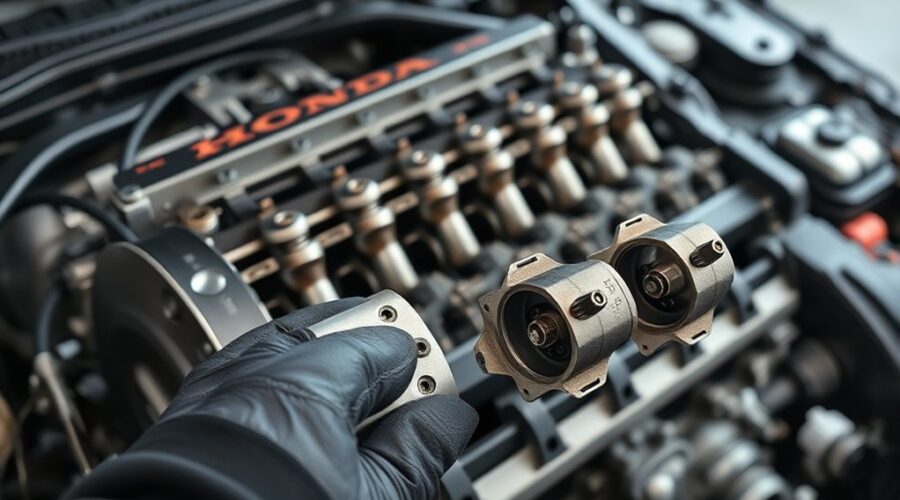
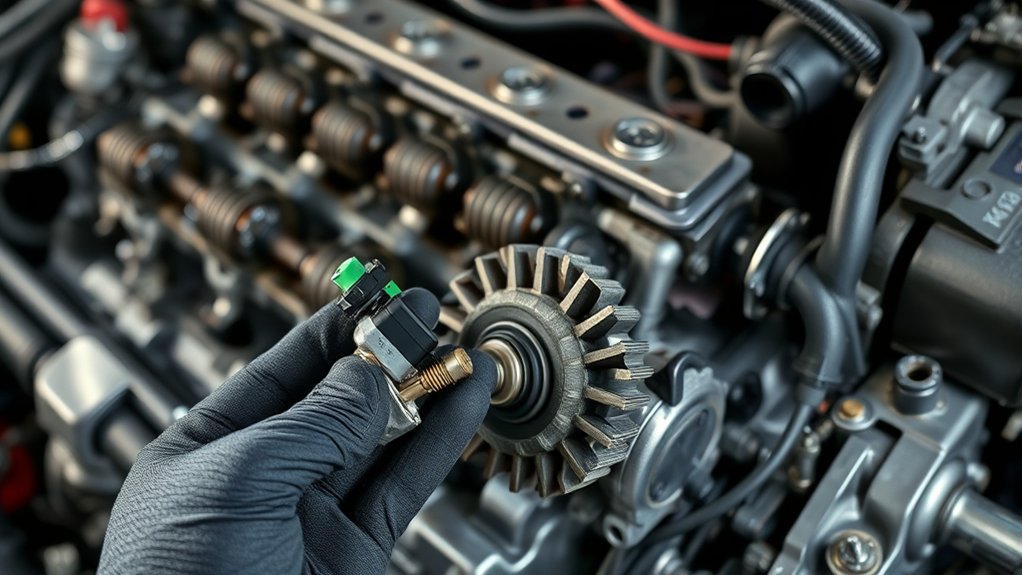
VTEC engagement represents a critical change in engine operation, marked by the activation of a solenoid that directs oil pressure to engage the rocker arm mechanism. This pivotal moment occurs around 4,500 RPM, shifting the engine to a more aggressive camshaft profile, optimizing performance.
- A 12V signal activates the VTEC solenoid.
- Oil pressure locks low-rpm rocker arms to high-rpm rocker arms.
- The system employs three cam lobes per cylinder in twin-cam configurations.
- Enhanced valve lift and duration improve airflow.
- Significant increases in power output and responsiveness are achieved.
Through VTEC engagement, the engine capitalizes on the benefits of both efficiency and performance, ensuring that drivers experience heightened acceleration and responsiveness. This sophisticated mechanism underscores the importance of precision engineering in modern automotive design, delivering a balance between everyday drivability and exhilarating performance when demanded.
The Role of Variable Timing Control (VTC)
Following the dynamic changes initiated during VTEC engagement, Variable Timing Control (VTC) plays a pivotal role in enhancing engine performance. VTC enables continuous adjustment of camshaft timing by up to 50 degrees, optimizing efficiency across various RPM ranges. This technology utilizes hydraulic pressure to modify camshaft positioning, thereby improving low-end torque and fuel efficiency during low-speed driving.
In conjunction with VTEC, which switches between different cam profiles, VTC guarantees smooth shifts and responsive acceleration. This synergy allows Honda engines to balance power output and emissions effectively, tailoring valve timing to suit diverse driving conditions.
| Aspect | Contribution |
|---|---|
| Camshaft Timing | Adjusts by up to 50 degrees |
| Low-End Torque | Enhanced during low-speed driving |
| Fuel Efficiency | Improved combustion |
| Emission Control | Balances power and emissions |
| Engine Models | Found in Honda Accord and Civic |
Differences Between Traditional VTEC and i-VTEC
The evolution of variable valve timing technology highlights significant distinctions between traditional VTEC and its advanced counterpart, i-VTEC. These differences reflect advancements aimed at optimizing both performance and fuel efficiency.
- Camshaft Profiles: Traditional VTEC switches between two profiles; i-VTEC employs Variable Timing Control for continuous adjustment.
- Timing Precision: i-VTEC features a 50-degree range for more precise timing changes compared to fixed profiles in traditional VTEC.
- Performance Balance: While traditional VTEC maximizes performance at high RPMs, i-VTEC enhances fuel efficiency at lower RPMs.
- Airflow Efficiency: i-VTEC uses multiple intake valves per cylinder, improving combustion efficiency, unlike traditional VTEC’s single secondary intake valve.
- Operational Modes: i-VTEC includes economy modes, engaging one intake valve for low-speed operation, contrasting with traditional VTEC’s performance-centric design.
These distinctions illustrate how i-VTEC redefines the landscape of variable valve timing, merging high performance with enhanced fuel efficiency.
Why Choose i-VTEC for Better Fuel Economy?
i-VTEC technology offers significant fuel efficiency advantages through its Variable Timing Control (VTC), which adapts valve timing based on driving conditions. This system optimizes engine performance while minimizing fuel consumption, particularly at low RPMs where only one intake valve is utilized. Additionally, the ability to activate a secondary intake valve enhances power delivery without compromising overall fuel economy, contributing to reduced emissions as well.
Fuel Efficiency Benefits
Enhancing fuel efficiency is a critical consideration for modern automotive engineering, and i-VTEC technology stands out as an effective solution. This innovative system optimizes valve timing and lift characteristics, delivering significant advantages:
- Adjusts performance at low RPMs to enhance fuel economy.
- Operates with one intake valve per cylinder, reducing emissions.
- Utilizes a 50-degree range of continuous camshaft phasing for real-time adaptation.
- Achieves up to 24 mpg combined, particularly in models with Variable Cylinder Management (VCM).
- Incorporates combustion chamber swirl in K-Series engines to boost efficiency without sacrificing power.
Engine Performance Optimization
Fuel efficiency is closely linked to engine performance optimization, particularly through advanced technologies like i-VTEC. This system integrates Variable Valve Timing Control (VTC) with VTEC, enabling continuous camshaft phasing that enhances performance across a broader RPM range. By adjusting valve timing by up to 50 degrees, i-VTEC maximizes torque output at lower RPMs, greatly improving fuel efficiency during everyday driving. At low RPMs, it operates with a single intake valve per cylinder, minimizing fuel consumption before engaging the secondary valve for higher-speed performance. Additionally, the implementation of Variable Cylinder Management (VCM) allows for cylinder deactivation in low-load scenarios, further reducing fuel consumption. Consequently, i-VTEC engines, such as the K24A2, achieve impressive fuel efficiency ratings, balancing power and economy effectively.
Reduced Emissions Impact
The integration of advanced technologies in engine design has led to significant reductions in emissions, particularly with systems like i-VTEC. This innovative approach employs Variable Timing Control (VTC) to optimize fuel efficiency and minimize environmental impact. Key benefits include:
- Continuous adjustment of camshaft phasing for efficiency across RPM ranges
- Operation with one intake valve at low speeds for improved fuel economy
- Enhanced combustion efficiency resulting in lower CO2 emissions
- Better fuel economy ratings, exemplified by the 2011 Honda Accord V6 achieving 24 mpg combined
- Classification as an ultra-low-emission vehicle (ULEV) through leaner air-fuel mixtures
These attributes collectively underscore the importance of i-VTEC in promoting sustainable driving without compromising performance.
Honda Engines That Showcase i-VTEC
Honda’s i-VTEC technology has revolutionized engine design, showcasing impressive versatility and performance across several models. The K20A engine exemplifies this innovation, delivering 212 hp and 149 lb-ft of torque, making it a favorite among performance enthusiasts and ideal for engine swaps. This engine incorporates Variable Timing Control (VTC), enabling continuous camshaft phasing between 25 and 50 degrees to optimize torque output across various RPMs.
Additionally, the R-Series i-VTEC engine features a modified SOHC design with one small and two large lobes, allowing it to switch between Atkinson and normal cycles, thereby enhancing fuel economy. The 2011 Honda Accord’s V6 engine employs Variable Cylinder Management (VCM) to deactivate cylinders during low-speed driving, further improving efficiency. Finally, the 2004 Honda Stream introduced i-VTEC i, achieving an ultra-lean air-fuel ratio of up to 65:1, qualifying it as an ultra-low-emission vehicle (ULEV).
Debunking Myths About i-VTEC
The i-VTEC system is often misunderstood, with common misconceptions surrounding its focus on performance and reliability. Contrary to these beliefs, i-VTEC balances enhanced power with fuel efficiency and reduced emissions, operating effectively across varying driving conditions. This section aims to clarify these myths and highlight Honda’s engineering achievements in creating a durable and efficient engine platform.
Common Misconceptions Explained
How does i-VTEC truly function in the domain of engine performance? Several misconceptions cloud its true capabilities:
- Performance vs. Efficiency: i-VTEC enhances both, optimizing fuel efficiency during low-speed driving.
- Variable Valve Timing Integration: It combines VTC with traditional VTEC for continuous camshaft phasing.
- Cylinder Deactivation: Variable Cylinder Management (VCM) deactivates cylinders under light loads to improve economy.
- Broad Application: Found in diverse Honda engine variants, i-VTEC proves versatile across performance and economy-focused designs.
- Activation Misunderstandings: i-VTEC does not engage at a fixed RPM; instead, it activates based on various factors like engine load and oil pressure.
These insights clarify the multifaceted nature of i-VTEC, debunking myths surrounding its functionality in performance and efficiency.
Performance vs. Efficiency Balance
Understanding the balance between performance and efficiency in i-VTEC technology reveals its sophisticated design and functionality. i-VTEC optimizes fuel consumption by utilizing one intake valve per cylinder at low RPMs, engaging a second valve around 2,200 RPM to enhance performance without compromising efficiency. The integration of Variable Timing Control (VTC) allows for an adjustable camshaft phasing range of up to 50 degrees, optimizing torque across varying conditions. This adaptability guarantees smoother power delivery and reduces lag traditionally associated with VTEC engagement.
| Aspect | Performance | Efficiency |
|---|---|---|
| Valve Operation | Dual valve engagement | Single valve at low RPMs |
| Camshaft Phasing | Up to 50 degrees adjustment | Optimized for fuel savings |
| Emissions Compliance | Meets modern standards | Reduced emissions |
Simple Ways to Boost Your i-VTEC Engine
Boosting the performance of an i-VTEC engine can be achieved through strategic modifications that enhance airflow and optimize power delivery. Implementing these changes can lead to significant improvements in throttle response and overall engine efficiency.
- Upgrade to a high-quality cold air intake system for better airflow.
- Pair the intake with a performance exhaust system to reduce back pressure.
- Reprogram the stock ECU or install an aftermarket ECU for optimized VTEC engagement points.
- Opt for lightweight performance parts, like a performance flywheel, to decrease rotational mass.
- Use reputable aftermarket components from trusted manufacturers to guarantee durability and performance gains.
These modifications not only facilitate quicker engine response during acceleration but also enhance the overall driving experience. Each element plays a vital role in maximizing the potential of the i-VTEC engine, allowing enthusiasts to liberate its true capabilities.
Future of i-VTEC Technology
The future of i-VTEC technology is poised for significant advancements in variable timing systems, emphasizing the integration of continuous camshaft phasing and variable lift mechanisms to enhance both performance metrics and fuel efficiency. Innovations such as ultra-lean combustion systems and the potential development of camless engines represent a shift towards eco-friendly engine solutions that minimize emissions. Additionally, as the automotive landscape evolves, hybridization strategies may be incorporated, optimizing the balance between performance and environmental responsibility in Honda’s offerings.
Advanced Variable Timing Systems
Advancements in variable timing systems represent a pivotal evolution in i-VTEC technology, focusing on enhanced engine performance and efficiency. The integration of these systems allows for significant improvements:
- Continuous camshaft phasing via Variable Valve Timing (VVT)
- Timing adjustments ranging from 25 to 50 degrees
- Enhanced torque output and fuel efficiency at low to mid-range RPMs
- Incorporation of turbocharging and gasoline direct injection in VTEC Turbo
- Future possibilities with variable lift mechanisms and elimination of traditional camshafts
These developments enhance adaptability, responsiveness, and overall performance. Honda’s commitment to research indicates a trend toward more sophisticated systems, positioning i-VTEC at the forefront of engine technology, ensuring peak performance while addressing modern efficiency demands.
Eco-Friendly Engine Innovations
Eco-friendly innovations in i-VTEC technology are redefining automotive engineering, focusing on sustainability without compromising performance. The integration of Variable Timing Control (VTC) allows for continuous camshaft phasing adjustments, enhancing fuel efficiency across a broader RPM range. The R-Series i-VTEC employs a dual-lobe system to switch between Atkinson and standard cycles, considerably improving fuel efficiency during everyday driving. Additionally, Honda’s i-VTEC technology achieves an air-fuel ratio of up to 65:1, facilitating ultra-lean combustion that qualifies as an ultra-low-emission vehicle (ULEV). Variable Cylinder Management (VCM) further enhances fuel consumption through cylinder deactivation, optimizing engine efficiency under light-load conditions. Collectively, these advancements position i-VTEC as a leading force in eco-friendly automotive innovation.
Enhanced Performance Metrics
Innovations in i-VTEC technology continue to push the boundaries of engine performance, aligning with the growing demand for both efficiency and power. This advanced system integrates several key features to enhance driving experiences:
- Continuous camshaft phasing of up to 50 degrees for optimized torque.
- Variable lift and timing coupled with a dual-stage intake system for improved fuel efficiency.
- Variable Cylinder Management (VCM) enabling cylinder deactivation during low-load conditions.
- Future advancements may achieve ultra-lean combustion ratios, potentially reaching 65:1.
- Designed to balance performance with stringent emission standards.
These enhancements guarantee that i-VTEC not only meets the needs of performance enthusiasts but also adheres to environmentally conscious standards, embodying the future of automotive engineering.
Frequently Asked Questions
Is I-Vtec Better Than VTEC?
i-VTEC generally surpasses traditional VTEC due to its advantages in efficiency and performance. However, potential disadvantages include complexity and cost. Comparisons reveal i-VTEC technology optimizes valve timing better, enhancing responsiveness while reducing emissions effectively.
Is I-Vtec Real VTEC?
i-VTEC represents a genuine evolution of VTEC technology, integrating innovative features for enhanced performance. Its advantages include improved torque and fuel efficiency, setting it apart in comparisons of i-VTEC innovations versus traditional VTEC systems.
Is the I-Vtec the Best Engine?
Evaluating the i-VTEC reveals its advantages in performance, efficiency, and reliability. When compared to other systems, its adaptability across various applications underscores its appeal, appealing to both enthusiasts and eco-conscious consumers seeking peak functionality.
Does VTEC Really Make a Difference?
VTEC markedly enhances performance through optimized efficiency and reliability, offering distinct advantages in tuning. Its historical impact on engine design underscores the balance between power and economy, demonstrating profound differences in driving experience across various RPM ranges.
Conclusion
In conclusion, i-VTEC exemplifies Honda’s commitment to integrating advanced engineering for peak performance. The serendipitous alignment of variable timing and lift control technologies not only enhances power delivery but also promotes fuel efficiency and lower emissions. As Honda continues to innovate, the evolution of i-VTEC may coincide with emerging automotive trends, suggesting a promising future for enhanced performance and sustainability in the automotive landscape. Therefore, i-VTEC stands as a demonstration of Honda’s engineering prowess and foresight.