
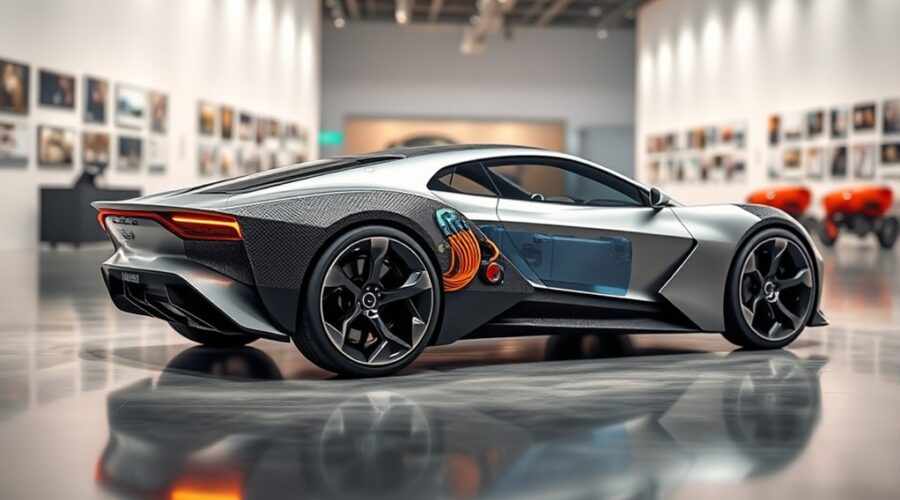
Ford concept cars are show vehicles that previewed new styling, technology or power sources, from the atomic-age Nucleon of 1957 to the hydrogen-powered Model U of 2003. Most were never built for sale, but several shaped real cars, including the Probe series that influenced the Ford Sierra.
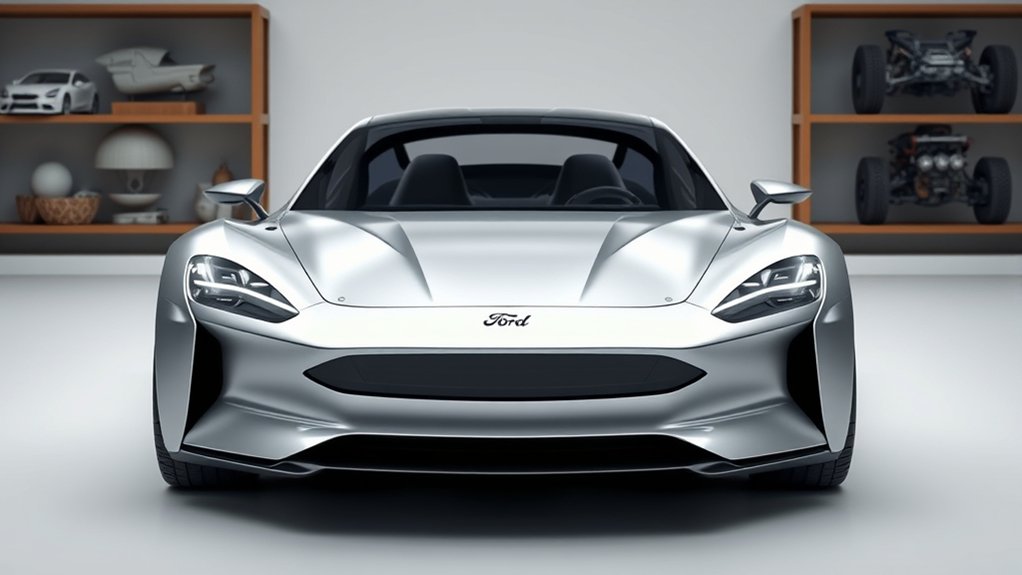
Landmark Ford concept cars
| Concept | Year | What it showed |
|---|---|---|
| X-100 | 1953 | A show car made for Ford’s 50th anniversary, billed as packed with advanced features (Ford’s claim) |
| Nucleon | 1957 | A scale-model idea for a nuclear-powered car with a small rear reactor driving a steam engine; Ford projected about 5,000 miles per reactor |
| Probe I to III | 1979-1981 | Aerodynamic studies; Probe III’s bodywork evolved into the Ford Sierra (sold in North America as the Merkur XR4Ti) |
| Probe IV and V | 1983, 1985 | Increasingly radical low-drag designs, reported at 0.15 and 0.137 Cd |
| Model U | 2003 | A concept with a supercharged 2.3 L hydrogen four-cylinder and hybrid transmission, and a highly configurable interior |
Ford Nucleon: the nuclear car that never was
The Nucleon was developed in 1957 and only a scale model was demonstrated. The mock-up is displayed at the Henry Ford Museum in Dearborn, Michigan. Ford assumed reactors would shrink enough to make the idea practical, which never happened.
The Probe series and aerodynamics
The Probe concepts ran from 1979 to 1985 and explored low-drag shapes with covered wheels and pop-up headlights. The Probe III’s body evolved into the Ford Sierra, a mainstream car, which shows how a concept could influence production.
The name later returned on a production car: Ford’s front-drive Probe coupe for 1989 was originally developed as the fourth-generation Mustang and built on a Mazda platform at Flat Rock, Michigan. It is not the same as the concepts.
Model U: Ford’s hydrogen concept
The 2003 Model U debuted at the North American International Auto Show. Ford described it as a modern 21st-century interpretation of the original Model T, with a hydrogen-fuelled supercharged four-cylinder, a hybrid transmission and a highly automated interior with slots designed to reduce clutter. It was never intended for production.
Why automakers build concept cars
- To test public reaction to new styling.
- To demonstrate technology before it is ready for production.
- To show a company’s direction to investors and the press.
Figures quoted for concept cars are usually the company’s own claims, not independent measurements, so treat them as design targets.
For a comparison from another maker, read about the Mercedes-Benz concept cars, and see the Mercedes Silver Lightning concept.
Sources: Wikipedia entries on the Ford Nucleon, Ford Probe and Ford Model U; Ford Heritage Vault descriptions.
Frequently Asked Questions
What is the most famous Ford concept car?
The Ford Nucleon (1957) and the Probe series are among the best known. The Nucleon imagined a nuclear-powered car, while the Probe concepts explored aerodynamics.
Was the Ford Nucleon ever built?
No. Only a scale model was demonstrated. The mock-up is displayed at the Henry Ford Museum in Dearborn, Michigan.
Did Ford concept cars become production cars?
Some influenced production. The Probe III’s body evolved into the Ford Sierra, though most concepts were never built for sale.
What powered the Ford Model U?
The 2003 Model U used a supercharged 2.3-litre hydrogen four-cylinder paired with a hybrid electric transmission.
What is a concept car?
A concept car is a show vehicle that previews styling, technology or ideas. It usually is not intended for production.
How is the production Ford Probe related to the concepts?
Ford took the Probe name from the concept series for a 1989 front-drive coupe, but that car was developed as a Mustang replacement on a Mazda platform and is not one of the concepts.



[…] are targets or demonstration results, not sales specs. For concepts from other makers, see our Ford concept cars guide and Hyundai N Vision 74 […]