The Mercedes-Benz F 015 Luxury in Motion, revealed in 2015, marked a decisive shift in concept car thinking. It was less a vehicle for manual driving than a mobile lounge built around autonomy, safety, and passenger comfort. Walnut wood flooring, nappa leather seating, and advanced control systems gave the interior a domestic quality. Yet its technical intent reached beyond design, raising questions about how luxury transport might soon function.
Key Takeaways
- The Mercedes-Benz F 015 Luxury in Motion debuted in 2015 as a vision of autonomous, comfort-focused future mobility.
- Its cabin is designed as a high-tech lounge with walnut flooring, white nappa leather seats, and multiple integrated displays.
- The concept uses radar, cameras, LIDAR, and AI for fully autonomous driving and continuous surroundings scanning.
- Rotating seats and gesture-based controls support face-to-face interaction, entertainment, and strain-free passenger use.
- It emphasizes safety, electric mobility, and reclaimed travel time, turning commuting into a shared social experience.
What Is the Mercedes-Benz F 015 Concept?
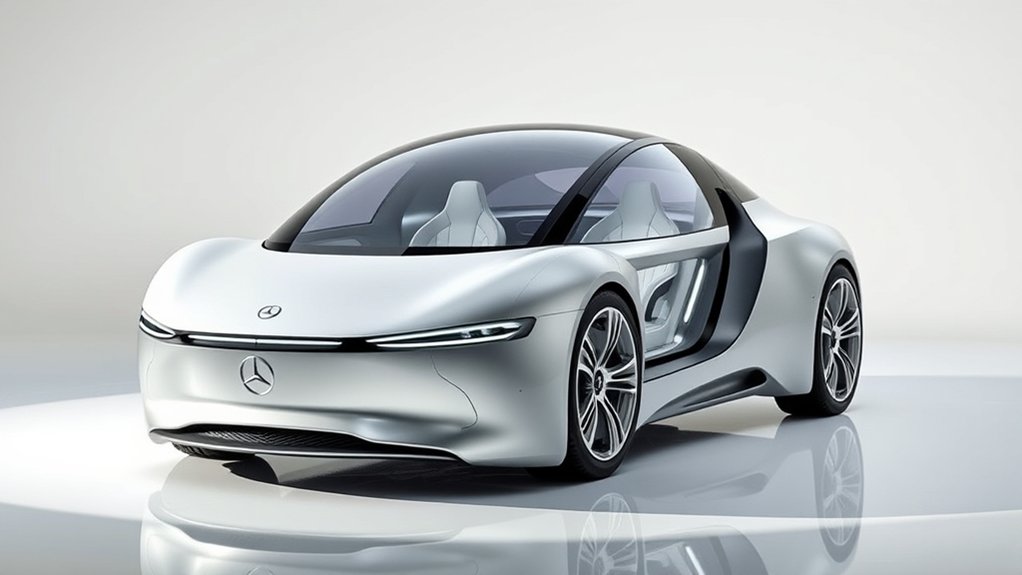
The Mercedes-Benz F 015 Luxury in Motion concept presents a vision of autonomous mobility centered on passenger comfort, social interaction, and technological refinement.
As a study in Luxury in Motion, it reimagines the cabin as a high-tech lounge rather than a conventional driver’s compartment. Walnut wood flooring and white nappa leather seats signal deliberate restraint, while multiple display screens extend function across the interior.
Eye-tracking and hand-gesture controls replace routine command inputs, allowing occupants to engage the vehicle with minimal effort.
In historical terms, the concept marks a decisive step toward the future of mobility, where travel becomes time reclaimed for reading, conversation, or quiet leisure.
Mercedes-Benz uses it to demonstrate how advanced autonomy can coexist with elegance, producing a machine that serves freedom rather than demanding attention.
How the F 015 Concept Started
Mercedes-Benz began shaping the F 015 as an early concept vision for a radically different form of mobility, one centered on autonomy rather than driver control.
Its development reflected a deliberate effort to anticipate long-distance travel in which the cabin would function as a moving social and living space.
From the outset, the project linked technical innovation with the goal of redefining comfort, convenience, and passenger experience.
Early Concept Vision
Introduced in 2015, the F 015 Luxury in Motion Concept marked Mercedes-Benz’s early statement on the future of autonomous mobility, presenting a vision in which the car functioned less as a driver-controlled machine and more as a mobile living space.
Developed under Mercedes-Benz Group, the concept drew on a lineage that began when the company invented the automobile, then pushed beyond it. Its lounge-like cabin encouraged social exchange, while eye-tracking and hand-gesture controls reduced friction between occupant and machine.
Eco-friendly materials and an electric drivetrain signaled a broader shift toward cleaner personal transport.
Historically, the F 015 framed freedom as access to time, space, and interaction, not merely speed, and it positioned luxury as a liberated, shared experience rather than a private command center.
Autonomous Mobility Goals
Revealed in 2015, the F 015 Luxury in Motion concept marked Mercedes-Benz’s deliberate move toward autonomous mobility, presenting a future in which the vehicle would serve as a flexible social environment rather than a driver-centered machine.
This Mercedes-Benz study framed travel as liberated time, with passengers seated face to face for conversation, relaxation, or private retreat. Its cabin replaced conventional controls with multiple display screens, eye-tracking, and hand-gesture interfaces, signaling a historical shift from steering to interaction.
By merging luxury with automation, the concept sought to redefine personal mobility through comfort, convenience, and autonomy.
The project also reflected Mercedes-Benz’s broader technological ambition: to prepare fully autonomous production vehicles and advance a mobility model in which movement becomes an expression of freedom rather than obligation.
F 015 Design and Cabin Layout
With the F 015 Luxury in Motion, Mercedes-Benz conceived a cabin that functions less like a conventional automobile interior and more like a high-tech lounge, intended to encourage relaxation and conversation among occupants.
In the F 015, passenger cars were reimagined as private rooms for liberated movement, where walnut wood flooring and white nappa leather seats supplied a refined domestic atmosphere.
The layout favored openness and composure, replacing cramped utility with a measured sense of space.
Multiple integrated display screens extended the interior’s technical vocabulary, offering entertainment and information without interrupting the calm.
Eye-tracking and hand-gesture controls further reduced physical strain, allowing interaction that felt direct and fluid.
Historically, the design marked a deliberate shift in Mercedes-Benz thinking: comfort was no longer decorative, but structural.
The cabin therefore balanced luxury and advanced systems, presenting commuting not as confinement, but as an experience of ease, autonomy, and social freedom.
How the F 015 Supports Autonomous Driving
Beyond its lounge-like cabin, the F 015 Luxury in Motion was structured to make autonomous driving the basis of the entire passenger experience.
Mercedes-Benz treated the concept as a passenger car freed from conventional driver-centered priorities, replacing control with comfort, observation, and social use. Its fully autonomous driving system allowed occupants to read, converse, or rest while the vehicle managed motion through changing traffic conditions.
Mercedes-Benz reimagined the passenger car around comfort, conversation, and observation, letting autonomy replace the need to drive.
Sensors and artificial intelligence continuously scanned the surroundings, interpreting road situations with the precision expected of a luxury brand seeking to make liberation credible rather than theatrical.
Inside, rotating seats supported face-to-face interaction, turning travel into a mobile salon. Eye-tracking and hand gestures let occupants command displays without physical strain.
In historical terms, the F 015 presented autonomous driving not as a technical novelty alone, but as a redefinition of mobility in which the car served its passengers first.
Key Technologies Inside the F 015
The F 015 distinguished itself through autonomous driving systems that paired advanced automation with a redefined notion of mobility, allowing the vehicle to shift from active transport to controlled leisure.
Inside, a luxury digital interface used eye-tracking and hand-gesture recognition to let passengers manage multiple displays with unusual ease.
This arrangement, set within a high-grade lounge of white nappa leather and walnut trim, linked technical innovation with social comfort.
Autonomous Driving Systems
Central to the F 015 Luxury in Motion concept is an autonomous driving system that redefines the role of the automobile from operator-driven machine to mobile living space.
In Mercedes-Benz history, this marked a decisive departure from the combustion engine era, when human control dominated every mile. Here, autonomous driving systems combine radar, cameras, and LIDAR to read traffic, lanes, and obstacles with exacting breadth.
Eye-tracking and hand-gesture controls permit passengers to command functions without strain, supporting a sense of freedom within motion. The cabin operates as a lounge, where travel becomes social rather than burdensome.
Luxury Digital Interface
Where autonomous control removed the need for constant driver input, the F 015 Luxury in Motion turned the cabin into a digitally mediated environment.
Its luxury digital interface presented multiple screens for entertainment, navigation, and communication, a worlds first in the reimagining of enclosed travel.
Eye-tracking and hand-gesture controls replaced traditional effort with quiet responsiveness, allowing passengers to command functions with minimal motion.
The lounge-like interior, finished in white nappa leather and walnut wood flooring, framed technology as comfort rather than intrusion.
Seamless connectivity let devices merge into the journey, supporting work, rest, and conversation alike.
- Freedom from fixed seating roles
- Calm interaction through gesture
- Private luxury with shared space
- Mobility shaped for leisure
Safety Features in the F 015 Concept
| Feature | Function | Effect |
|---|---|---|
| 360-degree sensors | Monitor surroundings | Broad situational awareness |
| Robust safety cell | Reinforces cabin | Collision protection |
| Predictive algorithms | Anticipate danger | Proactive response |
| Communication systems | Signal pedestrians, vehicles | Safer urban movement |
The concept combined cameras and sensors to survey the road continuously, while software evaluated risks before they became threats. A reinforced structure sheltered occupants, and the cabin retained seatbelts and adaptive restraints suited to autonomous operation. Integrated external communication supported clear interactions with pedestrians and nearby traffic, reducing uncertainty in crowded environments. In historical terms, the F 015 translated Mercedes-Benz safety doctrine into an emancipated mobility prototype, where control was shared with systems designed to preserve human security.
How the F 015 Points to Electric Cars
The F 015 Luxury in Motion concept also signaled Mercedes-Benz’s direction toward electric vehicles, pairing autonomous driving with an eco-focused powertrain strategy.
In historical terms, it marked a decisive break from combustion-centered prestige, translating mobility into a quieter, cleaner promise.
Mercedes-Benz used the concept to test how electric vehicles could carry not only passengers, but also a sense of release from traffic, noise, and dependence.
Its advanced battery technology suggested greater range and efficiency, reinforcing the practical case for electrification through the EQ lineage.
- Freedom from exhaust and engine vibration
- Confidence in extended electric range
- Comfort shaped by spacious interior design
- Ease through smart connectivity and control
Analytically, the F 015 framed the future driver as a participant in a more liberated system, where technology serves dignity rather than congestion.
The result was a concept that made Mercedes-Benz electrification appear both inevitable and desirable.
What the F 015 Reveals About Future Mobility
Seen in historical context, the Mercedes-Benz F 015 Luxury in Motion concept reveals future mobility as a shift from driving as a task to travel as a managed experience. Its autonomous driving program relocates control from the road to the cabin, where passengers are freed for conversation, work, or repose. The interior, arranged like a high-tech lounge, uses walnut wood flooring and white nappa leather to frame movement as comfort rather than obligation. Displays, eye-tracking, and hand-gesture controls suggest an interface built for intuitive ease, not mechanical labor.
| Feature | Meaning | Effect |
|---|---|---|
| Autonomous driving | Relinquishes steering | Expands personal freedom |
| Lounge interior | Domesticizes travel | Encourages leisure |
| Digital controls | Simplifies interaction | Improves accessibility |
| Innovation | Recasts commuting | Signals mobility’s future |
Historically, the F 015 marks Mercedes-Benz’s insistence that innovation can turn transport into a liberated social space, where motion serves experience.
Frequently Asked Questions
What Are Some Interesting Facts About Mercedes-Benz?
Mercedes-Benz pioneered the first automobile in 1886, forged the Mercedes legacy through a 1926 merger, advanced Automotive innovation with crumple zones and ABS, led premium sales in 2018, and now expands electric EQ mobility.
What Is the Coolest Car Ever Built?
The coolest car ever built may be the Mercedes-Benz 300SL; evidence supports the theory through its gullwing design, 160 mph speed, and enduring luxury performance, while later electric innovations extended its liberation-inspired legacy.
What Things Did Mercedes Invent?
Mercedes-Benz invented automotive innovations including the first gasoline automobile, the crumple zone, ABS, the honeycomb radiator, and ESP. These engineering breakthroughs reshaped safety, control, and performance, advancing mobility toward greater liberation from danger and instability.
What Are the Key Features of Mercedes-Benz Cars?
Mercedes-Benz cars feature luxury performance, innovative technology, advanced safety systems, refined interiors, and electric mobility. Historically, they combine strong engineering, premium materials, driver-assist features, and comfort, producing vehicles engineered for security, status, and liberated movement.
Conclusion
In historical terms, the Mercedes-Benz F 015 Luxury in Motion marked a decisive shift in automotive thinking: not merely a concept car, but a forecast of mobility as autonomous, electric, and social. Its lounge-like cabin, with walnut flooring and nappa leather, redefined the interior as living space. Significantly, Mercedes placed four swiveling seats around a shared environment, underscoring interaction over driving. The F 015 remains a compelling early statement of future transport, comfort, and control.