
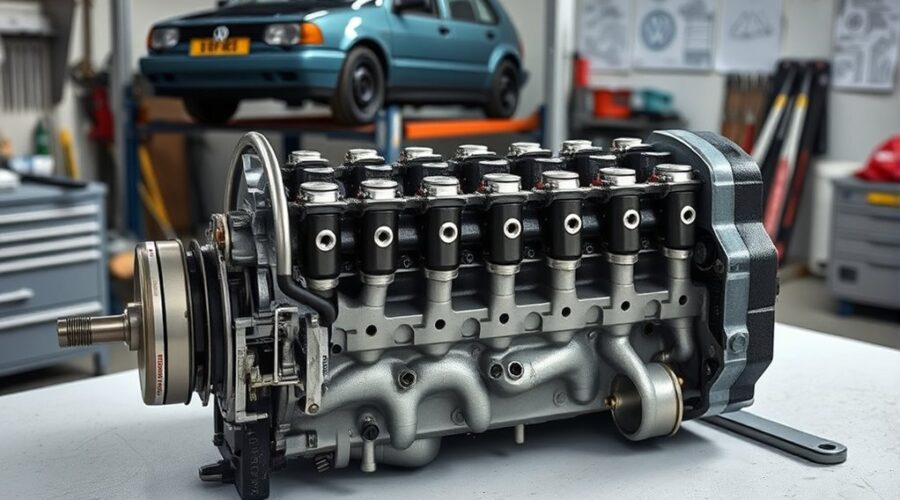
The Volkswagen VR5 is an unusual five-cylinder engine that paired compact packaging with a narrow 15-degree V layout. Developed in the late 1990s, it used a staggered cylinder arrangement and a 2.3-liter displacement to produce 150 PS, later 170 PS. Its design raised questions about balance, intake layout, and serviceability, especially since it occupied a narrow niche in VW’s range. The engineering choices behind it are more revealing than the output figures suggest.
Key Takeaways
- The Volkswagen VR5 is a compact 2.3-liter five-cylinder engine with a 15-degree V angle and a single cylinder head.
- It was developed in the late 1990s to fit transverse engine bays, sharing architecture and dimensions with the VR6.
- Bore and stroke are 81.0 mm × 90.2 mm, with 10-valve AGZ and 20-valve AQN/AZX variants.
- Power output ranged from 150 PS to 170 PS, with firing order 1-2-4-5-3 helping its distinctive smooth sound.
- It appeared in models like the Golf Mk4, Bora, New Beetle, Passat B5, and SEAT Toledo Mk2, but remained a niche engine.
What Is the Volkswagen VR5 Engine?
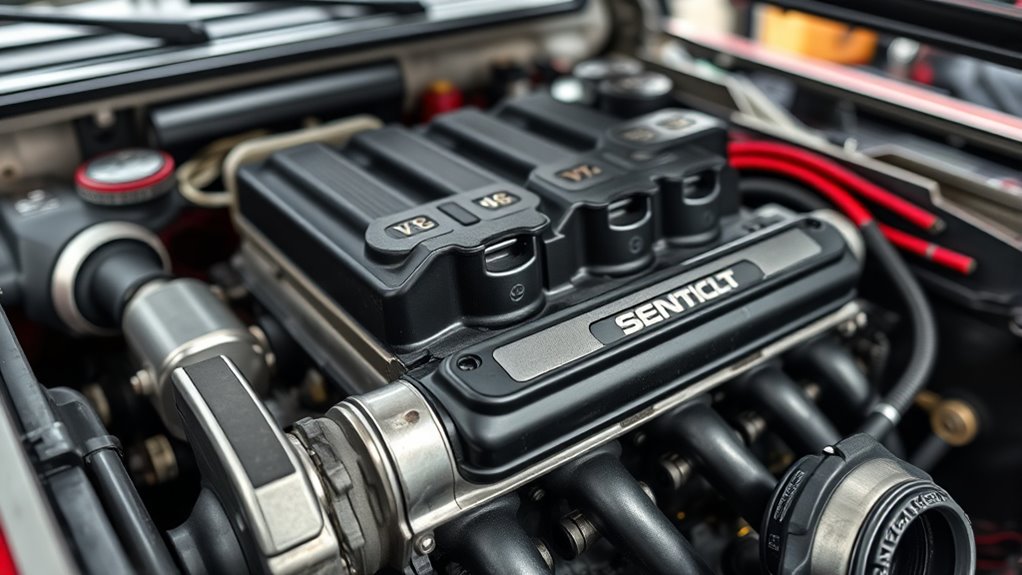
The Volkswagen VR5 engine is a compact five-cylinder powerplant with a 15-degree cylinder angle, using two cylinders on one side and three on the other, all under a single cylinder head.
This layout places the cylinders in a staggered arrangement, allowing the VR5 engine to occupy compact engine bays where a conventional V-engine would be broader. The design combines elements of inline and V configurations while remaining mechanically distinct.
Its firing order, 1-2-4-5-3, matches the logic of an inline-five and supports smooth sequential operation. Volkswagen paired the architecture with multi-point fuel injection and tuned crankshaft and valve geometry to manage balancing demands.
The result was an engine with a notable sound signature and efficient packaging. It appeared in several Volkswagen models, including the Golf Mk4 and Passat B5, where reduced width and moderate weight were practical advantages for liberated space and tighter installation constraints.
How VW Developed the VR5
Volkswagen developed the VR5 in the late 1990s as a compact five-cylinder solution, using a 15-degree cylinder angle and a single cylinder head to package the engine more efficiently than a conventional V layout.
Volkswagen’s VR5 used a 15-degree bank angle and single head to deliver compact five-cylinder packaging.
This VR5 Engine was Volkswagen’s answer to space constraints, combining two banks within one narrow block while preserving smooth five-cylinder operation. The architecture drew from the VR6 program, sharing its 81.0 mm bore, 90.2 mm stroke, and 10.0:1 compression ratio, but reducing overall width for transverse installation.
Volkswagen refined the compact engine solution for vehicles such as the Golf Mk4 and Passat B5, where freedom from packaging limits mattered. Early AGZ units delivered 150 PS and 209 N⋅m, while later AQN and AZX versions increased output to 170 PS and 220 N⋅m.
A dual-mass flywheel was used to control vibration. The result was a practical alternative to an inline-five engine without sacrificing refinement.
VR5 Engine Specs and Firing Order
With a 15-degree cylinder angle and five staggered cylinders split two on one side and three on the other, the VR5 used a compact 2.3-liter layout that displaced 464.8 cc per cylinder from an 81.0 mm × 90.2 mm bore and stroke.
The VR5 engine employed a firing order of 1-2-4-5-3, a sequence close to an inline-five and central to its smooth, distinct delivery. Initial output was 150 PS (110 kW; 148 hp), later increased to 170 PS (125 kW; 168 hp).
A single cylinder head served both versions, while valve count differed by version: the AGZ used 10 valves, and the AQN/AZX used 20 valves for improved airflow. This arrangement linked displacement, cylinder angle, and combustion timing in a tightly packaged unit.
For drivers seeking mechanical freedom, the specification reflected efficient engineering without unnecessary bulk, while preserving the identity of the VR5 engine.
Why VW Chose a 15-Degree V Angle
Volkswagen selected a 15-degree V angle to keep the VR5 engine exceptionally compact, enabling installation in engine bays designed for either four- or six-cylinder units.
The narrow-angle layout also supports the shared VR architecture, using a single cylinder head to reduce manufacturing complexity and maintenance requirements.
This configuration minimizes the engine footprint while preserving efficient power delivery and balanced operation.
Compact Engine Packaging
The VR5 engine’s 15-degree V angle was chosen to create a compact package that could fit into engine bays originally intended for either four- or six-cylinder layouts.
This VR5 compact design uses staggered rows to shorten overall length while preserving a single cylinder head. The narrow angle supports transverse installation in smaller vehicles, where space is limited and efficient engine packaging matters.
Two cylinders on one bank and three on the other are arranged to use available volume without excessive width. A single intake manifold and exhaust manifold further reduce installation complexity and service burden.
The layout retains V-engine advantages, including lower mass and smoother power delivery than many inline engines, while avoiding unnecessary bulk.
In practical terms, the architecture expands mechanical freedom within constrained chassis spaces.
Shared VR Architecture
Although the VR5 uses an unusual 15-degree V angle, that narrow geometry was central to Volkswagen’s shared VR architecture: it allowed five cylinders to be packaged in a compact, staggered layout while retaining a single cylinder head.
The VR5, like the VR6, used shared components to reduce tooling demands and exploit proven engineering. Its narrow-angle V arrangement placed the cylinders in staggered rows, preserving a compact design suitable for bays intended for four- or six-cylinder engines.
This layout lowered mass and part count, simplified assembly, and supported efficient airflow through the head and ports. The result was an engine that occupied a niche between conventional inline and V engines, delivering distinctive mechanical character without unnecessary complexity or excess size.
How the VR5 Head and Intake Work
At the core of the VR5’s compact packaging is a single cylinder head that spans all five cylinders, simplifying assembly and maintenance while preserving the engine’s narrow 15-degree V-angle.
In this VR5 layout, the cylinder head and intake manifold form an integrated package that reduces parts count and supports a compact design without sacrificing serviceability. The intake manifold is a single unit feeding every cylinder, which limits complexity and helps maintain uniform charge distribution.
Valve configuration also evolved: the early AGZ version used 10 valves, while the later AQN and AZX versions adopted 20 valves to improve airflow dynamics and combustion efficiency.
The valve orientation is flipped within the head, a structural choice that promotes more direct airflow paths across the chambers.
Together, these elements let the engine occupy less space in the bay while delivering controlled breathing through a tightly managed cylinder head and intake manifold arrangement, consistent with the VR5 concept.
How VW Managed VR5 Vibrations
Volkswagen addressed VR5 vibration control by specifying crankshaft counterweights to offset the engine’s uneven mass distribution and rotating forces.
This balance strategy was complemented by a dual-mass flywheel, which damped torsional oscillations and reduced transmitted vibration.
Together, these measures improved smoothness despite the engine’s asymmetric cylinder layout and firing order.
Counterweights and Crankshaft Balance
Because the VR5’s staggered two-plus-three cylinder layout creates an uneven mass distribution, VW had to engineer the crankshaft and rotating assembly carefully to control vibration.
The crankshaft uses individual crank pins for each cylinder, a design that supports smoother rotation than a compromised layout might suggest. Strategic counterweights offset the staggered mass, improving balancing across the full rev range.
The firing order, 1-2-4-5-3, further moderates vibrations by following a sequence associated with the relatively even behavior of inline-five engines. This arrangement reflects a precise engineering response to asymmetric geometry, not an attempt to conceal it.
The result is a mechanically disciplined unit whose crankshaft and counterweights translate unconventional packaging into controlled motion, preserving drivability and allowing the engine to operate with notable refinement under load.
Dual-Mass Flywheel Damping
To manage the VR5’s inherent vibration from its 15-degree cylinder angle and unusual firing order, Volkswagen fitted a dual-mass flywheel to the engine.
This dual-mass flywheel divided the rotating mass into two sections, improving absorption of torsional vibrations generated by the compact cylinder configuration. The arrangement reduced noise and softened load changes that would otherwise reach the driveline.
By addressing inherent balance issues, the system supported more stable operation across the rev range. Compared with a traditional single-mass flywheel, it improved performance characteristics without sacrificing refinement.
The result was a smoother driving experience, with fewer oscillations transmitted to occupants and less mechanical stress on related components.
In practical terms, the flywheel helped the VR5 remain usable, civilised, and responsive despite its unconventional layout.
Where the VR5 Engine Was Used
The VR5 engine appeared in several Volkswagen Group models, including the Golf Mk4, Bora, New Beetle, and Passat B5, as well as the SEAT Toledo Mk2. This VR5 engine used a unique engine configuration that let Volkswagen place five cylinders in a compact form.
In the Volkswagen Golf Mk4, it served as a compact power option. In the New Beetle, it demonstrated fitment within a distinctive body shell. In the Passat B5, it provided a measured blend of power and efficiency. The SEAT Toledo also received this layout, extending its use across the group.
- Volkswagen Golf Mk4: compact hatchback application.
- Volkswagen Bora: sedan integration.
- New Beetle: retro-styled packaging.
- Passat B5 and SEAT Toledo: broader family-car use.
Why the VR5 Stayed Niche
Introduced by Volkswagen in the late 1990s as a compact alternative between four-cylinder and VR6 engines, the VR5 remained niche because its unusual five-cylinder layout arrived in a market increasingly dominated by turbocharged engines.
Although the VR5 could produce up to 170 hp and 168 lb-ft of torque, its niche status reflected practical limits rather than output alone. The engine’s close-coupled cylinder arrangement and firing order, similar to an inline-five, created balancing challenges and persistent vibration characteristics.
Despite solid output, the VR5’s unusual layout brought balancing issues and vibrations that limited its appeal.
Those traits complicated servicing, made repair procedures less straightforward, and reduced everyday appeal. Production costs were also elevated by the specialized architecture, which was harder to justify against simpler inline-four and turbocharged designs offered by competitors.
Exposure was further constrained because the VR5 was never sold in the U.S. market. As a result, the engine remained a technically interesting but commercially limited solution, valued more for compact packaging than for broad adoption or long-term market favoring.
Frequently Asked Questions
What Are the Specifications of the VR5 Engine?
The VR5 engine specifications include 2.3-liter displacement, 15-degree angle, 1-2-4-5-3 firing order, 10.0:1 compression, and 150–170 PS power output. It offers engine performance, fuel efficiency, design advantages, manufacturing challenges, and market competition.
What Are the Disadvantages of a V5 Engine?
A V5 engine suffers from compromised engine efficiency, uneven weight distribution, and less refined power delivery. Its throttle response can be inconsistent, maintenance costs are higher, and market availability is limited, increasing repair difficulty.
What Cars Came With the VR5 Engine?
Like a rare key in a crowded lock, the VR5 appeared in the Volkswagen Golf Mk4, Bora/Vento, New Beetle, Passat B5, and SEAT Toledo Mk2, shaping engine performance, design innovations, manufacturing challenges, tuning potential, market impact, vehicle applications.
What Does R Stand for in VR6?
R stands for Reihenmotor, German for inline engine. In VR6 performance, this Engine design bridges V5 vs V6 concepts, affecting Torque characteristics, Fuel efficiency, and Maintenance tips; observers note compactness, smoothness, and mechanical freedom.
Conclusion
In the end, the VR5 stands as Volkswagen’s elegant answer to a question few buyers asked: how to make a five-cylinder engine fit neatly into a narrow bay while sounding suitably unusual. Its 15-degree V layout, staggered cylinders, and carefully managed vibration control show real engineering discipline. Yet history rewarded mainstream turbo fours, not this compact oddity. The VR5 remains a technical curiosity—clever, refined, and commercially outpaced by more conventional choices.