
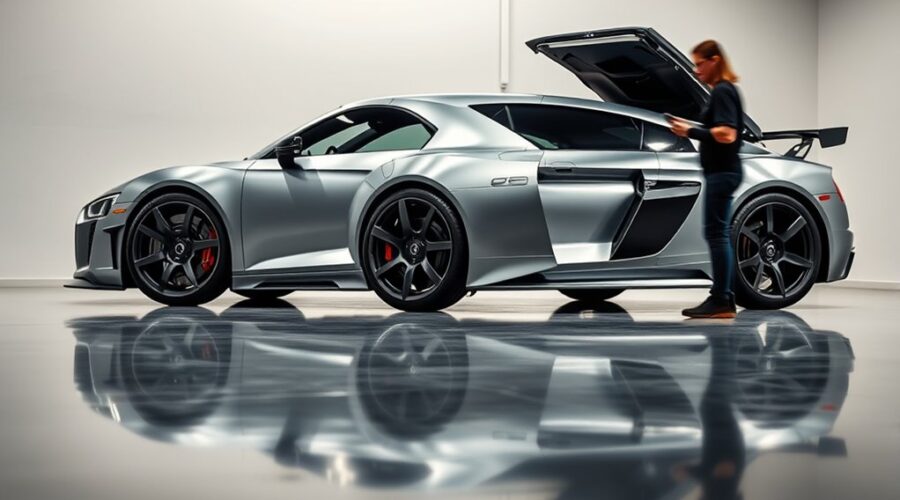
The Audi R26 is set to mark Audi’s entry into Formula 1 in 2026, bringing a hybrid powertrain split evenly between electric and combustion output, with roughly 350 kW, or 475 hp. Its claimed size is substantial for a modern single-seater, with a 5440 mm length, 1900 mm width, and 3400 mm wheelbase. But the headline figures only tell part of the story. The details behind its efficiency, chassis layout, and drivetrain are where the project becomes more revealing.
Key Takeaways
- The Audi R26 is Audi’s first factory Formula 1 car, debuting in 2026 with titanium silver, carbon black, and red livery.
- Its dimensions are 5,440 mm long, 1,900 mm wide, 980 mm high, with a 3,400 mm wheelbase.
- The 2026 hybrid power unit uses a 50/50 electric-combustion split, with about 350 kW, or 475 hp, from the electric side.
- Upgraded energy recovery, MGU-K capacity, and brake-by-wire braking improve efficiency, response, and controlled aggression.
- First fired up on December 19, 2025, the car was shakedown-tested in Barcelona and revealed in Berlin on January 20, 2026.
What Is the Audi R26?
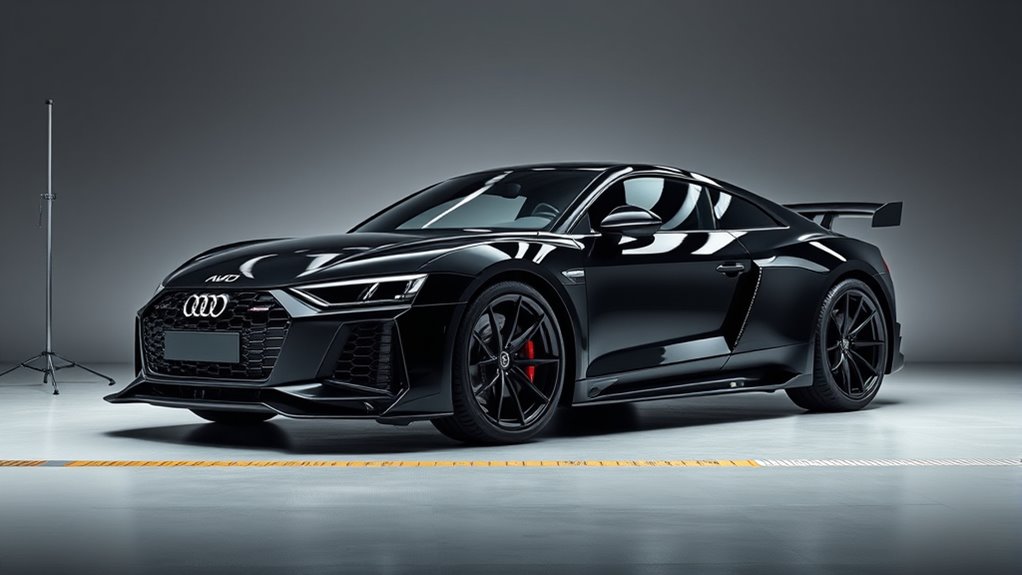
The Audi R26 is Audi’s first factory Formula 1 car, set to debut in the 2026 season as the brand’s entry into the sport’s top tier. Developed by the Audi F1 Team, it serves as a purpose-built competition platform rather than an adaptation of an existing chassis.
The car presents a titanium silver, carbon black, and Audi red livery, signaling a factory identity built around precision and controlled aggression. Its architecture is defined by Formula 1’s current dimensional limits, with an overall length of 5440 mm, a width of 1900 mm, a height of 980 mm, and a wheelbase of no more than 3400 mm.
The R26 also integrates a seamless semi-automatic 8-speed gearbox with quickshift operation and advanced braking hardware, including carbon self-ventilating Brembo discs and rear hydraulic control. This specification positions the car as a technically disciplined machine for unrestricted competitive intent.
Audi R26 Powertrain and Hybrid Output
At the core of the Audi R26 is a power unit developed entirely at Audi’s Competence Centre Motorsport in Neuburg, Germany, configured around a 50/50 split between electric and internal combustion output. This architecture gives the Audi Revolut F1® Team a compact hybrid system aimed at precise energy deployment and stronger acceleration.
Developed in Neuburg, the Audi R26’s compact hybrid power unit delivers balanced electric and combustion performance for sharper acceleration.
The electric side delivers roughly 350 kW, or 475 hp, marking a substantial rise in electrical assistance versus earlier Formula 1 concepts. Audi’s upgraded energy-recovery hardware is engineered to capture more kinetic energy under braking, converting otherwise wasted motion into usable power with greater efficiency.
The overall integration targets both lap-time gains and a cleaner performance profile, reflecting the FIA’s emphasis on sustainable motorsport. Beyond the circuit, the same engineering approach is intended to support road-relevant technologies, linking competition development to future mobility.
The result is a powertrain centered on efficiency, responsiveness, and technical independence.
2026 F1 Rules Behind the R26
The 2026 Formula 1 regulations impose a revised power unit architecture with an equal 50/50 split between electrical and combustion output, directly shaping the R26’s design.
With the MGU-H eliminated, Audi can allocate more capacity to the MGU-K, increasing kinetic energy recovery and electric deployment.
These rule changes also reinforce tighter efficiency and sustainability targets, while driving corresponding revisions in aerodynamics and chassis packaging.
New 2026 Regulations
As the 2026 Formula 1 regulations reshape power-unit architecture, Audi’s R26 is being developed around a mandatory 50/50 split between electric and combustion power, a change that places far greater emphasis on electric deployment and efficiency. For Audi, R26: Technical,new chapter means a freer allocation of energy under tighter control. | Rule | Effect |
| — | — |
|---|---|
| 50/50 split | Equal electrical contribution |
| MGU-H removal | Higher kinetic recovery via MGU-K |
| Sustainability and noise limits | Cleaner design and controlled acoustics |
Developed at Neuburg, the unit targets roughly 350kW from electric boost alone. The framework rewards precise energy management, reduced losses, and robust thermal control, while preserving performance within a more responsible regulatory envelope.
Power Unit Revisions
Shaped by six major 2026 F1 rule changes, the Audi R26 power unit moves to a 50/50 split between electric and combustion output, with the electric side alone expected to provide about 350kW (475hp). This rebalanced architecture replaces earlier systems where electricity supplied roughly 20% of total output, giving engineers far greater freedom to extract pace and efficiency.
- MGU-H deletion simplifies packaging.
- Upgraded MGU-K triples kinetic energy recovery.
- Neuburg-built hardware keeps development fully in-house.
The revised power unit reflects FIA sustainability targets by prioritizing road-relevant technology and cleaner performance pathways.
In technical terms, the R26 is designed to convert regulation into leverage: less waste, more recoverable energy, and a stronger foundation for competitive independence under the 2026 framework.
Audi R26 Speed, Efficiency, and Reliability
Audi’s R26 is engineered to balance speed, efficiency, and reliability under the 2026 regulations, with a power unit configured for an even 50/50 split between electric and internal combustion output and an electric boost of roughly 350kW (475hp) to strengthen acceleration and energy deployment.
Team data indicates that the upgraded MGU-K can recover kinetic energy at nearly triple the previous rate, improving lap-time potential while preserving usable energy for strategic deployment.
A seamless semi-automatic paddle shift gearbox reduces interruption during gear changes, sharpening response and maintaining thrust through shifts.
Aerodynamic development, including a distinctive splitter and bib, supports cleaner airflow management, enhancing stability and reducing wasted energy at high speed.
Reliability remains central to the program: a unified infrastructure across Audi’s facilities is intended to align testing, production, and validation, limiting failure modes and improving durability in competition.
The result is a powertrain package focused on liberated pace, controlled efficiency, and repeatable performance.
Audi R26 Dimensions and Chassis Size
Measured at 5,440 mm in length, 1,900 mm in width, and 980 mm in height, the Audi R26 uses compact, low-profile proportions to support high-speed stability and aerodynamic efficiency. Its Audi R26 dimensions reflect a disciplined packaging strategy, with a wheelbase of no more than 3,400 mm helping maintain balance under heavy load and rapid direction changes.
The chassis adopts a flat-top surface beneath the raised bodywork, reducing drag and guiding airflow cleanly across critical surfaces.
A flat-top chassis beneath raised bodywork reduces drag and channels airflow cleanly across critical surfaces.
- Long wheelbase control improves straight-line composure.
- Low height limits frontal area and lift.
- Extended splitter bib aids air direction and cooling.
These geometric decisions are not decorative; they are functional elements that shape vehicle behavior in race conditions. The result is a chassis architecture that favors precision, liberated pace, and consistent aerodynamic load without unnecessary bulk.
Audi R26 Gearbox, Differential, and Battery
Beyond chassis proportions and aerodynamic packaging, the Audi R26’s drivetrain hardware continues the same emphasis on control and efficiency. The car uses an in-house developed 8-speed plus 1 reverse gearbox, paired with seamless semi-automatic paddle shift technology for rapid, uninterrupted gear changes.
A quickshift system further reduces shift time, sharpening response and supporting lap-time gains. The transmission is complemented by a limited-slip differential, which manages torque delivery to improve traction and stability during acceleration and cornering.
Power comes from an Audi lithium-ion battery integrated into the hybrid system, helping achieve the mandated 50/50 split between electric and internal combustion output. This architecture reflects the 2026 regulations, where performance is tied closely to energy management and mechanical precision.
For Hülkenberg and Gabriel Bortoleto, the package is intended to provide predictable deployment, efficient power transfer, and the kind of responsive control that supports driver freedom on track.
Audi R26 Braking System
The Audi R26 uses Brembo carbon self-ventilating brake discs at both axles, providing strong thermal management under sustained racing loads.
At the rear, a brake-by-wire hydraulic control system is employed to improve modulation and response accuracy.
Together, these components support consistent braking performance and contribute to overall vehicle stability in competition.
Brembo Carbon Discs
Carbon self-ventilating Brembo brake discs at both axles give the Audi R26 a high-capacity thermal foundation, allowing the system to maintain braking consistency under repeated heavy loads and extreme racing temperatures.
Brembo carbon construction supports rapid heat rejection and stable pedal feel, which benefits drivers seeking uncompromised control.
- Front and rear discs work as a matched set for balanced deceleration.
- Nickel-plated aluminum monobloc calipers add rigidity while limiting mass.
- A Brembo tandem master cylinder coordinates hydraulic output across both axles.
Together, these components reinforce stability, safety, and predictable response at speed. The result is a braking package engineered for liberation from fade, delivering precision when every meter matters.
Brake-By-Wire Rear Control
Integrating brake-by-wire control at the rear axle, the Audi R26 uses an electronic-hydraulic braking architecture to refine force distribution and improve response during high-load deceleration.
The brake-by-wire rear control system allows calibrated rear brake force adjustment, helping the car adapt to changing grip, tire load, and circuit conditions without excess intervention. This setup supports precise pedal behavior and stable chassis balance, especially when braking zones demand rapid modulation.
Carbon self-ventilating Brembo discs manage heat efficiently, sustaining consistent friction under repeated stops.
Brembo nickel-plated aluminum monobloc calipers reduce mass while preserving rigidity. A Brembo tandem master cylinder coordinates front and rear actuation, reinforcing synchronization.
The result is controlled, efficient braking performance that supports driver confidence and operational freedom.
Audi R26 Launch, Fire-Up, and Shakedown
Audi’s R26 first came to life with an inaugural fire-up at the Hinwil site in Switzerland on December 19, 2025, a key step in validating the new car’s systems ahead of its debut campaign.
That Audi R26 launch sequence progressed through controlled validation, aligning hardware, software, and cooling behavior under the 2026 Formula One rule set.
- December 19, 2025: first fire-up confirmed basic powertrain integration.
- January 9, 2026: shakedown at Circuit de Barcelona-Catalunya enabled early running checks.
- January 20, 2026: Berlin reveal presented the final livery and design direction.
The shakedown provided a brief but essential systems audit, exposing any calibration issues before heavier testing.
A brief but vital systems audit, the shakedown exposed calibration issues before more intensive testing.
Its development emphasized compliance, efficiency, and performance within tighter technical regulations, while the power unit from Audi’s Competence Centre Motorsport remained the central performance architecture.
The sequence marked a disciplined shift from static verification to track-ready form.
Audi R26 Team Facts and Key Details
Powered by an in-house Audi unit with a 50/50 split between combustion and electric output, the R26 is built around a hybrid system that delivers roughly 350kW (475hp) of electric boost and reflects the team’s factory-led engineering model.
Audi R26 is supported by a fully integrated operation spanning Neuburg for power unit development, Hinwil for chassis engineering, and Bicester for technology support. This structure aligns hardware, software, and race execution under one technical chain, reducing dependency on external suppliers and improving development control.
Nico Hülkenberg provides depth with more than 250 Grands Prix, while Gabriel Bortoleto adds momentum after back-to-back Formula 3 and Formula 2 titles.
The braking package uses carbon self-ventilating Brembo discs with an electronic control hydraulic system, underscoring the car’s advanced specification.
Audi’s Mission 2030 plan frames 2026-2027 as the Challenger phase before a push toward championship status by 2030, placing Audi R26 within a deliberate, liberation-oriented climb.
Frequently Asked Questions
Is the Audi R26 a Formula 1 Car?
Yes, the Audi R26 is a Formula 1 car, developed for the 2026 season. Its Racing Heritage reflects Audi’s factory entry, combining advanced hybrid power, technical regulation compliance, and performance-focused engineering.
What Is Audi’s Most Reliable V8?
Audi’s most reliable V8 is the 4.2-liter V8, a near-legendary unit with Engine Longevity, aluminum construction, timing chains, and proven durability; in properly maintained form, it can seemingly defy age while delivering 420 horsepower.
What Is the Audi R26 Concept?
The Audi R26 Concept is Audi’s first factory Formula 1 project, a technical Concept Design previewing future production themes, hybrid sustainability systems, and the marque’s long-term push for competitive independence, engineering renewal, and motorsport credibility.
Is the Audi R8 Engine a Lamborghini Engine?
Birds of a feather, yes. The Audi R8’s Engine Origins trace to Lamborghini’s Gallardo-derived 5.2-liter V10. Audi retuned it for its own character, sharing architecture but not simply borrowing a finished Lamborghini engine.
Conclusion
The Audi R26 closes the gap between road-derived engineering and outright race machinery: 350 kW of hybrid output against a compact 1900 mm-wide chassis, 5440 mm in length, and a 3400 mm wheelbase. Electric recovery and combustion power sit side by side, while the upgraded MGU-K and semi-automatic gearbox emphasize precision over spectacle. In the same frame, efficiency and aggression, restraint and speed, are no longer opposites but components of one Formula 1 debut.