Race car photos are most useful when you can read what they show: the wings, engine layout and tyres tell you which era and series a car belongs to. This guide covers five landmark cars worth searching for, what to look for in an image, and how to find pictures you can legally use.
Landmark race cars to look for in photos
| Car | Why it matters |
|---|---|
| 1906 Renault (French Grand Prix) | Ferenc Szisz won the 1906 French Grand Prix at Le Mans, run over two days on closed public roads, 12 laps of a 103.18 km circuit (about 1,238 km). It is commonly called the first Grand Prix. |
| Chaparral 2E (1966) | The first of the high-wing race cars, a Can-Am design from 1966. |
| Lola T70 | A Lola T70 driven by John Surtees won the first Can-Am championship in 1966. |
| McLaren M6A (1967) | McLaren introduced it for Can-Am in 1967 and dominated the series from 1967 to 1971. |
| Chaparral 2J | A twin-engined car: a big-block Chevrolet for propulsion and a small snowmobile engine driving rear fans, with movable skirts to create a vacuum under the car. |
| Porsche 917/30 (1972) | A 5.4-litre flat-12 Can-Am car that won six of eight races in the 1973 championship. |
Why Can-Am photos are so popular
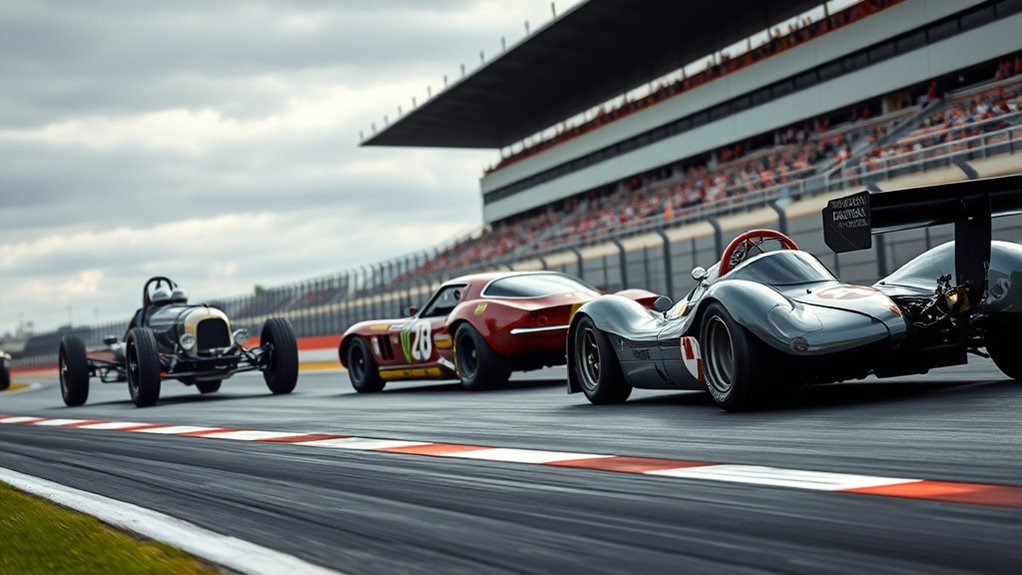
The original Can-Am series ran from 1966 to 1974 with few technical rules, so teams tried radical ideas. Photos of the period show wings, fans and enormous V8 and flat-12 engines on very light bodywork.
Photo-wise, that makes Can-Am cars easy to tell apart: McLaren’s papaya-orange cars, the white Chaparrals and the Porsche 917/30 all look nothing like each other.
What to look for in a race car photo
- Wings and splitters: tall mounted wings point to the late 1960s; a flat, full-width front splitter suggests a modern car.
- Engine layout: exposed V8s, flat-12s or mid-engine bodywork show the class and era.
- Tyres: slicks suggest a dry race on a modern circuit, while treaded tyres point to wet-weather or road-based racing.
- Number, livery and sponsor: these are usually the fastest way to identify the exact car and race.
- Background: circuit signage, grandstands and pit buildings help date the picture.
Where to find race car photos you can use
Looking at a photo and reusing it are different things. Most professional race photos are copyrighted, and in Canada you need permission or a licence for commercial use.
- Wikimedia Commons: a large library of images with clear licences; always check each file’s licence and credit requirements.
- Museum and team archives: many provide editorial or press images on request.
- Your own photos: track days and club events are open to spectators at many circuits, so check the venue’s photography rules first.
To learn the context behind the pictures, read our guides to race track types, the Mazda 787B and Japanese race cars.
Sources: Wikipedia entries on Can-Am and the 1906 French Grand Prix.
Frequently Asked Questions
What was the first Grand Prix?
The 1906 French Grand Prix, held on 26 and 27 June near Le Mans, is commonly called the first Grand Prix. Ferenc Szisz won in a Renault over 12 laps of a 103.18 km circuit.
What made the Chaparral 2J unusual?
It had two engines: a big-block Chevrolet for propulsion and a small snowmobile engine driving fans at the rear, with movable skirts creating a vacuum under the car for downforce.
Which cars dominated Can-Am?
McLaren dominated the original Can-Am series from 1967 to 1971 after introducing the M6A. Porsche’s 917/30 later won six of eight races in the 1973 championship.
When did Can-Am run?
The original Can-Am series ran from 1966 to 1974. A revived series ran from 1977 to 1987.
What should I look for to identify a race car in a photo?
Check the wings and splitters, engine layout, tyres, race number and livery, and any circuit signage. These usually narrow down the era and series.
Can I use race car photos from the internet on my website?
Only if the licence allows it. Most professional photos are copyrighted, so use images with a clear open licence, such as many on Wikimedia Commons, or get permission.