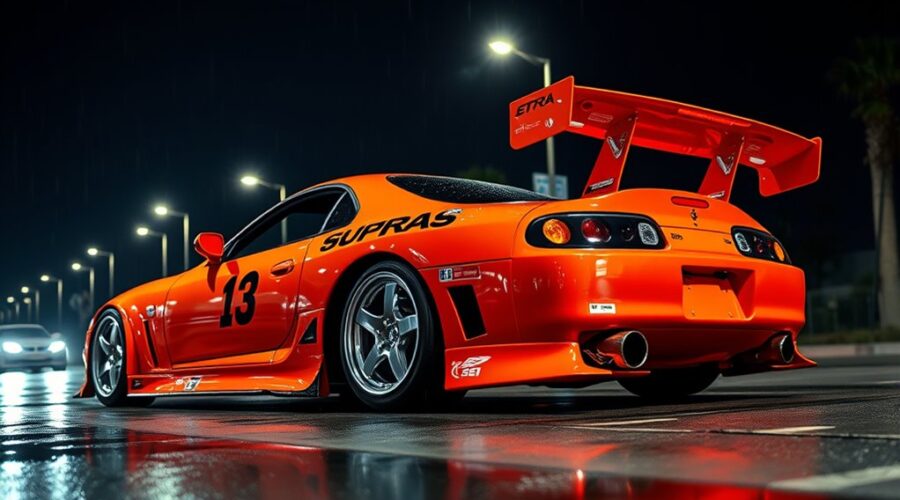
Brian O’Conner’s 1993 Toyota Supra became one of the most recognizable cars in *The Fast and the Furious*. Built by Eddie Paul, the hero car combined a 2JZ-GE inline-six, a Bomex body kit, and bright Diablo Candy Orange paint. Its screen presence and modified performance made it more than a prop. The real story, though, involves what was changed for stunts, what was preserved, and why the car still commands attention.
Brian O’Conner’s Supra in *The Fast and the Furious
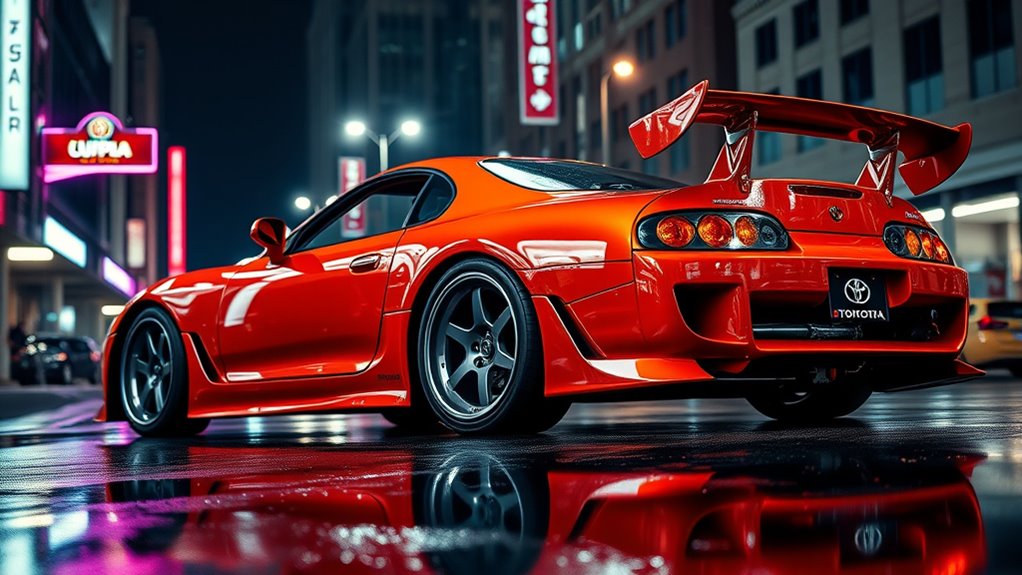
Brian O’Conner’s 1993 Toyota Supra in *The Fast and the Furious*, built by Eddie Paul, was powered by a 2JZ-GE 3.0-liter inline-six rated at 220 horsepower.
As the film’s hero car, the Supra served mainly for close-up photography, giving Paul Walker’s character a machine that symbolized controlled speed and chosen motion. Its presence in the final race against Vin Diesel fixed the car in franchise memory and made the Supra an emblem of technical confidence and personal autonomy.
The 2JZ-GE engine provided a credible baseline for the car’s on-screen authority, while the chassis’ competition-ready support equipment helped it endure production demands.
Unlike expendable stunt units, this hero example carried higher historical value and stronger collector appeal. That status was confirmed when it sold for $199,800 at Mecum’s Indy Auction in May 2015, reflecting the lasting power of the Supra and its association with Paul Walker.
How Brian O’Conner’s Supra Was Built
Brian O’Conner’s Supra began as a Toyota Supra platform centered on a 3.0-liter inline-6, chosen for its strong performance potential.
Eddie Paul and The Shark Shop in El Segundo, California, built the car for the film, refining its structure and powertrain for production use.
Film-ready modifications included a Bomex body kit, APR wing, roll cage, heavy-duty suspension, competition seats, and a Jaz Products fuel cell to support stunt work.
Base Supra Platform
The hero car’s foundation was a 1993 Toyota Supra powered by the 3.0-liter 2JZ-GE inline-six, rated at 220 horsepower in stock form. This base platform used a manual transmission and the naturally aspirated inline-6 engine, not the Toyota Supra Turbo twin-turbo setup that later defined the model’s reputation.
For the film, the chassis offered a strong, adaptable shell for a street-racing icon. Its rear-drive layout and balanced structure suited aggressive driving scenes without excess complexity.
The stock hardware provided a reliable starting point for controlled modification, allowing the car to project speed, discipline, and independence. That mechanical honesty mattered: the machine began as a capable production coupe, then became a symbol of self-directed performance, built on a foundation that was accessible rather than elite.
Shark Shop Build
Constructed by Eddie Paul at The Shark Shop in El Segundo, California, the hero Supra was purpose-built for the Fast and Furious franchise and tailored to read as a high-performance street machine on camera.
The shark shop build transformed a factory Toyota into a vivid performance car, using a Lamborghini Diablo Candy Orange pearl finish and a Bomex body kit to sharpen its silhouette.
Under the hood, the Tuner specification raised output to about 544 horsepower, far beyond the stock 320, while a wet-shot nitrous system added 100 horsepower for controlled bursts in racing scenes.
Extensive documentation and a Certificate of Authenticity confirm its status as a hero vehicle.
The result was a machine engineered for speed, identity, and cinematic freedom.
Film-Ready Modifications
Built by Eddie Paul at The Shark Shop, Brian O’Conner’s Supra was configured as a film-ready hero car with heavy-duty suspension, a full roll cage, and other safety-focused hardware for stunt work.
These film-ready modifications supported the Supra driven in high-speed scenes while protecting the driver and crew. A Bomex body kit, APR wing, and Lamborghini Diablo candy orange paint gave the car a vivid, camera-friendly profile suited to movie cars built for close-ups.
Underneath, the 2JZ-GE 3.0-liter inline-6 retained its base character but was tuned for filming demands. Inside, competition seats, a Jaz Products fuel cell, and upgraded audio systems balanced control, safety, and presentation.
The result was a liberated-looking hero car designed more for visual impact than racing supremacy.
The Supra Specs Behind the Hero Car
- Engine: 220 hp, smooth inline-six delivery.
- Body: Bomex panels sharpened the profile.
- Running gear: Dazz alloy wheels with Yokohama tires.
- Structure: Heavy-duty suspension and full roll cage supported filming abuse.
The package balanced style and function, letting the car read as a hero machine while remaining dependable under production demands.
The build balanced style and function, making the car feel like a hero while enduring production demands.
Its later $199,800 Mecum Indy Auction result in 2015 confirmed that the film Supra had become more than a prop; it was a collectible artifact of cinematic mobility and automotive aspiration.
Which Supra Parts Were Built for Stunts
The 1993 Toyota Supra used for stunt work was fitted with a full roll cage to improve occupant protection during impacts and high-load maneuvers.
Heavy-duty suspension components were added to better absorb jumps, landings, and repeated abuse on set.
A stunt-ready Jaz Products fuel cell supported reliable fuel delivery while reducing risk under filming conditions.
Roll Cage Reinforcement
- Driver-space protection during collisions
- Structural rigidity for filmed impacts
- Reduced cabin deformation in crashes
- Support for liberated, high-risk action driving
Along with competition seats and a Jaz Products fuel cell, the cage made the Supra functional under pressure.
The result was a purpose-built machine that could perform safely while delivering aggressive cinematic movement.
Heavy-Duty Suspension
With the roll cage handling occupant protection and chassis integrity, the 1993 Toyota Supra also received a heavy-duty suspension package built specifically for stunt use.
The setup centered on Bilstein shocks and Eibach coil-over springs, components chosen to absorb impact, control body motion, and preserve handling under extreme loads.
Custom bushings and Stillen sway bars further tightened chassis response, reducing flex and improving stability during high-speed maneuvers.
For stunt work, this calibration helped the car tolerate jumps, hard landings, and collisions without losing control.
The result was a suspension system engineered for durability rather than comfort, reinforcing safety while enabling precise movement in filmed action.
In a production built around speed and escape, the suspension made the Supra a reliable platform for demanding sequences.
Stunt-Ready Fuel Cell
Among the Supra’s stunt-focused upgrades, a Jaz Products fuel cell replaced the stock fuel tank to improve safety during high-performance filming. This stunt-ready fuel cell reduced fuel slosh, lowered leak risk, and supported aggressive motion without compromising control.
Paired with the roll cage, it formed part of a purpose-built cabin package for freedom under pressure. The setup enabled the car to endure repeated launches, slides, and jumps while protecting the crew.
- Safer fuel storage
- Stable delivery under load
- Crash-resistant placement
- Support for repeat takes
The system complemented heavy-duty suspension, competition seats, and reinforced bodywork. Together, these parts transformed the 1993 Supra into a reliable stunt platform, engineered for fast movement, structural integrity, and cinematic independence.
How the Movie Supra Differs From a Real MKIV
The film’s Supra differs substantially from a production MKIV in both mechanical specification and purpose-built preparation. The movie Supra uses a modified 2JZ-GE, rated at 220 hp, whereas a real MKIV, especially the twin-turbo variant, can deliver 320 hp and accept modifications beyond 600 hp.
Its role is not daily travel; it is a controlled performance tool shaped for filming. Heavy-duty suspension, a full roll cage, Jaz Products fuel cell, and competition seats prioritize safety and durability under stunt loads.
Exterior changes, including the Bomex body kit and APR wing, emphasize visual aggression, while a stock MKIV usually retains a more restrained form. The production Supra is tuned for balance, reliability, and everyday freedom on the road.
Why Paul Walker’s Supra Became Iconic
Paul Walker’s Supra became iconic because it fused cinematic identity with tuner-culture symbolism in a single, instantly readable package. As Brian O’Conner’s hero car, the Supra appeared in close-up shots, giving Paul Walker’s screen presence a mechanical signature that felt both precise and rebellious.
The 2JZ-GE 3.0-liter inline-6, rated at 220 horsepower, reflected early-2000s performance culture without excessive showmanship. Its film modifications sharpened that message:
- Bomex body kit for aggressive aero.
- APR wing for track-inspired stance.
- Candy Orange pearl paint for instant recognition.
- Troy Lee graphics for visual authority.
The Supra’s form communicated motion, competence, and independence. It did not merely support the role; it helped define it.
Auction Value and Collector Appeal
Auction results have confirmed the Supra’s status beyond screen iconography, with the 1993 Toyota Supra from *The Fast and the Furious* bringing $199,800 at Mecum’s Indy Auction in May 2015. That sale established clear auction value for a film car with documented provenance.
As a hero vehicle driven by Paul Walker, it carries unusual collector appeal because identity, screen exposure, and celebrity association converge in one asset. Film-specific modifications, including reinforced suspension and exterior upgrades, add to its market profile without erasing authenticity.
In collector circles, such details matter because they signal verified use, not replica status. The enduring popularity of Fast and Furious continues to support demand, helping sustain future value as fan interest remains active.
Documentation and a Certificate of Authenticity further strengthen the case, giving buyers confidence in origin and chain of custody. For collectors seeking liberated ownership of cultural hardware, the Supra remains a benchmark.
Fast & Furious Supra Facts and Specs
- Engine: 2JZ-GE, 220 hp, naturally aspirated.
- Structure: reinforced suspension, full roll cage.
- Appearance: Bomex body kit, APR wing, Dazz alloy wheels.
- Legacy: driven by Paul Walker, built by Eddie Paul, later auctioned as a collectible.
Its balanced chassis and aggressive aero gave the car a distinct visual identity while supporting controlled stunt performance.
The result was a liberated, iconic machine: technical, recognizable, and central to the franchise’s street-racing image.
Frequently Asked Questions
What Are the Specifications of the Supra in Fast and Furious?
The Supra featured a 2JZ-GE 3.0-liter inline-six, 220 hp, Bomex body kit, APR rear wing, Dazz alloy wheels, heavy-duty suspension, and roll cage; Supra modifications favored visuals over Supra racing, shaping Supra legacy.
What Are Some Interesting Facts About the Toyota Supra?
Toyota Supra blends Racing Legacy with Iconic Design, earning admiration for its robust inline-six performance, tunable chassis, and enduring reliability. It became a motorsport and street-culture symbol, celebrated for balance, speed, and engineering simplicity.
What Are the Specifications of Paul Walker’s Supra?
It used a 2JZ-GE 3.0-liter inline-six, making 220 horsepower. Supra modifications included a Bomex body kit, APR wing, Dazz wheels, Yokohama tires, reinforced suspension, and a roll cage for Supra racing and Supra history.
Is a Supra Faster Than a Hellcat?
No; in a Hellcat comparison, Supra performance usually trails the supercharged Dodge in straight-line speed. In drag racing, a stock or mildly modified Supra is generally slower, though heavily tuned builds can narrow the gap.
Conclusion
Brian O’Conner’s Supra remains the series’ mechanical crown jewel, a machine that blends Hollywood spectacle with real-world tuning credibility. Its modified 2JZ inline-six, Bomex body kit, and stunt-ready construction made it both a memorable hero car and a benchmark for movie vehicles. Like a time capsule on wheels, it captures early-2000s tuner culture, Paul Walker’s on-screen legacy, and the enduring appeal of Japanese performance engineering.