A V4 engine places four cylinders in two banks, usually at 90 degrees, to reduce length and improve packaging. Its compact layout can aid balance, though the crankshaft and firing order add design complexity. First seen in the 1898 Mors car and later refined by Lancia, the format found use in cars, motorcycles, boats, and industrial machines. Its strengths are clear, but the tradeoffs are equally important.
Key Takeaways
- A V4 engine uses four cylinders in two banks, usually at a 90° angle, for compact packaging and good balance.
- First seen in the 1898 Mors car, the V4 was popularized by Lancia’s 1922 Lambda and later used by Ford and Saab.
- Its crankshaft typically uses two crankpins, often split for smoother firing intervals and reduced vibration.
- V4 engines deliver a low center of gravity and efficient space use, making them useful in cars, motorcycles, marine, and industrial applications.
- Drawbacks include higher manufacturing complexity, tougher maintenance access, and less power than larger engine layouts.
What Is a V4 Engine?
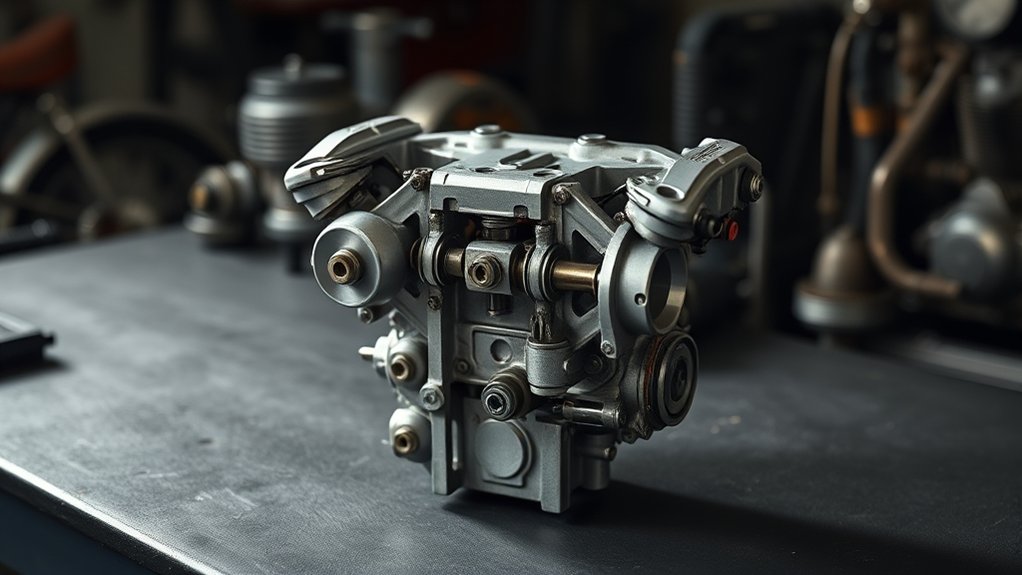
A V4 engine is a four-cylinder internal combustion layout with two cylinders arranged in each bank of a V configuration, typically at a 90° angle. This V4 engine configuration produces a compact size while preserving mechanical balance that is useful in constrained vehicle designs.
With a shared crankshaft and paired cylinder banks, the geometry can reduce vibration through strong primary and secondary balance. Historically, the arrangement appeared in the 1898 Mors car, establishing an early precedent for non-inline four-cylinder engineering.
Later examples, including the Ford Taunus V4, the Porsche 919 Hybrid, and the Honda VFR750F, show its use where smooth delivery and packaging efficiency matter. It is often selected when spatial freedom is prioritized over sheer cylinder count, yet it remains less common today because manufacturing demands are high and output is limited relative to larger engines.
How V4 Engines Are Built
V4 engines are built around two cylinder banks arranged in a V layout, commonly at a 90° angle to support balance and limit vibration.
Their compact architecture permits a shorter crankshaft, which contributes to efficient power transmission and a lower center of gravity.
The crankshaft design and firing order are then calibrated to maintain smooth torque delivery across the operating range.
Cylinder Bank Layout
Two cylinder banks define the V4 engine layout, each carrying two cylinders set at a V angle that is typically 90 degrees. This V4 configuration contrasts with an inline-four engine by arranging mass in a narrower form, reducing overall length and supporting a more compact chassis.
The geometry places cylinders closer to the vehicle centerline, lowering the center of gravity and improving stability in motorcycles and cars. With four cylinders divided evenly between the banks, the architecture permits a shorter crankshaft than inline layouts, which can aid power delivery efficiency.
The bank arrangement also contributes to strong balance characteristics, with primary balance achieved and secondary imbalance reduced. As a result, the layout offers a technically efficient path toward controlled, liberated machine movement.
Crankshaft And Firing Order
Although V4 engines are relatively compact, their crankshaft design is central to how the layout manages balance and firing smoothness. The crankshaft usually carries two crankpins, either shared or split; split crankpins are preferred because they support even firing intervals and more refined operation.
A 90-degree V-angle is common, since it improves primary and secondary balance and suppresses vibration. Compared with an inline-four, the shorter crankshaft reduces package length and increases design freedom in the chassis.
The firing order also shapes behavior: a 180-degree sequence is often selected to strengthen power delivery and smoothness. By aligning opposing cylinders to cancel forces, the engine can deliver efficient output while preserving rider comfort and mechanical composure.
How V4 Crankshafts and Firing Order Work
V4 crankshafts are arranged around either split or shared crankpins, with the pin layout determining how cylinder pairs are phased across the rotation cycle.
Firing order patterns, commonly including sequences such as 1-2-3-4, are selected to maintain even combustion spacing and stable power delivery.
Split crankpins generally support smoother operation and more uniform firing intervals than shared pins, while the V-angle further influences vibration behavior and engine balance.
Crankpin Layout Basics
The crankshaft layout of a V4 engine is central to how it runs, with most designs using two crankpins that may be shared by opposing cylinders or split for more even firing intervals.
In a V4, the crankshaft architecture determines compactness, reducing overall engine length versus inline-four layouts while preserving usable packaging space. A 90° V-angle is often selected because it gives perfect primary balance and better secondary balance, limiting vibration and easing mechanical load.
The selected crankpin arrangement also shapes how torque is released through the crankshaft, influencing smoothness, performance, and component stress. In this V4 configuration, a balanced firing sequence is essential for consistent power delivery.
For demanding applications, especially racing, crankshaft design can materially affect handling, response, and track-side traction.
Firing Order Patterns
Depending on the crankshaft geometry, a V4 engine may produce either evenly spaced or irregular firing intervals, because the firing order is determined by how the crankpins are arranged and whether cylinders share pins or use split journals.
In V4 engines, the firing order strongly shapes vibration, torque continuity, and acoustic character. A common 90° layout uses 1-3-2-4, a sequence that can reduce resonance and support steadier power delivery.
Wider-angle configurations often improve balance, while shorter crankshafts can sharpen response under load.
- Firing order governs pulse timing.
- Crank design sets interval symmetry.
- 90° angles aid balance.
- Smooth delivery supports rider control.
- Sound profile reflects sequencing.
Split Versus Shared Pins
Distinct crankshaft architectures in a V4 engine determine whether cylinders share crankpins or use split pins, and that choice directly affects firing intervals, smoothness, and vibration.
In V4 engines, shared pins couple cylinders on common journals, often producing uneven firing and greater torsional disturbance.
Split crankpins assign each cylinder its own pin, improving interval regularity and enabling smoother, more liberated power delivery. This arrangement is favored in racing, where reduced noise, better balance, and sharper control matter.
A 90° V-angle can achieve perfect primary balance and improved secondary balance, especially with split crankpins.
Firing sequences also benefit, often aligning with 1-2-3-4 rather than the less efficient 1-3-2-4 pattern. Such geometry is central to tuning and extracting precise high-output performance.
Why V4 Engines Stay Compact and Smooth
Compactness in a V4 engine comes from its V-shaped cylinder arrangement, which shortens the overall engine length relative to an inline-four layout. This geometry gives V4 engines a shorter crankshaft, reducing mass and internal flex while improving response.
A 90° V-angle supports perfect primary balance and better secondary balance, so vibration is suppressed without excessive countermeasures. Split crankpins further refine firing evenness, helping torque arrive with measured consistency and fewer oscillations.
- Reduced length eases packaging constraints
- Shorter crankshaft lowers rotational inertia
- Balanced geometry suppresses vibration
- Split crankpins improve firing regularity
- Lightweight alloys support smooth operation
Advanced aluminum alloys and precise manufacturing tighten tolerances, limiting friction and noise. The result is a compact power unit that preserves mechanical refinement, allowing engineering freedom without sacrificing operational stability or efficiency.
V4 Engine History in Cars
The automotive history of the V4 engine began with the 1898 Mors rear-engined car, the earliest known vehicle to use the configuration, and later gained wider recognition through Lancia’s 1922 Lambda, whose narrow-angle V4 demonstrated a more refined packaging approach. These V4 engines revealed an engineering path that balanced compactness with usable power output.
| Milestone | Significance |
|---|---|
| 1898 Mors | First known car V4 |
| 1922 Lancia Lambda | Narrow-angle innovation |
| 1962 Ford Taunus V4 | Broad production use |
| 1971 Saab 96 | Compact-car adoption |
| 2014 Porsche 919 Hybrid | Turbocharged performance |
Ford’s Taunus V4 extended the layout into mass-market service from 1962 to 1981, while Saab used a Ford-sourced unit in the 1971 96, reinforcing the format’s practical appeal. Later, Porsche’s 919 Hybrid proved that V4 engines could support elite motorsport demands. Across these cars, the configuration served drivers seeking efficiency, mechanical clarity, and freedom from excessive bulk.
V4 Engine History in Motorcycles
Motorcycle development adopted the V4 layout later than cars, but it quickly revealed its value in packaging and performance. The first production example was the Matchless Silver Hawk, built from 1931 to 1935, using a narrow V design and one-piece head that signaled an early search for compact power.
- Matchless Silver Hawk introduced the concept
- Honda VF series modernized V4 engines
- NSR500 proved racing potential
- VFR750F restored road relevance
- Ducati and Aprilia continue development
Honda then advanced the format with the VF series in 1983, bringing modern V4 engines to street and competition use.
The NSR500 followed in 1984, its V4 two-stroke architecture dominating Grand Prix racing and securing ten world titles.
The NSR500’s V4 two-stroke design dominated Grand Prix racing, winning ten world titles.
In 1986, the VFR750F balanced reliability, cost, and performance, strengthening the format’s reputation.
Today, Ducati and Aprilia maintain the V4 tradition with high-performance machines, demonstrating that compact configuration, smooth power delivery, and mechanical efficiency remain tools for riders seeking technical freedom.
V4 Engines in Boats and Industry
V4 engines found an important niche in boats and industry because their short overall length and balanced layout suit installations where space and weight distribution matter.
In marine use, V4 engines are especially common in outboard motors, where compact dimensions improve packaging and help maintain proper trim. Johnson and Evinrude introduced a 70.7 cubic inch V4 outboard in 1958, and it became a reference point for reliable, efficient boat propulsion.
In industrial settings, Wisconsin Motor Manufacturing began producing petrol V4 engines in 1935. Its VR4D, the largest model, displaced 255 cubic inches and produced 56.5 horsepower, demonstrating that compact architecture can still deliver useful power.
Across both sectors, the design’s balanced firing characteristics support smooth operation, lower vibration, and efficient machinery performance.
For operators seeking practical autonomy from bulkier layouts, V4 engines offer a controlled compromise between size, stability, and power.
Famous V4 Engine Models
Notable V4 engine models demonstrate how the configuration has moved beyond compact packaging in boats and industrial machinery into broader performance and automotive applications.
Among V4 engines, the Saab 96 introduced a Ford-sourced unit in 1960, proving early automotive viability.
Honda’s VFR750F, launched in 1986, reestablished confidence in the motorcycle engine category through smooth delivery and disciplined reliability.
Yamaha’s VMAX, first sold in 1985, translated V4 architecture into muscle-bike force.
Ducati’s Desmosedici Stradale, revealed in 2018, extends the layout into modern superbike engineering.
Porsche’s 919 Hybrid showed the same cylinder arrangement in 2.0 L turbocharged form, validating it in elite endurance racing.
- Saab 96: early road-car application
- Honda VFR750F: reputation restored
- Yamaha VMAX: performance identity
- Ducati Desmosedici Stradale: contemporary superbike relevance
- Porsche 919 Hybrid: motorsport precision
V4 Engine Advantages and Drawbacks
Although V4 engines are relatively uncommon, their layout offers a clear set of trade-offs that shape their use. Their compact architecture supports efficient packaging, freeing vehicle designers from the spatial demands typical of an inline four while still preserving a useful balance between power and size.
The 90° V-angle can deliver strong primary and secondary balance, reducing vibration and promoting smooth operation. This refinement is valuable where mechanical calm and tight installation matter.
Yet the same design brings limits. V4 engines usually produce less power than larger layouts, constraining performance in demanding roles. Manufacturing is more complex, raising cost and making maintenance harder. Replacement parts can be scarce, and many mechanics have limited experience with the configuration because of its rarity.
As a result, the design offers efficiency and smoothness, but at the price of accessibility, serviceability, and broad practical adoption.
Frequently Asked Questions
What Is the History of the V4 Engine?
The V4 engine began in early automotive experimentation, with Mors and Lancia advancing it before Ford and Honda expanded its use. Its history reflects V4 advantages in compactness and V4 applications across cars and motorcycles.
What Is the Best V4 Engine Ever Made?
Ten world titles suggest the Honda NSR500 as the best V4 engine ever made. Its engine performance dominated racing, while popular models like the VFR750F and RC30 broadened the V4’s technical reputation and appeal.
Why Are V4 Engines Rare?
V4 engines are rare because engine design is complex, costly, and awkward in performance comparison with inline-fours and V-twins. Their balance challenges, limited output, and scant production history suppress mass adoption and parts availability.
Could a V4 Beat a V6?
Yes—under certain conditions, a V4 can beat a V6. Picture a compact engine sneering at a bulkier rival; performance comparison favors the V4’s design advantages in weight, balance, and track agility, despite lower displacement.
Conclusion
In a curious engineering twist, the V4—despite its modest four-cylinder count—has long delivered a level of compactness and balance that larger, more powerful layouts often struggle to match. Its 90-degree bank angle, inherently smooth operation, and space-saving architecture explain its appeal in cars, motorcycles, and specialized machinery. Yet the same design that simplifies packaging can complicate production and limit output, leaving the V4 technically admirable, if somewhat ironically underappreciated.