
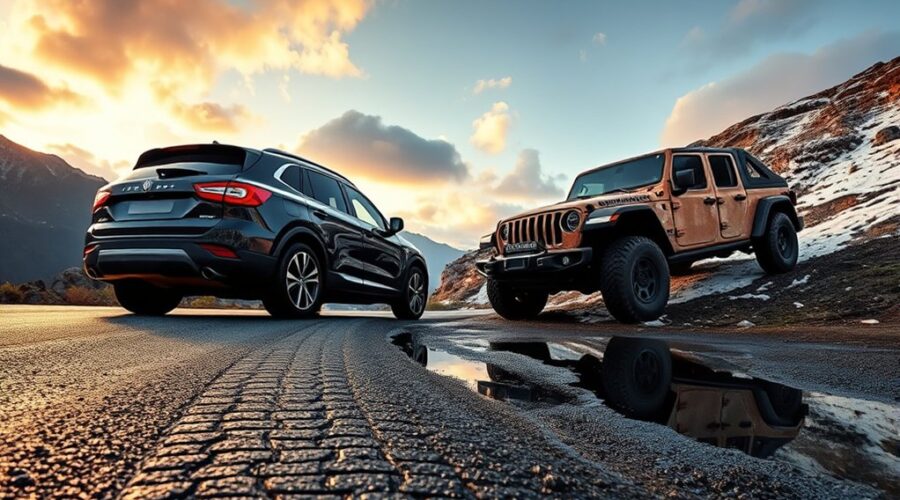
AWD is better for most drivers: it works automatically, suits paved roads, rain and light snow, and costs less fuel than a traditional 4×4. 4×4 (four-wheel drive) is better if you drive deep snow, mud, steep trails or tow heavy loads off pavement, because it has low-range gearing and a more robust drivetrain.

Quick answer: AWD vs 4×4 at a glance
| AWD | 4×4 / 4WD | |
|---|---|---|
| How it works | Automatic, always ready; a computer shifts power between axles | Driver engages it, often with a lever or button |
| Best on | Wet roads, ice, light to moderate snow | Deep snow, mud, rocks, steep trails |
| Low range | Usually not available | Common on truck-based SUVs |
| On dry pavement | Safe to leave on | Part-time systems should be used only on loose surfaces |
| Fuel use | Small penalty over 2WD | Usually larger penalty, extra weight |
| Typical vehicles | Crossovers, wagons, cars | Trucks and off-road SUVs |
How AWD works
AWD systems send power to all four wheels and adjust the split as traction changes. Many are front-biased and send torque to the rear only when the front wheels slip. Others are rear-biased or split power more evenly.
You do not need to do anything. That is why AWD is common on crossovers such as the Subaru Crosstrek.
How 4×4 works
Traditional 4×4 uses a transfer case to link the front and rear driveshafts. Most have a high range for slippery roads and a low range for crawling and pulling, which multiplies torque at low speed.
Part-time 4WD locks the axles together, so it should not be used on dry pavement because the drivetrain can bind in turns. Full-time systems can. See a real example in our 4Runner TRD Off-Road Premium specs, which uses part-time 4WD with a locking rear differential, and the 2025 Ford Bronco specs.
Which should you choose?
- Daily commuting with winter weather: AWD with good winter tires.
- Rural roads, unplowed lanes, trails: 4×4 with low range.
- Frequent towing off pavement or boat ramps: 4×4.
- Fuel economy matters: AWD or even 2WD with winter tires.
Tires matter more than the drivetrain
AWD and 4×4 help you accelerate, not stop or turn. Winter tires make a bigger difference to braking and cornering than the drivetrain does, and are worth using in Canadian winters.
What to check when buying
- Whether the system is full-time, part-time or on-demand.
- Whether low range is available.
- Ground clearance and tire size for your terrain.
- Whether the specific model offers AWD or 4×4 on your trim. Some, like the Chevrolet Trax, are front-drive only. Check before you assume.
FAQ
Is AWD better than 4×4?
For most daily driving, yes. AWD works automatically on pavement and light snow. 4×4 is better for deep snow, mud and off-road use.
Can I use 4×4 on dry pavement?
Part-time 4WD should not be used on dry pavement because it can cause drivetrain binding. Full-time 4WD and AWD systems can be used.
Does AWD use more fuel?
Usually a little more than 2WD because of extra weight and drivetrain friction. Traditional 4×4 typically costs more.
Do I need AWD or 4×4 in Canadian winters?
Not always. Winter tires matter more for braking and cornering. AWD helps with traction on snowy roads, and 4×4 helps on deep snow or unplowed roads.
What is low range in 4×4?
A lower gear set in the transfer case that multiplies torque at slow speed for crawling and pulling.
Can AWD cars go off-road?
Light trails and gravel, yes. For rocks, deep mud or steep climbs, 4×4 with low range and more ground clearance is better.


