
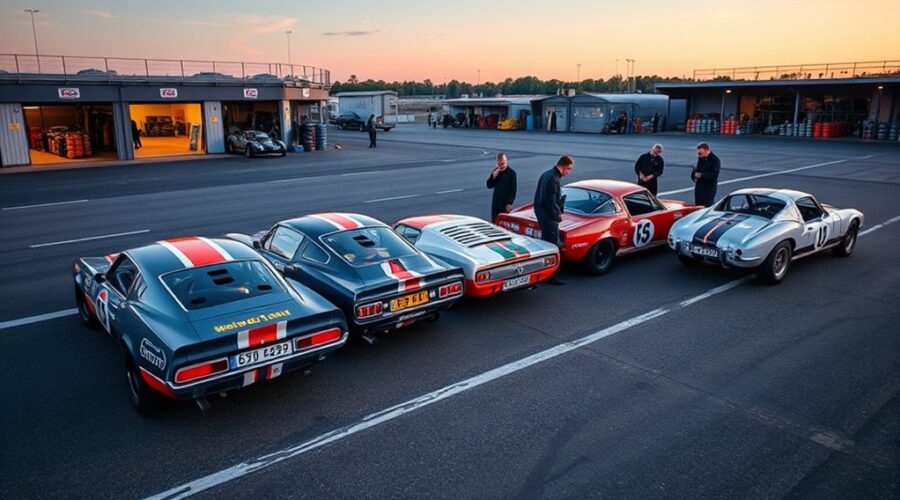
Ford Racing Company has long linked Ford’s road cars with its competition machines. From Henry Ford’s 1901 race win to the Flathead V8 and the GT40’s Le Mans dominance, its record spans major eras. NASCAR victories, Indy efforts, and later EcoBoost engineering show a steady push for speed and durability. The full story reveals how those advances shaped both racing results and Ford’s wider technical reputation.
Ford Racing’s Early Wins
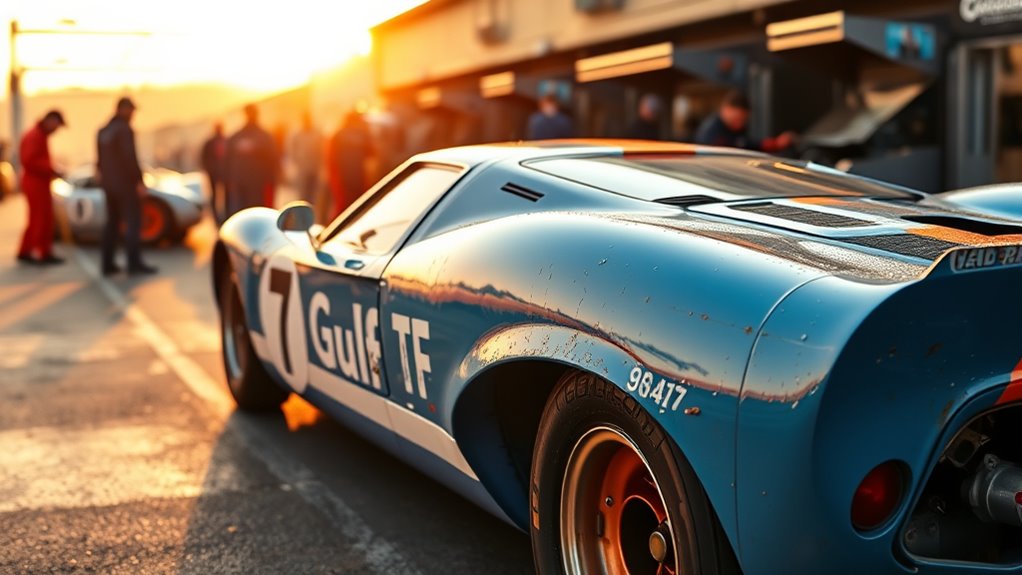
Ford Racing’s early successes began with Henry Ford’s first and only race win on October 10, 1901, when he defeated Alexander Winton at the Detroit Driving Club. This first race gave Ford Racing public proof that speed and engineering could challenge established powers.
In 1903, Barney Oldfield drove the Ford 999 to 60 mph on a dirt track, confirming the company’s technical ambition. The Model T later strengthened that reputation by winning the 1909 transcontinental race from New York to Seattle, showing durability across harsh distances and demanding conditions.
Decades later, Jim Roper’s 1949 NASCAR victory in a Lincoln marked Ford’s entry into stock car competition under a wider performance culture. Tiny Lund then delivered Ford’s first Daytona 500 win in 1963, a result later associated with the era of Henry Ford II.
These early milestones demonstrate a pattern of liberation through mechanical capability, public challenge, and competitive progress.
How Ford Racing Built Its NASCAR Legacy
NASCAR became a central arena for Ford Racing’s competitive identity after Jim Roper’s 1949 Grand National victory in a Lincoln marked the brand’s debut in stock car racing. Ford then leveraged the Flathead V8, introduced in 1932, to power a durable run of wins across the national series.
| Milestone | Significance |
|---|---|
| 1949 debut | Jim Roper opened Ford’s NASCAR account |
| Flathead V8 | Delivered early performance advantage |
| 1963 Daytona | Tiny Lund earned Ford’s first Daytona 500 win |
| 1964 Mustang | Became a sharp, resilient NASCAR contender |
| 2015 total | Ford recorded its 1,000th win |
The Ford Mustang strengthened this racing legacy by combining speed and agility with a platform that matched changing competition. Tiny Lund’s Daytona triumph confirmed Ford’s place among elite teams, while the 1,000th win in 2015 signaled sustained dominance. Together, these achievements show how Ford used engineering, persistence, and disciplined competition to build a lasting NASCAR legacy.
Ford Racing at Le Mans and Indy
On Europe’s most demanding circuits and America’s premier oval, Ford expanded its racing reputation through a series of landmark endurance and open-wheel achievements.
The Ford GT40 delivered the breakthrough at the 1966 24 Hours of Le Mans, producing a 1-2-3 finish that ended Ferrari’s six-year streak and signaled Ford’s arrival in elite endurance racing. That victory was not isolated; the GT40 then secured four straight Le Mans wins from 1966 to 1969, reinforcing Ford’s standing in the Manufacturers Championship.
In Indy car racing, Ford’s 1963 partnership with Colin Chapman produced strong results, including Jim Clark’s win at the Milwaukee 200. Clark later gave Ford’s first Indianapolis 500 victory in 1965, extending Ford’s influence beyond the NASCAR Cup Series and into open-wheel competition.
The Ford Mustang also entered international racing in 1964, finishing first and second in the Tour du France Automobile, broadening Ford’s competitive reach.
What Made Ford Race Cars Fast
Speed came to Ford race cars through a steady combination of engineering breakthroughs and competition-driven refinement. Early success with Barney Oldfield’s Ford 999 in 1903 showed how disciplined tuning could turn high-performance vehicles into serious contenders.
The Flathead V8, introduced in 1932, widened access to power and improved performance for race cars, giving Ford a durable foundation. Later, the Ford GT40 paired advanced aerodynamics with a lightweight chassis, helping secure victory at the 24 Hours of Le Mans and proving that efficiency and stability could free speed from excess mass.
In modern eras, the EcoBoost twin-turbo engine raised output while conserving fuel, a practical advantage in long-distance racing. Collaboration with Chip Ganassi Racing added data-led development and race-day adaptation, strengthening Ford’s competitive edge.
Across decades, the pattern remained consistent: speed emerged from mechanical innovation, careful testing, and the refusal to accept limits in pursuit of faster, more capable race cars.
Ford Racing’s Biggest Milestones
Ford Racing’s biggest milestones trace a clear progression from early breakthrough to sustained championship success.
In 1901, Henry Ford’s victory over Alexander Winton at Grosse Pointe helped establish the credibility that became Ford Motor Company in 1903. That first car era later gave way to engineering advances such as the 1932 Flathead V8, a powerplant that strengthened Ford’s reach across racing and the broader automotive industry.
Henry Ford’s 1901 victory at Grosse Pointe helped launch the credibility behind Ford Motor Company.
In 1950, Ford earned its first NASCAR Grand National win with Shirtless Jimmy Florian, and later drivers including Dale Jarrett kept the program visible in stock car competition.
The 1966 Ford GT40’s 1-2-3 finish at the 24 Hours of Le Mans ended Ferrari’s six-year run and proved Ford could challenge elite rivals overseas.
Decades later, Joey Logano’s 2018 NASCAR Cup title, Ford’s first since 2004, confirmed that its competitive drive remained intact without winning every event, but by building durable momentum.
Frequently Asked Questions
What Is Ford’s History in Racing?
Ford’s racing history spans Vintage Models, Performance Engineering, Shelby Partnership, Ford GT Le Mans Triumph, NASCAR Influence, Mustang Evolution, Rally Success, Electric Racing, and Global Competitions, reflecting a persistent, competitive, technologically adaptive motorsport legacy.
What Are Some Interesting Facts About the Ford Motor Company?
Like a river carving industry, Ford Innovations include the Mustang Legacy, EcoBoost Technology, Electric Vehicles, Performance Models, Racing Partnerships, Global Expansion, Safety Innovations, Production Techniques, and Classic Models—an objective record of adaptable engineering and mass mobility.
What Are the Key Milestones in the History of Ford Motor Company?
Key milestones include the Model T, Assembly Line, V8 Engine, Mustang Launch, EcoBoost Technology, Racing Heritage, Global Expansion, Electric Vehicles, Safety Innovations, and Corporate Partnerships, each shaping Ford’s industrial reach, performance identity, and modern evolution.
What Was Ford’s Biggest Flop?
Ford’s biggest flop was the Edsel launch, a costly symbol among Ford’s failures, alongside Mustang troubles, Pinto controversy, racing disappointments, Bronco issues, Explorer rollovers, Taurus decline, F 150 challenges, and marketing missteps.
Conclusion
Ford Racing’s history reflects a steady blend of ambition, engineering, and competitive success. From Henry Ford’s 1901 breakthrough to the Flathead V8, GT40 dominance at Le Mans, and modern NASCAR titles, the company repeatedly turned technical progress into victories. For example, the GT40’s four-year Le Mans sweep showed how focused design could redefine endurance racing. Overall, Ford’s racing legacy remains a clear case of innovation driving results across generations.