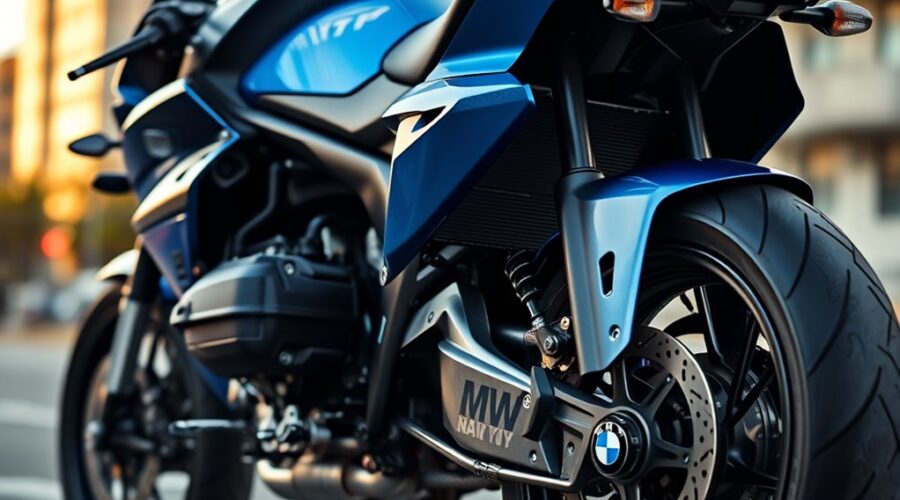
BMW’s street bike range centers on a 999 cc inline-four platform, with the M 1000 R rated at 210 hp and the S 1000 R at 204 hp. Seat heights span roughly 820 mm to 865 mm, reflecting different rider fits. The M 1000 RR adds a 3.1-second 0-100 km/h claim and 314 km/h top speed. The real distinction, however, appears in the chassis and electronic package that separates each model.
BMW Street Bike Models Compared
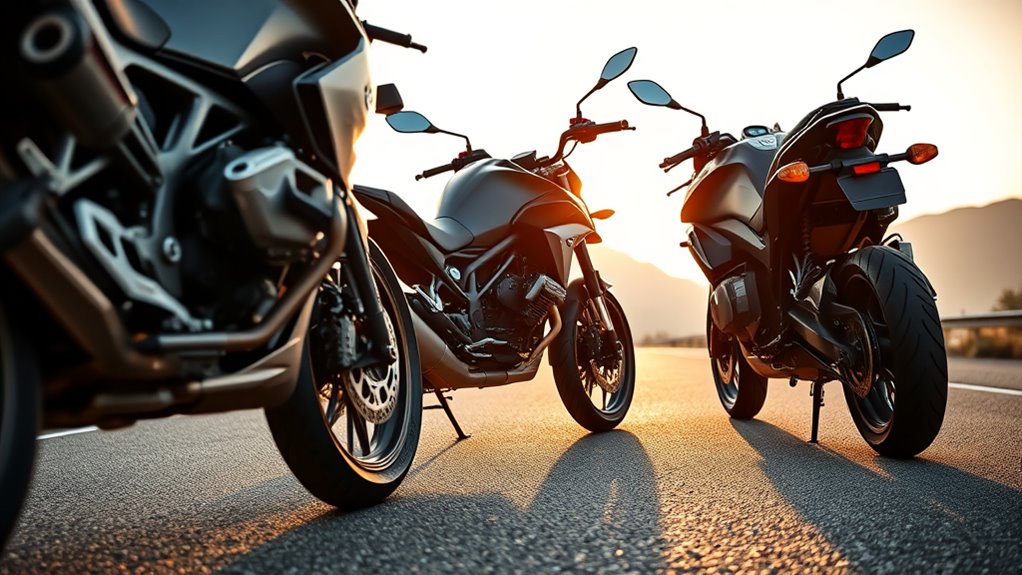
BMW’s street-focused performance lineup spans several distinct configurations, each tuned to a different balance of power, aerodynamics, and usability.
The BMW M 1000 RR and BMW S 1000 RR represent the most track-oriented interpretations, pairing compact dimensions with aggressive bodywork and high aerodynamic efficiency.
The BMW M 1000 RR and BMW S 1000 RR deliver the most track-focused performance, with compact, aerodynamic bodywork.
The BMW M 1000 R and BMW S 1000 R shift the formula toward upright ergonomics, reducing wind protection but increasing everyday control and freedom of movement.
Across the range, performance remains the defining metric, yet each model delivers a distinct riding experience.
The BMW M 1000 RR emphasizes maximum acceleration and top speed, while the BMW S 1000 RR offers similarly focused intent with slightly different output positioning.
The BMW M 1000 R adds naked-bike immediacy, and the BMW S 1000 R favors accessible street dynamism.
In comparison, the powertrain layout supports varied use cases without obscuring the shared technical character.
Powertrain Specs
The street-focused M models share a common 999 cc in-line four-cylinder architecture, but their power outputs are tuned to distinct performance levels.
In BMW Motorrad powertrain specs, the M 1000 R produces 154 kW (210 hp) and 113 Nm of torque. The M 1000 RR raises output to 160 kW (218 hp), and the M 1000 XR delivers 147 kW (201 hp) with the same torque figure. Each engine is paired with a 6-speed gearbox, supporting clean engagement and controlled power delivery.
- M 1000 R: balanced street performance with weight reduction focus.
- M 1000 RR: maximum performance orientation, with the highest horsepower.
- M 1000 XR: versatile output for broader road use.
This in-line four-cylinder layout emphasizes efficiency, compact packaging, and response, while BMW Motorrad calibrates each model for its intended use.
The result is a technical platform that supports liberation through precise, accessible performance.
Performance Numbers
Performance numbers provide a clearer picture of how BMW Motorrad’s street-oriented M models translate powertrain tuning into real-world pace.
The M 1000 RR leads the lineup with 160 kW (218 hp), delivering explosive acceleration and a 0-100 km/h time of 3.1 seconds, alongside a 314 km/h top speed.
The M 1000 RR leads with 218 hp, hitting 100 km/h in 3.1 seconds and topping 314 km/h.
The M 1000 R follows with 154 kW (210 hp) and a 3.2-second sprint, balancing naked-bike agility with high-output performance.
The M 1000 XR posts 147 kW (201 hp), reaches 0-100 km/h in 3.2 seconds, and carries a 275 km/h top speed for long-distance speed.
The S 1000 RR remains a benchmark sport bike, producing 152 kW (204 hp) and matching the M 1000 RR’s 3.1-second launch.
The S 1000 R, at 170 hp and roughly 3.0 seconds to 0-60 mph, shows how a BMW motorcycle can deliver accessible acceleration with liberated street intent.
Dimensions and Seat Height
Dimensionally, BMW’s street-focused M and S models show clear differences in stance and rider ergonomics. Across these BMW models, length, height, and seat height define distinct use cases and degrees of liberation.
The S 1000 RR is the shortest at 2,056 mm, with a 1,145 mm height and 820 mm seat height, favoring a compact supersport profile.
- M 1000 R: 2,085 mm length, 1,176 mm height, 830 mm seat height.
- M 1000 RR: 2,085 mm length, 1,228 mm height, 865 mm seat height.
- M 1000 XR: 2,170 mm length, 1,382 mm height, 850 mm seat height.
The S 1000 XR extends to 2,208 mm, 1,290 mm high, with an 840 mm seat height, while the M 1000 XR remains shorter but taller in stance.
In practical dimensions, the M 1000 RR delivers the highest perch, and the M 1000 R balances accessibility with upright control.
Brakes, Suspension, and Control
Braking, suspension, and electronic control systems distinguish BMW’s street bike lineup as much as power output or dimensions, with each model calibrated for a specific balance of stability, feedback, and rider assistance.
The M 1000 RR uses twin 320 mm front brakes and a 220 mm rear disc, with ABS Pro supporting hard use while preserving the braking system’s precision. Its suspension package combines a bridge-type frame, M Carbon wheels, and adjustable components to sharpen response.
The S 1000 RR relies on a 45 mm inverted telescopic fork for accurate front-end control and reduced mass.
On the M 1000 XR, integral ABS strengthens braking during cornering and deceleration, keeping control consistent on open roads.
The M 1000 R adds Race Pro modes and performance settings that let riders tailor delivery for road or track conditions, extending the sense of freedom through adaptable dynamics rather than excess.
Electronics and Rider Aids
BMW’s electronic rider aids are calibrated to refine control, manage power delivery, and reduce rider workload across varied conditions.
On the M 1000 RR and S 1000 RR, ABS Pro and Dynamic Traction Control (DTC) intervene with high precision, preserving composure under hard braking and aggressive corner exits.
The S 1000 RR offers four riding modes—Rain, Road, Dynamic, and Race—plus three Pro modes for customizable riding modes, while the M 1000 RR adds Race Pro modes for track-focused calibration and freer response.
Hill Start Control (HSC) supports launches on inclines without rollback, reinforcing confidence in urban or mountain use.
- ABS Pro: cornering stability.
- Shift Assistant Pro: clutchless upshifts for uninterrupted acceleration.
- Semi-active suspension: adaptive damping that complements electronic control.
Together, these systems translate technical capability into controlled freedom, allowing the rider to exploit performance with minimal intrusion.
Frequently Asked Questions
What Are the Key Features of BMW Bikes?
BMW bikes feature BMW design innovations, advanced safety features, engine technology advancements, customization options, touring capabilities, off road performance, lightweight construction, rider ergonomics, connectivity features, and maintenance requirements balanced for precision, control, and freedom.
Is BMW Faster Than Kawasaki?
No—like a sprinter chasing a rocket, BMW usually trails Kawasaki in outright speed. BMW acceleration comparison, Kawasaki top speed, engine performance metrics, racing history analysis, rider experience feedback, design innovations comparison, handling characteristics review, weight distribution effects, market pricing trends, brand loyalty factors.
What Are Common BMW Motorcycle Problems?
Common BMW motorcycle problems include engine reliability issues, electrical system failures, transmission problems, fuel system concerns, brake system defects, suspension performance issues, overheating problems, tire wear patterns, maintenance costs, and aftermarket modifications risks.
Which BMW Bike Is the Most Powerful?
The BMW M 1000 RR stands as the most powerful, a thunderous apex in BMW engine performance. Its motorcycle torque ratings, powertrain innovations, and racing heritage analysis outpace rivals in top speed comparisons, rider experience reviews.
Conclusion
Across BMW’s street lineup, the 999 cc inline-four serves as a polished spine, turning fuel into measured force. The M 1000 R stands as the sharpest edge, while the S 1000 R offers that same engineered pulse with greater accessibility. Seat heights, braking systems, and rider aids form the chassis of confidence around this core. Together, the models suggest a balanced machine ecosystem: speed, control, and precision functioning like linked gears in one deliberate mechanism.