
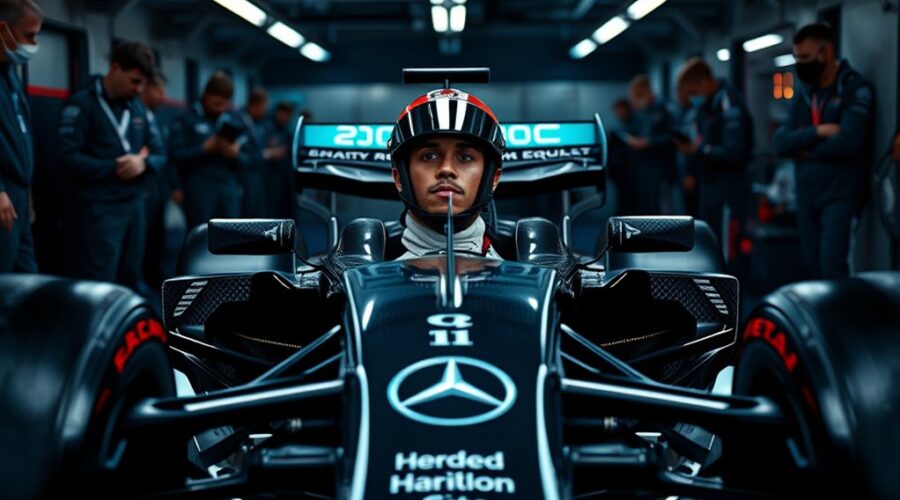
Lewis Hamilton’s journey in Formula One represents a blend of exceptional talent and groundbreaking innovation. From his early life shaped by diverse influences to his historic achievements on the track, Hamilton’s impact extends far beyond racing. His pioneering use of technology and commitment to social causes reflect a transformative figure in motorsport. As the narrative unfolds, the complexities of his rivalries and advocacy efforts reveal a compelling portrait of an athlete redefining success in modern sports.
Key Takeaways
- Lewis Hamilton debuted in Formula One in 2007, winning four races and finishing third in his first season with McLaren.
- He became the youngest World Champion in 2008 and has since won seven championships, tying the record with Michael Schumacher.
- Hamilton’s transition to Mercedes in 2013 led to six additional titles and a record 106 Grand Prix victories as of 2021.
- His advocacy for diversity and social justice includes founding Mission 44 and promoting initiatives like The Hamilton Commission.
- Technological innovations, such as turbo-hybrid engines and advanced telemetry, have significantly enhanced performance and safety in his racing career.
Lewis Hamilton’s Early Life and Influences
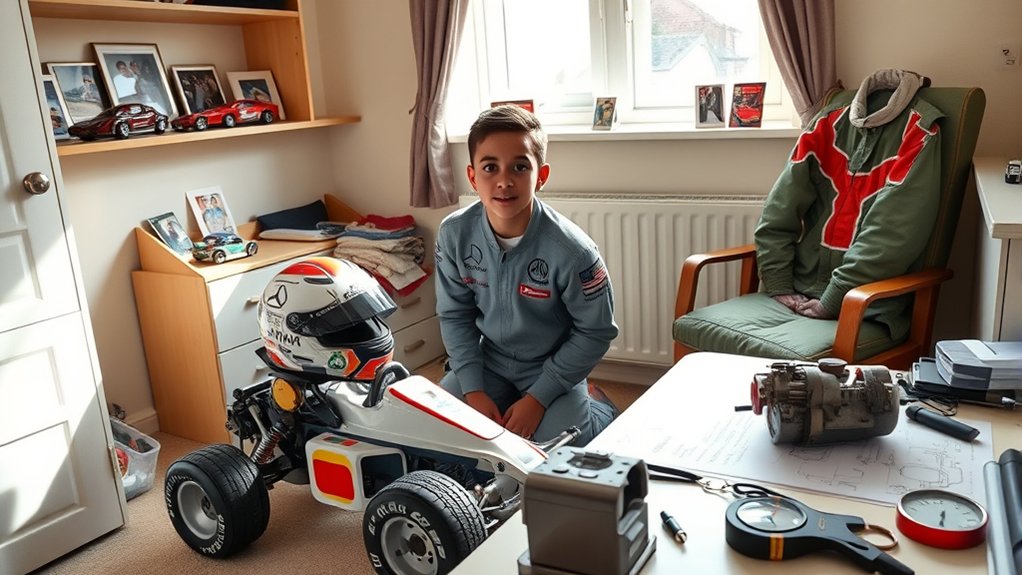
Lewis Hamilton’s formative years played a vital role in shaping the champion he would become. Born Lewis Carl Hamilton in 1985 to parents of mixed-race descent, his early life was marked by challenges, particularly following his parents’ separation when he was just two. Raised primarily by his mother, Carmen, alongside his half-sisters, he experienced a modest upbringing until moving in with his father at twelve. This change ignited his racing career, as he began karting at eight, rapidly showcasing his prowess by clinching the British cadet karting championship by age ten. Hamilton’s ambition became evident when he approached McLaren’s Ron Dennis at the same age, expressing his desire to race for the team. His father’s unwavering support, often juggling multiple jobs, was essential in overcoming financial barriers in a sport typically dominated by wealth, setting the stage for Hamilton’s future success.
Major Milestones in Hamilton’s Formula One Journey
Lewis Hamilton’s Formula One career is marked by a series of significant achievements that have redefined the sport. From his remarkable debut in 2007 to his historic championship wins, Hamilton has consistently set new benchmarks, including being the first driver to reach 100 race victories. His journey is not only a reflection of his driving prowess but also highlights his impact on the sport’s landscape, particularly in promoting diversity and equality.
Key Career Achievements
A remarkable journey through the world of Formula One defines Hamilton’s career, characterized by groundbreaking achievements and a relentless pursuit of excellence. Making his debut in 2007 with McLaren, Hamilton won four races and finished third in the championship, breaking barriers as the first Black driver in the sport. His first Drivers Championship came in 2008, marked by a thrilling last-lap victory in Brazil, making him the youngest champion at that time. Shifting to Mercedes in 2013, Hamilton won six additional titles, including consecutive championships in 2014 and 2015. As of 2021, he holds the record for the most Grand Prix victories with 100 wins, alongside an impressive tally of 104 pole positions and 207 podium finishes in Formula One history.
Historic Championship Wins
Throughout his illustrious career in Formula One, Hamilton’s championship wins have not only redefined the sport but also positioned him among its all-time greats. His journey began in 2008 when he secured his first World Championship, becoming the youngest champion with a dramatic last-lap overtake in Brazil. Hamilton followed this with back-to-back titles in 2014 and 2015, showcasing his dominance with 11 victories in 2014 alone. In 2017, he clinched his fourth championship, achieving a record 363 points and matching Michael Schumacher’s seven titles in 2020. Each historic championship solidified Hamilton’s legacy, illustrating his relentless pursuit of excellence and transforming the expectations of what a Formula One driver can achieve.
Technological Innovations in Hamilton’s Career
Revolutionizing the landscape of Formula 1, the technological innovations during Lewis Hamilton’s career have played a pivotal role in his success on the track. The introduction of turbo-hybrid engines in 2014 marked a significant shift, enhancing power efficiency and performance. Hamilton’s early adoption of a semi-automatic paddleshift gearbox in 2006 allowed for faster, more consistent gear shifts, setting a new standard in the sport.
Additionally, the utilization of carbon fibre monocoque chassis improved both vehicle safety and performance, allowing Hamilton to push limits while minimizing risks. His 2021 achievement of 100 race wins underscored the advantages of advanced aerodynamics and tire technology developed at Mercedes. Furthermore, Hamilton’s mastery of data analytics and vehicle telemetry reflects the increasing reliance on technology in modern F1 racing, enabling him to optimize race strategies and maintain a competitive edge throughout his illustrious career.
Lewis Hamilton’s Historic Achievements in Formula One
Lewis Hamilton’s achievements in Formula One are nothing short of historic, marking him as one of the sport’s all-time greats. With seven World Championships and a record 106 race victories, he has set benchmarks that challenge the limits of competitive excellence. His enduring rivalries and fierce battles on the track further enrich his legacy, illustrating both his skill and the dramatic narratives that have defined his career.
Seven-Time World Champion
Seven World Drivers Championships mark a monumental achievement in the domain of Formula One, a feat accomplished by Lewis Hamilton, who shares this prestigious record with Michael Schumacher. Hamilton became the youngest Formula 1 World Champion at just 23 years and 300 days during his thrilling 2008 season, clinching the title in a dramatic finale at the Brazilian Grand Prix. His career is characterized by relentless success, with an unparalleled 106 race wins, 104 pole positions, and 207 podium finishes. Hamilton’s influence transcends racing; as the first Black driver in Formula One, he has sparked crucial conversations around diversity and inclusion in motorsport. His accomplishments embody both sporting excellence and the power of representation in breaking barriers.
Record-Breaking Wins
While many drivers have left their mark on Formula One, none have done so quite like Hamilton, whose record-breaking achievements have redefined the sport’s landscape. With over 106 wins, he holds the record for the most victories in F1 history, becoming the first driver to surpass 100 race wins and secure 100 pole positions. Hamilton’s dominance is further exemplified by his seven World Drivers Championships, tying him with Michael Schumacher for the most titles. His consistency is remarkable, with over 207 podium finishes, reinforcing his status as one of the sport’s greats. The pinnacle of his prowess was showcased in the 2020 season, where he clinched 11 wins, adding yet another layer to his illustrious legacy.
Historic Rivalries and Battles
What defines a champion in Formula One? For Lewis Hamilton, it is the fierce rivalries that have shaped his career and the championship landscape. His intense battles with Fernando Alonso, Nico Rosberg, and Sebastian Vettel not only defined seasons but also tested his resilience. The 2016 season exemplified this, as Hamilton and Rosberg engaged in a nail-biting contest, culminating in a mere five-point difference in the championship. The rivalry with Vettel brought dramatic moments, particularly at the 2018 German Grand Prix, where Hamilton triumphed from 14th position. In 2021, his contentious clashes with Max Verstappen culminated in a controversial title showdown. These rivalries have not only solidified Hamilton’s legacy but also transformed the very essence of competitive spirit in Formula One.
Rivalries and Their Impact on Hamilton’s Success
Rivalries in Formula 1 often serve as crucibles for talent, and Lewis Hamilton’s career is a demonstration of this phenomenon. Each rivalry has refined his skills and pushed him toward success, often impacting his championship outcomes.
| Rivalry | Impact on Success |
|---|---|
| Alonso (2007) | Showcased talent; finished just 1 point shy of title. |
| Rosberg (2013-2016) | Intense competition; lost championship by 5 points in 2016. |
| Vettel (2017-2018) | Capitalized on mistakes to secure back-to-back titles. |
| Verstappen (2021) | Controversial finale; propelled Hamilton’s intensity. |
| Overall | Rivalries serve as key motivators, enhancing competitive edge. |
Hamilton’s frequent acknowledgment of these rivalries illustrates their role in shaping his journey, making each championship battle not just a quest for glory, but a transformative experience that has defined his legacy in the sport.
Hamilton’s Advocacy and Influence Beyond the Track
Advocacy has emerged as a defining aspect of Lewis Hamilton’s legacy, extending his influence far beyond the racetrack. His commitment to social justice and equality has reshaped the dialogue within motorsport and beyond.
- Founded Mission 44, supporting underrepresented youth in motorsport with £20 million.
- Launched The Hamilton Commission to address systemic barriers faced by Black individuals in the industry.
- Became a vocal advocate for racial justice following George Floyd’s murder, promoting Black Lives Matter in Formula 1.
- Recognized in Time’s 100 most influential people for challenging discrimination and promoting equality.
- Engaged in environmental activism, launching a plant-based burger restaurant and advocating for sustainable practices.
Hamilton’s multifaceted advocacy illustrates his desire to create a more inclusive and equitable world, inspiring future generations while leveraging his platform to effect meaningful change.
Frequently Asked Questions
Which Race Has Hamilton Never Won?
Hamilton has never won the Monaco Grand Prix, a notable gap in his achievements. The circuit’s nuances and challenging Monaco challenge often thwarted his race strategies, preventing him from securing victory despite multiple attempts.
What Are 10 Interesting Facts About Formula 1?
Formula 1 epitomizes racing innovations, featuring advanced aerodynamics and hybrid technology. Team dynamics shape strategies, while intense driver rivalries fuel competition. Together, these elements create a thrilling spectacle that captivates audiences worldwide and pushes engineering boundaries.
What Is Lewis Hamilton’s History?
Lewis Hamilton’s history reflects a remarkable racing heritage, overcoming early challenges to achieve significant career milestones. His journey from karting prodigy to seven-time world champion underscores resilience and determination, inspiring future generations in motorsport and beyond.
How Did Lewis Hamilton Get Started in F1?
From remote-control cars to the racetrack, Hamilton’s karting career ignited early influences, propelling him through junior championships. His remarkable talent culminated in a Formula 1 debut with McLaren, reshaping the sport’s landscape forever.
Conclusion
To sum up, Lewis Hamilton’s journey in Formula One embodies the fusion of talent, technology, and tenacity. His groundbreaking use of turbo-hybrid engines and commitment to diversity have not only reshaped racing but also sparked conversation akin to a 21st-century renaissance. Beyond the track, Hamilton’s advocacy for environmental sustainability positions him as a transformative figure, echoing the visionary spirit of historical icons who dared to challenge the status quo. His legacy will certainly inspire future generations of racers and activists alike.