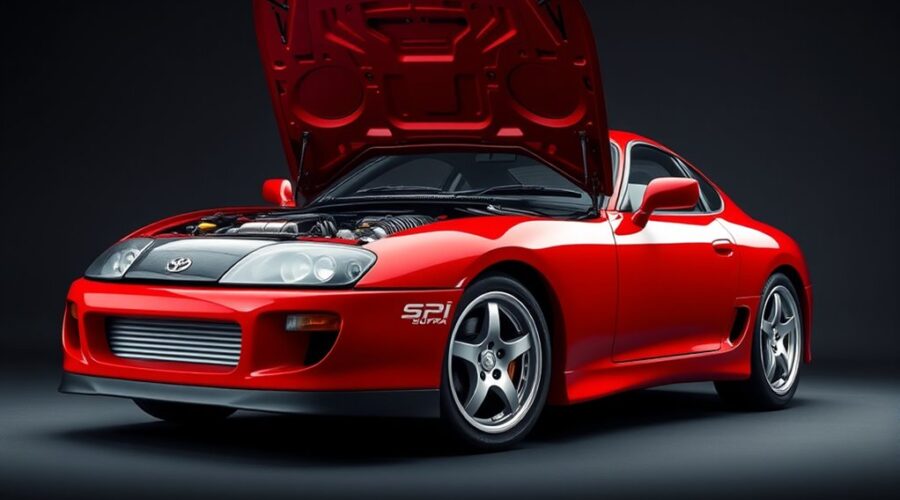
The Toyota Mk4 Supra, built from 1993 to 2002, paired a 3.0L inline-six with rear-wheel drive and a chassis tuned for balance rather than drama. Its 2JZ-GE and twin-turbo 2JZ-GTE engines defined the car’s reputation, while performance figures, dimensions, and factory hardware helped shape its status. What made one version easier to modify, and why do certain details still drive its value today?
Mk4 Supra Overview
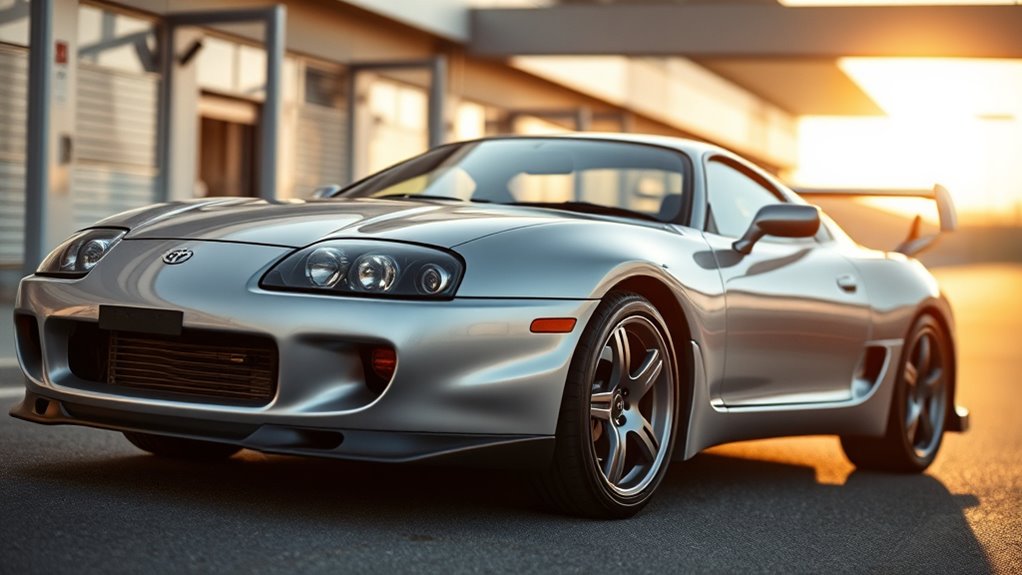
The Toyota Mk4 Supra, produced from 1993 to 2002, is a well-known sports car built around a 3.0L inline-six engine offered in naturally aspirated and twin-turbo forms.
As a Mk4 Supra, it established a reputation as a performance car with a balance of speed, durability, and daily usability. The twin-turbo version reached up to 321 hp and 315 lb-ft of torque, helping it deliver 0-60 mph in about 4.5 seconds and a quarter-mile pass near 13.3 seconds.
Balancing speed, durability, and daily usability, the twin-turbo Supra delivered 321 hp and 4.5-second 0-60 runs.
Its cast-iron block and aluminum head supported strong factory engineering and extensive modification potential. The car’s aerodynamic body, 1430 to 1510 kg curb weight, and compact dimensions of 4,480 mm long, 1,810 mm wide, and 2,550 mm wheelbase contributed to stable handling.
It remains recognized for mechanical freedom, allowing owners to pursue high-output builds with confidence and precision.
2JZ-GE vs. 2JZ-GTE Engines
Though both versions share the same 3.0L straight-six architecture, the 2JZ-GE and 2JZ-GTE serve very different roles in the Mk4 Supra lineup. The 2JZ-GE is naturally aspirated, using a 10.0:1 compression ratio to deliver about 220 hp and 210 lb-ft, while the 2JZ-GTE lowers compression to 8.5:1 and adds sequential turbochargers for 276 hp in Japan and up to 321 hp export, plus 315 lb-ft.
Both use a cast-iron block, aluminum head, and dual overhead cams, but their character differs sharply.
- 2JZ-GE: calm, capable, and accessible.
- 2JZ-GTE: urgent, forceful, and commanding.
- Both engines: durability that supports long-term freedom.
- 2JZ-GTE: stock internals often tolerate up to 600 hp.
The 2JZ-GE pairs with a W58 5-speed manual or 4-speed automatic, while the 2JZ-GTE uses a 6-speed Getrag manual or 4-speed automatic with manual shift mode.
Mk4 Supra Transmission Options
The Mk4 Supra was offered with two transmission choices: a 4-speed automatic and a 6-speed manual developed with Getrag.
The automatic includes a manual shift mode and is known for smooth gear changes, while the manual is preferred for its precision and direct driver engagement.
Both setups were engineered to manage the output of the 2JZ-GTE engine reliably under demanding conditions.
6-Speed Manual
Available in the Mk4 Supra lineup was a 6-speed manual transmission developed in partnership with Getrag, giving the car a direct and highly engaging driving character.
Paired with the 3.0L twin-turbo 2JZ-GTE engine, the 6-speed manual let drivers exploit power with exact control and a sense of freedom.
Its close-ratio gearing sharpened acceleration and kept response immediate during spirited driving.
The shift action remained smooth and precise, reinforcing the Supra’s sporty feel.
For tuning, this gearbox was often favored because it supported higher-output builds with greater driver authority.
- Clean engagement
- Precise power delivery
- Faster response
- Confident control
4-Speed Automatic
Balancing the Supra’s high-performance character with easier everyday use, the Mk4 also offered a 4-speed automatic transmission. It paired with the twin-turbo 2JZ-GTE and was built to manage substantial torque with smooth, durable shifts. A manual shift mode gave drivers more direct control when the road invited harder use, while a lock-up torque converter improved efficiency at steady cruise.
| Trait | Effect | Value |
|---|---|---|
| 4-speed automatic | Ease in traffic | Daily comfort |
| Manual shift mode | Added control | More freedom |
| 2JZ-GTE compatibility | High-load durability | Strong reliability |
| 315 lb-ft rating | Quick response | Export performance |
| Lock-up converter | Better cruising economy | Balanced use |
Compared with the 6-speed manual, the 4-speed automatic favored relaxed commutes without surrendering the Supra’s essential urgency.
Mk4 Supra Performance Numbers
With the twin-turbo 2JZ-GTE, the Mk4 Supra delivers strong factory performance numbers that vary by market, producing 276 hp in Japanese specification and 321 hp in export form, both rated at 315 lb-ft of torque.
In Mk4 Toyota form, the twin turbo layout gives it a liberated feel on open roads and disciplined control in repeated testing. Acceleration is brisk and measurable:
- 0-60 mph: 4.5 seconds
- 0-100 kph: 5.7 seconds JDM, 5.3 seconds export
- Quarter-mile: 13.8 seconds at 162 kph JDM, 13.3 seconds at 173 kph export
- Top speed: about 180 mph, or 155 mph when electronically limited
With a curb weight near 1,490-1,510 kg, it also posts roughly 0.95 g on the skidpad.
These figures show a car engineered for speed, stability, and restraint.
Turbo Setup and Tuning Potential
The Mk4 Supra’s 2JZ-GTE uses a sequential twin-turbo layout, with the export-spec CT12B setup designed to improve spool and throttle response.
This configuration supports strong factory output while leaving substantial headroom for performance upgrades.
With suitable turbo, intercooler, and ECU changes, the engine can exceed 600 hp reliably and, in heavily built form, approach 1,500 hp.
Sequential Turbo Layout
Toyota’s Mk4 Supra uses a sequential twin-turbo layout in which a smaller turbo spools first to build low-end torque before a larger unit takes over at higher RPM, broadening the usable powerband and improving response.
This sequential turbo layout on the 2JZ-GTE gives the car a composed surge rather than abrupt delivery. The Japanese MKIV uses a CT20A ceramic turbocharger, while export cars receive a CT12B steel unit, creating distinct character.
- Cleaner throttle response
- Stronger midrange pull
- Broader RPM coverage
- Greater tuning flexibility
The system supports accessible acceleration, helping the export model reach 60 mph in about 4.5 seconds.
With larger turbos, ECU calibration, and improved intercooling, the architecture remains highly adaptable for drivers seeking mechanical freedom.
Power Gains And Limits
Built around the 2JZ-GTE’s durable twin-turbo architecture, the Mk4 Supra offers substantial performance headroom without sacrificing everyday drivability. The sequential setup, with two differently sized turbos, broadens the power band and sharpens response. With sensible modifications, reliable power gains to around 600 horsepower are common, while stock internals have supported far greater output in extreme builds.
| Modification | Effect | Result |
|---|---|---|
| ECU remap | Refines fueling and boost | Stronger midrange |
| Fuel system upgrade | Supports higher demand | Safer delivery |
| Larger turbos | Increases airflow | Higher peak output |
Extensive aftermarket support, including intercoolers, exhausts, and standalone management, allows owners to pursue freedom through carefully controlled power gains, while preserving the engine’s resilience.
Mk4 Supra Dimensions and Weight
Measuring 4,490 mm (176.8 inches) in length, 1,810 mm (71.3 inches) in width, and 1,270 mm (50.0 inches) in height, the Mk4 Supra has proportions that support both stability and aerodynamic efficiency.
Measuring 4,490 mm in length, 1,810 mm in width, and 1,270 mm in height, the Mk4 Supra blends stability with aerodynamic efficiency.
Its dimensions and weight place it in a balanced performance class, with a 2,550 mm wheelbase that helps the chassis remain composed under load. Curb weight ranges from 1,430 kg to 1,510 kg, depending on variant, giving owners a clear sense of how equipment changes alter mass.
The 70-liter fuel tank supports longer journeys with fewer interruptions, reinforcing a feeling of distance without constraint. The low drag coefficient further enhances efficient motion through the air.
- Compact height
- Broad stance
- Moderate curb weight
- Long-range fuel capacity
Brakes, Wheels, and Handling
The Mk4 Supra’s braking system used 296 mm front and 307 mm rear rotors before 1995, with larger 323 mm front and 324 mm rear rotors on later models for stronger stopping performance.
It rode on 17-inch staggered wheels, paired with 235/45 front and 255/40 rear tires, a fitment that supported traction and handling balance.
With its double-wishbone front suspension, multi-link rear setup, and near 0.95 g skidpad capability, the chassis delivered significantly secure grip and cornering stability.
Brake Rotor Sizes
Brake hardware on the Mk IV Supra changed by market and model year, with Japanese-spec cars using 296 mm front rotors and 307 mm rear rotors before 1995, then moving to 323 mm fronts and 324 mm rears afterward; export models likewise use 323 mm front rotors and 324 mm rear rotors.
These brake rotors gave the car a performance-oriented feel, supporting controlled deceleration and confident road use.
- Smaller early discs served base Japanese cars.
- Larger later discs improved heat capacity.
- Export specifications matched the upgraded setup.
- The package supported stable, liberated driving.
With traction control aiding stability, the system complemented the Supra’s balanced chassis without changing the platform’s fundamental character.
Wheel Fitment Changes
Wheel fitment on the Mk4 Supra evolved alongside its braking upgrades and chassis tuning, with pre-1995 Japanese models using 296 mm front and 307 mm rear brakes paired with 16×8-inch wheels, while post-1995 cars adopted 323 mm front and 324 mm rear brakes with 17×8-inch wheels for greater stopping power and performance.
| Model | Wheel sizes | Brakes |
|---|---|---|
| Pre-95 | 16×8 in | 296/307 mm |
| Post-95 | 17×8 in | 323/324 mm |
The revised wheel sizes supported broader tire options and more confident response. A staggered wheel setup, with 17×9.5-inch rear wheels, helped the chassis put power down cleanly while preserving balance. Four-wheel independent suspension, a MacPherson strut front, semi-trailing arm rear, and low center of gravity further sharpened handling, giving the Supra a freer, more controlled character on the road.
Skidpad And Grip
With 17-inch wheels, 235/45 front tires, and 255/40 rear tires, the Mk4 Supra pairs a balanced contact patch with four-wheel independent suspension to deliver strong cornering grip and predictable high-speed composure.
On a skidpad, it records about 0.95 g, a figure that reflects substantial lateral capability and stable balance. Brakes measure 323 mm at the front and 324 mm at the rear, supporting confident deceleration during aggressive driving.
- Measured grip
- Calm body control
- Stable braking
- Released momentum
Traction control, standard in Japanese cars and optional elsewhere, adds another layer of control without dulling the chassis.
Together, these elements let the driver pursue speed with a sense of freedom, while the machine remains composed, communicative, and ready for committed cornering.
Interior and Driver Features
Inside the Toyota Mk4 Supra, the cabin is built around a wrap-around dashboard that keeps the driver’s instruments and controls within easy view and reach. This interior favors driver focus, with clear gauges, logical switch placement, and a layout that supports quick, confident movement.
Seating was offered in cloth or a leather/vinyl mix, while full leather trim appeared only in UK models. Front occupants receive generous space, giving the cabin a relaxed feel without weakening its performance-oriented character.
Rear seats exist, yet limited legroom makes them most suitable for children rather than adults. Practicality is not absent: the trunk is small, but accessible enough for daily use.
As many original cabins age, well-preserved examples have become harder to find, increasing demand for aftermarket parts that help owners restore the classic appearance and preserve the Supra’s distinctive interior identity.
Production Years and Model Updates
Produced from 1993 to 2002, the Toyota Mk4 Supra marked the fourth generation of the Supra lineup and received a series of updates throughout its run.
The MkIV SUPRA arrived as a shorter, lower, and wider machine, giving it a more aerodynamic profile and a lighter chassis than its predecessor. Offered in both naturally aspirated 2JZ-GE and twin-turbo 2JZ-GTE forms, it delivered power levels that varied by market from 220 hp to 321 hp.
A notable 1997 update introduced variable timing, improving efficiency and refining performance without diluting the car’s character.
- 1993: launch of the fourth-generation model
- 1997: variable timing added
- Engine choices: naturally aspirated or twin-turbo
- 2002: final production year, sealing its legacy
That final year completed a nine-year production span, strengthening the Supra’s reputation as a liberated icon of engineering intent.
What Affects Mk4 Supra Value?
The Mk4 Supra’s value is shaped by a combination of rarity, specification, condition, and cultural reputation. The Mk4 Supra, once priced near $40,000, now sees resale value climb beyond $100,000 for preserved examples. Collectors prize factory originality, because unmodified cars offer a clearer link to the model’s heritage and performance freedom.
| Factor | Impact |
|---|---|
| Turbo engine | Higher value |
| Manual gearbox | Strong premium |
| Hardtop body | Greater rarity |
| Original condition | Collector demand |
| Media exposure | Cultural pull |
Turbo models, especially those with the 2JZ-GTE twin-turbo engine, command stronger prices than naturally aspirated versions. Manual transmissions generally outperform automatics in the market, while hardtop cars often bring more than targa examples. Modified builds can also attract interest, particularly when power climbs past 1,500 hp, though originality usually protects long-term value better. Appearances in the Fast and Furious franchise further elevate demand, reinforcing the Mk4 Supra as a sought-after symbol of automotive liberation and lasting desirability.
Frequently Asked Questions
What Are the Key Features of the Toyota Supra MK4?
Its key features include engine options from the 2JZ-GE and twin-turbo 2JZ-GTE, strong tuning potential, rear-wheel drive, a six-speed Getrag manual, aerodynamic styling, wrap-around dashboard, and notable performance credentials.
Which MK4 Supra Is Considered the Best?
Like a runner breaking the tape in 4.5 seconds, the twin-turbo 2JZ-GTE is generally the best mk4; mk4 comparisons favor its 321 hp, six-speed Getrag manual, VVT-i upgrades, and tuning potential.
Is the Toyota Supra MK4 Fast?
Yes, the Mk4 Supra is fast, with strong acceleration, a 180 mph top speed, and a legendary 2JZ engine. Its racing history and engine tuning potential helped it earn enduring performance credibility.
Is a Supra Faster Than a Hellcat?
Like a duel between thunderclouds, the Hellcat is generally faster. In this Hellcat comparison, Supra performance is strong, but the Dodge’s 0-60, quarter-mile, and top-speed figures usually surpass the Mk4 Supra’s capabilities.
Conclusion
The Mk4 Supra stands out for its balanced chassis, its durable 2JZ engine family, and its celebrated tuning potential. It offers strong performance, a capable six-speed manual or four-speed automatic, and impressive handling for a car of its era. It remains sought after not only for its speed, but for its engineering, its reliability, and its lasting cultural impact. It is valued for what it is, for what it can do, and for what it represents.