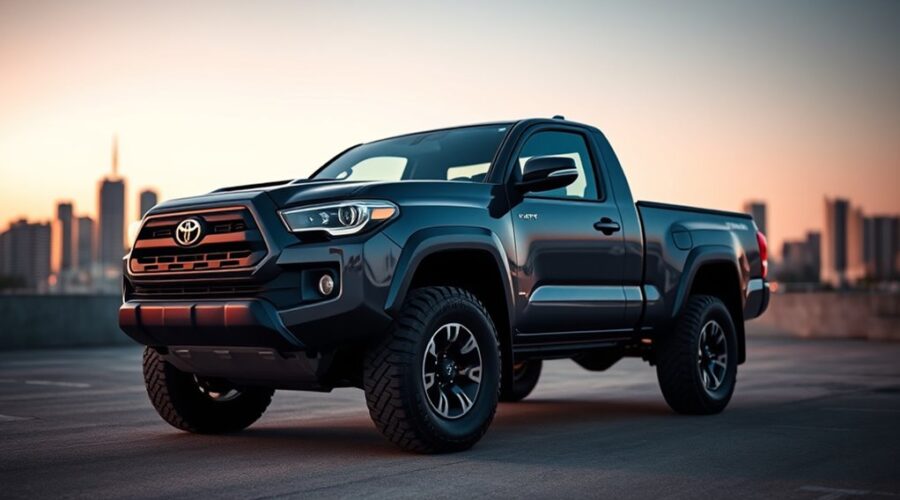
The Toyota Tacoma is the smallest truck in Toyota’s lineup, but it still offers a range of cab styles, bed lengths, and trim choices. Its turbocharged 2.4-liter four-cylinder engine produces up to 278 horsepower, with a hybrid version rated at 326 horsepower. Lengths span 212.3 to 225.5 inches, towing reaches 6,500 pounds, and efficiency can climb to 35 MPG. The details become more interesting when the equipment and configurations are compared.
Toyota Tacoma Specs at a Glance
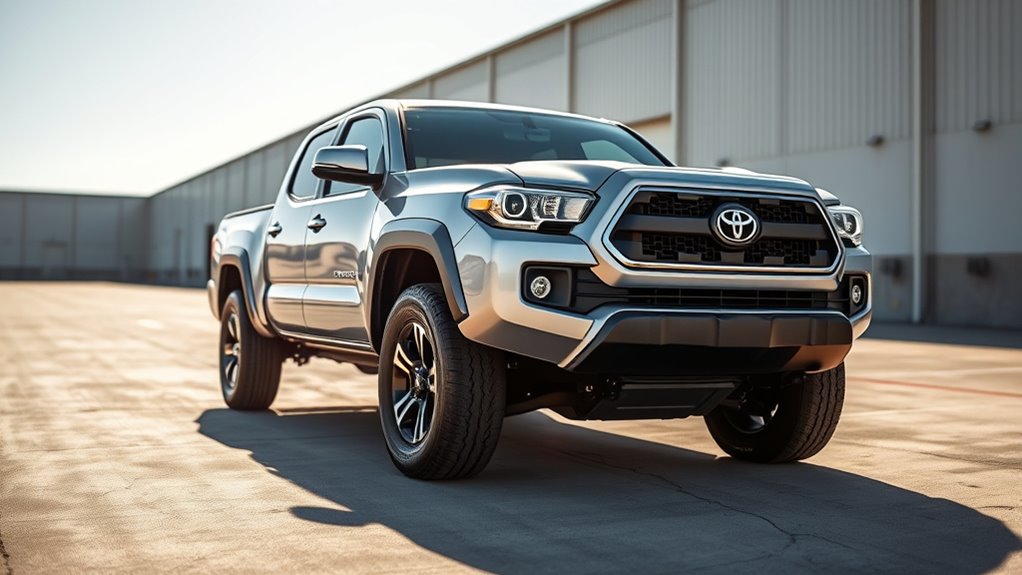
The 2026 Toyota Tacoma is offered in two primary configurations: Access Cab with a 6-foot bed, and Double Cab with either a 5-foot or 6-foot bed, giving it flexibility for cargo and passenger needs.
Across the lineup, the Toyota Tacoma combines practical packaging with a 212.3- to 225.5-inch overall length, a 74.4-inch width, and about 70.6 inches of height. Ground clearance measures roughly 9.4 inches, or 9.6 inches on TRD Pro models, supporting freedom on rough terrain.
The turbocharged four-cylinder engine is paired with capabilities suited to work and daily travel, including a maximum towing capacity of 6,500 pounds and a 1,705-pound payload rating. These figures position the truck as a technically capable platform for hauling, commuting, and off-road use.
The result is a compact pickup with measured proportions, strong utility, and enough clearance to move beyond paved routes without sacrificing highway composure.
What Powers the Toyota Tacoma?
Powering the Toyota Tacoma is a turbocharged 2.4-liter four-cylinder engine, offered in two output levels rated at 228 or 278 horsepower.
Powered by a turbocharged 2.4-liter four-cylinder, the Tacoma offers 228 or 278 horsepower.
In both forms, the turbocharged 2.4-liter four-cylinder delivers 317 lb-ft of torque at 1,700 rpm, giving the Toyota Tacoma immediate low-end response and controlled acceleration across varied terrain.
The drivetrain is paired with either an eight-speed automatic or a six-speed manual transmission, allowing drivers to select a configuration that matches intended use and mechanical preference.
A hybrid variant raises output to 326 horsepower, adding electrical assistance for greater efficiency and stronger performance in demanding conditions.
This powertrain lineup reflects a balanced engineering approach: compact displacement, significant torque, and multiple transmission choices.
The result is a mid-size truck engineered to move with authority while maintaining flexibility for off-road travel and daily operation.
Toyota Tacoma Towing and Payload
Towing capability in the Toyota Tacoma is built around a turbocharged 2.4-liter four-cylinder engine rated at 278 horsepower and 317 lb-ft of torque, giving the truck the low-end output needed for demanding work.
Conventional models deliver a towing capacity of 6,500 pounds, while hybrid variants are rated at 6,000 pounds, allowing users to move trailers with practical confidence. The payload capacity also reaches 1,705 pounds, supporting cargo transport without excessive compromise.
- Trailer Backup Guide assists reverse maneuvers with directional precision.
- Straight Path Assist helps maintain a controlled trailer line.
- A 131.9-inch wheelbase contributes to steady towing behavior.
These advanced towing technologies improve control, reducing driver strain and expanding operational freedom.
The Tacoma’s configuration positions it as a capable tool for hauling tasks that require measured strength, mechanical efficiency, and dependable handling under load.
Toyota Tacoma Dimensions and Bed Sizes
The Toyota Tacoma’s exterior dimensions vary by cab configuration, with overall length ranging from 212.3 inches in the Access Cab with a 5-foot bed to 225.5 inches in the Double Cab with a 6-foot bed.
Bed length options include a 60.5-inch standard bed and a 73.7-inch long bed, allowing different cargo and packaging requirements.
Its 131.9-inch wheelbase and cab styles affect fit, stability, and the balance between passenger space and load capacity.
Tacoma Length and Width
Toyota Tacoma dimensions vary by cab and bed configuration, with the Access Cab measuring 212.3 inches in overall length and the Double Cab extending to 225.5 inches.
These Tacoma length figures shape the truck’s overall dimensions while Tacoma width remains a fixed 74.4 inches across all trims, supporting confident lane placement and trail control. Its 70.6-inch height and 131.9-inch wheelbase further reinforce a balanced, usable stance.
- Access Cab: 212.3-inch length
- Double Cab: 225.5-inch length
- Width: 74.4 inches
This uniform Tacoma width helps preserve stability without constraining cabin or cargo utility.
For drivers seeking practical mobility and freedom across varied terrain, the dimensions present a technically efficient package.
Bed Length Options
Available Tacoma bed length options expand the truck’s utility without materially altering its compact, maneuverable profile.
Two configurations are offered: a standard 5-foot bed measuring 60.5 inches and a long 6-foot bed measuring 73.7 inches. Overall length changes accordingly, with the standard-bed Tacoma at 212.3 inches and the long-bed version at 225.5 inches.
Both layouts preserve a compact footprint suited to urban streets while giving operators freedom to choose between tighter packaging and greater cargo volume. Bed height is approximately 19.1 inches, supporting efficient loading and unloading.
Maximum payload capacity reaches 1,705 pounds, though actual hauling ability depends on the selected bed configuration and equipment.
These bed length options provide practical versatility without compromising the truck’s fundamental agility.
Cab Styles and Fit
Cab selection in the Toyota Tacoma is closely tied to bed configuration and overall packaging, with the Access Cab typically paired with a 6-foot bed and the Double Cab offered with either a 5-foot or 6-foot bed.
These cab styles shape dimensions, turning behavior, and cargo versatility for users seeking autonomy in utility.
- Access Cab: 212.3-inch overall length, optimized for easier maneuvering.
- Double Cab with 6-foot bed: 225.5 inches overall, maximizing storage space.
- Payload capacity: up to 1,705 pounds, supporting substantial hauling demands.
Bed dimensions measure 19.1 inches in height and 41.5 inches in width, while the 131.9-inch wheelbase contributes stability and ride control under load.
Which Tacoma Cab and Trim Fits Best?
The Tacoma’s cab choice depends primarily on how much passenger room and cargo flexibility are required, since the Access Cab pairs with a 6-foot bed and a shorter 212.3-inch overall length, while the Double Cab stretches to 225.5 inches and offers either a 5-foot or 6-foot bed.
For drivers prioritizing maneuverability, the Access Cab’s smaller footprint suits urban streets, tighter parking, and simpler daily use. The Double Cab better serves crews, families, or anyone needing expanded rear seating and greater long-distance comfort.
Both configurations benefit from improved interior materials and available heated and cooled front seats, so trim selection can focus on layout rather than comfort deficits.
Importantly, Tacoma payload capacity remains identical at 1,705 pounds across both cab styles, preserving hauling capability regardless of the body choice. That consistency allows a practical, freedom-oriented decision: choose the cab that best matches space needs, driving environment, and cargo demands.
Toyota Tacoma Fuel Economy and Hybrid Power
The 2026 Toyota Tacoma hybrid powertrain is rated at up to 326 horsepower and an estimated 35 MPG combined, pairing higher output with improved fuel efficiency.
The base turbocharged 2.4-liter four-cylinder produces 278 horsepower and supports a maximum towing capacity of 6,500 pounds while maintaining competitive mileage for the segment.
Fuel-saving technologies in both configurations are intended to optimize city and highway efficiency without reducing payload or light-duty hauling capability.
Tacoma Hybrid Efficiency
Delivering a notable balance of output and efficiency, the Tacoma hybrid uses the i-FORCE MAX powertrain to produce up to 326 horsepower and 465 lb-ft of torque while targeting an estimated 35 MPG combined.
The Tacoma hybrid advances fuel economy without surrendering utility, pairing a turbocharged 2.4-liter four-cylinder with electric assist for immediate response and reduced consumption. Its technical package supports a 6,000-pound towing rating, preserving practical freedom for work or travel.
- Regenerative braking recovers energy during deceleration.
- Electric torque improves launch performance.
- Combined operation extends driving range.
This powertrain architecture places efficiency and capability in a balanced envelope, giving the Tacoma hybrid a measured advantage over conventional gasoline alternatives.
Turbo Engine MPG
Building on that balance of efficiency and capability, the Tacoma’s turbocharged 2.4-liter four-cylinder broadens the truck’s performance range while keeping fuel use in check.
The turbocharged engine is offered in 228- or 278-horsepower states and delivers 317 lb-ft of torque at just 1,700 rpm, supporting assertive launch response and useful passing power.
In standard gasoline form, fuel economy is rated at up to 23 mpg highway, a practical figure for commuting and longer travel. Maximum towing capacity reaches 6,500 pounds, preserving work-grade utility.
Acceleration is competitive, with 0-60 mph runs near 7.0 seconds.
For drivers seeking greater efficiency and stronger output, the i-FORCE MAX hybrid raises total output to 326 horsepower and returns about 35 mpg combined, extending capability without surrendering efficiency.
Fuel-Saving Tech Features
Toyota’s fuel-saving technology package helps the Tacoma balance work-ready capability with improved efficiency, led by the available i-FORCE MAX hybrid powertrain, which produces up to 326 horsepower and 465 lb-ft of torque. This setup uses advanced technology to support fuel efficiency without limiting utility.
- Standard Tacoma models can reach up to 26 MPG, keeping operating costs controlled.
- Hybrid powertrains are expected to deliver about 35 MPG combined, strengthening liberation from frequent fueling stops.
- An electronic locking rear differential improves traction on uneven terrain while helping reduce wasted energy.
Together, these systems allow vigorous power delivery, measured consumption, and confident daily use. The result is a mid-size truck engineered for independence, efficiency, and capability across urban routes, highways, and remote trails alike.
Tacoma Interior and Tech Features
The 2026 Toyota Tacoma introduces a redesigned interior with upgraded materials and high-resolution displays that modernize the cabin and improve usability. Its interior features combine a standard 7.0-inch digital gauge cluster with available 12.3-inch instrumentation, giving drivers clearer access to operating data and route information. The tech features are arranged for direct control, while the seating position is optimized for headroom and long-distance comfort in a spacious cabin. Optional heated and cooled front seats expand climate comfort across seasons, supporting reduced fatigue during extended travel.
| Feature | Standard | Optional |
|---|---|---|
| Gauge cluster | 7.0-inch digital | 12.3-inch display |
| Front seats | Manual climate control | Heated and cooled |
| Cargo bed | 5-foot or 6-foot | XtraCab 6-foot |
Cargo flexibility further supports practical use, with six-foot bed availability for XtraCab and five- or six-foot configurations for Double Cab models. These interior and interface upgrades emphasize function, visibility, and occupant comfort.
What Makes the Toyota Tacoma Different
Distinctive capability defines the Toyota Tacoma through a turbocharged 2.4-liter four-cylinder engine rated at up to 278 horsepower and 317 lb-ft of torque, paired with utility-focused strength that includes 6,500 pounds of towing capacity and a 1,705-pound payload rating.
That combination separates the Toyota Tacoma from many midsize rivals by linking work-ready output with practical versatility. Its 9.4 inches of ground clearance supports stronger off-road capability, while the available TRD Off-Road package sharpens traction management for demanding terrain.
Cab choices also matter, with Access Cab and Double Cab configurations allowing a measured balance between passenger room and cargo flexibility.
- Powertrain: turbocharged efficiency with torque-rich response
- Utility: competitive towing capacity and payload figures
- Freedom: elevated clearance and advanced driver-assistance systems
Together, these attributes create a truck engineered for independence, adaptability, and controlled performance across urban routes, job sites, and remote trails.
Frequently Asked Questions
What Is Toyota’s Smallest Pickup Truck?
Toyota’s smallest pickup truck is the forthcoming Stout, expected to revive Toyota Truck History with Compact Truck Features and Toyota Truck Comparisons favoring urban use, efficiency, and light-duty practicality for drivers seeking liberation from oversized trucks.
What Toyota Trucks to Stay Away From?
Like rusty hinges on a gated road, the Toyota T100, early Hilux, and aging Sequoia are often avoided. Reliability issues, weak engine performance, and poor safety ratings make them less suitable for drivers seeking liberation.
What Toyota Truck Has the Best Engine?
The Tacoma hybrid appears to have the best engine, delivering 326 horsepower with strong engine performance, solid reliability ratings, and improved fuel efficiency. The Tundra’s twin-turbo V6 offers more torque, but less balanced efficiency.
Which Small Toyota Is Best?
Which small Toyota is best? The compact Stout appears strongest overall, balancing Compact Performance, Off Road Capability, and Fuel Efficiency; its hybrid, unibody layout, and light-duty utility suit drivers seeking practical liberation from bulky trucks.
Conclusion
In the compact kingdom of midsize pickups, the Toyota Tacoma stands as a capable guide, balancing strength, efficiency, and versatility like a well-engineered compass. Its turbocharged 2.4-liter engine and available hybrid system provide two distinct roads to performance, while dimensions, cab choices, and towing capacity shape its practical mission. With upgraded interior technology and refined materials, it functions less like a simple truck and more like a dependable tool built for varied terrain and daily demands.