
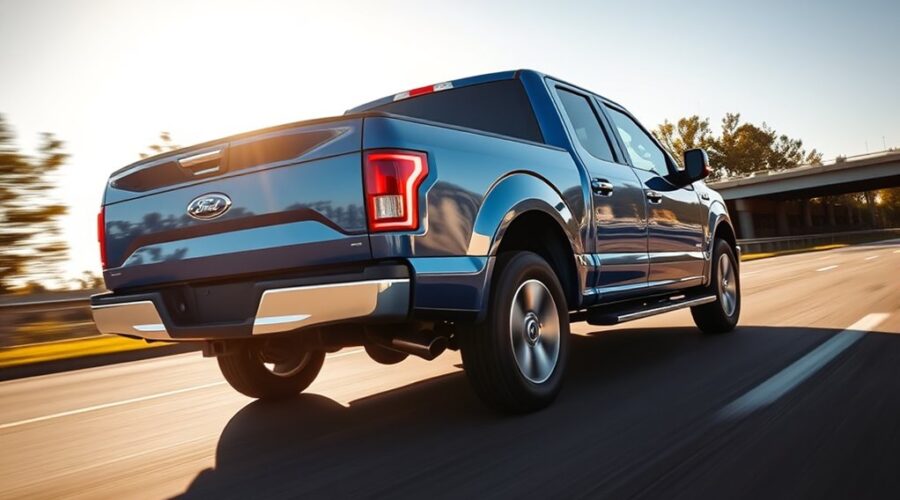
The 2015-2017 Ford F-150 with the 6R80 automatic pairs strong towing capability with familiar full-size truck dimensions and broad cab configurations. Yet NHTSA flagged a recall affecting nearly 1.4 million units after reports of sudden downshifts without driver input. The issue ties to transmission control logic, not basic hardware alone, and the repair process is software-based. The full scope of the failure pattern is more specific than it first appears.
Why This Ford F-150 Recall Matters

The Ford F-150 recall matters because the NHTSA investigation identified a transmission defect in nearly 1.4 million trucks from model years 2015 to 2017 that can cause sudden downshifts and potential loss of control.
The Ford F-150 recall matters because a transmission defect may cause sudden downshifts and loss of control.
This Ford recall is not a routine compliance action; it addresses a powertrain fault that can convert ordinary driving into an unstable event.
Degraded electrical connections in the transmission lead frame interrupt communication between the transmission range sensor and the powertrain control module, creating conditions for an unexpected sudden downshift.
Reports of wheel lockup in more than 40% of affected owners underscore the severity of the safety risk.
Ford’s record of 444 warranty claims, 121 field reports, two injuries, and one accident indicates a measurable failure pattern.
The NHTSA response and the planned software update aim to restore safer operation, reduce exposure to injuries, and return drivers to a more liberated, controlled driving experience.
Which Ford F-150 Trucks Are Affected?
The recall covers nearly 1.4 million Ford F-150 trucks built between March 12, 2014, and August 18, 2017, with the affected population concentrated in 2015, 2016, and 2017 model years.
The specific hardware configuration identified is the 6-speed automatic 6R80 transmission, which defines the subgroup at issue.
Ford’s VIN lookup tool can be used to verify whether an individual truck falls within the recalled build range.
Affected Model Years
Affected Ford F-150 trucks are limited to certain 2015, 2016, and 2017 model-year vehicles equipped with the 6R80 six-speed automatic transmission, built between March 12, 2014, and August 18, 2017.
These affected model years represent the primary Powertrain population in the recalls, with nearly 1.4 million Ford F-150 units exposed to the sudden downshift condition.
The defect is associated with Output Shaft Speed sensor signal loss, which can trigger an abrupt transmission downshift and, in some cases, rear wheel lockup.
Ford’s record shows more than 444 warranty claims and 121 field reports, confirming a persistent safety concern.
For drivers seeking liberation from preventable mechanical control, the affected trucks are those requiring scrutiny, repair, and recall compliance under the identified model years.
Transmission Build Dates
Ford F-150 trucks are included in the sudden downshift recall when they were built between March 12, 2014, and August 18, 2017, and were equipped with the 6R80 six-speed automatic transmission. The 2015-2017 Ford F-150 population is the core set, with 1,392,935 pickups implicated.
Engineering review ties the recall to degraded electrical connections in the transmission lead frame, which can produce signal loss from the Output Shaft Speed sensor and trigger unexpected gear shifts.
- Build date verification narrows eligibility.
- Transmission code confirms the 6R80 six-speed automatic.
- VIN lookup clarifies exposure and supports informed action.
The resulting downshift risk was serious enough to prompt investigation after rear-wheel lockups were reported, making precise identification essential for owners seeking mechanical autonomy and safer operation.
What Causes the Sudden Downshift?
The sudden downshift in affected Ford F-150 trucks is primarily associated with loss of signal from the output shaft speed (OSS) sensor, which interrupts communication with the powertrain control module.
Degraded electrical connections within the transmission lead frame can also impair the transmission range sensor, creating incorrect gear commands.
Together, OSS signal loss and lead frame wear can trigger abrupt downshifts, including shifts to neutral, during normal driving.
OSS Signal Loss
OSS signal loss is the primary trigger behind the sudden downshift behavior in the Ford F-150 transmission system, as loss of communication between the Output Shaft Speed sensor and the powertrain control module can force an abrupt and unintended shift.
In Ford F-150 pickups, this transmission defect can produce unexpected downshifts at programmed road speeds, narrowing the driver’s margin for safe control.
- Electrical discontinuity in the OSS circuit interrupts speed data.
- The Powertrain Control Module then miscalculates gear state and commands a downshift.
- The resulting deceleration may cause loss of vehicle control and elevate risk of a crash.
Analytical testing linked the condition to sudden directional changes and wheel lockup, especially during reverse incline maneuvers, underscoring the system’s failure to preserve orderly motion.
Lead Frame Wear
Lead frame wear is a leading mechanical-electrical cause of the sudden downshift condition in affected F-150 transmissions, following the loss of OSS signal described above.
In F-150 trucks, degraded lead frame wear can interrupt the transmission range sensor pathway and weaken communication with the powertrain control module. Heat cycling and vibration accelerate contact deterioration, producing signal loss that may trigger an unexpected downshift or neutral event.
This failure mode is most concerning in the 6R80 six-speed automatic used in nearly 1.4 million trucks built from 2014 to 2017.
When the vehicle is traveling 35 to 64 mph, abrupt wheel speed reduction can increase crash risks. Reports of rear wheel lockup in more than 40% of cases underscore the need for accountable repair.
How the 6R80 Transmission Fails
In affected Ford F-150 trucks, the 6R80 transmission is reported to fail when loss of signal from the Output Shaft Speed sensor disrupts shift control, sometimes triggering abrupt downshifts into neutral or lower gears. This sudden downshifting undermines vehicle control when degraded electrical connections in the lead frame corrupt transmission data and command logic.
The failure mode is mechanically simple and socially costly: a programmed downshift window between 35 and 64 mph can force a rapid wheel-speed reduction, increasing crash risk and, in some reports, wheel lockup.
- OSS sensor wear from heat and vibration can interrupt speed feedback.
- Lead frame connection degradation can misroute control signals.
- The resulting gear change can occur without driver intent, limiting control.
Ford has stated the condition reflects time-related wear rather than a manufacturing defect, distinguishing it from earlier recall patterns.
For drivers seeking autonomy, the defect represents an unacceptable surrender of control.
What Warning Signs to Watch For
Warning signs may be limited, but owners should watch for a malfunction indicator light or wrench light, which can point to a degrading Transmission Range Sensor connection before an unexpected downshift occurs.
These warning lights are often the earliest visible signal of trouble, yet some trucks present no alert at all. In that case, attention must shift to unusual transmission behavior, including a brief move into neutral while reversing uphill or abrupt gear changes at 35 to 64 mph.
Warning lights may appear first, but some trucks give no alert before shifting abruptly or slipping into neutral uphill.
Such events can precede vehicle control issues and, in severe cases, loss of control. Survey data showing wheel lockup events in more than 40% of affected owners reinforces the need for scrutiny.
The absence of a warning does not imply normal operation; instead, it may indicate that the fault is advancing without driver notice. Any change in shifting consistency should be treated as a technical red flag.
How the Recall Fix Works
The recall remedy centers on a powertrain control module (PCM) software update designed to improve detection of failed transmission range sensor (TRS) signals before an unintended downshift can occur. This recall fix recalibrates powertrain control logic, giving the vehicle control module more time to interpret sensor faults and suppress unexpected downshifts that could produce loss of vehicle control.
- The software update extends fault-monitoring intervals.
- The transmission range sensor is evaluated with greater diagnostic tolerance.
- Vehicles showing prior codes may require lead-frame replacement.
The process is analytical rather than mechanical first, targeting command logic before hardware intervention. By reprogramming the PCM, Ford aims to reduce abrupt transmission responses while preserving driver autonomy and road stability.
Affected owners can later confirm status through VIN tools or Ford contact channels, but the core mitigation is the calibrated software update, which narrows exposure to unsafe shift behavior.
What Ford Will Repair at No Cost
Ford’s recall remedy extends beyond the software logic described above and is offered at no cost to owners, beginning with a powertrain control module (PCM) update intended to correct the sudden downshift condition in affected F-150 trucks.
Ford’s recall campaign covers approximately 1,392,935 vehicles from model years 2015 through 2017 equipped with the 6R80 transmission.
In cases where the calibration change alone does not restore expected operation, Ford may authorize replacement of the transmission lead frame, a hardware correction designed to stabilize shift behavior and reduce fault recurrence.
This no cost program is structured to remove the burden from owners while restoring predictable powertrain control.
Interim notification letters are scheduled, but the repair itself remains the central remedy.
For drivers seeking autonomy from defect risk, the recall process presents a direct path to a corrected transmission system, with Ford bearing the expense of the update and any required parts.
How to Check Your VIN for the Recall
To verify whether a specific F-150 is included in the sudden downshift recall, owners can use the NHTSA VIN lookup tool on the agency’s website, available since April 15, 2026.
This NHTSA VIN lookup accepts the Vehicle Identification Number and returns open recall data tied to the Ford F-150, including the recall number and affected configuration. The process is direct and informational, enabling users to assess status without intermediaries.
- Enter the 17-character VIN exactly as stamped on the vehicle and registration documents.
- Review any recall entries flagged by the system, especially those linked to sudden downshifting behavior.
- Note that affected owners may receive interim letters beginning April 27, 2026, with final remedy letters expected in July 2026.
For additional confirmation, Ford customer service reports can be cross-checked by calling 866-436-7332.
The result is a transparent method for reclaiming vehicle knowledge and autonomy.
What Owners Should Do Next
Affected Ford F-150 owners should verify recall status by entering the Vehicle Identification Number (VIN) on the NHTSA website.
Then watch for interim notification letters beginning April 27, 2026, which will outline the recall and next steps. Owners should treat any malfunction indicator light or wrench light as a diagnostic signal, especially where the transmission range sensor may be implicated.
Until the remedy is available, continued monitoring is prudent. Ford expects a free software update for the powertrain control module to begin in July 2026, and owners should schedule service promptly once the campaign opens.
During inspection, technicians may also review stored fault codes; if prior codes are present, the transmission lead frame may be replaced at no cost.
This process gives owners a clear path toward resolution, reducing exposure to unintended downshift behavior while preserving operational control and transparency over the recall response.
Frequently Asked Questions
What Year to Stay Away From Ford F-150?
Avoid 2015–2017 Ford F-150s, especially for Ford F 150 reliability issues and Common F 150 complaints. F 150 model comparisons favor 2018+; Best F 150 years reflect safer F 150 owner experiences, sound F 150 maintenance tips, wiser Used F 150 buying advice.
What Year Does the F-150 Have Transmission Problems?
2015–2017 F-150s most often show transmission issues. Reliability ratings, common complaints, repair costs, maintenance tips, owner experiences, and recall history indicate degraded lead-frame connections causing sudden downshifts, abrupt deceleration, and lockup risks.
Why Did the Ford F-150 Suddenly Downshift?
The Ford F-150 suddenly downshifted because heat and vibration degraded transmission connections, disrupting OSS signals; transmission issues followed. Driver feedback, gear ratios, maintenance tips, software updates, towing capacity, and performance upgrades could mitigate recurrence.
Which F-150 Has the Best Transmission?
The best transmission is found in 2021–2024 F-150s with the 10-speed automatic. Transmission Types, Best Models, User Reviews, Performance Ratings, Reliability Factors, Maintenance Tips, and Upgrade Options all favor this efficient, responsive, more liberated drivetrain.
Conclusion
The Ford F-150’s 2015-2017 6R80 recall underscores how a software fault can turn a dependable powertrain into a liability. By reducing the risk of unexpected downshifts, the update restores transmission control and improves safety without altering the truck’s core specs or utility. For owners, the issue is not cosmetic; it is a system-level concern. Addressing it promptly is like tightening a critical fastener before a load shifts and causes damage.