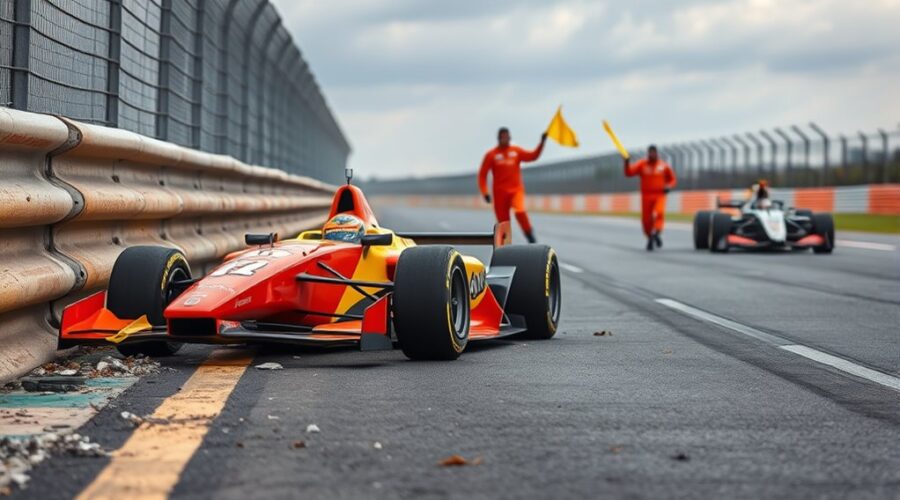
The Anthoine Hubert crash at Spa-Francorchamps on August 31, 2019, remains one of the most serious accidents in modern Formula 2. Understanding it means separating the FIA’s verified sequence from later assumptions about driver blame, warning flags, track design, and the safety work that followed.
Quick Answer
The 2019 Spa F2 crash began when Giuliano Alesi lost control. Ralph Boschung and Anthoine Hubert took evasive action, Hubert hit Boschung and then a barrier, and Juan Manuel Correa, after striking debris and losing control, hit Hubert side-on at about 218 km/h. The FIA assigned no driver fault.
Spa-Francorchamps F2 Crash Overview
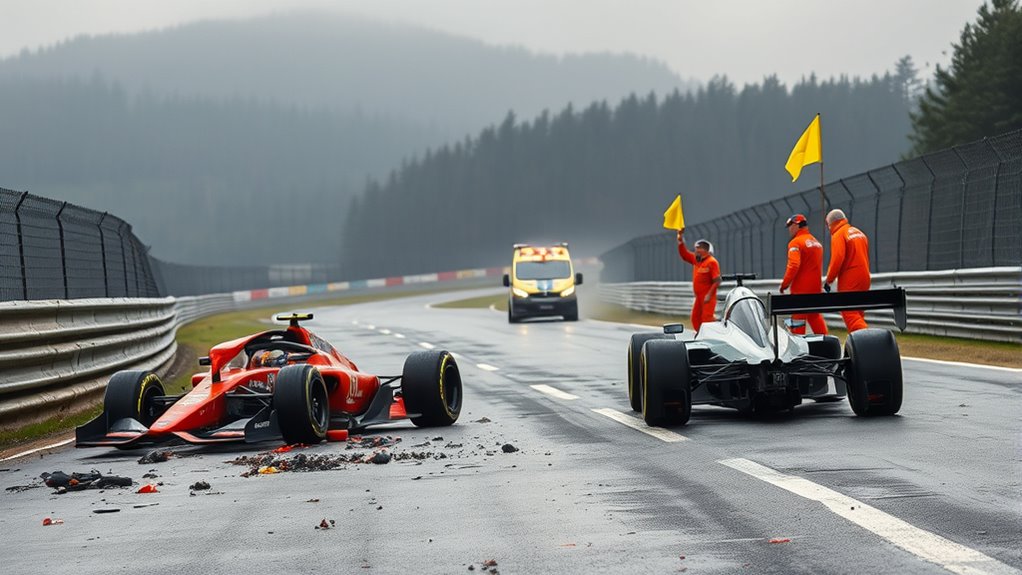
The Spa-Francorchamps Formula 2 accident happened on lap 2 of the feature race on August 31, 2019. Four cars were involved in the sequence: those of Giuliano Alesi, Ralph Boschung, Anthoine Hubert, and Juan Manuel Correa.
According to the FIA’s final investigation, the sequence began while Sector 1 was green. Alesi lost control at the exit of Turn 3 and struck the barrier about 1.9 seconds later.
Boschung and Hubert began reacting to Alesi’s accident before the relevant yellow flag was displayed because they were already close to the incident. Their cars then made contact as they tried to avoid the developing situation.
Hubert lost his front wing and headed toward the barrier. Correa arrived moments later, struck debris from Alesi’s car, suffered front-right suspension damage, and lost his own front wing. He then collided almost perpendicularly with the side of Hubert’s car.
The FIA described the crash as the result of multiple contributory factors. It found no single specific cause and no evidence that a driver had failed to react appropriately to the circumstances.
How the Anthoine Hubert Crash Unfolded
The Anthoine Hubert crash developed extremely quickly. From Alesi’s initial loss of control to the main collision between Correa and Hubert, drivers had only seconds to recognize and respond to a rapidly changing sequence.
| Stage | What Happened | Verified Figure |
|---|---|---|
| Alesi loses control | Giuliano Alesi lost control at the exit of Turn 3 and hit the barrier rearwards. | Barrier impact about 1.9 seconds later |
| Hubert takes evasive action | Hubert and Boschung made contact. Hubert lost his front wing and then struck the barrier. | Hubert was travelling at about 262 km/h before losing control and hit the barrier at about 216 km/h; peak recorded load was 33.7g |
| Correa encounters debris | Correa struck debris, damaging his front-right suspension and losing his front wing. | Debris impact about 1.5 seconds after the yellow flag |
| Main side impact | Correa’s car struck Hubert’s virtually stationary car at an angle of about 86 degrees. | Correa about 218 km/h; peak recorded loads of 65.1g for Correa’s car and 81.8g for Hubert’s car |
| Race response | Double yellow flags followed the main impact, and the race was then stopped with a red flag. | Red flag about 2.7 seconds after the double yellow |
The FIA also found a reasonable probability that a loss of right-rear tyre pressure contributed to Alesi losing control. That was one element in the sequence rather than a finding that one mechanical issue alone caused the entire accident.
Medical and rescue personnel began responding almost immediately. The FIA reported that the first medical assessment of Hubert took place within a minute of the red flag and that an extrication team was present within about two minutes.
Why Anthoine Hubert Died
Anthoine Hubert died because the second collision exposed his car to an exceptionally severe side impact. Correa’s car approached at about 218 km/h and struck Hubert’s nearly stationary car at roughly 86 degrees, creating what the FIA described as non-survivable trauma.
The peak load recorded by Hubert’s car during that impact was 81.8g. This figure describes the extreme acceleration measured through the vehicle during the crash; it should not be read as a simple measure of the exact force experienced by every part of a driver’s body.
The geometry of the collision was especially serious. Open-wheel racing cars are designed with strong survival cells and crash structures, but a high-energy, near-perpendicular car-to-car impact presents a different challenge from a more typical frontal or glancing collision.
Hubert had already struck the barrier before Correa arrived. After the side impact, Hubert’s car was accelerated away at more than 100 km/h and suffered another barrier impact.
The FIA concluded that Hubert suffered fatal, non-survivable injuries in the main collision. It also found that the medical and rescue response was timely, meaning the outcome was not attributed to a delayed emergency response.
FIA Findings and Safety Changes
The FIA’s central finding was that there was no single cause and no driver to blame for the 2019 Spa F2 crash. Investigators examined vehicle data, video, physical evidence, medical information, and the actions of race control and marshals before reaching that conclusion.
The report also found that yellow flags were deployed appropriately and that drivers reacted consistently with the situation they faced. This matters because a simplified version of the accident can make it sound as though drivers continued at racing speed despite an established caution zone. The FIA’s timing showed a much faster and more complex chain of events.
What Safety Work Followed Across FIA Circuit Racing?
The FIA did not present every subsequent safety measure as a direct consequence of Hubert’s crash alone. Its 2020 circuit-racing safety programme drew on investigations into 28 serious and fatal circuit accidents from 2019.
That broader programme examined ways to improve debris containment, wheel and component tethering, front and side crash structures, survival-cell compatibility, headrest attachment, front-wing retention, and communication of warning information to drivers. It also included research into methods of slowing cars in run-off areas.
Formula 2 continued to develop its cars as those findings and newer FIA standards evolved. The FIA says the 2024-generation F2 car introduced stronger side-intrusion protection, tougher survival-cell testing, improved performance in T-bone-style impacts, and new wheel-restraint cables.
What Changed at Spa-Francorchamps?
Spa-Francorchamps later underwent major safety and homologation work, but the official circuit does not describe those changes as being caused solely by Hubert’s accident. The project also supported FIA requirements and the return of top-level motorcycle racing under FIM standards.
During the 2021–2022 work, the circuit enlarged several run-off areas, installed or restored gravel traps, changed barriers, and made substantial alterations around the Raidillon area while retaining the basic Grand Prix track layout. The circuit’s own account of the Spa-Francorchamps safety works describes the project as a broader programme to strengthen safety and adapt the venue for both car and motorcycle competition.
That distinction is important. Hubert’s death intensified attention on high-speed open-wheel crashes, but modern motorsport safety changes usually result from several investigations, new test standards, engineering research, and lessons gathered across different accidents.
Anthoine Hubert’s Career and Legacy
Anthoine Hubert was already an established junior-category champion before entering Formula 2. He started racing karts as a child, won the French F4 title in 2013, became the 2018 GP3 champion, and then won twice during his rookie Formula 2 season in 2019.
| Year | Series | Milestone |
|---|---|---|
| 2010 | CIK-FIA Karting Academy Trophy | Runner-up |
| 2011–2012 | CIK-FIA U18 World Karting Championship | Third in both seasons |
| 2013 | French F4 Championship | Champion |
| 2018 | GP3 Series | Champion |
| 2019 | FIA Formula 2 Championship | Two victories, at Monaco and Le Castellet |
A Formula 1 account of Hubert’s career records his rapid progress through French F4, European junior racing, GP3, and Formula 2. He was also a Renault junior driver during his 2019 F2 season.
Formula 2 later created the Anthoine Hubert Award for the highest-placed rookie in the championship. Guanyu Zhou became its first recipient for the 2019 season.
The championship also confirmed that car number 19 would no longer be used in Formula 2, preserving the number associated with Hubert’s final season.
Frequently Asked Questions
Can You Explain the Anthoine Hubert Crash?
The crash was a rapid four-car sequence during the 2019 Spa Formula 2 race. After Giuliano Alesi lost control, Ralph Boschung and Anthoine Hubert took evasive action, Hubert struck a barrier, and Juan Manuel Correa then hit Hubert’s car side-on at about 218 km/h. The FIA found multiple contributory factors and no driver at fault.
Did a tyre problem play a part in the Spa F2 crash?
The FIA found a reasonable probability that a loss of internal pressure in Giuliano Alesi’s right-rear tyre contributed to his loss of control. It treated this as one factor among several, not as the single cause of the crash.
Was the emergency response too slow?
No. The FIA judged the marshal and medical response timely. Hubert’s first on-site medical evaluation took place 54 seconds after the red flag, and the first extrication team arrived within about two minutes.
What Was the Last Death in F2?
As of October 2026, Anthoine Hubert remains the most recent driver to die following an FIA Formula 2 Championship race. He suffered fatal injuries in the feature race at Spa-Francorchamps on August 31, 2019.
Was Any Driver Blamed for the 2019 Spa F2 Crash?
No driver was blamed by the FIA for the 2019 Spa Formula 2 crash. Its investigation found no single specific cause and no evidence that any driver failed to react appropriately to the circumstances that developed during the accident.
Related reading: see the Spa-Francorchamps circuit guide for the track layout, or read about other racing incidents such as the Juha Miettinen crash and the Kimi Antonelli crash.
Sources
- FIA — Spa-Francorchamps Formula 2 Accident Investigation: Crash sequence, speeds, impact loads, flag timing, emergency response, contributory factors, and driver-fault findings.
- FIA — Further Safety Initiatives: Broader 2019 accident research and subsequent work on debris, crash structures, warning systems, and run-off safety.
- FIA — Next-Generation Formula 2 Safety: Safety developments incorporated into the 2024 Formula 2 car.
- Circuit de Spa-Francorchamps — 2022 Circuit Works: Run-off, gravel, barrier, Raidillon, and homologation-related safety changes.
- FIA Formula 2 — Anthoine Hubert Award: Hubert’s F2 record and creation of the rookie award bearing his name.
- Formula 1 — Anthoine Hubert, 1996–2019: Hubert’s junior-career milestones and 2019 Formula 2 victories.
- Formula 1 — Honouring Anthoine Hubert: Confirmation that Formula 2 retired car number 19.
- Formula 1 — Jules Bianchi, 1989–2015: Bianchi’s death following injuries sustained in the 2014 Japanese Grand Prix.