The Toyota Tundra’s i-FORCE MAX hybrid powertrain gives it 437 horsepower and 583 lb-ft of torque, positioning it as a serious candidate for camping duty. Its towing capacity reaches up to 12,000 pounds, while payload is rated near 1,940 pounds. CrewMax models add interior space for longer trips, and off-road systems like Multi-Terrain Select and Crawl Control expand its capability. The key question is which specs matter most in actual campsite use.
Key Takeaways
- The Toyota Tundra i-FORCE MAX hybrid delivers 437 horsepower and 583 lb-ft of torque for strong camper towing.
- Maximum towing capacity reaches up to 12,000 pounds when properly equipped, depending on trim and configuration.
- Payload capacity is about 1,940 pounds, making weight distribution and cargo planning important for safe camping setups.
- Off-road camping aids include Multi-Terrain Select, Crawl Control, and an electronic locking rear differential.
- The CrewMax cabin, 6.5-foot bed, and 12.3-inch touchscreen improve comfort, storage, and travel convenience.
What Makes the Tundra a Camper Truck?
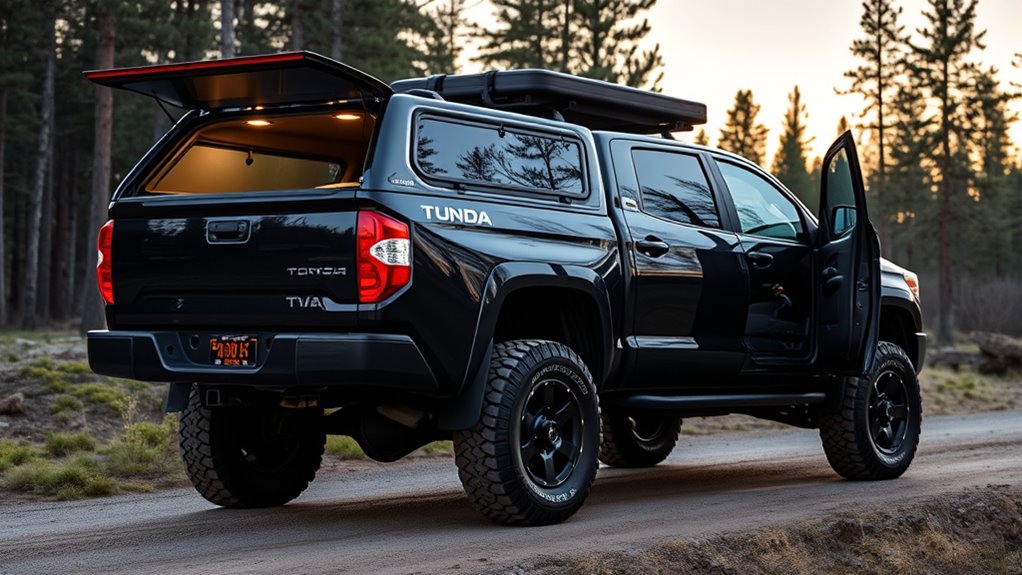
The Toyota Tundra qualifies as a capable camper truck because it combines heavy-duty towing and hauling capacity with technology and cabin space suited to travel.
Toyota positions the Tundra for camper trailers through strong towing capacity, a payload capacity near 1,940 pounds, and chassis control calibrated for loaded travel.
The i-FORCE MAX hybrid powertrain delivers 437 horsepower and 583 lb-ft of torque, supporting steady acceleration on grades and rough access roads.
The i-FORCE MAX hybrid powertrain delivers 437 horsepower and 583 lb-ft of torque, supporting confident travel on steep grades and rough access roads.
Advanced towing technologies such as Trailer Backup Guide and Tow/Haul Mode reduce setup complexity and improve maneuverability when freedom requires mobility without dependence on crowded campgrounds.
The spacious CrewMax cab adds passenger room, storage flexibility, and long-distance comfort, which matters on family expeditions.
Together, these elements make the Tundra a technical platform for self-directed camping, where transport, equipment, and occupants can move as a single integrated system with fewer compromises and greater operational confidence.
How Much Can the Tundra Tow?
The 2025 Toyota Tundra offers towing capacity up to 12,000 pounds when properly equipped, with exact limits varying by trim and configuration.
The SR model is rated for up to 8,300 pounds, while the SR5 Double Cab RWD with the 6.5-foot bed reaches the maximum tow figure.
Trailer Backup Guide, Trailer Sway Control, and the available twin-turbo V6 and i-FORCE MAX Hybrid powertrains support controlled towing performance.
Tundra Towing Limits
Towing capacity for the 2025 Toyota Tundra ranges widely by trim and configuration, with properly equipped models reaching up to 12,000 pounds. These Tundra towing limits define a maximum towing capacity shaped by cab style, bed length, and drivetrain choice.
Towing performance remains strong across the lineup, while advanced towing technologies such as Trailer Backup Guide and Trailer Sway Control support precise maneuvering and greater control. The SR model is rated to tow up to 8,300 pounds, showing that towing capabilities vary meaningfully by specification.
For stable hauling, weight distribution across passengers and cargo must be managed carefully to preserve safety and trailer balance. In practical use, the Tundra enables liberated movement of campers, equipment, and freight without compromising technical confidence.
Tow Ratings By Trim
Although towing strength varies by configuration, the 2025 Toyota Tundra’s tow ratings by trim span from 8,300 pounds on the SR to 12,000 pounds on the properly equipped SR5 Double Cab RWD with a 6.5-foot bed. Its towing capacity depends on cab, bed, and drivetrain.
| Trim | Tow rating |
|---|---|
| SR | 8,300 lb |
| SR5 Double Cab | 12,000 lb |
| TRD Pro | High-capability off-road towing |
| Other trims | Configuration dependent |
The TRD Pro suits rugged hauling, while advanced towing technology such as Trailer Backup Guide supports controlled maneuvering. Payload capacity, up to about 1,940 pounds, can reduce effective load allowance. For drivers seeking maximum towing capacity and liberated travel, these tow ratings by trim define the Tundra’s practical limits.
Towing Tech Features
Beyond the tow ratings by trim, the 2025 Toyota Tundra adds a suite of towing technologies that help translate its maximum 12,000-pound capability into controlled real-world use when properly equipped. This towing technology supports varied towing needs with precision and restraint.
- Trailer Backup Guide and Straight Path Assist help align trailers.
- Integrated Trailer Brake Controller lets cabin adjustments refine stopping feel.
- Blind Spot Monitor with Trailer Coverage and trailer distance monitoring extend awareness.
- Tow/Haul Mode recalibrates shifting for steadier pull, aiding performance and fuel efficiency under load.
Together, these systems reduce guesswork and improve confidence when hauling campers, equipment, or boats, while preserving a more liberated driving experience on highway grades, tight sites, and changing road conditions.
How Much Space Does the Tundra CrewMax Offer?
The Toyota Tundra CrewMax provides a particularly spacious cabin, with 44.5 inches of rear legroom and a total interior volume of 136.5 cubic feet, placing it among the roomier full-size truck configurations for passenger comfort and utility.
The Tundra CrewMax emphasizes interior space through a cabin design that favors openness and accessible movement for rear occupants. A wide rear door opening supports easier entry and exit, reducing constraints in daily use.
For users seeking a versatile layout, the rear seats fold upward to expand cargo space without compromising the primary seating arrangement. This configuration improves adaptability for hauling gear, camping equipment, or other large items.
Available trim levels may add comfort-oriented amenities, but the core spatial advantage remains the same: generous rear legroom, strong total interior volume, and a cabin designed to support both transport and personal freedom.
How Much Payload Can the Tundra Carry?
The 2025 Toyota Tundra can be rated for a maximum payload of about 1,940 pounds when properly equipped, though the exact figure depends on trim, cab style, engine choice, and drivetrain.
Payload is distinct from towing capacity because it accounts for the combined mass of passengers, cab cargo, and bed equipment carried by the truck itself.
Proper weight distribution and configuration are critical, since these factors directly influence hauling stability, towing limits, and overall performance.
Tundra Payload Ratings
2025 Toyota Tundra payload ratings reach approximately 1,940 pounds when properly equipped, though the exact figure varies by trim, cab style, bed length, engine choice, and driveline configuration.
These Tundra payload ratings define maximum payload capacity for gear, passengers, and trailer tongue weight, supporting safe driving when loading is disciplined.
- SR and SR5 Double Cab, rear-wheel drive
- 6.5-foot bed configuration
- Engine choices and cab style alter limits
- Towing technologies help manage load control
For contractors and families, this technical margin promotes practical freedom without sacrificing stability.
Proper weight distribution remains essential because every pound affects chassis behavior, braking response, and suspension reserve.
The strongest configurations provide useful capability while preserving predictable handling under real-world demands.
Payload Versus Towing
Payload ratings naturally lead into the broader question of how the Tundra balances hauling passengers, cargo, and trailer load. In the 2025 Toyota Tundra, maximum payload reaches roughly 1,940 pounds when properly equipped, but the figure varies with trim, engine options, cab style, and bed length.
Payload covers passengers, cab cargo, bed cargo, hauling equipment, and trailer tongue weight, so truck owners must treat it as a whole-system limit rather than a separate figure from towing. High towing capacity does not mean unlimited cargo carry, because added load reduces margin for safe operation.
Proper weight distribution preserves stability, braking, and steering response. When payload is managed carefully, the Tundra can support demanding work or recreation without compromising performance or the freedom of efficient hauling.
Factors Affecting Payload
Several variables determine how much payload the 2025 Toyota Tundra can carry, with the maximum reaching approximately 1,940 pounds when properly equipped. Payload capacity depends on engine choice, cab configuration, bed length, and weight distribution, each altering the truck’s usable margin.
- Gross Vehicle Weight Rating sets the upper limit for cargo, passengers, and trailer tongue weight.
- Safety features and chassis tuning help preserve control under load.
- Heavier cabs reduce available payload capacity.
- Proper loading supports ideal towing and stable transport.
Exceeding rated limits can degrade handling, braking, and stability, especially when hauling equipment or passengers.
For liberated operation, the truck must remain within specification, ensuring towing capacity and payload capacity are balanced without compromising roadworthiness.
What Off-Road Features Help on Camping Trips?
Toyota trucks offer a range of off-road features that can improve performance on camping trips, especially when routes include mud, rocks, loose soil, or steep grades. Multi-Terrain Select adjusts power delivery for traction, while Crawl Control manages throttle and braking on uneven climbs, supporting controlled off-road adventures. An electronic locking rear differential further improves grip in low-traction conditions. High ground clearance and durable suspension systems help the chassis clear obstacles and maintain stability on rough approaches to remote sites. Many models also provide towing capacity up to 12,000 pounds, allowing trailers or equipment to move without undermining trail capability.
| Feature | Function | Camping Benefit |
|---|---|---|
| Multi-Terrain Select | Tunes traction response | Adapts to changing surfaces |
| Crawl Control | Automates low-speed control | Aids steep or uneven trails |
| Ground clearance | Raises underbody height | Clears rocks and ruts |
These systems together support practical mobility, letting campers access remote terrain with more confidence and less mechanical strain.
What Is the Tundra’s Fuel Economy?
The 2025 Toyota Tundra delivers competitive fuel economy for a full-size pickup, with the standard twin-turbo V6 rated at up to 23 mpg in the city and 22 mpg on the highway.
This Toyota Tundra Engine balances fuel efficiency with towing and hauling capability, preserving utility without unnecessary penalty.
The i-FORCE MAX hybrid raises fuel economy further on select routes, returning up to 20 mpg city and 24 mpg highway.
Real-world results vary by trim and drivetrain; four-wheel drive models usually reduce efficiency.
- Standard twin-turbo V6 engine: efficient baseline performance.
- i-FORCE MAX hybrid: stronger highway economy.
- Drivetrain choice: 4WD typically lowers fuel economy.
- Tow/Haul mode: advanced technologies support towing a trailer while managing consumption.
For drivers seeking liberation from compromise, the Tundra’s fuel economy supports daily mobility and demanding work with measured, technically advanced control.
How Comfortable Is the Tundra For Travel?
Comfort for travel is one of the Toyota Tundra’s strongest attributes, as its spacious cabin is engineered to support long-distance driving with minimal fatigue. The truck interior emphasizes comfort through high-quality materials and ergonomic seating, creating a controlled environment for long trips.
Available three-zone climate control helps maintain consistent temperatures for passengers, reducing distraction and improving overall ride quality. In CrewMax form, the generous rear seating area expands usable space, allowing occupants to stretch out without compromise.
Advanced technology also supports travel ease: a 12.3-inch touchscreen with wireless connectivity keeps systems accessible and communication streamlined. The available Panoramic View moonroof further opens the interior, admitting natural light and improving the sense of openness.
Together, these elements produce a cabin that feels liberated, stable, and technically refined, making the Tundra a practical choice for travelers who value comfort, space, and sustained usability on extended routes.
Which Tundra Specs Matter Most for Camping?
For camping use, the most relevant Tundra specifications are its towing capacity, power output, cab space, and cargo bed length.
The i-FORCE MAX hybrid powertrain supplies up to 437 horsepower and 583 lb-ft of torque, giving the truck the muscle to move camping trailers and loaded gear with authority. Its maximum towing capacity reaches 12,000 pounds when properly equipped, a figure that expands payload and towing flexibility for overland setups.
The spacious CrewMax cab supports occupants with generous rear room, while bed lengths up to 6.5 feet improve cargo management for tents, coolers, and recovery tools.
The spacious CrewMax cab offers generous rear room, while bed lengths up to 6.5 feet boost cargo flexibility.
- towing capacity for trailer mass
- powertrain output for grade climbing
- CrewMax cab for comfortable movement
- Trailer Backup Guide for precise campsite alignment
Straight Path Assist and Trailer Backup Guide reduce stress during tight maneuvers, allowing more focused, liberated travel.
Frequently Asked Questions
Are Toyota Campervans Any Good?
Yes; Toyota campervans are generally strong options. Toyota reliability, camper versatility, interior space, off road capability, fuel efficiency, maintenance costs, resale value, and user reviews all suggest durable, practical platforms for liberated travel.
What Is Toyota’s Biggest Weakness?
Toyota’s biggest weakness is Innovation challenges, especially limited EV offerings. Toyota reliability concerns remain low, yet Maintenance costs, Fuel efficiency issues, Off road capability, Interior space, Safety ratings, and Resale value can’t fully offset market lag.
What Are the Key Features of Toyota Pickups?
Toyota pickups feature Toyota reliability, off road capability, fuel efficiency, strong towing capacity, interior comfort, high safety ratings, broad customization options, and exceptional resale value, serving practical autonomy through durable, versatile, technically advanced design.
What Engine Was the Toyota Tundra With 1,000,000 Miles?
The million-mile Tundra used the 5.7-liter iForce V8, a freight-train heart. Tundra engine reliability, high mileage performance, maintenance history insights, fuel efficiency concerns, owner testimonials, long term durability, common repairs, driving experience.
Conclusion
Overall, the Toyota Tundra presents a strong camper-truck package. Its 437-horsepower i-FORCE MAX hybrid powertrain, 12,000-pound towing capacity, and roughly 1,940-pound payload give it the muscle needed for trailers and gear. The CrewMax cabin adds usable passenger space, while off-road systems such as Multi-Terrain Select and Crawl Control improve rough-terrain capability. Fuel economy and comfort remain practical for long trips, making the Tundra a well-rounded option that covers the bases.