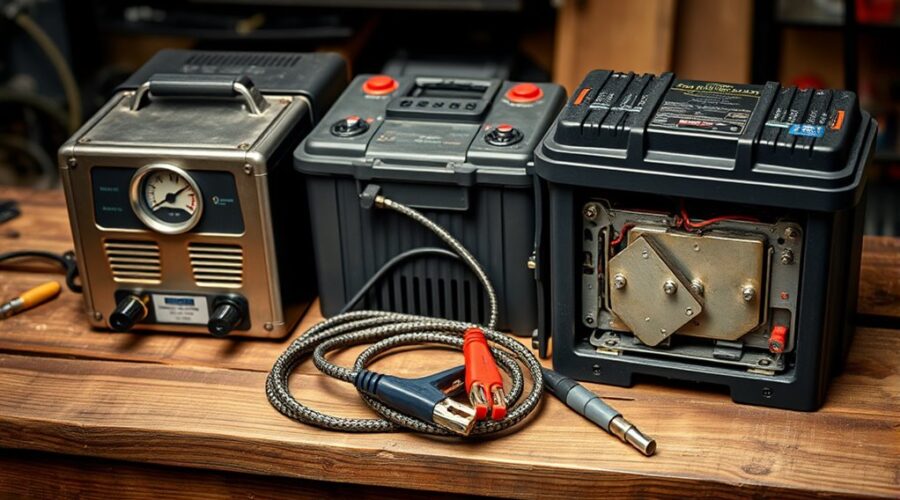
An automatic battery maintainer is a compact control device designed to preserve charge without causing overcharge. Its development followed advances in microprocessor regulation, sensing circuits, and multi-stage charging logic. Modern units can detect voltage, temperature, and polarity errors, then switch among bulk, float, and maintenance modes as needed. The result is more than simple charging. It raises a practical question about how much intelligence a small power device can actually provide.
Key Takeaways
- Automatic battery maintainers keep batteries charged without overcharging, making them useful for long-term vehicle and equipment storage.
- They use microprocessor-controlled smart charging to monitor battery condition and switch between bulk, float, and trickle modes.
- Built-in protections like reverse polarity, thermal control, and temperature compensation improve safety and charging efficiency.
- Many models automatically adjust for battery types such as AGM, gel, flooded, and lithium-ion, improving compatibility and battery life.
- Choosing the right maintainer means matching voltage, chemistry, and amperage, with smart shutoff and monitoring features preferred.
What Is an Automatic Battery Maintainer?
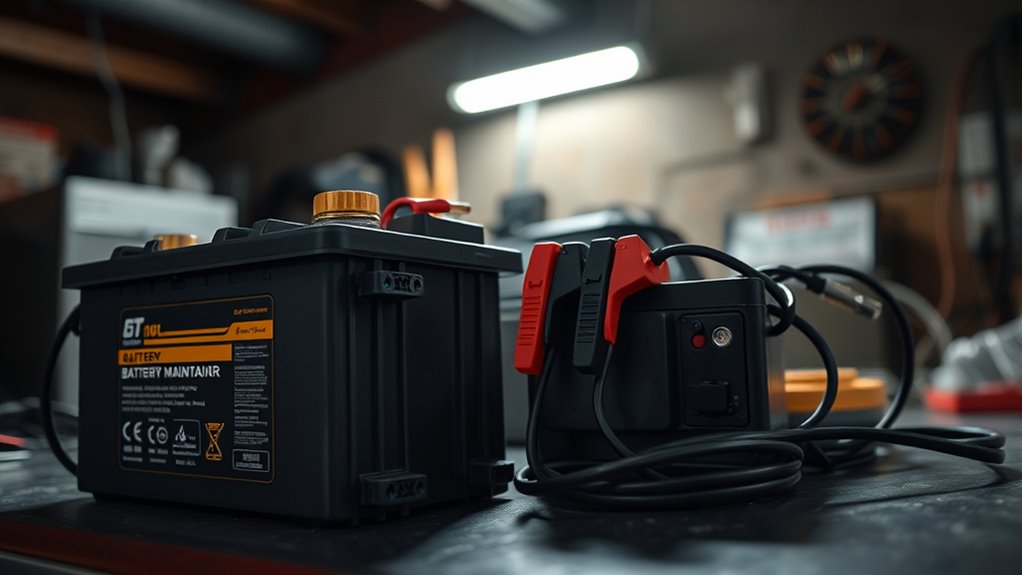
An automatic battery maintainer is a smart charging device designed to preserve battery charge without the risk of overcharging. It operates as a Battery maintainer that continuously monitors voltage, current, and battery condition through microprocessor-controlled smart charging.
When charge falls below a set threshold, it shifts to trickle charge mode, delivering only the energy required to sustain readiness. This controlled behavior is especially effective during long-term storage, when vehicles and equipment may remain idle yet must stay prepared for use.
When charge dips below the threshold, it shifts to trickle charge, preserving readiness during long-term storage.
The system adjusts output according to battery type, including AGM batteries, which require regulated charging profiles to avoid damage. Built-in safeguards such as reverse polarity protection and thermal protection reduce operational risk and support safe handling.
In practical terms, the device limits dependence on manual intervention, enabling stable maintenance of electrical capacity with precision, efficiency, and reliability.
Best Battery Maintainers to Buy
Several maintainer models stand out for distinct use cases: the Battery Tender 15 AMP offers adjustable charging and an LCD status display, while the NOCO Genius10 adds lithium-ion compatibility and battery-repair capability.
The CTEK Multi US 7002 emphasizes multi-stage charging and recondition mode, and the Battery Tender Plus 4 Bank supports simultaneous maintenance of multiple batteries with isolated outputs.
Selection should be based on battery chemistry, number of batteries, charging sophistication, and budget, with the Motopower MP00205A serving as a low-cost option for basic 12V maintenance.
Top-Rated Maintainer Picks
Selecting a top-rated battery maintainer depends on charging capacity, battery chemistry compatibility, and the presence of diagnostic or recovery functions. A Battery Charger with smart charger logic improves battery maintenance by regulating current, then sustaining an AGM battery through float charge rather than crude trickle chargers.
Battery Tender 15 AMP combines charger and maintainer roles with three stages and an LCD. NOCO Genius10 supports lithium-ion cells and repair mode for sulfation. CTEK Multi US 7002 adds eight-step reconditioning. Battery Tender Plus 4 Bank Multibank Charger sustains four batteries at once. NOCO Genius1 offers compact, temperature-adaptive control.
- Dual-purpose units reduce equipment dependence.
- Recovery modes extend serviceable battery life.
- Float charge preserves readiness without overcharge.
- Multi-bank designs support fleet autonomy.
- Temperature compensation increases operational precision.
Key Buying Considerations
Choosing the best battery maintainer starts with matching the unit to the battery chemistry, since AGM, flooded lead-acid, and gel batteries each respond differently to charging profiles. A proper Battery Charger must specify battery type support and a true maintenance mode to preserve capacity without stress.
Smart chargers add automatic shutoff and voltage monitoring, which help prevent overcharging and reduce failure risk during storage. Amperage also matters: 0.75 to 2.0 amps suits long-term maintenance, while higher output suits fast top-offs, not continuous use.
Build quality should be assessed carefully, because durable construction improves reliability and service life. For buyers seeking proven performance, expert reviews and customer feedback consistently favor models such as Battery Tender Plus and NOCO Genius series, both widely regarded as precise, dependable, and liberation-friendly tools for controlled energy stewardship.
How Smart Battery Maintainers Work
Smart battery maintainers use microprocessor charging control to regulate voltage and current according to battery condition and chemistry.
Once full charge is detected, they switch to automatic float maintenance to hold the battery at a safe level without overcharging.
This control logic preserves capacity, reduces degradation, and supports long-term battery readiness.
Microprocessor Charging Control
Microprocessor-controlled battery maintainers regulate charging through adaptive algorithms that continuously monitor battery voltage and adjust current, voltage, and charging phase to match the battery’s condition.
This smart battery control is microprocessor-controlled, enabling precise charging parameters across different battery types, including flooded, AGM, and gel cell. When full charge is detected, maintenance mode is entered to prevent stress and preserve capacity.
Temperature compensation modifies output in response to ambient conditions, improving safety and electrical efficiency. Multi-phase charging sequences restore charge efficiently and reduce sulfation, supporting long-term battery health.
Such automation limits guesswork, giving users controlled energy management and practical independence.
- Voltage feedback guides real-time regulation.
- Chemistry-specific profiles support battery types.
- Maintenance mode reduces overcharge risk.
- Temperature compensation stabilizes performance.
- Multi-phase charging recovers usable capacity.
Automatic Float Maintenance
Automatic battery maintainers typically shift from bulk or absorption charging into float mode once full charge is detected, using microprocessor-controlled regulation to hold voltage at a low, stable level that offsets self-discharge without overcharging the battery.
This automatic float maintenance allows the smart controller to preserve charge when the battery is fully charged, then resume precise regulation as conditions change. Temperature compensation further refines output, preventing drift in hot or cold environments.
Models that identify AGM and Gel chemistries can tailor voltage targets, improving compatibility across battery types. At the battery terminals, reverse-polarity protection and spark-limiting circuitry support safe to use operation during connection.
The result is sustained readiness over long periods, with minimal intervention and controlled energy flow aligned to battery health and user autonomy.
Key Features of a Good Battery Maintainer
A good battery maintainer is defined by its ability to alternate automatically between charging and float modes, keeping voltage within an ideal range without overcharging the battery.
In practice, battery maintainers use smart technology and microprocessor-controlled charging to regulate each charge cycle with precision, preserving autonomy from manual intervention. Their low amperage output, usually under 2 amps, supports steady maintenance rather than aggressive replenishment.
Built-in safety features, including reverse polarity and thermal protection, reduce operational risk and protect both operator and equipment. Compatibility is also critical, because effective units accommodate flooded lead-acid, AGM batteries, and gel cells without compromising performance.
- Adaptive control improves efficiency.
- Safety features strengthen reliable use.
- Low current supports long-term maintenance.
- Compatibility expands practical application.
- Microprocessor control enables accurate regulation.
Which Battery Types and Voltages It Supports
Battery maintainers are designed to support multiple chemistries, including flooded lead-acid, AGM, gel cell, and lithium-ion batteries, so they can serve a broad range of automotive applications. Most automatic battery maintainers operate at 6V and 12V, matching common vehicle systems and extending utility across diverse batteries.
Compatibility is not universal, however; each unit must align with the target battery types and voltage to prevent damage and preserve charge retention. Many smart maintainers detect chemistry automatically and then calibrate charging parameters for AGM batteries, gel, or lithium-ion cells with controlled current and float behavior.
Some models add temperature compensation, modifying output as ambient conditions shift, which improves maintenance precision and supports battery health. In practice, the technical value lies in selective regulation rather than raw output.
Users seeking electrical autonomy benefit from maintainers that adapt intelligently, because correct voltage and chemistry matching enables safe, efficient upkeep without surrendering control to preventable errors.
How to Set Up a Battery Maintainer
After confirming that a maintainer matches the battery’s chemistry and voltage, the setup process is straightforward but must be executed with care.
A battery maintainer should first be matched to the battery type, including AGM batteries or flooded lead-acid cells, to reduce risk of battery discharge.
Next, connect the red lead to the positive terminal and the black lead to the negative terminal, securing each clamp firmly.
Then plug the maintainer into a grounded power source, ideally in a ventilated area where gas accumulation is unlikely.
If indicators are present, observe them until maintenance mode appears, showing that the unit is holding a full charge rather than forcing continuous current.
Periodic inspection remains essential, because maintainers operate best when cables, clamps, and battery posts are intact.
Manufacturer instructions provide the final operational boundary.
- Verify chemistry
- Secure polarity
- Ventilate workspace
- Confirm maintenance mode
- Inspect wear
How to Choose the Right Model
Selecting the right automatic battery maintainer begins with matching the unit to the battery’s chemistry, since AGM, flooded, and gel batteries each require compatible charging profiles to avoid damage and preserve capacity.
For AGM batteries, the chosen chargers must explicitly support sealed designs and regulated absorption stages. The unit should also match voltage requirements, typically 6V or 12V, so the battery receives correct support without stress.
An appropriate amperage rating matters as well; battery maintainers usually deliver under 2 amps, providing slow, stable current suited to long-term storage. Smart models with automatic shutoff and monitoring reduce overcharge risk and maintain safe float conditions.
Build quality should not be ignored, because durable construction and reputable manufacturers improve reliability over repeated use.
In practical terms, the best model is the one that aligns chemistry, voltage, and current limits while preserving autonomy, allowing the battery to remain ready without constant supervision or unnecessary intervention.
Frequently Asked Questions
Can I Leave a Battery Charger Maintainer Plugged in All the Time?
Yes, a smart maintainer may remain connected continuously if Voltage regulation is accurate. It can preserve Battery lifespan, reduce Charging cycles, and limit Temperature effects, provided Safety precautions, Maintenance tips, and ideal usage suit the battery type.
What Are the Technical Specifications for a Battery Charger?
Battery charger specifications include voltage regulation, current output, safety features, energy efficiency, and compatibility with battery types. Charging cycles—bulk, absorption, float—are controlled precisely. Maintenance tips emphasize correct settings, temperature monitoring, and periodic inspection.
What to Look for in a Battery Maintainer?
A maintainer should match battery types and voltage compatibility, offer smart charging modes, safety features, and low amperage. Maintenance frequency matters. Brand comparisons and price ranges help; higher cost is not always necessary.
Will a Battery Maintainer Stop Charging When Full?
Yes, a battery maintainer typically stops charging when full, using voltage regulation and safety features. This protects battery health, reduces unnecessary charge cycles, supports varied battery types, and offers maintenance tips for lifespan extension.
Conclusion
To summarize, the automatic battery maintainer represents a precise convergence of microprocessor control, adaptive charging, and protective circuitry. By regulating float and trickle modes, it sustains battery health across lead-acid, AGM, and lithium-ion systems while reducing sulfation and overcharge risk. Proper selection depends on voltage compatibility, safety features, and charging logic. In practice, the adage applies: an ounce of prevention is worth a pound of cure, especially in battery preservation.