

Older Subaru specs follow one pattern: a horizontally opposed (boxer) four-cylinder from the EJ engine family, full-time all-wheel drive, and 130 to roughly 175 hp in everyday trims. The EJ22 made about 130 to 142 hp, the 2.5-litre EJ25 about 155 to 175 hp, and the turbocharged versions went well beyond that.
Quick answer
- Engines: EJ20 (2.0 L), EJ22 (2.2 L) and EJ25 (2.5 L) boxer fours, with a 3.0 L or 3.6 L flat-six in some Legacy and Outback models.
- Typical power: EJ22 about 130 to 142 hp; EJ25 about 155 to 175 hp; turbo EJ25 roughly 210 to 260 hp in Foresters and Legacy GTs.
- Known weak point: head gaskets on the 2.5-litre EJ251.
- Not covered here: the current Outback, which is a different, modern car.
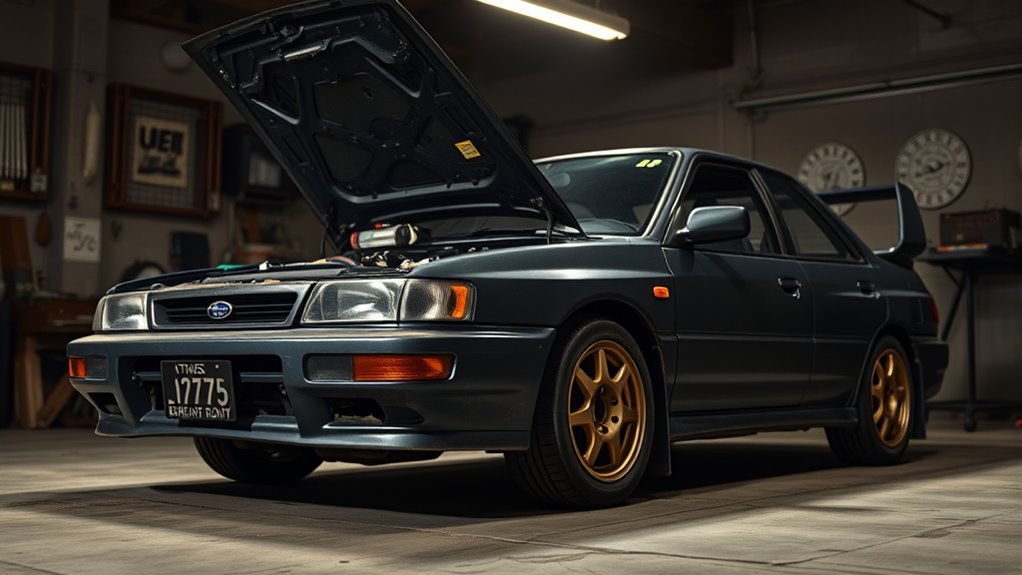
Older Subaru engine specs
| Engine | Displacement | Typical power (varies by market and year) |
|---|---|---|
| EJ20 | 1,994 cc | Varies widely; turbo versions in Japan-market cars |
| EJ22 (SOHC) | 2,212 cc | 130 hp (1989-94), 135 hp (1995-96), 137 hp (1997-98), 142 hp (1999) |
| EJ25 (SOHC EJ251/EJ253) | 2,457 cc | About 162 to 175 hp |
| EJ25 (DOHC) | 2,457 cc | About 155 to 173 hp |
| EJ255 turbo | 2,457 cc | About 210 to 261 hp depending on model (for example 256 hp in the 2005-06 U.S. Legacy GT and Outback XT) |
All EJ engines are 16-valve flat-fours with timing belts. SOHC engines through 1995 are non-interference, but all DOHC engines and SOHC engines from 1998 on are interference engines, so a snapped belt can bend valves. The belt also drives the water pump.
Older Subaru Legacy generations
| Generation | Years | Notes |
|---|---|---|
| First (BC/BF) | 1989-1994 | Introduced the EJ boxer engine; front-wheel drive with optional full-time AWD |
| Second (BD/BG) | 1995-1999 (North America) | Outback started in 1995 as a trim package; AWD standard in North America from 1996 |
| Third (BE/BH) | 1998-2003 | Standard 2.5 L EJ251 in the U.S.; 3.0 L EZ30 flat-six in Outbacks from 2001 |
| Fourth (BL/BP) | 2003-2009 | Turbo 2.5 L derived from the WRX STI engine; H6 available |
Older Subaru Forester generations
- First generation (1997-2002): 2.5 L EJ25 with 165 hp, rising to about 174 hp in later GT versions.
- Second generation (2003-2008): 2.5 L naturally aspirated at about 162 to 173 hp, and a turbo XT added in the U.S. for 2004, reaching 230 hp by 2006.
- Third generation (2008-2013): naturally aspirated 2.5 L at about 169 hp and a 227 to 259 hp turbo XT; ground clearance is listed at about 8.9 in (230 mm).
What to check on an older Subaru
- Head gaskets: the single-layer-gasket EJ251 is known for internal coolant leaks and external seepage. Later multi-layer steel gaskets and the EJ253 improved on this. Look for coolant loss, overheating or oil at the heads.
- Timing belt: ask for proof of replacement, and replace it with the water pump if there is none.
- Rust: check rear arches, sills and subframes, especially on cars that lived through Canadian winters and road salt.
- Driveline: listen for wheel-bearing noise and check for CV-boot tears. Mismatched tyre sizes can strain a full-time AWD system.
- Service history: maintenance records tell you more than mileage on a car this old.
For Outback-specific figures, see our older Subaru Outback specs guide. Compare with modern cars in our Subaru Wilderness specs and 2024 Subaru Impreza specs pages.
Sources: Wikipedia entries on the Subaru EJ engine, Legacy and Forester.
Frequently Asked Questions
What engines did older Subarus use?
Most used the EJ family of boxer fours: the 2.0-litre EJ20, 2.2-litre EJ22 and 2.5-litre EJ25, with turbo versions of the EJ20 and EJ25 in performance models. Some Legacy and Outback models used a flat-six.
How much power did older Subarus make?
The EJ22 made about 130 to 142 hp and the naturally aspirated EJ25 about 155 to 175 hp. Turbo EJ25 engines in cars such as the Forester XT and Legacy GT made roughly 210 to 261 hp.
Do older Subarus have head gasket problems?
The 2.5-litre EJ251 is known for head gasket failures because of its single-layer gasket. Later multi-layer steel gaskets and the EJ253 improved reliability.
Do older Subaru engines have timing belts?
Yes. All EJ engines use timing belts, which also drive the water pump. DOHC engines and SOHC engines from 1998 on are interference designs, so a broken belt can damage valves.
Which older Subaru is best to buy?
It depends on use. Check service history, rust and head gasket condition first, and choose a model with documented timing belt and cooling work rather than the lowest mileage.
Is the Subaru Outback in this guide?
The older Outback is based on the Legacy wagon and is covered in detail in our separate older Subaru Outback specs article.


