

The Subaru Outback Wilderness stands apart with a 2.4-liter turbocharged BOXER engine, 260 horsepower, 277 pound-feet of torque, and standard Symmetrical All-Wheel Drive. It uses an 8-speed CVT and offers 9.5 inches of ground clearance, plus X-MODE for low-traction conditions. With 81 cubic feet of cargo space and a 191.7-inch length, its packaging is practical, but its fuel use, towing limits, and equipment details add more to evaluate.
What Makes the Outback Wilderness Different
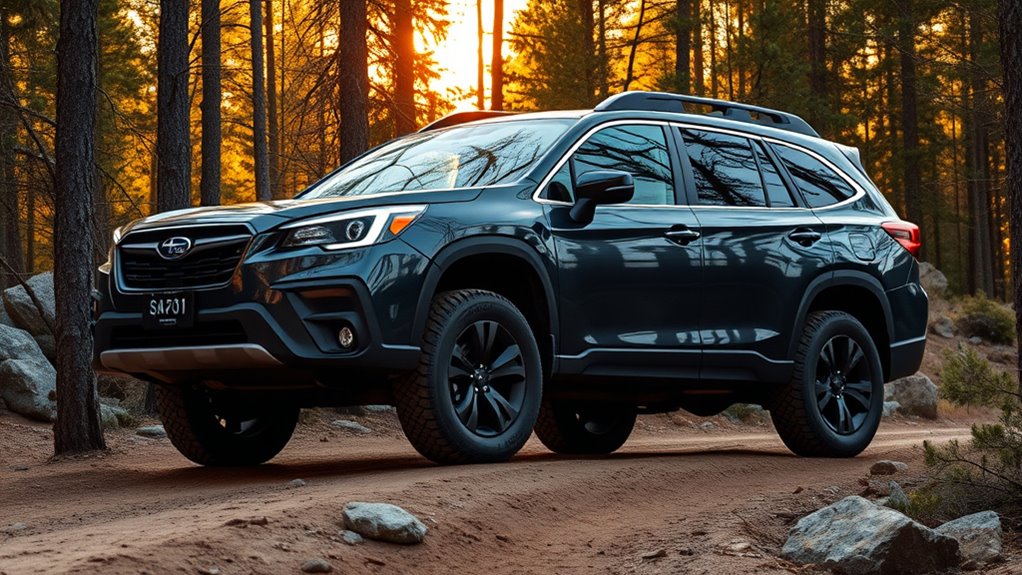
The 2026 Subaru Outback Wilderness distinguishes itself with a turbocharged 2.4-liter SUBARU BOXER engine producing 260 horsepower and 277 pound-feet of torque, giving it stronger low-end performance for off-road driving.
The Subaru Outback Wilderness adds 9.5 inches of ground clearance, which improves breakover and approach angles on rutted trails. Its off-road upgrades include a revised X-MODE system, tuned for more controlled traction on loose or uneven surfaces.
Standard all-terrain tires and retuned suspension support stability while reducing harshness over broken terrain, preserving composure in daily use. The turbocharged engine and SUBARU BOXER engine layout emphasize balanced packaging and accessible torque delivery.
Towing capacity is rated at 3,500 pounds, expanding utility for trailers, bikes, and camping equipment. Overall, the model pairs rugged hardware with practical performance, offering a more capable, freedom-oriented alternative to standard Outback variants without abandoning on-road refinement.
Outback Wilderness Powertrain and Output
Power comes from a 2.4-liter turbocharged SUBARU BOXER engine rated at 260 horsepower and 277 pound-feet of torque, providing the 2026 Outback Wilderness with strong low-end response for off-pavement driving and loaded travel.
The Outback Wilderness powertrain pairs this turbocharged SUBARU BOXER engine with a continuously variable transmission that includes an 8-speed manual mode, allowing more deliberate control when terrain or grade demands it.
Symmetrical All-Wheel Drive is standard, distributing traction with a layout intended for stability on loose or uneven surfaces. Ground clearance measures 9.5 inches, supporting clearance over obstacles and reinforcing off-road capability.
Towing capacity reaches 3,500 pounds, giving the model practical utility for trailers, bikes, or expedition cargo.
Together, these specifications define a chassis and drivetrain package aimed at drivers seeking mobility beyond paved limits, with output tuned for accessible force, predictable response, and the freedom to carry equipment into remote places.
Outback Wilderness Performance On- and Off-Road
Built around a 2.4-liter turbocharged SUBARU BOXER engine producing 260 horsepower and 277 pound-feet of torque, the 2026 Subaru Outback Wilderness is tuned for both everyday pavement use and demanding off-road conditions.
Its 9.5 inches of ground clearance gives the wagon-like crossover a clear advantage in rough terrain, while the X-MODE system, with Dual-Mode settings, calibrates traction for mud, snow, and loose surfaces.
Approach and departure angles of 20 degrees and 22.5 degrees support cleaner obstacle clearance. All-terrain tires come standard, reinforcing its off-road capability without sacrificing road composure.
Towing capacity is rated at 3,500 pounds, extending utility for small trailers and outdoor gear. Fuel economy estimates remain competitive at 21 MPG city and 27 MPG highway.
- Subaru stability on pavement
- Outback Wilderness confidence off-road
- turbocharged SUBARU BOXER engine strength
- Liberation through versatile, efficient travel
Outback Wilderness Dimensions and Cargo Space
Measuring 191.7 inches long, 74 inches wide, and 68.3 inches high, the 2026 Subaru Outback Wilderness occupies a practical footprint that supports both maneuverability and utility. Its dimensions, combined with 9.5 inches of ground clearance, reinforce off-road capability without sacrificing cabin packaging. The Outback Wilderness carries 34.6 cubic feet of cargo space behind the rear seats, enough for expedition-grade equipment and daily cargo. Folding the rear seats reveals a total cargo capacity of 81 cubic feet, creating a flexible load bay for liberated travel.
| Measure | Value | Effect |
|---|---|---|
| Length | 191.7 in | Stable packaging |
| Width | 74 in | Confident stance |
| Height | 68.3 in | Upright utility |
| Ground clearance | 9.5 in | Off-road capability |
| Cargo space | 34.6/81 cu ft | Flexible storage |
The 18-gallon fuel tank supports extended use, complementing the Outback Wilderness’ practical dimensions and cargo-oriented design.
Outback Wilderness Fuel Economy and Range
The 2026 Subaru Outback Wilderness carries an EPA-estimated 21 mpg in city driving, 27 mpg on the highway, and 23 mpg combined, figures that align with its turbocharged 2.4-liter engine and 260-horsepower output. This fuel economy profile positions the Outback Wilderness as a practical choice for drivers seeking mobility without compromise.
With an 18-gallon tank, city driving range reaches about 378 miles, while highway range extends to roughly 486 miles.
- City MPG supports urban commuting.
- Highway MPG improves long-distance freedom.
- All-wheel drive helps balance traction and efficiency.
- 75-mph testing showed about 29 MPG.
In varied driving conditions, the turbocharged engine sustains performance while preserving efficiency.
High ground clearance and all-wheel drive contribute to capability without excessive fuel penalty, reinforcing the model’s technical appeal for drivers who value range, autonomy, and off-pavement readiness.
Outback Wilderness Safety Features
Enhanced EyeSight Driver Assist Technology gives the 2026 Subaru Outback Wilderness a more advanced safety envelope, using upgraded sensors to improve forward monitoring and driver awareness.
Among the core Outback Wilderness features, EyeSight Driver Assist Technology supports Adaptive Cruise Control and lane-related intervention logic, helping maintain spacing and reduce workload on open roads.
Standard safety features include Blind-Spot Warning and Rear Cross-Traffic Alert, which add lateral and rearward detection for cleaner decision-making in dense traffic or tight exits.
Emergency Stop Assist with Safe Lane Selection can apply braking when driver response is absent, while the standard Symmetrical All-Wheel Drive contributes predictable traction across variable surfaces.
Available Hands-Free Assist technology extends highway support with semi-autonomous capability.
Subaru’s ACSI safety rating has placed the Outback Wilderness at number one for seven consecutive years, reflecting a systems-oriented approach to occupant protection and situational control.
Outback Wilderness Interior, Tech, and Comfort
Inside the 2026 Subaru Outback Wilderness, the cabin emphasizes practicality and comfort through a spacious redesign, water-repellent StarTex upholstery, and anodized copper accents that reinforce the model’s rugged character.
The Outback Wilderness interior centers on a 12.1-inch Subaru Multimedia touchscreen, pairing wireless Apple CarPlay and Android Auto with a responsive 1-inch screen interface for navigation, media, and vehicle settings. Heated seats for the front and rear outboard positions extend cold-weather comfort, while a 10-way power-adjustable driver’s seat with lumbar support improves long-distance support.
- Water-repellent upholstery resists mud, moisture, and daily wear
- Rear seat folding expands cargo capacity to 81 cubic feet
- Increased headroom improves cabin freedom and occupant space
- Copper trim and durable materials balance utility with refinement
This layout supports an open, flexible environment suited to active use. The redesigned cabin aims to deliver comfort without sacrificing function, giving passengers a practical and liberated space for travel, gear, and changing conditions.
Outback Wilderness Price, Towing, and Value
Priced from $44,995, the 2026 Subaru Outback Wilderness positions itself as a premium, capability-focused midsize SUV with hardware that supports its off-road intent.
The Outback Wilderness price reflects its rugged design, added ground clearance, and reinforced chassis tuning, all of which expand off-road capabilities without sacrificing everyday usability.
Its 3,500-pound towing capacity adds practical utility for small trailers, bikes, or camping equipment, while the 2.4-liter turbocharged engine delivers 260 horsepower for confident highway merging and trail access.
EPA-estimated fuel economy of 21 MPG city and 27 MPG highway remains competitive given the vehicle’s dimensions and equipment.
As a Consumer Reports Recommended Model, it combines reliability with value, especially for buyers seeking long-term durability and mechanical competence.
In this segment, the Wilderness trim stands out by pairing liberation-oriented adventure hardware with measured operating costs, making its asking price technically defensible for drivers prioritizing capability over image.
Frequently Asked Questions
What Is Special About the Subaru Wilderness?
The Subaru Wilderness stands out for Wilderness Features, Off Road Capability, Interior Comfort, Safety Ratings, Fuel Efficiency, Towing Capacity, Technology Options, Design Aesthetics, Cargo Space, and Customer Reviews, appealing to drivers seeking capable, independent exploration.
What Are the Biggest Issues With the 2026 Subaru Outback Wilderness?
Biggest issues include Outback reliability concerns, modest Fuel efficiency ratings, higher Maintenance costs assessment, and costly pricing. Wilderness off road capability is strong, but Interior space analysis, Technology features overview, Safety ratings comparison, Customer satisfaction feedback, Competitor comparison analysis, Resale value expectations remain mixed.
Is the Outback Wilderness Fast?
Yes—the Outback Wilderness moves like a lifted foxfire, with strong performance metrics and quick acceleration comparison. Reviews note sharp engine responsiveness, balanced handling dynamics, credible off road capability, modest top speed, efficient transmission options, restrained fuel efficiency.
Which Engine Is Better for My Subaru Outback, 3.6 or 2.4 Turbo?
The 2.4 turbo is generally better. In this engine comparison, performance metrics, fuel efficiency, towing capacity, and driving experience favor it; reliability ratings, maintenance costs, resale value, owner reviews, and off road capability remain decisive.
Conclusion
To sum up, the Subaru Outback Wilderness presents a well-rounded specification sheet for drivers seeking capability without excess ceremony. Its turbocharged 2.4-liter BOXER engine, standard all-wheel drive, 9.5 inches of ground clearance, and X-MODE system support confident performance across varied terrain. Practical dimensions, generous cargo volume, and a suitably equipped cabin further enhance its appeal. With strong safety credentials and a reputation for durability, it remains an especially composed choice for adventurous, efficiency-minded households.