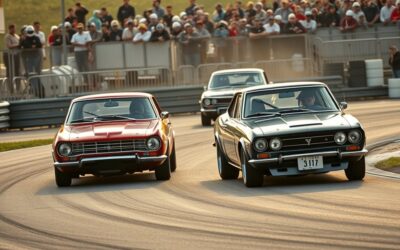
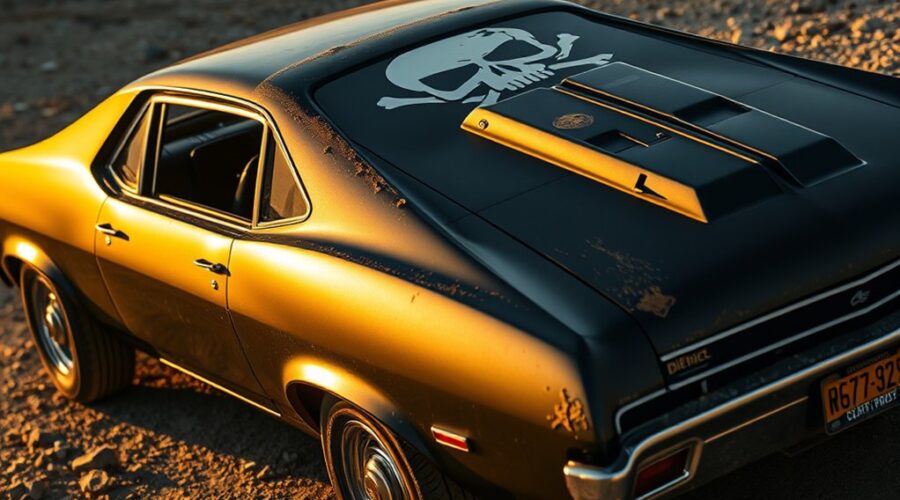
The car in *Death Proof* is a 1971 Chevrolet Nova, chosen for its plain profile and brutal straight-line presence. Tarantino used it to echo earlier American chase films while giving Stuntman Mike a machine that looked ordinary until it moved. Beneath the surface were stunt-ready changes, a TH350 transmission, and a 650 Edelbrock carburetor. Its production history is more complicated than the film suggests, and the surviving cars carry that story forward.
Key Takeaways
- Stuntman Mike’s car is a 1971 Chevrolet Nova built for high-speed stunt work in *Death Proof*.
- Tarantino chose it as a tribute to American muscle-car cinema and earlier Chevy Nova appearances in his films.
- The car featured a matte black finish, low stance, chrome trim, TH350 transmission, and a 650 Edelbrock carburetor.
- *Death Proof* used practical effects only, with real high-speed stunts, including Zoë Bell riding on the hood.
- Five Novas were destroyed during production, leaving a few survivors, including the preserved “Jesus” car.
What Car Is in Death Proof?
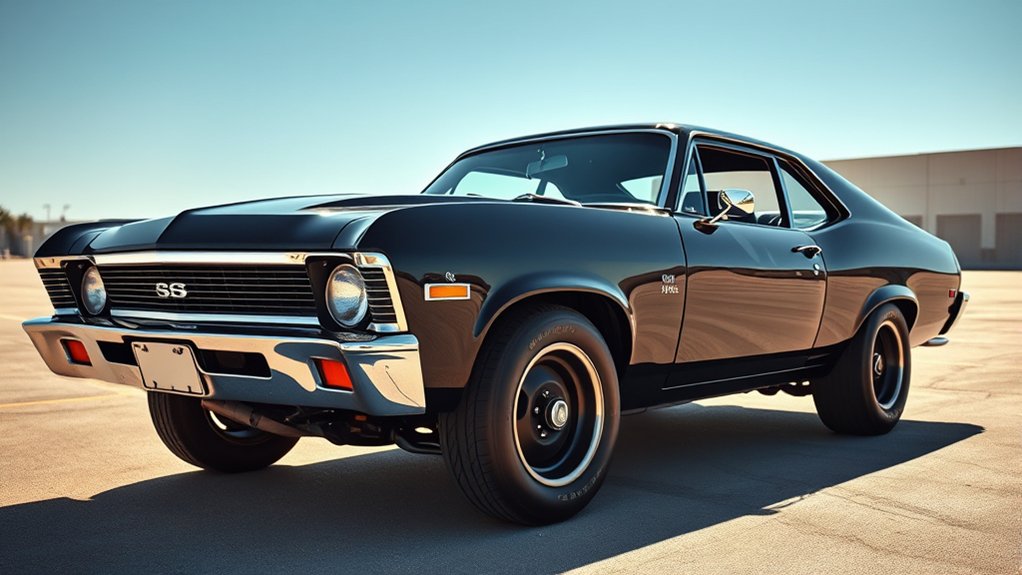
The car at the center of *Death Proof* is a 1971 Chevrolet Nova, the machine driven by Stuntman Mike and presented in the film as “death-proof.” Built for high-speed stunt work, the Nova was fitted with a TH350 transmission and a 650 Edelbrock carburetor to support its performance demands.
Historically, the 1971 Chevrolet Nova belonged to an era when American muscle cars embodied power and defiance, and the film recast that legacy in the service of predatory spectacle. Its body became a mobile instrument of threat, while its mechanical alterations enabled sustained velocity in chase scenes staged at 80 to 100 mph.
The presence of stuntwoman Zoë Bell on the hood, without CGI, underscored the material reality of the danger. Seven Novas were used in production, yet the surviving cars now carry the residue of that labor, including the “Jesus” car, a reminder of cinema’s manufactured peril.
Why Tarantino Chose the Chevy Nova
Tarantino’s choice of the Chevy Nova in *Death Proof* reflected a long-standing fascination with the model, which had already appeared in earlier films such as *Reservoir Dogs* and *Pulp Fiction*.
The car’s presence also carried a deliberate historical signal through its license plate, JJZ 109, a direct homage to Steve McQueen’s Mustang in *Bullitt*.
In this way, the Nova functioned not only as a stunt vehicle but as a carefully constructed citation of American car-cinema history.
Tarantino’s Nova Obsession
Although Quentin Tarantino is best known for revitalizing genre cinema, his choice of the Chevy Nova in *Death Proof* also reflects a deeper fascination with classic American muscle cars and the film history attached to them.
Tarantino treated the Nova as a symbolic death-proof car, not merely transport, but a rolling artifact of rebellion and speed.
- V8 posture, low stance, chromed restraint
- Stuntman Mike’s hard-edged, sunlit machine
- TH350 gearbox, built for violent acceleration
- 650 Edelbrock carburetor feeding raw torque
- Surviving shells, one passed to Buddy Joe Hooker
The Tarantino Chevy Nova becomes an analytical bridge between cinematic memory and mechanical freedom, honoring vintage power while staging liberation through motion.
Bullitt Tribute Plate
Few details in *Death Proof* are as revealing as the Nova’s JJZ-109 license plate, a deliberate nod to Steve McQueen’s Mustang in *Bullitt*.
Tarantino used this tribute to bind *Death*, *Proof*, and *Bullitt* into one lineage of speed, rebellion, and screen myth. The plate does more than quote a classic; it situates the Chevy Nova inside cinema history, where the car becomes an agent of motion and defiance.
This homage reflects Tarantino’s studied reverence for car-chase tradition and his desire to restore the cultural force of such images. By echoing *Bullitt*, he grants the Nova authenticity, nostalgia, and symbolic weight, allowing it to stand not merely as a prop but as a liberated character, charged with memory and menace.
Death Proof Car Specs and Modifications
- Matte black body
- Low-slung stance
- Chrome trim
- Fuel cell beneath
- Close-up survivor
How the Death Proof Stunts Worked
Those matte-black, low-slung machines were only part of the story; the spectacle of *Death Proof* depended on how those cars were made to move and survive.
The production relied on practical effects, using a 1971 Chevrolet Nova and a 1970 Dodge Challenger for chase work, with no CGI to soften the danger or dilute the impact.
Stuntwoman Zoe Bell became central to the film’s legend, riding the Nova’s hood at roughly 80 to 100 mph, a sequence that made bodily risk visible rather than abstract.
Another landmark stunt had the Nova blasted from a cannon, with Buddy Lee Hooker inside to guide the landing, then roll about 160 yards.
Such high-speed crashes were engineered through careful choreography, reinforced with roll cages and upgraded engines in surviving cars.
The result was a liberation of spectacle through material risk, where every impact remained immediate, physical, and historically rooted in old-school stunt craftsmanship.
Death Proof Car Details Fans Notice
The *Death Proof* Nova rewards close inspection, and its details reveal how deliberately Tarantino shaped the car’s on-screen identity. In the Death Proof lineage, the 1971 Chevrolet Nova carries a license plate, JJZ-109, echoing Bullitt and signaling cinematic rebellion. Its TH350 transmission and 650 Edelbrock carburetor gave the stunt cars sharper response, while post-production amplified engine notes turned machinery into pulse.
Fans also notice the chrome rubber duck hood ornament, a sly Convoy reference that softens menace with roadside folklore.
- Black paint, hard edges, and a low stance
- JJZ-109 flashing under harsh daylight
- Chrome duck perched above the grille
- Exhaust sound swelling beyond the frame
- Multiple Novas, one surviving “Jesus” car
Seven Novas served production, yet the set’s craftsmanship matters more than scarcity. Each Chevrolet Nova became a mobile emblem of controlled speed, inviting viewers who value liberation to read the film’s mechanical language as history, not mere decoration.
What Happened to the Death Proof Novas
After filming, the *Death Proof* Novas split into two fates: five were destroyed during production, including one blown apart in a stunt, while only two survived. This outcome reflected the film’s commitment to practical effects and the brutal realism of stunt work.
The seven Chevrolet Novas were not merely props; they were engineered tools, fitted with roll cages and modified engines to endure the violence demanded on set. Among the surviving models, one became the “Jesus” car, preserved for close-up shots and marked by deliberate aging effects that gave the vehicle a hard-won history.
The other surviving Nova later entered the hands of stuntman Buddy Joe Hooker, who upgraded its engine to a 383 block with 425 hp. Together, the remaining cars stand as evidence of a production that treated machinery as both instrument and witness to cinematic freedom.
Frequently Asked Questions
What Are the Specifications of the Death Proof Car?
It is a 1971 Chevrolet Nova, fitted with car modifications including a TH350 transmission, 650 Edelbrock carburetor, special shocks, and a JAZ 12-gallon fuel cell; stunt driving reached 80–100 mph, preserving cinematic realism.
What Were the Cars in Death Proof?
The film featured a 1971 Chevrolet Nova and a 1970 Dodge Challenger, echoing Bullitt-era muscle. Their car chase scenes, precise stunt coordination, and film symbolism underscored a historical, detailed celebration of speed and liberation.
What Does Quentin Tarantino Think of Death Proof?
Tarantino regards Death Proof as his worst film, yet still a proud, playful pastiche. He sees Tarantino’s Inspirations, Film Reception, and Cinematic Techniques as evidence of daring craft, preserving grindhouse liberation despite mixed reactions.
Why Is Stuntman Mike a Killer?
He kills to dominate, not merely to murder. Stuntman psychology reveals craving control, while killer motivations feed on fear; horror tropes mask his impotence. Historically, his violence collapses when liberated women refuse victimhood.
Conclusion
In *Death Proof*, the 1971 Chevrolet Nova stands as more than a stunt car; it is a rolling artifact of American muscle, engineered for speed and cinematic violence. Its TH350 transmission, Edelbrock carburetor, and practical stunt modifications helped shape the film’s tactile realism. Like a steel ghost from the muscle-car era, it carried both menace and homage, linking Tarantino’s tribute to *Bullitt* with the enduring legacy of handcrafted movie stunts and surviving screen icons.