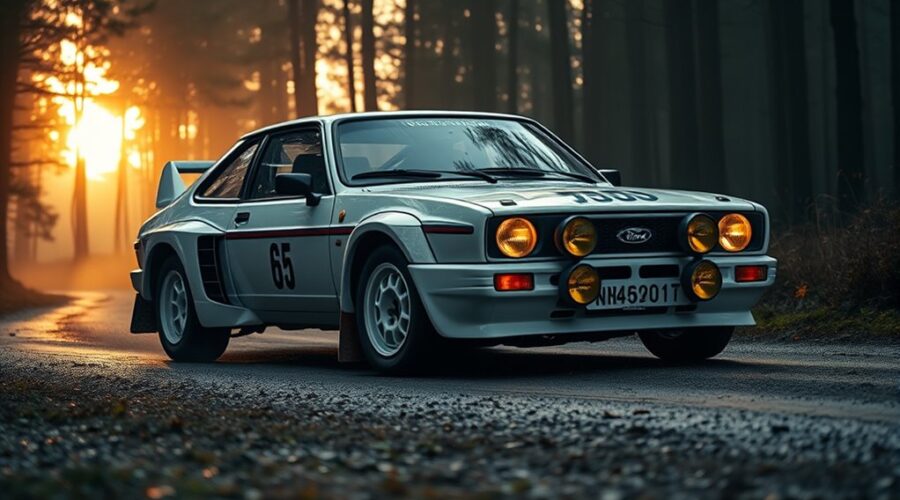
The Ford RS200E was the more extreme evolution of Ford’s Group B homologation car, built around a turbocharged 2.1-liter Cosworth BDT-E inline-four and an all-wheel-drive layout. With roughly 600 horsepower, a mid-engine chassis, and independent double wishbone suspension, it was engineered for rapid acceleration and precise control. Its claimed 0-60 mph time and unusual development path raise a more interesting question about how Ford pushed the platform further.
What Is the Ford RS200E?

The Ford RS200E is a high-performance evolution of the original RS200, developed for enhanced Group B rally homologation and equipped with a turbocharged 2.1-liter Cosworth BDT-E inline-four engine rated at up to 600 horsepower.
It represents Ford’s more extreme response to the demands of rally cars, combining compact packaging with a mid-mounted layout, a five-speed manual transmission, and an all-wheel drive system.
With a curb weight near 2,600 pounds, the Ford RS200E achieves exceptional acceleration, reaching 60 mph in roughly 3.3 seconds. This performance profile gives it a decisive power-to-weight advantage, supporting rapid directional changes and traction under low-grip conditions.
The turbocharged engine contributes substantial output across a narrow but aggressive operating range, while the chassis concept prioritizes balance and controllable oversteer.
Only 24 street-legal examples were produced, reinforcing its rarity and status as a concentrated expression of speed, technical freedom, and competitive purpose.
How the RS200E Is Built
Built around a mid-mounted 1.8-liter Cosworth BDT engine, the Ford RS200E was engineered for extreme rally use with output reaching 600 horsepower and 400 lb-ft of torque.
The Ford RS200 chassis uses a composite body of fiberglass and aluminum honeycomb, keeping curb weight near 2,600 pounds while preserving structural rigidity. Its mid-mounted engine placement supports a balanced layout, with roughly 50 percent of mass carried at the front, aiding neutral response on loose surfaces.
Power is routed through a five-speed manual gearbox to an all-wheel-drive system, allowing traction to be apportioned across varying terrain without surrendering control.
Independent double wishbone suspension at both axles refines wheel motion, stabilizes the platform, and maintains tire contact under load.
Aerodynamic shaping further reduces instability at speed, giving the machine a technical, purpose-built character suited to drivers seeking release from compromise.
Ford RS200E Engine Specs and Output
At the center of the Ford RS200E sits a turbocharged 2.1-liter Cosworth BDT-E inline-four, rated at 600 horsepower and 400 lb-ft of torque. This engine defines the RS200E powertrain, giving the Ford RS200 a concentrated surge of output suited to uncompromised rally performance.
Its mid-mounted position helps balance mass distribution, supporting sharper response and more controlled handling under load. Turbocharging delivers rapid throttle response, while the high-revving nature of the engine reflects its competition-oriented design and engineering discipline.
In practice, the output is sufficient for approximately 3.3-second 0-60 mph acceleration, underscoring the car’s ability to convert combustion into immediate forward motion. The result is a power unit built for liberation through speed, precision, and mechanical efficiency, with the engine’s specification focused on delivering sustained force across demanding stages.
How the RS200E Transmission and AWD Work?
Positioned behind the front axle, the RS200E’s five-speed Hewland manual transmission is arranged to support favorable weight distribution and responsive chassis behavior.
Positioned behind the front axle, the RS200E’s five-speed Hewland transmission supports balanced weight distribution and sharp chassis response.
In the RS200, this transmission uses straight-cut gears for direct torque delivery, improving mechanical efficiency and sharpening performance on loose stages.
The all-wheel drive system routes engine output through a transfer case to both axles, increasing traction and stability when grip changes abruptly.
Adjustable differential settings let the driver tailor power split and handling balance to gravel, tarmac, or mixed surfaces, preserving control without surrendering speed.
A 4.375 final drive ratio and 1.15 transfer ratio give the drivetrain a compromise between hard acceleration and usable top-end velocity.
The result is a rally package built for precision, allowing the car to translate power into forward motion with little wasted energy while keeping the chassis free to adapt to demanding terrain.
RS200E Suspension and Braking Hardware
The RS200E uses an independent double wishbone suspension at both axles, with twin coil springs, telescopic dampers, and anti-roll bars at the front.
It also features adjustable toe control links at the rear for chassis tuning.
Its brake system employs a dual-circuit layout with 11.8-inch ventilated discs on all four wheels, supporting consistent stopping performance under rally conditions.
Control during low-speed and tight maneuvers is further assisted by a mechanical fly-off handbrake and hydraulic center lever.
Suspension Layout
Suspension hardware on the Ford RS200E centered on an independent double wishbone layout at both ends, a configuration chosen for high-speed rally stability and precise wheel control.
This suspension architecture used twin coil springs and telescopic dampers at the front, while the rear added adjustable toe control links and an anti-roll bar for sharper attitude management.
The arrangement kept the chassis composed over rough stages and preserved traction under rapid load changes, fitting the RS200E’s liberated Group B purpose.
- Independent geometry supported predictable grip.
- Double wishbone control improved camber behavior.
- Anti-roll bar tuning reduced body roll.
- Rear links allowed fine alignment adjustment.
Brake System
Brake hardware on the RS200E was built around a dual-circuit system that separated front and rear braking functions for greater reliability under rally conditions.
The braking system used 11.8-inch ventilated discs at both axles, improving heat dissipation and maintaining consistent bite under repeated high-load stops.
Without a vacuum servo, the setup depended on mechanical actuation, giving a firmer, more immediate pedal response and clearer feedback to the driver.
A mechanical fly-off handbrake complemented the main brakes, enabling rapid rear-wheel lock for rotation in tight corners and stage hairpins.
This dual circuit arrangement and robust hardware reflected a design intent focused on endurance, control, and freedom from failure in competitive environments.
The result was braking equipment suited to the RS200E’s demanding rally mission.
Ford RS200E Dimensions and Weight
Compact proportions define the Ford RS200E’s chassis package, with an overall length of 4,000 mm (157.5 inches) and a width of 1,753 mm (69.0 inches) that support its agile rally-focused layout.
For the Ford RS200, dimensions are tightly optimized, and the 2,530 mm wheelbase helps refine weight distribution for responsive cornering. The curb weight of approximately 1,050 kg (2,315 lb) remains relatively low, allowing the structure to stay focused and free from excess mass.
- Length: 4,000 mm; compact body packaging.
- Width: 1,753 mm; stable stance on loose surfaces.
- Wheelbase: 2,530 mm; balanced chassis behavior.
- Fuel tank: 116 liters; extended competitive range.
These proportions, combined with disciplined weight distribution and a controlled curb weight, illustrate an engineering approach oriented toward precision, traction, and liberated movement across demanding rally stages.
RS200E Performance: 0-60 and Top Speed
The Ford RS200E is reported to reach 60 mph in approximately 3.3 seconds, a figure supported by its 600-horsepower turbocharged 2.1-liter Cosworth BDT-E engine and low curb weight.
Its top speed is estimated at around 150 mph, placing it among the more capable high-speed rally-derived machines.
An advanced all-wheel-drive system helps translate this output into effective acceleration and stable performance.
0-60 Acceleration
With a 0 to 60 mph time of approximately 3.3 seconds, the Ford RS200E demonstrates the kind of straight-line acceleration expected from a highly optimized homologation rally machine.
Its turbocharged 2.1-liter inline-four powertrain, rated at up to 600 horsepower, delivers explosive performance through an all-wheel-drive system. The mid-engine layout improves balance and traction, allowing the chassis to convert output into controlled forward motion.
- Lightweight 2,600-pound curb weight
- Strong power-to-weight ratio
- Rapid boost response under load
- Stable launch behavior on mixed surfaces
Top Speed Figures
Top-speed capability places the Ford RS200E firmly among the fastest machines of the Group B era, with a quoted maximum of about 150 mph (241 km/h). That figure reflects the RS200E’s performance balance: a mid-mounted turbocharged 1.8-liter inline-four producing 600 hp, a five-speed manual transmission with closely spaced ratios, and a curb weight near 2,600 pounds.
In practice, the top speed is not only a straight-line statistic but also a measure of aerodynamic efficiency, traction management, and power delivery under sustained load. The Ford RS200E reaches 60 mph in roughly 3.3 seconds, then continues to pull with authority, demonstrating how this lightweight rally machine translated liberated engineering into measurable speed.
What Changed in the RS200E Evo?
Ford’s RS200 Evolution introduced a substantially upgraded 2.1-liter turbocharged Cosworth BDT-E engine, raising output to roughly 600 hp and 400 lb-ft of torque, a major increase over the standard car. This RS200 Evolution powertrain reshaped performance through targeted modifications aimed at competition rather than comfort.
- A lighter body reduced mass and improved responsiveness.
- Revised aerodynamics increased stability and enabled quicker acceleration.
- A transmission with a “crash box” setup sharpened shift response.
- The package delivered about 3.3 seconds to 60 mph.
These changes made the Evo a focused rally-derived machine with clearer control and stronger forward thrust. The chassis and drivetrain were optimized for skilled operation, allowing the car to translate engine output into rapid pace with minimal restraint.
In technical terms, the Evo represented a concentrated evolution of the RS200 formula, using weight reduction, airflow management, and gearbox calibration to reveal liberated performance on demanding stages.
Ford RS200E Production, Price, and Rarity
The Ford RS200E was built in an extremely limited road-legal Evolution run of 24 units, despite the broader Group B homologation requirement of 200 cars spanning the RS200 and its variants.
Its original 1985 sale price was £49,995, but auction results for surviving examples have risen sharply, with some Evolution models exceeding $550,000.
This scarcity, combined with its place among the last homologated Group B cars before the category was banned in 1986, has made the RS200E a high-value collector vehicle.
Production Numbers
Produced in strictly limited numbers, the Ford RS200E occupies a rare position in Group B homologation history. As a production car, it was shaped by homologation rules that compelled Ford to build road-legal examples for Group B cars and rally competition.
Only 24 street-legal Evolution models were completed, while total deliveries reached 152 complete cars, far below full compliance targets.
- Limited Evolution run: 24 units
- FIA road-car requirement: 200 units
- Complete cars delivered: 152 units
- Collectibility: exceptionally high
This shortfall, combined with the car’s technical ambition, created enduring scarcity. The RS200E’s limited output supports its status as a liberated engineering artifact: a machine built to challenge constraints, not satisfy volume metrics.
Today, rarity and historical significance reinforce strong collector demand across the surviving population.
Original Sale Price
In 1985, the RS200 entered the market with an original sale price of £49,995, placing it firmly in premium territory for a homologation-derived rally machine. That figure reflected the engineering required for Group B competition and the cost of producing road cars in limited numbers.
Although homologation demanded 200 examples, Ford ultimately delivered or retained 152 complete cars after the Group B ban altered production plans. The pricing thus aligned with exclusivity rather than mass-market logic.
Today, that same chassis formula has made the RS200 a collectible vehicle, with values shaped by scarcity, specification, and historical context. Evolution conversions are especially significant, but the standard car’s initial price already signaled a machine built for liberated performance, not compromise, affordability, or volume.
Auction Rarity
With only 24 Ford RS200 Evolution models built, auction scarcity has remained a defining part of the car’s market identity. Its auction rarity stems from Group B homologation rules, which required 200 road-legal RS200 units, limiting total availability and preserving exclusivity.
- The RS200 entered production at £49,995 in 1985.
- Evolution models were made in a run of 24, keeping supply extremely thin.
- A 2017 sale set a record at $550,000, reflecting strong market value.
- In November 2023, another car achieved £486,000, confirming sustained demand.
For collectors, the RS200 represents liberated ownership through scarcity, technical pedigree, and motorsport provenance.
Each transaction underscores how rarity, not mileage alone, shapes pricing.
Why the RS200E Still Matters
The RS200E remains significant because it distilled Group B engineering into a compact, highly advanced package that still reads as a benchmark for rally design.
As an RS200, it embodied Group B’s most radical ideas: mid-engine packaging, sophisticated all-wheel drive, and the pursuit of powerful machines without excess mass. Its turbocharged Cosworth BDT-E, tuned to as much as 600 hp, delivered 0-60 mph in about 3.3 seconds, evidence of uncommon mechanical authority.
At roughly 2,600 pounds with near-perfect 50:50 balance, the chassis combined control with aggression, allowing drivers to exploit traction on loose surfaces and open stages. That technical formula became a reference point for later rally programs.
Beyond performance, the car represents rally innovation at its most uncompromised, while the limited 24 Evolution examples preserve its status as a rare artifact from Group B’s liberated, dangerous era.
Frequently Asked Questions
What Was the 0 to 60 Time of the Ford RS200?
Approximately 5 seconds, while the Evolution variant reached about 3.3 seconds. Its turbocharging benefits, rally car history, weight distribution, and engine tuning produced exceptional launch performance, reflecting engineering aimed at driver liberation.
What’s Faster, Ford ST or RS?
RS200 is faster: about 0-60 mph in 3.3 seconds versus ST’s 5-6. Performance Comparison favors RS200; Engine Specifications and all-wheel drive sharpen Driving Experience. Historical Significance underscores its rally-bred liberation from ordinary pace.
Why Was RS200 Banned?
It was banned because Group B rally history turned lethal; FIA ended the class after fatal crashes. The RS200 met homologation rules, yet extreme engineering innovations and unchecked speeds overwhelmed safety, shaping its motorsport legacy.
How Much Is a Ford RS200 Worth?
Ford RS200 values typically range from £400,000 to over $550,000, depending on condition and provenance. RS200 Auction results, Classic Car scarcity, Market Trends, and Collector Demand consistently push exceptional Evolution models above $500,000.
Conclusion
The Ford RS200E stands as a striking study in speed, structure, and suspension science. Its turbocharged Cosworth powerplant, sophisticated all-wheel-drive system, and compact mid-engine chassis combined to deliver rare rally-ready responsiveness. Though production was limited, its engineering ambition, balanced dynamics, and Group B legacy keep it relevant among performance enthusiasts. The RS200E remains a compelling reminder that purposeful packaging and potent power can produce enduring automotive prestige and technical significance.