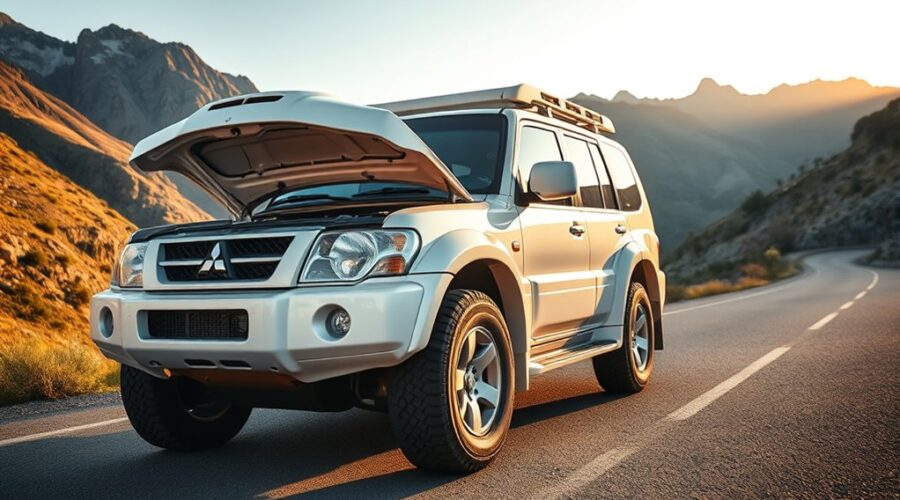
The Mitsubishi Pajero Evolution is a rare homologation SUV built for Dakar success, not everyday comfort. It pairs a 3.5-liter DOHC V6 with a 5-speed automatic and shiftable 4WD, producing 275 bhp and 256 lb-ft of torque. Its compact body, wide stance, and 1,970 kg curb weight shape a surprising driving character. The details behind its rally roots, street-legal spec, and collector status make it more than a niche off-roader.
Key Takeaways
- The Mitsubishi Pajero Evolution is a 1997–1999 homologation special built for Dakar Rally competition.
- Its 3.5-liter 24-valve DOHC V6 produces 275 bhp and 256 lb-ft of torque.
- A 5-speed automatic transmission and shiftable 4WD system deliver strong traction and flexibility.
- Key dimensions are 4,075 mm long, 1,875 mm wide, 1,915 mm high, with a 2,420 mm wheelbase.
- About 2,693 road-legal units were produced, making it rare and highly collectible.
What Is the Mitsubishi Pajero Evolution?
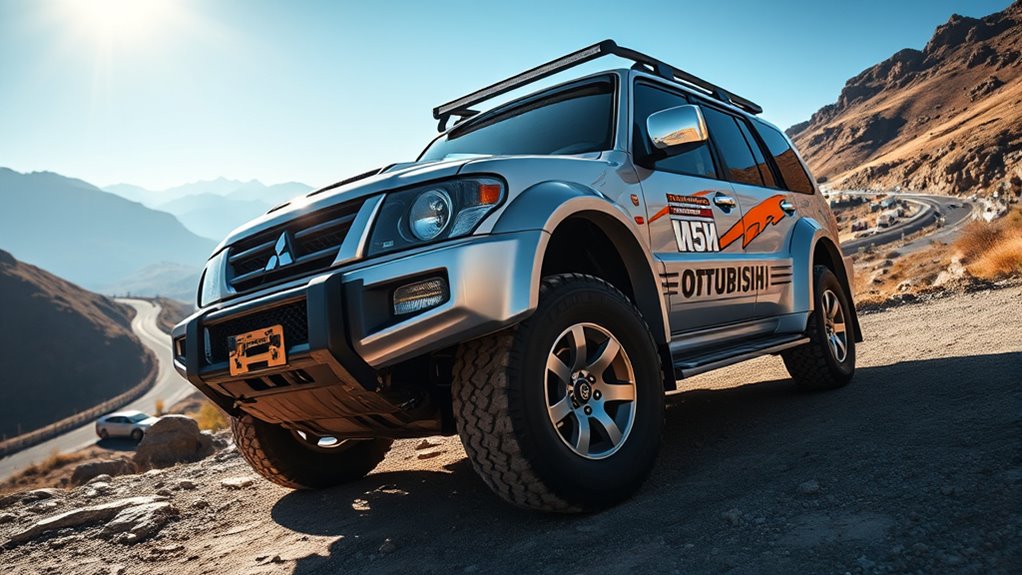
The Mitsubishi Pajero Evolution was a homologation special produced from 1997 to 1999 for Dakar Rally competition, with about 2,693 road-legal units built.
A rare homologation special, built for Dakar and limited to just 2,693 road-legal units.
The Mitsubishi Pajero Evolution served as a street-legal expression of Mitsubishi’s rally program, created to satisfy competition rules while preserving the rugged character needed for desert racing. It was engineered with a distinctive body, including wide fenders and an aerodynamic shape that supported stability over rough terrain.
The model became known for combining practical utility with a focused performance identity, reflecting a machine built for controlled movement across difficult ground rather than comfort alone. Its limited production and direct link to Dakar success made it a significant example of purpose-built off-road design.
For drivers and enthusiasts seeking mechanical freedom, it represents an uncommon blend of legality, endurance, and motorsport heritage. Mitsubishi later extended this reputation through repeated Dakar victories, reinforcing the model’s place in off-road competition history.
Pajero Evolution Engine and Drivetrain
Power comes from a 3.5-liter 24-valve DOHC V6 6G74 engine, rated at 275 bhp at 6,500 rpm and 256 lb-ft of torque at 3,000 rpm, giving the Pajero Evolution strong response for demanding off-road use.
In the Pajero Evolution engine and drivetrain, output is routed through a 5-speed automatic transmission with a torque converter, supporting smooth, controlled shifts under load. A shiftable 4WD system lets the driver choose traction suited to changing surfaces, from loose gravel to hard-packed tracks.
This setup favors confident movement and mechanical freedom over rigidity, matching the vehicle’s rally-bred intent. The drivetrain works with a curb weight of 1,970 kg, helping maintain stability at speed across rough ground.
Wider track width and independent suspension further improve grip and composure, making the package more capable than standard Pajero models while remaining focused on durability, traction, and practical off-road performance.
Mitsubishi Pajero Evolution Dimensions
Dimensions play a central role in the Mitsubishi Pajero Evolution’s off-road character, with a 2,420 mm wheelbase that supports stability and controlled handling over uneven ground. These dimensions give the SUV a compact yet purposeful stance, helping it navigate demanding terrain without unnecessary bulk.
Its overall length of 4,075 mm contributes to a balanced profile and a cabin that feels accommodating for occupants. At 1,875 mm wide, the Pajero Evolution presents strong road presence and improved lateral stability, useful on loose surfaces and narrow trails.
The 1,915 mm height supports generous ground clearance, reinforcing its capability in rugged conditions. With a curb weight of 1,970 kg, the model combines structural substance with a level of agility suited to rally-focused use.
Together, these dimensions define a machine built for freedom of movement, practical space, and confident off-road function.
How the Pajero Evo Drives
That compact footprint feeds directly into how the Mitsubishi Pajero Evolution drives, giving it a planted feel that suits both fast roads and rough terrain.
Its 3.5-liter V6 delivers 276 hp and 256 lb-ft of torque, so responses stay immediate rather than sluggish. The 1,970 kg curb weight is substantial, yet it does not dull the chassis; instead, it helps settle the truck at speed and on uneven ground.
An independent suspension setup improves control by smoothing broken surfaces while preserving body stability. Steering feedback is remarkably clear for a body-on-frame SUV, which gives the driver a stronger sense of placement and motion.
A 50/50 split center differential and Torsen differentials add dependable traction, keeping power usable when surfaces change quickly.
The result is a capable, well-balanced machine that feels composed, direct, and mechanically honest.
Why Mitsubishi Built the Pajero Evolution
Mitsubishi built the Pajero Evolution as a homologation special for the Dakar Rally, and it was produced in limited numbers to satisfy competition rules between 1997 and 1999. The goal was to translate proven rally experience into a road-legal SUV with real competition credibility.
Built as a Dakar homologation special, the Pajero Evolution brought rally-bred credibility to a road-legal SUV.
About 2,693 units were made, giving the model enough exclusivity to meet regulatory demands while still reaching buyers. Its engineering drew on Mitsubishi’s long record in the Dakar Rally, where the Pajero platform secured 12 victories from 1985 to 2007.
The Evolution used a 3.5-litre V6 with 276 hp, balancing performance and daily usability. Wide fenders and winglets were fitted to improve airflow and stability on rough terrain.
The result was a machine shaped by liberation from ordinary SUV limits, combining rally function, rugged speed, and a distinctive identity in its era.
Street-Legal V55W Specs
The street-legal V55W version of the Mitsubishi Pajero Evolution is centered on a 3.5-liter DOHC V6 rated at 276 horsepower and 256 lb-ft of torque.
Its 5-speed automatic transmission and shiftable 4WD system support the model’s performance-oriented off-road setup.
Production was limited to about 2,693 units between 1997 and 1999 for Dakar Rally homologation.
V55W Engine Specs
A homologation special, the street-legal V55W Pajero Evolution pairs a 3.5-liter 24-valve DOHC V6 with 275 bhp at 6,500 rpm and 256 lb-ft of torque at 3,000 rpm.
These v55w engine specs deliver a broad power band suited to controlled acceleration and confident off-road progress.
- 3.5-liter DOHC V6
- 275 bhp at 6,500 rpm
- 256 lb-ft at 3,000 rpm
- Torque converter automatic with shiftable 4WD
The drivetrain supports traction freedom on loose surfaces, while the 1,970 kg curb weight adds planted stability.
A 2,420 mm wheelbase and 9.6-inch ground clearance help it clear rough terrain with composure.
The package reflects Mitsubishi’s rally-focused engineering, balancing usable output with durability and mobility.
Homologation Production Numbers
Produced from 1997 to 1999, the street-legal V55W Pajero Evolution was built in a limited run of about 2,693 units for homologation purposes. This figure reflects Mitsubishi’s strategy to qualify a Dakar Rally contender for public roads while preserving its competition-focused identity.
Based on the second-generation Pajero, the model combined rally intent with legal registration, giving buyers access to a machine shaped by motorsport rather than convention. Its rarity remains central to its appeal, as the low production number signals exclusivity and purpose.
Wide fenders, winglets, and the 3.5-litre V6 further reinforced its specialized character. For collectors and enthusiasts seeking liberation from ordinary SUVs, the homologation-built V55W stands as a compact statement of performance and mechanical freedom.
Dakar Rally History and Wins
The Mitsubishi Pajero Evolution debuted in the Dakar Rally in 1997, returning the brand to one of off-road racing’s toughest stages after earlier Mitsubishi successes.
From 1997 to 2007, it collected nine victories, supported by race-focused changes such as a wider stance and upgraded suspension in the T2 class.
That record established the Pajero line as a long-standing benchmark in Dakar history and earned Mitsubishi the Guinness World Records title for most Dakar Rally wins by a manufacturer.
Dakar Debut And Development
Arriving as a homologation special for off-road competition, the Mitsubishi Pajero Evolution made its Dakar Rally debut in 1997 and immediately proved its capability by winning the event in both 1997 and 1998.
The Dakar debut reflected a focused development path built to satisfy T2 class rules while retaining rugged utility and freedom-oriented performance.
- Purpose-built for off-road competition
- 2,693 road-legal units produced
- Immediate Dakar victory in 1997
- Repeat success in 1998
Its robust chassis and terrain-ready setup supported confident movement across harsh rally landscapes.
In broader context, the Pajero line accumulated 12 Dakar wins from 1985 to 2007, giving Mitsubishi a Guinness World Records title.
Victory Timeline And Milestones
Mitsubishi’s off-road rally record is best understood through its Dakar timeline, which began with the Pajero Evolution’s debut in 1983 and soon produced its first victory in 1985 after just three attempts. This victory timeline shows steady progress toward competitive freedom.
| Year/Span | Milestone |
|---|---|
| 1983 | Dakar debut |
| 1985 | First win |
| 1985–2007 | 12 total wins |
| 1997–2007 | Nine wins aided by Pajero Evolution |
| Guinness record | Most wins by a manufacturer |
The sequence reflects disciplined development rather than chance. Each milestone expanded Mitsubishi’s authority in desert racing, while the Pajero Evolution remained central to repeated success. For readers seeking proof of engineering independence, the timeline demonstrates how capability turned into dominance across decades.
Rally Legacy And Records
Carving out an enduring place in Dakar history, the Pajero Evolution collected 12 rally victories between 1985 and 2007, becoming one of the most successful off-road competition vehicles ever built.
Its rally legacy began with a Paris-Dakar debut in 1983, then a first win in 1985 on the third attempt.
- 12 Dakar wins
- 1983 debut
- 2,500 T2 units
- Guinness record holder
Built for the T2 class, the homologated Pajero Evolution translated engineering into freedom over hostile terrain, sustaining high-speed control where limits usually constrained rivals.
Mitsubishi’s dominance earned Guinness World Records recognition for Most Dakar Rally Wins by a Manufacturer, confirming a record shaped by durability, speed, and repeatable performance.
Production Numbers and Collector Appeal
Approximately 2,693 Mitsubishi Pajero Evolution models were produced between 1997 and 1999, with most built to satisfy homologation requirements for the Dakar Rally.
These production numbers place the model among the rarer Mitsubishi performance SUVs, and scarcity has become central to its collector appeal.
As a homologation special, it stands as a direct artifact of Mitsubishi’s off-road motorsport era, linking road use with competition intent.
Its distinctive bodywork, rally-derived chassis tuning, and JDM status distinguish it from ordinary Pajero variants and strengthen demand among enthusiasts.
The wider market for vintage SUVs has also raised interest, with well-preserved examples sometimes commanding six-figure prices.
For collectors, the Pajero Evolution represents limited output, cultural significance, and a clear motorsport identity.
That combination makes it not merely an unusual SUV, but a historically important automotive symbol.
Buying a Pajero Evolution: Common Issues
Buying a Pajero Evolution requires careful inspection, because its low-volume, rally-focused design brings several practical ownership challenges. Limited parts sharing with other Mitsubishi models can make replacements slow and costly, so buyers should confirm availability before purchase. A pre-purchase inspection should focus on oil leaks, especially around the engine and transmission, and verify stable oil pressure during operation.
- Check the underbody and wheel arches for rust or corrosion, which can erode off-road confidence.
- Examine bushings and shocks, since the suspension’s performance tuning can accelerate wear.
- Review service history for drivetrain stress, maintenance records, and any modifications.
- Confirm that unique components are intact and functioning, because scarcity raises repair risk.
A well-documented example can still deliver durable capability, but neglected units may demand significant restoration.
Frequently Asked Questions
What Are the Key Features of the Mitsubishi Pajero Evo?
Its key features include a 3.5-liter V6, four-wheel drive, automatic transmission, wide track, independent suspension, vented aluminum hood, and broad fenders, delivering strong Off Road Capability, stability, and confident handling on rough terrain.
Which Is the Best Pajero Engine?
The 3.5-liter V6 6G74 is widely regarded as the best Pajero engine. Engine Comparisons favor its powerful, proven, polished blend of 275–280 bhp, strong torque, and rugged reliability for liberated, versatile driving.
How Much HP Can a Stock Evo Handle?
A stock Evo typically handles around 350–400 horsepower with proper Evo Modifications, while remaining reliable. Beyond that, stress on drivetrain, cooling, and balance rises. Careful tuning preserves capability, but limits depend on engineering and maintenance.
Which EVO Has the Best Engine?
Engine Comparisons suggest the Evo X MR’s 4B11T often wins for balance, strength, and tunability, while earlier 4G63 engines remain legendary for raw potential. Which Evo has the best engine depends on priorities.
Conclusion
The Mitsubishi Pajero Evolution remains a rare echo of Dakar’s brutal theater, a road-going machine shaped by sand, endurance, and ambition. Its 3.5-liter V6, compact stance, and shiftable 4WD system give it the composure of a seasoned competitor, while its limited production preserves its mystique. For collectors, it is more than a homologation special; it is a tangible reminder of an era when rally-bred engineering was built to conquer both stage and street.