
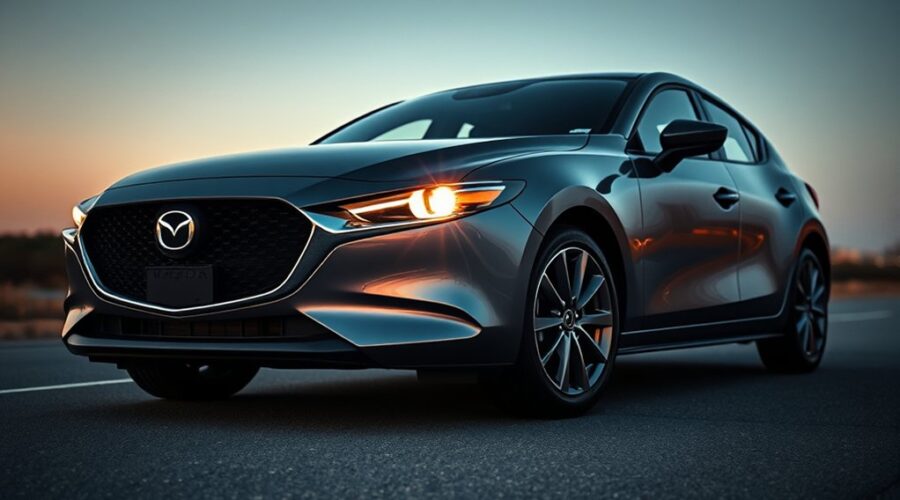
The 2026 Mazda3 hatchback AWD is sold in Canada as the Mazda3 Sport with Mazda’s i-Activ all-wheel drive. AWD is available on the GS with the Luxury Package and on the GT, and it is standard on the GT Turbo, which makes up to 250 hp on premium fuel.
Natural Resources Canada rates the AWD automatic at 8.3 L/100 km combined, against 7.9 for the front-drive automatic. The turbo AWD is rated at 8.9 L/100 km combined.
The main differences come down to drivetrain, power, fuel use, and trim. The standard 2.5-litre engine makes 186 horsepower, while the GT Turbo reaches 250 horsepower and 320 lb-ft of torque on 93-octane premium fuel.
Quick Answer
The 2026 Mazda3 Sport offers 186-hp front- and all-wheel-drive configurations plus a GT Turbo with standard AWD. The turbo produces up to 250 hp and 320 lb-ft on premium fuel. Automatic FWD is the most fuel-efficient Canadian configuration at 7.9 L/100 km combined.
Key Takeaways
- Canadian GX and GS models use the 186-hp Skyactiv-G 2.5 engine and front-wheel drive as standard.
- i-Activ AWD is available with the GS Luxury Package and GT, while the GT Turbo includes AWD as standard.
- The GT Turbo makes 250 hp and 320 lb-ft on 93-octane fuel, or 227 hp and 310 lb-ft on 87 octane.
- The hatchback offers 569 litres of cargo volume behind the rear seats and 1,334 litres with them folded to the ceiling.
- GX and GS use 16-inch wheels, while GT and GT Turbo models use 18-inch wheels.
Which Mazda3 hatchback AWD and turbo trims are offered?
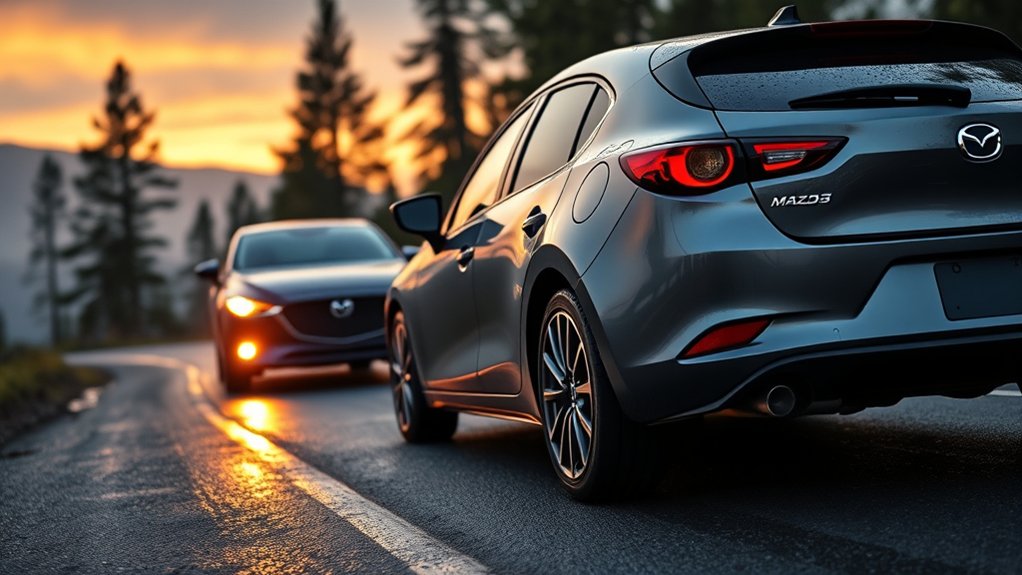
Yes. The 2026 Mazda3 Sport offers both i-Activ AWD and a turbocharged 2.5-litre engine, but availability depends on trim. Front-wheel drive remains standard on the lower Canadian configurations.
According to Mazda Canada’s 2026 Mazda3 Sport information, i-Activ AWD is optional on the GS when equipped with the Luxury Package and on the GT. The GT Turbo uses AWD as standard.
Mazda says the i-Activ AWD system monitors vehicle and road-condition information continuously and can adjust torque distribution as conditions change. It works alongside G-Vectoring Control Plus, which uses small engine-torque and braking adjustments to help the car respond more smoothly through turns.
The transmission choice also depends on configuration. GX and GS models use a six-speed automatic. GT buyers can choose an automatic or an available six-speed manual with front-wheel drive, while the GT Turbo uses the six-speed automatic and AWD.
Mazda Canada’s 2026 pricing and packaging announcement confirms the following drivetrain choices.
| Configuration | Drivetrain | Transmission |
|---|---|---|
| GX / GS | FWD | 6-speed automatic |
| GS Luxury Package | FWD or available AWD | 6-speed automatic |
| GT | FWD or available AWD | 6-speed manual or automatic, depending on drivetrain |
| GT Turbo | AWD | 6-speed automatic |
Mazda3 Hatchback Engine, Horsepower, and Torque
The 2026 Mazda3 Sport has two versions of Mazda’s 2.5-litre four-cylinder engine. The naturally aspirated Skyactiv-G 2.5 makes 186 horsepower and 186 lb-ft of torque, while the turbocharged version produces substantially more torque at lower engine speeds.
The standard engine is a 2,488 cc DOHC 16-valve inline-four with direct fuel injection. It develops 186 hp at 6,000 rpm and 186 lb-ft at 4,000 rpm, with a 13.0:1 compression ratio and a 6,500 rpm redline.
The Skyactiv-G 2.5 T Dynamic Pressure Turbo uses a lower 10.5:1 compression ratio. With 93-octane gasoline, it produces 250 hp at 5,000 rpm and 320 lb-ft at 2,500 rpm.
You do not have to use premium fuel to operate the turbo. Mazda lists output of 227 hp at 5,000 rpm and 310 lb-ft at 2,000 rpm when running 87-octane regular gasoline.
A major difference between the two engines is not only peak horsepower but also how early the turbo produces its additional torque.
| Engine | Horsepower | Torque | Fuel |
|---|---|---|---|
| Skyactiv-G 2.5 | 186 hp | 186 lb-ft | Regular unleaded |
| Skyactiv-G 2.5 T | 250 hp on 93 octane; 227 hp on 87 | 320 lb-ft on 93 octane; 310 lb-ft on 87 | Regular permitted; premium required for maximum output |
Mazda3 Hatchback Fuel Economy, Acceleration, and Handling
For Canadian buyers, the most useful fuel-economy figure is 7.9 L/100 km combined for the naturally aspirated Mazda3 Sport with front-wheel drive and the six-speed automatic. AWD and turbo models use more fuel.
The 2026 Natural Resources Canada Fuel Consumption Guide lists four Mazda3 five-door powertrain combinations.
| Configuration | City | Highway | Combined |
|---|---|---|---|
| 2.5 FWD automatic | 8.9 L/100 km | 6.8 L/100 km | 7.9 L/100 km |
| 2.5 FWD manual | 9.5 L/100 km | 6.9 L/100 km | 8.3 L/100 km |
| 2.5 AWD automatic | 9.3 L/100 km | 7.0 L/100 km | 8.3 L/100 km |
| 2.5 Turbo AWD automatic | 10.1 L/100 km | 7.5 L/100 km | 8.9 L/100 km |
A single 0–60 mph or 0–100 km/h time does not accurately describe the whole lineup because the Mazda3 Sport comes with several drivetrain and transmission combinations. Mazda does not publish one acceleration figure for all Canadian versions, so a blanket 7.5-second claim can be misleading.
What is consistent across the range is the chassis layout. The Mazda3 uses electrically assisted rack-and-pinion steering, a MacPherson-strut front suspension, and a torsion-beam rear suspension.
G-Vectoring Control Plus also works in the background. It can make small adjustments to engine torque and braking to support smoother weight transfer and stability when you steer into and out of a corner.
Mazda3 Hatchback Dimensions, Cargo Space, and Weight
The 2026 Mazda3 Sport remains a compact hatchback, measuring about 4,459 mm long with its licence-plate holder and riding on a 2,725 mm wheelbase. Cargo volume is 569 litres behind the rear seats.
With the rear seats folded and cargo measured to the ceiling, available volume increases to 1,334 litres. That is roughly 20.1 cubic feet behind the seats and 47.1 cubic feet in the larger folded-seat measurement.
Curb weight changes significantly with drivetrain. A manual FWD model weighs about 1,361 kg, while an automatic naturally aspirated FWD model is about 1,388 kg. The naturally aspirated AWD configuration rises to about 1,499 kg, and the turbo AWD model is about 1,550 kg.
| Measurement | 2026 Mazda3 Sport |
|---|---|
| Wheelbase | 2,725 mm (about 107.3 in.) |
| Overall length | 4,459 mm with licence-plate holder (about 175.6 in.) |
| Body width | 1,796 mm (about 70.7 in.) |
| Height | 1,440 mm (about 56.7 in.) |
| Cargo behind rear seats | 569 L (about 20.1 cu. ft.) |
| Cargo with rear seats folded | 1,334 L to ceiling (about 47.1 cu. ft.) |
The added mass of AWD and the turbo powertrain helps explain why specifications such as fuel consumption differ across configurations. If cargo capacity matters most, the hatchback body remains the practical advantage over the Mazda3 sedan.
Mazda3 Hatchback Wheels, Brakes, and Suspension
The 2026 Mazda3 Sport does not use 18-inch wheels on every trim. GX and GS models use 16-inch alloy wheels, while GT models move to 18-inch alloys. The GT Turbo also uses 18-inch wheels with a black finish.
The standard 16-inch setup uses 205/60R16 tires. GT models use 215/45R18 tires, which have a shorter sidewall and give the upper trims a more aggressive appearance.
Underneath, Mazda uses an independent MacPherson-strut front suspension with coil springs and a stabilizer bar. The rear suspension is a torsion-beam design. Electric power-assisted rack-and-pinion steering completes the basic chassis layout.
Brake hardware also changes with drivetrain. Naturally aspirated FWD cars use 280 mm ventilated front discs, while AWD versions use larger 295 mm ventilated front discs. Rear braking is handled by 265 mm solid discs.
ABS and electronic brake-force distribution help control braking force. These systems work with the wider stability-control package rather than changing how you normally operate the brake pedal.
How Safe Is the 2026 Mazda3 Hatchback?
The 2026 Mazda3 hatchback earned an IIHS Top Safety Pick+ designation. IIHS gives the hatchback Good ratings in its small-overlap front, updated moderate-overlap front, and updated side evaluations.
The IIHS 2026 Mazda3 hatchback rating also lists Good pedestrian front-crash-prevention performance, while its vehicle-to-vehicle front-crash-prevention system receives an Acceptable rating.
Canadian GX models already include a broad set of driver-assistance features. These include Mazda Radar Cruise Control with Stop & Go, Smart Brake Support Front, Lane-Departure Warning, Lane-Keep Assist, Driver Attention Alert, High Beam Control, Blind Spot Monitoring, and Rear Cross-Traffic Alert.
Higher trims add features such as a 360-degree View Monitor, Traffic Sign Recognition, front and rear parking sensors, Cruising and Traffic Support, and additional rear braking assistance. Availability still depends on trim, so compare the exact equipment on the vehicle you are considering.
Related Mazda3 guides
For the turbo engine in detail, see our Mazda3 Turbo AWD specs and Mazda3 hatch turbo specs. The standard engine is covered in our Mazda3 hatchback 2.5 specs, and the previous model year is in our 2025 Mazda3 specs.
Sources
- Mazda Canada: 2026 Mazda3 Sport power, trim, AWD, fuel-economy, technology, and wheel information.
- Mazda Canada News: 2026 trim packaging, drivetrain availability, manual-transmission availability, and GT Turbo specifications.
- Natural Resources Canada: 2026 Mazda3 five-door fuel-consumption ratings.
- Insurance Institute for Highway Safety: 2026 Mazda3 hatchback crash-test and crash-prevention ratings.
- Transport Canada: Canadian vehicle recall and VIN-lookup information.
- Honda Canada: 2026 Civic Hatchback engine and hybrid output specifications.
Frequently asked questions
What are the key features of Mazda3 hatchback AWD?
The main AWD feature is Mazda’s i-Activ AWD system, which is available on the 2026 Mazda3 Sport GS with Luxury Package and GT and standard on the GT Turbo. AWD is paired with G-Vectoring Control Plus, while equipment such as heated features, premium audio, cameras, and driver-assistance technology varies by trim.
Is a Mazda3 faster than a Honda Civic?
Not every Mazda3 is faster than every Civic. The 2026 Mazda3 Sport GT Turbo produces up to 250 hp and 320 lb-ft on premium fuel, while Honda Canada lists the 2026 Civic Hatchback Hybrid at 200 hp and 232 lb-ft. Actual acceleration still depends on drivetrain, weight, tires, and test conditions.
What year should you avoid for a Mazda3 hatchback?
There is no single Mazda3 hatchback model year that every buyer should automatically avoid. For a used car, inspect its condition and service history and use the VIN to check outstanding recalls; Transport Canada provides recall and VIN-lookup resources for Canadian vehicles.
Why is Mazda3 insurance so high?
Mazda3 insurance is not universally expensive. Your premium can change with your province, postal area, age, driving record, annual distance, coverage, deductible, vehicle configuration, repair costs, theft data, and claims history. Get quotes for the exact trim because a GT Turbo AWD may be priced differently from a GX or GS.
Does Mazda3 hatchback AWD use more fuel than front-wheel drive?
Yes, slightly. The 2026 Natural Resources Canada guide rates the 2.5 AWD automatic at 8.3 L/100 km combined, compared with 7.9 for the front-drive automatic.
Is AWD standard on the Mazda3 hatchback?
No. Front-wheel drive is standard. AWD is optional on the GS with the Luxury Package and on the GT, and standard on the GT Turbo.




[…] Mazda 3 hatchback AWD specs […]