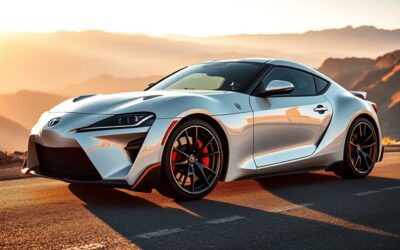
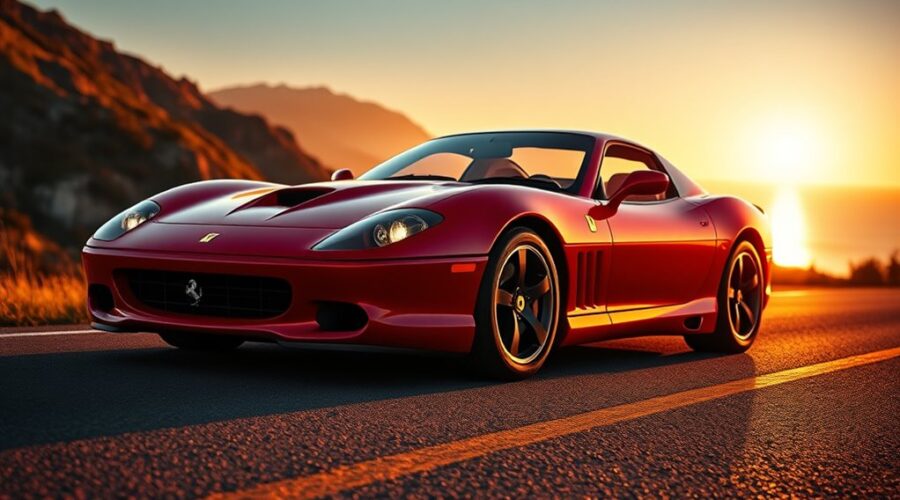
The Ferrari 296 GTB combines a twin-turbocharged 120-degree V6 with a 165 hp electric motor, producing 819 hp in total. It reaches 60 mph in 2.4 seconds and exceeds 205 mph, while measuring 4,565 mm long and weighing roughly 1,470 to 1,540 kg. Behind those figures lies a hybrid system, transmission logic, and chassis package that shape how the car behaves in more detail.
Ferrari 296 GTB Powertrain Basics
The Ferrari 296 GTB uses a twin-turbocharged 120° V6 engine rated at 654 hp at 8,000 RPM, combined with a plug-in hybrid system that adds a 165 hp electric motor for a total output of 819 hp.
This powertrain is arranged to deliver compact packaging, low center of gravity, and immediate response, supporting a driving experience that emphasizes mechanical clarity and control.
The hybrid system supplements the combustion engine during acceleration and enables electric-only operation for limited urban use through the eDrive mode.
An eight-speed dual-clutch automatic transmission manages torque transfer with rapid, synchronized shifts, preserving continuity across gear changes.
Drive modes including Hybrid, Performance, and Qualify alter power delivery, regeneration, and response calibration to suit varying demands.
The result is a technically advanced architecture that combines efficiency, flexibility, and assertive output.
For drivers seeking liberation from conventional constraints, the layout offers multiple operating states without sacrificing precision or engagement in the powertrain.
Ferrari 296 GTB Performance Figures
Acceleration figures place the Ferrari 296 GTB among the quickest production cars in its segment, with a claimed 0–60 mph time of 2.4 seconds and a quarter-mile run completed in 9.7 seconds.
These numbers reflect the immediate response of the hybrid powertrain, which pairs a 2,992 cc twin-turbo V6 with an electric motor for a combined 819 horsepower.
The resulting performance is not limited to launch acceleration; the car is rated for a top speed above 330 km/h, or 205 mph, indicating sustained output at high velocity.
Rated above 330 km/h, the Ferrari 296 GTB sustains its pace with ease at high velocity.
Aerodynamic management also supports this pace. An active mobile spoiler contributes to as much as 360 kg of downforce at speed, helping maintain stability when directional changes demand precision.
The overall calibration suggests a machine designed to translate power into controlled forward motion, with minimal compromise between efficiency, speed, and driver freedom.
Ferrari 296 GTB Dimensions and Weight
Measuring 4,565 mm in length, 1,958 mm in width, and 1,187 mm in height, the Ferrari 296 GTB presents a compact mid-engine profile that supports both packaging efficiency and aerodynamic performance.
Its dimensions place the car in a tightly controlled footprint, while the 2,600 mm wheelbase helps sustain directional stability and responsive turn-in. The kerb weight ranges from 1,470 to 1,540 kg, a figure that remains restrained for a vehicle of this type and supports a favorable power-to-weight ratio of 560 hp/ton.
This balance between size and mass contributes to the car’s agile road behavior and precise chassis response. The proportions also reflect Ferrari’s design lineage, combining classic visual compactness with a modern aerodynamic form.
How the Ferrari 296 GTB Hybrid System Works?
Combining a 2,992 cc twin-turbocharged V6 with a plug-in hybrid electric motor, the Ferrari 296 GTB produces a combined 830 PS (819 hp) and integrates electric assistance directly into its performance strategy.
The hybrid architecture pairs combustion and electric propulsion to expand response, efficiency, and range of use without diluting the car’s core intent. The electric motor contributes 123 kW (165 hp) and 315 Nm of torque, supplying immediate thrust that sharpens acceleration and supports low-speed movement with controlled precision.
In eDrive mode, the vehicle can travel on electricity alone up to 135 km/h, giving urban driving a quieter, freer character while reducing fuel use. Hybrid mode balances both power sources, while Performance and Qualify prioritize maximum output.
CO2 emissions are rated at 201 g/km, indicating a measured attempt to align high-output dynamics with environmental responsibility.
Ferrari 296 GTB Transmission and Drive Modes
The Ferrari 296 GTB uses an eight-speed dual-clutch automatic transmission that is tuned to deliver rapid, uninterrupted shifts and to work in step with its hybrid powertrain. This transmission system manages the changeover between the V6 engine and electric motor with minimal interruption, supporting clean delivery of power across the rev range.
With an 8,500 RPM redline, the engine can sustain aggressive acceleration before the next gear is selected.
Four drive modes provide distinct operating strategies. eDrive enables electric-only propulsion for quiet urban travel. Hybrid balances both power sources for efficient everyday use. Performance prioritizes immediate response and sustained output. Qualify activates track-focused calibration for maximum acceleration.
Together, the transmission system and drive modes help the 296 GTB reach 60 mph in 2.4 seconds, giving the driver precise control over how the car delivers speed, efficiency, and intensity.
Ferrari 296 GTB Chassis and Handling
With a wheelbase shortened by 50 mm, the Ferrari 296 GTB gains a more agile chassis layout that sharpens turn-in and improves responsiveness through corners. This reduction supports a more immediate handling character, allowing the chassis to react with greater precision to driver input.
An integrated ABS control module, paired with a 6w-CDS sensor, helps define grip limits more accurately, improving stability at the edge of adhesion. The revised brake-by-wire system and Aero brake calipers add consistency to pedal feel and braking force, reinforcing control under hard use.
A TMA actuator and 6w-CDS body sensor coordinate to refine cornering stability and overall vehicle behavior. The result is a chassis calibrated for rapid throttle response, stable balance, and confident handling across changing conditions, giving the driver a direct, unfiltered connection to the road and a more liberated sense of motion.
Ferrari 296 GTB Aerodynamics and Downforce
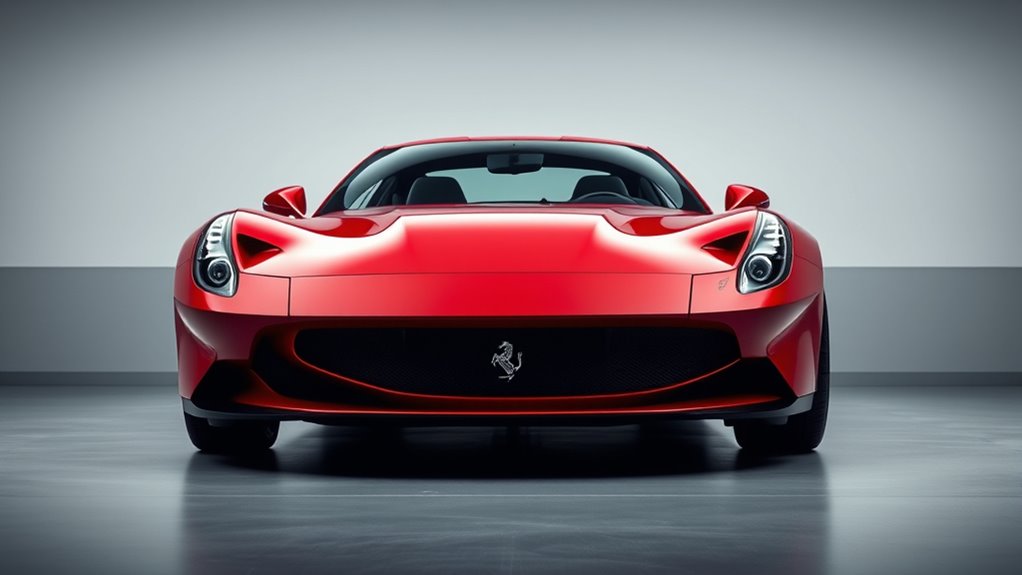
The Ferrari 296 GTB uses a sculpted front end and tapered bodywork to manage airflow efficiently while reducing drag.
At the rear, an active mobile spoiler and integrated aero elements work with the front tea-tray design to increase downforce and support underbody cooling.
These measures produce up to 360 kg of downforce at 250 km/h, improving high-speed stability, braking performance, and overall handling balance.
Sculpted Front End
Ferrari’s 296 GTB presents a sculpted front end that favors formal cleanliness and aerodynamic function, drawing inspiration from the compact, polished proportions of the 1963 Ferrari 250 LM while updating the theme with a modern, low-drag profile. The sculpted front end supports aerodynamic performance through tightly controlled surfaces and disciplined airflow management.
| Element | Effect | Outcome |
|---|---|---|
| Compact nose | Reduces frontal disturbance | Cleaner air passage |
| Smooth contours | Controls pressure build-up | Better stability |
| Low-drag form | Limits resistance | More efficient speed |
This treatment frees the car from excess visual mass while preserving Ferrari heritage. The result is a front section engineered for precision, helping handling and braking remain composed when demands rise.
Active Rear Spoiler
An active rear spoiler gives the Ferrari 296 GTB a variable aerodynamic advantage, rising to as much as 360 kg of downforce at 250 km/h.
The active rear spoiler alters its angle according to speed and driving load, refining aerodynamic performance with precise, adaptive control. This mobile surface supports stability during rapid direction changes and high-speed running, allowing the chassis to remain composed without unnecessary drag when full load is not required.
At the rear, the ring-shaped flying buttress helps guide airflow efficiently, reinforcing the car’s overall aerodynamic architecture.
In concert with the body’s sculpted forms, the spoiler reflects Ferrari’s technical heritage while serving a clear functional purpose. The result is a car that channels air with freedom, efficiency, and disciplined intent.
Downforce And Cooling
Aerodynamic downforce in the Ferrari 296 GTB is managed through a coordinated package of active and passive elements, with the mobile rear spoiler generating up to 360 kg at 250 km/h to increase rear stability under load.
The ring-shaped flying buttress and truncated tail channel airflow cleanly away from the body, reducing lift and preserving balance at speed.
Beneath the car, integrated front and rear tea-tray spoilers sharpen downforce and support cooling, directing air toward thermal-management zones without compromising efficiency.
This underbody architecture works with the shortened 50 mm wheelbase to maintain agility while keeping aerodynamic behavior composed.
The result is a car whose downforce strategy and cooling layout support braking, handling, and high-speed confidence, while remaining faithful to Ferrari design heritage and performance priorities.
Ferrari 296 GTB Interior and Technology
Though performance remains the central theme, the 296 GTB’s interior is organized around a full-digital interface that prioritizes driver visibility and rapid access to essential data. The interior pairs a driver-centric cockpit with an infotainment system that concentrates controls within immediate reach, reducing distraction and supporting decisive motion. Visible dashboard buttresses reinforce the cabin architecture while framing the technology in a clean, technical layout. A minimalist passenger area creates a co-driver environment without excess ornamentation, allowing the structure and interface to carry the message of purposeful freedom. The push-button shifter, inspired by classic Ferrari gearboxes, blends tactile heritage with contemporary control logic.
| Feature | Function |
|---|---|
| Full-digital display | Presents core vehicle data |
| Infotainment system | Centralizes key functions |
| Dashboard buttresses | Support structure and design |
| Push-button shifter | Combines legacy and modernity |
Ferrari 296 GTB Assetto Fiorano Package
The Ferrari 296 GTB Assetto Fiorano Package is centered on weight savings, using carbon fiber bodywork and an optional Lexan® rear screen to reduce mass by more than 12 kg while supporting aerodynamic efficiency.
Track-ready Multimatic dampers are calibrated for higher circuit performance, sharpening handling response and maintaining ride control under demanding conditions.
Its available 250 LM-inspired livery further reflects Ferrari’s racing heritage, combining functional development with a historically referenced visual package.
Weight Savings Focus
Ferrari’s Assetto Fiorano Package for the 296 GTB prioritizes mass reduction through extensive use of lightweight materials, trimming more than 12 kg versus the standard car.
This weight savings strategy supports sharper performance without compromising structural integrity or driving precision.
Carbon fiber bodywork lowers inertia, while optimized aerodynamics help the car move with less resistance and greater control.
The package’s optional ultra-light Lexan® rear screen further reduces mass, reinforcing the liberation of unnecessary weight from the chassis.
- Carbon fiber exterior components
- Over 12 kg reduction
- Lexan® rear screen option
- Aerodynamic efficiency gains
Track-Ready Suspension
Track-focused suspension calibrates the 296 GTB Assetto Fiorano for sustained circuit use, with Multimatic dampers sharpening body control, cornering stability, and transient response at high speed.
This track-ready suspension is tuned to sustain lateral load, reduce pitch and roll, and keep tire contact patches more consistent through repeated laps.
Within the Assetto Fiorano package, the damper calibration works alongside the reduced mass and aerodynamic revisions to create a more immediate chassis response.
Brake system adjustments further support modulation and repeatability under heavy use, helping the driver exploit the car’s limits with greater confidence.
The result is a disciplined, precise setup that favors speed, feedback, and mechanical clarity, translating advanced hardware into a freer, more responsive track-oriented driving experience.
250 LM Livery
Inspired by the iconic 250 LM, the Assetto Fiorano package gives the 296 GTB a motorsport-derived livery that reinforces its track intent while paying tribute to Ferrari’s racing heritage.
The livery uses classic Ferrari colors and motifs, translating legacy into a contemporary performance statement. Its visual treatment is not decorative alone; it aligns with the package’s aerodynamic strategy and lightweight carbon fiber bodywork.
- 250 LM-inspired graphic identity
- Classic Ferrari color execution
- Weight reduction over 12 kg
- Track-focused Multimatic dampers
Together, these elements sharpen performance, improve stability, and communicate a liberated, purpose-built character.
The result is a technically coherent specification, where appearance, handling, and race-derived engineering operate as one system.
Ferrari 296 GTB Price and Variants
The 296 GTB enters the market at an approximate starting price of $433,686, positioning it competitively within the high-end sports car segment, while European pricing typically spans from €271,114 to €476,574 depending on selected specifications and equipment.
Ferrari announced the model as a plug-in hybrid, integrating electrification without compromising the rear-drive supercar format. Pricing escalates with optional content, bespoke finishes, and performance-oriented packages, allowing substantial configuration freedom.
The Assetto Fiorano variant is the most track-focused execution, adding lightweight components, revised aerodynamics, and suspension calibration intended for more aggressive circuit use.
The Assetto Fiorano package is the most track-oriented setup, adding lightweight parts, aero upgrades, and sharper suspension tuning.
For buyers seeking open-air engagement, the 296 GTS provides a folding hardtop that can retract while driving at up to 45 km/h, preserving structural coherence and usability.
A higher-output 296 Speciale is expected in Q1 2026, with 868 horsepower and a distinct aerodynamic package. This range reflects a deliberate strategy: accessible entry, extensive customization, and performance escalation.
Frequently Asked Questions
How Quickly Does the Ferrari 296 GTB Go From 0 to 60 Mph?
It reaches 60 mph in 2.9 seconds. Such acceleration metrics place it among elite performance benchmarks, reflecting immediate torque, precise transmission control, and a technically advanced hybrid layout, optimized for drivers seeking liberated, unrestrained response.
Is the 296 Faster Than the SF90?
No; the SF90 is faster. Like two runners where one starts 0.4 seconds earlier, the performance comparison shows 296 GTB at 819 hp, 2.9 seconds to 60; SF90 reaches 986 hp, 2.5 seconds.
Is the Ferrari 296 Reliable?
The Ferrari 296 appears generally reliable, but engine longevity depends on disciplined use and maintenance costs are high. Its hybrid system reduces combustion strain, yet advanced electronics and brake-by-wire complexity demand careful servicing and expert diagnostics.
Is 296 GTB a Supercar?
Yes; the 296 GTB clearly meets supercar characteristics. By performance comparisons, its 819-horsepower hybrid drivetrain, sub-3-second sprint, and active aerodynamics place it squarely among elite machines, where the rubber meets the road for liberated driving.
Conclusion
In conclusion, the Ferrari 296 GTB combines a 654 hp twin-turbo V6 with a 165 hp electric motor, delivering 819 hp in a package that mirrors its performance claims with near-perfect efficiency. Coincidentally, its 2.4-second sprint to 60 mph and 205 mph-plus top speed align with its compact 4,565 mm footprint and low kerb weight. The result is a technically advanced supercar where hybrid engineering, aerodynamics, and chassis tuning converge with unusual precision.