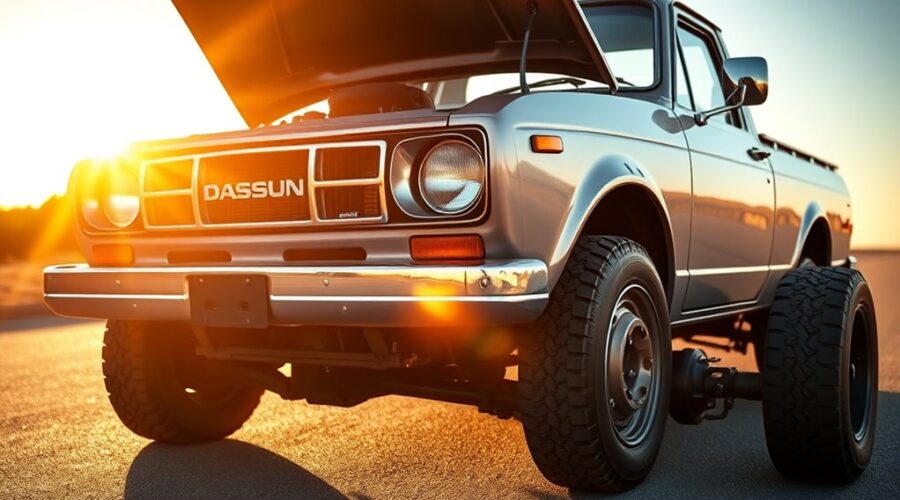
The Datsun Nissan pickup earned its place through simple engineering, compact size, and surprising toughness. Across the 220, 620, and 720 series, it used engines ranging from the 988 cc Type C to the 2.4-liter Z24, with modest performance and practical payload capacity. Its specifications changed by market and year, but the core formula stayed consistent. The details behind its drivetrain, dimensions, and U.S. variants reveal why it lasted so long.
Key Takeaways
- Datsun/Nissan pickups evolved from the 1934 Datsun 13 Truck through the 220, 320, 520, 620, and 720 series.
- Engine outputs ranged from 37 PS in early 988 cc models to 92–103 hp in the 2.4L Nissan 720.
- Most pickups used 4-speed or 5-speed manuals, with some 3-speed automatics and rear-wheel or 4WD options.
- Bed and chassis choices included short, long, regular, and extended configurations, with payloads around 850–1,000 kg.
- Known for durability and simple maintenance, Datsun pickups reached about 95–100 mph and 0–60 mph in 15–20 seconds.
Datsun Pickup Overview
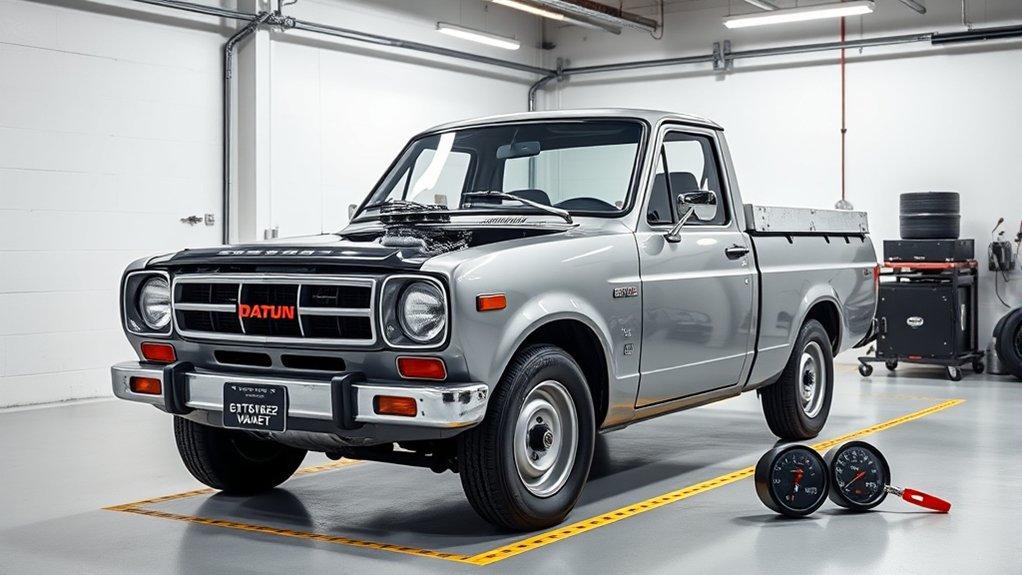
The Datsun pickup line traces back to the Datsun 13 Truck of 1934 and developed through successive models such as the Datsun 220, 320, and 520, each built around a practical, reliable, utilitarian formula.
As the Datsun name expanded, the trucks became a compact alternative to larger work vehicles, offering straightforward utility for drivers seeking mobility without excess.
The Datsun 220, launched in 1957, marked the line’s U.S. export debut and established its reputation for manageable payload capacity and honest road manners.
The Datsun 520 later refined the formula with added seating and a more versatile cabin, while the 720 brought further development before the badge shifted to Nissan in 1984.
Across these generations, the pickup remained focused on accessible transport, durability, and independence, making it a notable choice for users who valued function over ornament.
What Engines Powered the Datsun Pickup?
Powering the early Datsun pickups was a progression of modest but durable engines that matched the trucks’ utilitarian character.
The first Datsun Truck models, including the Datsun 220, used a 988 cc Type C “Stone Engine,” a compact four-cylinder engine rated at 37 PS, or about 36 hp.
The earliest Datsun trucks relied on the 988 cc Type C “Stone Engine,” a small but sturdy four-cylinder.
The Datsun 320 moved to the Nissan E-1, producing 60 PS and bringing a notable gain in usable strength.
Later Datsun 520 and 521 trucks adopted the 1.3-liter Nissan J13, rated at 67 hp, while the Datsun 620 increased output again with the 1.5-liter J15 at 77 hp.
Engine options broadened further in the Nissan 720 era, where the 2.4-liter Z24 delivered roughly 92 to 103 hp.
Across these generations, the emphasis remained on reliable workhorse power, supporting everyday hauling duties and practical load capacity without unnecessary complexity.
Datsun Pickup Transmission and Drivetrain
Transmission choices gave Datsun pickups a practical edge, with the 620 and 720 models offering 4-speed manuals, 5-speed manuals, and 3-speed automatic setups to suit different drivers and workloads.
This transmission range allowed buyers to match a manual for direct control or an automatic for easier everyday use. The drivetrain package also varied by model: the 720 came in rear-wheel drive and four-wheel drive forms, expanding its usefulness across pavement, job sites, and rougher ground.
Engines such as the 2.4L Z24 could be paired with either transmission type, while North American 620 trucks used the Nissan L engine with outputs from 96 hp to 110 hp, depending on configuration.
How Fast Was the Datsun Pickup?
Speed was never the Datsun pickup’s main selling point, but its performance was adequate for a light-duty truck of its era.
The Datsun pickup, especially the 620, reached a top speed of roughly 95 to 100 mph, depending on engine choice and load. Its acceleration was modest: 0 to 60 mph generally required 15 to 20 seconds, a pace that matched its work-oriented purpose rather than any sporting ambition.
Engine output ranged from about 96 hp to 110 hp in the 620 series, with inline-four displacements from 1.5L to 2.4L.
Later 720 models, introduced in 1980, stayed in a similar range, commonly making 92 to 103 hp.
Quarter-mile times were estimated at 20 to 25 seconds.
These numbers show a machine built for practical freedom of movement, not speed records.
Datsun Pickup Dimensions and Bed Sizes
The Datsun pickup lineup varied considerably in size and cargo layout across generations, with dimensions shaped by intended use. Early Datsun 120 series trucks offered standard and long beds, giving users flexible cargo space for work and travel.
The Datsun 520 and 521 were compact yet capable, with payload ratings near 1,000 kg, supporting practical hauling without unnecessary bulk.
The Datsun 620 came in short wheelbase and long wheelbase forms, measuring 2,575 mm and 2,815 mm respectively, allowing buyers to choose between maneuverability and greater load room.
Later, the Datsun 720 expanded this approach with regular and extended bed options, while its overall length reached about 4,845 mm and width about 1,690 mm.
These bed lengths and chassis variations show a clear focus on utility, giving drivers more control over cargo capacity and vehicle footprint, while the long wheelbase versions better suited larger loads and steadier hauling.
Datsun Pickup Suspension and Brakes
Datsun pickup suspension systems generally use an A-arm front setup with torsion bars, a design that balances ride comfort with predictable handling on rough roads. This torsion bar front suspension gives the truck a simple, adjustable structure that supports steady control without unnecessary complexity.
At the rear, leaf-spring rear suspension improves load capacity and durability, helping the pickup serve work duties with confidence. The arrangement favors utility, maintaining composure when the bed is carrying weight or when pavement quality declines.
Braking hardware typically pairs front disc brakes with rear drum brakes, providing stronger initial stopping power and dependable balance. The layout is straightforward, which supports ease of maintenance and long-term reliability.
For drivers seeking practical freedom and low-drama operation, these components reflect an engineering approach centered on function, endurance, and accessible service rather than excess.
Datsun Pickup Trim Levels and Features
Offered in a range of configurations, the Datsun 620 and later pickup models were tailored to different buyers through trim and body-style choices that balanced utility, comfort, and economy.
Datsun trim levels began with the stripped Lil Hustler, a bare-bones option aimed at budget-conscious buyers and known for straightforward reliability. Regular cab versions served as the practical base, while the King Cab added extra cabin space for those needing more room without moving to a larger truck.
Higher GL models introduced modest comfort upgrades, including cloth and leather seating, while the MPG model focused on fuel economy rather than extras.
Utility buyers could select the Bushmaster, a covered body style produced in the mid-1980s. Late models also adopted double wall beds and Nissan badging, signaling a design shift.
Together, these trim levels reflected a clear effort to offer freedom of choice across work, economy, and comfort needs.
Datsun Pickup U.S. Specs by Year
Across its U.S. truck lineup, Nissan’s early Datsun pickups evolved steadily in power, payload, and equipment.
The Datsun 220, launched in 1958, used a 988cc engine making 37 horsepower and carried about 1,000 lbs, establishing the first Datsun truck exported to America.
The Datsun 520, built from 1965 to 1972, raised output to 67 horsepower from a 1.3L engine and paired it with a four-speed manual transmission.
The Datsun 520, built from 1965 to 1972, boosted power to 67 horsepower with a 1.3L engine.
The Datsun 620, sold from 1972 to 1979, added regular cab and King Cab layouts, plus a 2.0L L20B gasoline engine or 2.2L diesel.
The Datsun 720, produced from 1980 to 1986, used 2.2L and 2.4L engines rated at 92 to 103 horsepower, while U.S. branding shifted to Nissan in 1984.
How the Nissan Hardbody Replaced the Datsun Pickup
When the Nissan Hardbody arrived in 1986.5, it effectively replaced the Datsun pickup in the U.S. market and marked the end of the Datsun nameplate for American trucks. Officially known as the D21, it represented the first Nissan-branded pickup sold after years of Datsun and Nissan badging overlap.
The shift was more than a name change; it signaled a clearer corporate identity in the truck market and an improved version of the earlier 720 platform. Rugged double-walled bed construction and sharper styling helped the model stand apart, while engine choices expanded its utility.
Buyers could select a 2.4L inline-4 with 106 hp or a 3.0L V6 with 140 hp, depending on work needs or daily use. Production continued until 1997, when the Frontier succeeded it, but the Hardbody had already secured Nissan’s place as a durable, independent presence in the segment.
Why the Datsun Pickup Still Matters
The Datsun pickup remains relevant because its reputation for lasting reliability made it a practical choice for both commercial work and daily use.
Models such as the 620 and 720 helped define the compact truck legacy in the U.S., combining modest size with useful payload capacity and straightforward engineering.
Its influence is still visible in modern pickups, including the Nissan Frontier, while preserved examples continue to draw collector interest.
Lasting Reliability
Built for straightforward utility, the Datsun 620 and 720 earned a reputation for lasting reliability through simple engineering, efficient engine options, and practical payload ratings often exceeding 1,000 lbs.
This Datsun pickup combined compact pickup proportions with dependable performance, allowing owners to handle work routes, errands, and daily use without unnecessary complexity.
The 720’s 2.4L engine, rated at up to 103 hp, reflected a practical balance of durability and efficiency rather than excess.
Because the design prioritized accessible mechanics and robust construction, maintenance stayed straightforward for independent owners and small businesses alike.
That same ruggedness later helped preserved examples gain collector attention, while the truck’s proven formula influenced modern Nissan pickups and set expectations for dependable utility.
Compact Truck Legacy
From the Datsun 220’s 1957 debut with an 850 kg payload, the compact pickup line established a practical formula that later models refined without losing their work-focused identity.
Datsun built a compact truck presence defined by utility, adaptability, and reliability, giving drivers a vehicle sized for urban routes yet capable on demanding jobs.
The 1972 Datsun 620 added the King Cab option and a strong J15 engine, widening its appeal without weakening its purpose.
In 1980, the 720 advanced design and powertrains, supporting both labor and daily use.
By 1986, the Hardbody reinforced the segment’s rugged image.
This lineage remains significant because it reflects durable engineering that gave owners useful mobility and a sense of independence.
Influence On Modern Pickups
Though compact in size, the Datsun pickup line helped define what a practical light truck could be, beginning with the 220’s emphasis on reliability, efficiency, and a payload of roughly 1,000 lbs.
Its influence carried into the 320’s independent front suspension, the 620’s King Cab layout, and later 720 models that balanced rugged construction with usable performance.
These choices expanded comfort, cargo flexibility, and driver control, traits now common in modern pickups.
The 1986½ Nissan Hardbody reinforced the formula with a durable double-walled bed and efficient engines, setting benchmarks for utility and style.
Collector interest has further preserved the trucks’ reputation, especially the 620 and Hardbody, which remain reference points for mini-truck design and practical freedom.
Frequently Asked Questions
What Is the Top Speed of the Datsun 620 Pickup Truck?
The Datsun 620 pickup truck reaches about 95 to 100 mph. Datsun 620 features, Engine specifications, Performance upgrades, and Collector interest all contribute to its appeal, with light weight supporting spirited, liberating driving.
Are Datsun Pickups Reliable?
Yes, Datsun pickups are generally reliable; Datsun durability is widely praised. Owner experiences often show long service life, while maintenance tips help prevent common issues. Their simple engineering supports repairability and steady performance.
What Is the Strongest Nissan Engine?
The strongest Nissan engine is the 5.6L V8 in the Titan. What engine could symbolize greater freedom? Among Nissan engine types, a performance comparison shows engine modifications and historical significance favor its 400-horsepower output.
What’s Special About the Nissan Hardbody?
Its Datsun history, Pickup design, and Hardbody features made it distinctive: rugged steel, double-walled bed, and versatile cab options. That blend of durability and affordability drove strong Market impact, especially among buyers seeking practical freedom.
Conclusion
Ultimately, the Datsun Nissan pickup earned its reputation through simple engineering, durable powertrains, and practical dimensions that made it useful in everyday work. With engines ranging from the 988 cc Type C to the 2.4-liter Z24, and performance figures that were modest but dependable, it offered enough capability for its era. Who would have expected such a compact truck to become a long-lasting favorite among collectors and enthusiasts?