The Porsche Cayenne blends road performance with credible off-road hardware. Its lineup spans V6 and twin-turbo V8 powertrains, with the Turbo S E-Hybrid producing up to 900 Nm of torque. Air suspension helps raise ground clearance to 268 mm. Acceleration is sharp for a large SUV, yet dimensions, drive modes, and chassis tech shape its terrain ability. The details become more interesting when the trim differences come into focus.
Key Takeaways
- The Cayenne offers up to 268 mm of ground clearance with air suspension for improved off-road approach and departure angles.
- Off-road mode locks the center differential and optimizes traction control for better grip, throttle response, and gear selection on rough terrain.
- Hill Descent Control works from 2 to 19 mph to maintain controlled, stable descents with minimal wheel slip.
- Powertrains range from a 2.9-liter twin-turbo V6 to a 4.0-liter twin-turbo V8 hybrid, producing 550 to 900 Nm of torque.
- Performance spans 4.7-second 0-60 mph sprints in the Cayenne S to 3.5 seconds in the Turbo E-Hybrid, with up to 186 mph top speed.
Porsche Cayenne Off-Road Specs at a Glance
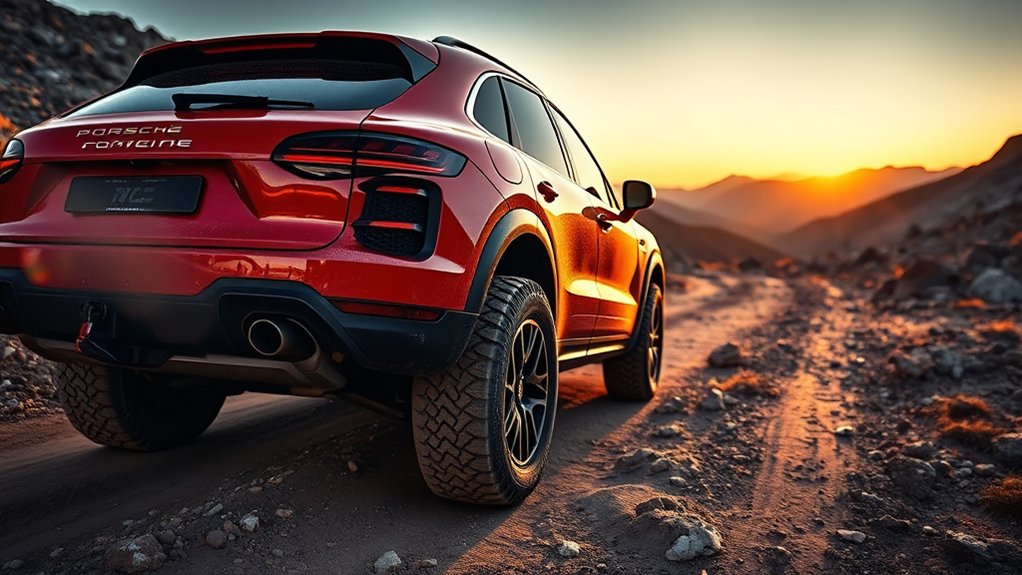
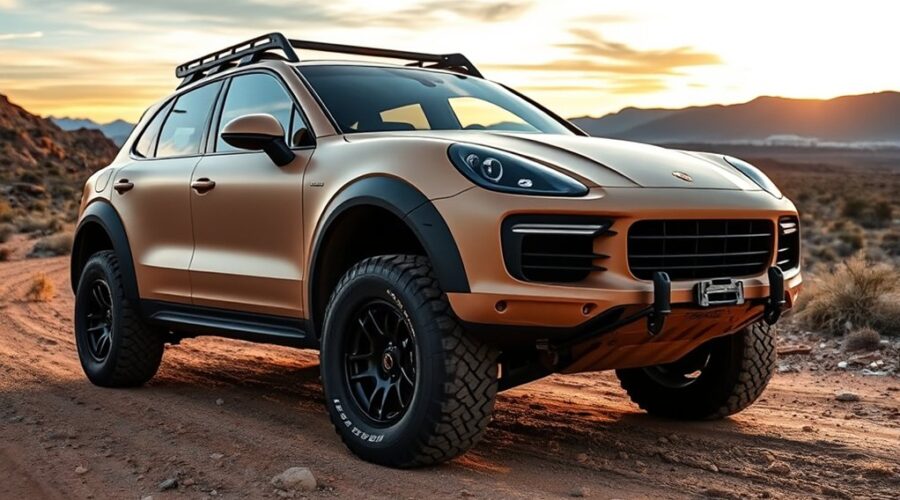
The Porsche Cayenne’s off-road specifications begin with a maximum ground clearance of 268 mm, supported by air suspension that can raise ride height by six inches for improved approach and departure angles.
Maximum ground clearance reaches 268 mm, with air suspension lifting the Cayenne six inches for better off-road angles.
Porsche Cayenne is available with a chassis designed for terrain independence, giving drivers a measurable margin over obstacles and uneven ground. The suspension calibration provides notable wheel articulation, helping the vehicle remain composed on ruts, rocks, and broken surfaces.
A dedicated off-road mode engages a locked center differential and optimized traction control to distribute grip under low-traction conditions. Hill descent control operates between 2 and 19 mph, maintaining controlled speed on steep grades without constant pedal input.
These systems form a technical package aimed at preserving mobility where pavement ends. The result is a controlled, capable platform that supports confident passage through demanding routes while keeping the driver focused on direction, momentum, and terrain management.
Which Porsche Cayenne Engines Make the Most Torque?
Off-road ability in the Cayenne range is closely tied to drivetrain output, and the torque figures show clear separation between variants.
At the top sits the Cayenne Turbo S E-Hybrid, combining a 4.0-liter twin-turbo V8 with a 100 kW electric motor for 900 Nm. That output gives the Cayenne the strongest low-speed reserve in the lineup.
The Cayenne E-Hybrid follows with 700 Nm from its 3.0-liter turbocharged V6 and electric assist, supporting efficient traction over loose terrain.
Among pure combustion versions, the Cayenne Turbo delivers 770 Nm from its 4.0-liter twin-turbo V8, while the Cayenne GTS produces 620 Nm from the same displacement.
The Cayenne S, using a 2.9-liter twin-turbo V6, reaches 550 Nm.
In torque terms, the hierarchy is clear: hybrid flagships lead, the Turbo remains highly capable, and the lower variants still provide substantial force for demanding routes.
How Quick Is the Porsche Cayenne?
The Porsche Cayenne lineup posts 0–60 mph times ranging from 4.7 seconds for the Cayenne S to 3.5 seconds for the Cayenne Turbo E-Hybrid, with the GTS and E-Hybrid both at 4.4 and 4.6 seconds, respectively.
Top speed figures vary by model and reflect the different outputs of the twin-turbo V8 and hybrid powertrains.
The hybrid variants add a strong acceleration burst, with the Turbo E-Hybrid producing 729 hp for the quickest launch performance.
0-60 Mph Times
Acceleration figures for the Porsche Cayenne span a broad performance range, depending on trim and powertrain.
The Cayenne line covers everyday urgency and high-output performance, giving drivers room to choose capability without surrendering control.
- Cayenne E-Hybrid: 0-60 mph in 4.6 seconds, 463 hp
- Cayenne S: 0-60 mph in 4.7 seconds, 468 hp
- Cayenne S E-Hybrid: 0-60 mph in 4.4 seconds, 512 hp
- Cayenne GTS: 0-60 mph in 4.4 seconds, 493 hp
At the top of the range, the Cayenne Turbo E-Hybrid reaches 0-60 mph in 3.5 seconds with 729 hp.
These results indicate that Cayenne performance varies considerably, yet each version remains tuned for rapid response, decisive acceleration, and road-going freedom.
Top Speed Figures
Top speed adds another measure of the Porsche Cayenne’s performance range, showing how far each powertrain can be pushed at the upper end.
These top speed figures place the Cayenne S at 170 mph with its 4.0-liter twin-turbo V8, while the GTS extends to 182 mph from a stronger 493 hp tune.
The Cayenne Turbo E-Hybrid reaches 183 mph, reflecting its 729 hp combined output. At the peak, the Turbo GT posts 186 mph, the highest figure in the lineup.
The E-Hybrid is not listed with a top speed here, but its 463 hp system remains part of the range.
Across the range, the numbers show a liberated SUV platform engineered for sustained pace, not just short bursts.
Hybrid Acceleration Burst
How quick is the Porsche Cayenne when its hybrid systems are engaged? The hybrid acceleration burst gives the Porsche Cayenne a clear performance advantage, translating electric torque into immediate motion.
- Cayenne E-Hybrid: 0-60 mph in 4.6 seconds.
- Cayenne S E-Hybrid: 0-60 mph in 4.4 seconds, with 512 hp from a 3.0-liter turbo V-6 and 100 kW motor.
- Cayenne Turbo E-Hybrid: 0-60 mph in 3.5 seconds, combining a twin-turbo V-8 and electric drive for 729 hp.
- Cayenne Turbo GT: 0-60 mph in 3.5 seconds, using a 4.0-liter twin-turbo V-8 rated at 471 kW.
These figures show a controlled release of force, where hybrid assistance improves response, efficiency, and freedom of acceleration.
Ground Clearance and Air Suspension
Air suspension gives the Porsche Cayenne a maximum ground clearance of 268 mm when raised, improving underbody protection and off-road usability. This ground clearance supports travel over ruts, rocks, and uneven tracks without excessive contact risk.
The system can lift the body by about six inches, improving approach and departure angles and giving the chassis more freedom over broken terrain. Although the figure is below the Range Rover’s 300 mm, it remains suitable for most off-road conditions and preserves the Cayenne’s road-oriented balance.
The air suspension also promotes wheel articulation, helping each wheel maintain contact as surfaces change. That motion contributes to stable, controlled progress on rough ground.
In combination with Porsche Torque Vectoring Plus, the setup strengthens traction and directional confidence. The result is a chassis that offers technical capability and a measured sense of liberation beyond paved roads.
What Off-Road Modes Does the Cayenne Offer?
Porsche equips the Cayenne with an Off-Road Mode designed to improve traction and stability on difficult terrain. This Off-Road Mode recalibrates throttle response and gear ratios to help the SUV maintain controlled motion when surfaces become uneven, loose, or low-traction.
A locked center differential further supports forward progress by distributing power more evenly across all wheels, reducing slip and preserving composure. The air suspension can also adapt to terrain changes, increasing wheel articulation and stability while the body remains aligned with the ground.
A locked center differential and adaptive air suspension help the Cayenne maintain traction, stability, and composure over uneven terrain.
- Optimized throttle mapping for finer control
- Revised gearing for tougher surfaces
- Locked center differential for stronger grip
- Adaptive suspension for obstacle clearance
Maximum ground clearance can rise to 268 mm, which broadens usable terrain capability and supports freer route selection without unnecessary compromise.
The system presents a technical setup aimed at confident off-road travel.
How Does the Cayenne Handle Steep Hills?
The Cayenne addresses steep hills with hill descent control, which maintains controlled downhill speeds between 2 and 19 mph.
Its raised suspension can provide up to 268 mm of ground clearance, improving approach and departure geometry on inclines.
This added clearance supports uphill and downhill stability in high-gradient terrain.
Hill Descent Control
Hill descent control on the Cayenne operates smoothly between 2 and 19 mph, helping maintain a controlled crawl on steep inclines. The hill descent control logic moderates braking and throttle inputs, preserving stability while freeing the driver from constant pedal correction.
With air suspension raised, 268mm ground clearance supports favorable geometry on rough descents.
- Stable speed control on steep grades
- Reduced wheel slip on loose surfaces
- Improved confidence on uneven terrain
- Center differential lock available in off-road mode
Testing on a 1:1 incline showed minimal wheel drama, indicating strong traction management. The system is engineered for composed downhill travel, allowing the vehicle to descend predictably and securely while maintaining directional control.
High-Gravity Climb Ability
With the air suspension raised to 268 mm, the Cayenne gains the ground clearance needed to improve approach and departure geometry on steep climbs.
This high-gravity climb ability is supported by Porsche Torque Vectoring Plus, which helps maintain traction and lateral stability when surface grip changes abruptly.
In off-road mode, the locked center differential distributes torque in a controlled manner, allowing the drivetrain to retain forward motion with limited slip.
Strong wheel articulation further reduces wheel drama over uneven grades, keeping contact patches engaged.
The result is a measured ascent that favors confident driving on demanding terrain.
For drivers seeking liberated movement beyond pavement, the Cayenne presents a technical balance of chassis control, power distribution, and stability management suited to steep hills.
Raised Suspension Clearance
Raised suspension clearance gives the Porsche Cayenne a practical advantage on steep hills, as its air suspension can be lifted by six inches to a maximum ground clearance of 268 mm, improving approach and departure angles.
This raised suspension clearance reduces underbody contact and supports freer movement over broken terrain.
- Better cresting on sharp rises
- Reduced scrape risk on rutted tracks
- Improved wheel travel and stability
- More confident line choice on descents
Hill descent control works from 2 to 19 mph, keeping speed measured on steep grades.
Off-road testing showed strong articulation and minimal wheel drama on a 1:1 incline.
With up to 729 hp in Turbo E-Hybrid form, the Cayenne sustains traction and control.
Advanced driver aids reinforce this capability, enabling precise, liberated progress over difficult surfaces.
Porsche Cayenne Dimensions That Matter Off Road
The Porsche Cayenne’s off-road capability is strongly influenced by its dimensions, starting with up to 268 mm of ground clearance when fitted with air suspension. This Porsche car uses suspension geometry more often associated with a sports car, yet its air suspension and Safety Features support controlled movement over uneven terrain.
A display allows the driver to monitor key settings, while the electrically adjustable instrument cluster helps present data clearly. In off-road trim, the Twin-Turbo V powertrain works with chassis systems to manage the vehicle’s mass and preserve traction.
Approach and departure angles are improved by a six-inch suspension lift, letting the car clear steep entries and exits. The 2,895 mm wheelbase aids wheel articulation, which supports deliberate obstacle crawling.
Despite weighing over 2,000 kg, the low center of gravity enhances stability and reduces unwanted body motion. These proportions give the Cayenne a measured, liberated off-road posture without sacrificing composure.
Inside the Cayenne: Comfort and Utility Features
Inside the Cayenne, comfort is supported by a luxury-focused cabin with high-quality trim, including Diamar painted accents and Neodyme dashboard highlights. The Cayenne presents an environment tuned for controlled comfort and practical utility, balancing refinement with functional hardware for liberated daily use.
- 2-Zone Automatic Climate Control lets front occupants select separate temperature zones.
- 8-way power seats support a precise driving position and sustained comfort.
- A retractable luggage compartment cover helps secure cargo space.
- Aluminum door-sill guards with model designation add durable utility.
These elements make the cabin feel purpose-built rather than decorative. Materials are selected for a premium tactile result, while layout choices improve access and load management.
For drivers who value autonomy, the interior supports clear adjustment, efficient storage, and a composed atmosphere without unnecessary complexity.
Key Safety and Driver Assist Tech in the Cayenne
Safety and driver-assist equipment in the Cayenne is structured around occupant protection and everyday control, with six airbags providing broad collision coverage and curtain airbags extending along the roof frame for added side-impact protection.
A Driver Memory Package stores seat and mirror positions, reducing setup time and supporting consistent driving posture.
Soft Close Doors improve closure assurance by drawing each door fully shut, lowering the chance of incomplete latching.
An emergency call system remains active for 10 years, enabling rapid incident reporting and support after a crash.
Porsche Active Suspension Management further contributes to control by continuously adapting damping response to road conditions, helping preserve stability on rough surfaces and during evasive maneuvers.
The result is a safety package oriented toward confidence, precision, and mobility with minimal distraction.
Together, these systems support secure operation without unnecessary complexity, giving the driver more freedom to focus on the route and the terrain.
Porsche Cayenne Prices, Trims, and Variants
The Porsche Cayenne lineup spans multiple trims, with pricing beginning at $103,100 for the Cayenne E-Hybrid and reaching $164,500 for the Turbo E-Hybrid.
Monthly lease rates are correspondingly broad, ranging from about $1,438.32 to $2,350.75.
Performance varies by variant, with models such as the Cayenne S, GTS, and S E-Hybrid pairing V8 or hybrid powertrains with 0-60 mph times between 4.7 and 4.4 seconds.
Cayenne Trim Lineup
Porsche’s Cayenne trim lineup spans a wide performance and price range, with each variant tuned to different power and acceleration targets.
The Cayenne trim lineup reflects distinct mechanical priorities, from efficient hybrid assistance to maximal output.
- Cayenne E-Hybrid: 463 hp, 0-60 mph in 4.6 seconds
- Cayenne S: 468 hp, 0-60 mph in 4.7 seconds
- Cayenne S E-Hybrid: 512 hp, 0-60 mph in 4.4 seconds
- Cayenne GTS and Turbo E-Hybrid: 493 hp and 729 hp, with 3.5-second sprint capability
This structure gives buyers a clear route to select a model aligned with acceleration, traction, and dynamic control.
The range supports liberated driving through measured escalation in power, hybrid capability, and chassis intent, while preserving Porsche’s technical identity across the lineup.
Pricing And Lease Rates
Pricing for the Cayenne lineup begins at $103,100 for the base model and rises to $164,500 for the Cayenne Turbo E-Hybrid, reflecting a broad span of performance and equipment levels.
Within this pricing structure, the Cayenne S starts at $108,300, the Cayenne S E-Hybrid at $111,600, and the Cayenne GTS at $132,400.
Lease rates track accordingly, beginning at $1,438.32 per month for the Cayenne E-Hybrid, $1,509.21 for the Cayenne S, and $1,554.20 for the Cayenne S E-Hybrid.
The Cayenne GTS is listed at $1,868.09 monthly, while the Cayenne Turbo E-Hybrid reaches $2,350.75.
This pricing range provides a clear, technically organized path for buyers seeking controlled access to Porsche utility, discretion, and autonomy.
Performance By Variant
Variant by variant, the Cayenne lineup spans a distinct performance hierarchy. This performance by variant structure gives buyers clear separation in output, acceleration, and cost, without compromising the platform’s all-terrain capability.
- Cayenne E-Hybrid: $103,100, 463 hp, 0-60 mph in 4.6 seconds
- Cayenne S: $108,300, 468 hp, 0-60 mph in 4.7 seconds
- Cayenne S E-Hybrid: $111,600, 512 hp, 0-60 mph in 4.4 seconds
- Cayenne GTS: $132,400, 493 hp, 0-60 mph in 4.4 seconds
At the top, the Cayenne Turbo E-Hybrid commands $164,500, 729 hp, and a 3.5-second sprint to 60 mph.
The spread indicates a scalable chassis tuned for control, speed, and personal freedom.
Frequently Asked Questions
Which Porsche Cayenne Is Best for Off-Road?
The Cayenne S appears best for off-road use, combining strong torque, air suspension, and 268mm ground clearance. Tire Options and hill descent control further improve traction, stability, and capability on demanding terrain.
Is the Porsche Cayenne Any Good Off-Road?
Yes—the Porsche Cayenne is very good off-road, with mountain-goat balance and controlled poise. Its air suspension, torque vectoring, hill descent control, and Tire Selection optimize traction, articulation, and clearance for demanding terrain.
What Is the Porsche Cayenne Off-Road Package?
The Porsche Cayenne off-road package is an optional Trail Features suite adding raised air suspension, traction management, and hill descent control. It improves ground clearance, articulation, and stability, enabling freer movement across rough terrain.
Which Is the Best Porsche Cayenne Engine?
The best Porsche Cayenne engine is the Cayenne Turbo E-Hybrid; a thunderbolt of power. Engine Comparisons show 729 hp and 3.5-second acceleration, making it the most potent, technically advanced, and freedom-oriented choice.
Conclusion
In conclusion, the Porsche Cayenne delivers an almost absurd blend of off-road capability and on-road speed. With up to 268 mm of ground clearance, air suspension, and advanced drive modes, it is engineered to tackle rough terrain with remarkable composure. Its twin-turbo V6 and V8 powertrains, especially the Turbo S E-Hybrid’s 900 Nm, make it feel outrageously strong. Add a refined cabin, serious safety tech, and varied trims, and the Cayenne remains a highly capable luxury SUV.