
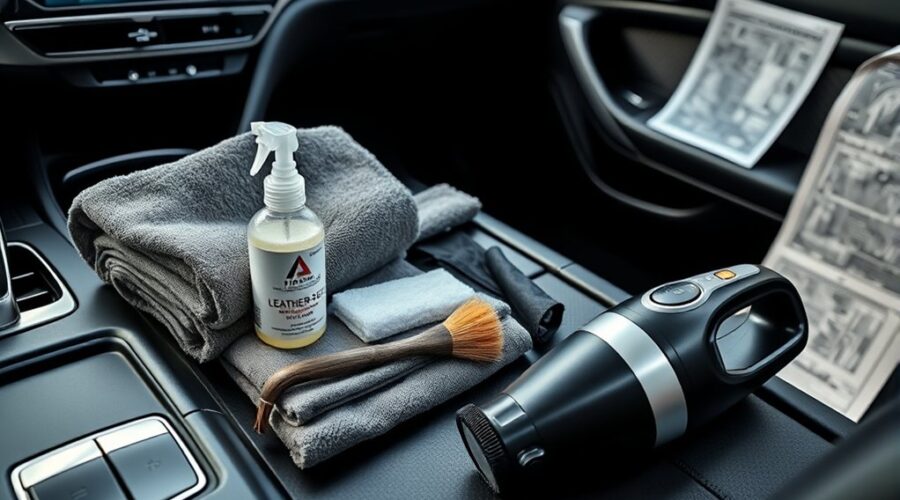
A car interior cleaning kit combines targeted cleaners, microfiber tools, and surface-safe formulas for leather, fabric, vinyl, glass, and plastic. Its design has shifted from basic brushes and rags to products calibrated for material compatibility, residue control, and faster application. The technical details matter, because one wrong choice can stain trim or leave films behind, and the differences between kits often appear only when the first stubborn contaminant surfaces.
Key Takeaways
- Car interior cleaning kits clean, protect, and maintain leather, fabric, plastic, and glass surfaces inside vehicles.
- Typical kits include microfiber cloths, brushes, upholstery cleaners, leather conditioners, glass cleaner, and odor eliminators.
- Microfiber towels, detailing brushes, and vacuum attachments improve dust removal and protect delicate interior surfaces.
- Modern kits evolved from simple brushes and rags to specialized, eco-friendly all-in-one systems with clearer instructions and better usability.
- Effective detailing starts with vacuuming, then surface-specific cleaning, stain treatment, odor control, and ammonia-free glass finishing.
What Is a Car Interior Cleaning Kit?
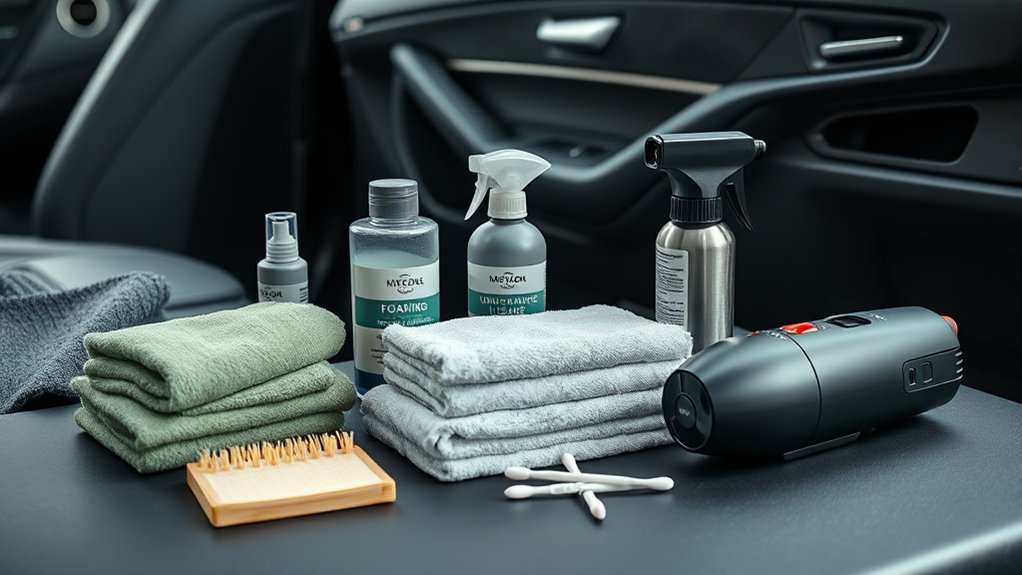
A car interior cleaning kit is a purpose-built set of automotive care products designed to clean, protect, and maintain interior surfaces such as fabric, vinyl, leather, glass, and trim.
A Car interior cleaning kit typically combines cleaning products calibrated for varied substrates, reducing the risk of abrasion, staining, or surface degradation. An upholstery cleaner addresses embedded soil in textile panels, while microfiber cloths support low-lint removal and controlled product application.
The kit generally relies on automotive-specific products rather than household formulas, because interior materials require pH-balanced, non-corrosive chemistry. Its function extends beyond appearance: it helps remove dust, allergens, and odor-causing residues, improving cabin hygiene and occupant comfort.
Regular use can preserve material integrity, slow wear, and maintain a clean, orderly interior that supports long-term resale value. For users seeking autonomy over vehicle care, the kit offers a systematic, efficient method for sustaining a liberated driving environment.
What’s in a Car Interior Cleaning Kit?
A typical car interior cleaning kit contains specialized cleaners calibrated for fabric, leather, plastics, and glass, reducing the risk of material damage while improving cleaning efficiency.
It also includes essential supplies such as microfiber cloths, brushes, and vacuums, which target dust, stains, debris, and allergens across seats, carpets, and trim.
In more extensive kits, leather conditioners, odor eliminators, and ammonia-free glass cleaners extend surface protection and maintain visibility and cabin freshness.
Essential Interior Supplies
An effective car interior cleaning kit typically combines specialized automotive cleaners with the tools needed to apply them correctly across multiple surfaces. For car cleaning and interior cleaning, the core set usually includes upholstery cleaner, leather conditioner, all-purpose cleaner, microfiber cloths, protective sprays, and odor eliminators. These products support controlled treatment of fabric, vinyl, plastic, and leather, reducing residue and material fatigue.
| Item | Function | Benefit |
|---|---|---|
| Upholstery cleaner | Lifts embedded soil | Preserves fabric integrity |
| Microfiber cloths | Apply and remove product | Limits scratching |
| Odor eliminators | Neutralize smells | Improves cabin air |
Instructions are often included to guide dosage, dwell time, and surface compatibility. Such specification enables users to clean efficiently, maintain material longevity, and keep the cabin orderly and autonomous.
Specialized Cleaning Tools
Specialized tools define the effectiveness of a car interior cleaning kit, because they allow controlled access to confined areas and improve cleaning precision across mixed materials.
In practice, specialized tools include microfiber cloths, detailing brushes, and vacuum attachments that release embedded debris without excess force. High-quality microfiber cloths trap dust and grit while protecting trim, screens, and polished surfaces. Detailing brushes dislodge particles from vents, seams, and switchgear. Vacuum attachments, especially crevice tools and upholstery nozzles, improve suction efficiency in narrow gaps.
- Upholstery cleaners address fabric contamination
- All-purpose cleaners support broad interior maintenance
- Leather conditioners preserve finished hide
- Odor eliminators refine cabin atmosphere
How Interior Kits Have Changed
Interior cleaning kits have shifted from simple assortments of cloths and brushes to more specialized systems designed for leather, fabric, plastic, and other interior surfaces.
Modern all-in-one kits typically integrate eco-friendly cleaners, microfiber tools, and steam-based devices to improve cleaning precision and efficiency.
This progression reflects increased consumer demand for broader functionality, clearer guidance, and higher-performance maintenance solutions.
Early Basic Kits
Early car interior cleaning kits were particularly limited in scope, typically combining brushes, rags, and simple cleaning solutions for basic dust removal and vacuuming.
These early basic kits addressed the car interior through surface dusting, targeting loose debris on dashboards, seats, and trim. Their construction was utilitarian: brushes loosened particles, the cleaning solution reduced adhered grime, and cloth rags collected residue without complex chemistry.
- Minimal tool count
- Manual surface dusting
- Limited stain control
- Basic vacuuming support
Such kits offered practical independence for owners, yet remained constrained by material sensitivity and low specialization.
They represented a foundational stage in interior care, before later developments expanded cleaning capability, precision, and user choice.
Modern All-In-One Kits
Modern all-in-one car interior cleaning kits represent a significant expansion beyond the limited brush-and-rag sets of earlier generations. They combine specialized agents for leather, cloth, and plastics with microfiber cloths, brushes, and sprayers, enabling one-package detailing. | Component | Function |
| — | — |
|---|---|
| Multi-surface cleaners | Remove grime from varied cabin materials |
| UV protectants | Reduce fading and surface degradation |
| Eco-friendly cleaning solutions | Support lower-impact maintenance |
These modern all-in-one car interior cleaning kits favor eco-friendly cleaning solutions and biodegradable formulas, aligning performance with restraint from unnecessary chemical load. Advanced packaging designs, including stackable bottles and clear labeling, organize sequential use and reduce handling errors. The result is a more efficient, technically coherent system that supports cleaner interiors, longer material life, and greater user autonomy through precise, liberated maintenance control.
How to Match Products to Surfaces?
Product selection should be matched precisely to each interior surface to avoid material damage and achieve consistent results. A suitable cleaning product is defined by compatible materials, not by marketing claims. Users should always test any new formula on an inconspicuous area, especially on dyed leather, coated fabric, or delicate trim.
Specialized automotive cleaning is preferable because automotive cleaning products are formulated to reduce chemical aggression found in household cleaners.
Specialized automotive cleaners are designed to reduce chemical aggression compared with household cleaners.
- Leather: use leather-specific cleaners and conditioners only.
- Upholstery: select fabric cleaners designed for fiber structure.
- Plastic surfaces: choose non-slick dressings to preserve grip and appearance.
- Glass: apply ammonia-free cleaners to protect tint and limit streaking.
Label review remains essential for verifying solvent strength, pH balance, and surface suitability. This disciplined selection process supports safer interiors and more autonomous maintenance, allowing each surface to be treated according to its own material logic without unnecessary compromise.
What Makes an Interior Kit Easy to Use?
Once the appropriate chemicals have been matched to each interior surface, usability depends on how efficiently the kit supports application, organization, and control.
An easy-to-use kit usually relies on spray bottles with ergonomic designs and sturdy nozzles, which reduce hand strain and improve directional accuracy. Color-coded or labeled containers streamline the cleaning process by signaling which solution belongs to each material, limiting confusion and waste.
Included microfiber cloths and brushes extend control by removing debris without damaging trim, glass, or upholstery. Specialized products, such as leather conditioners and fabric cleaners, add targeted capability without forcing the user to improvise with unsuitable agents.
Clear instructions further strengthen the system, translating technical compatibility into practical action. Together, these features lower friction, shorten setup time, and support independent, confident maintenance.
In effect, the kit becomes not merely a collection of chemicals, but a structured tool for disciplined interior care.
How to Detail a Car Interior Step by Step
A systematic interior detail begins with thorough vacuuming of the cabin, using narrow and brush attachments to extract loose debris from seats, seams, vents, and other tight spaces before any wet cleaning occurs. This first pass sets the baseline for a clean interior and improves auto detailing efficiency.
Floor mats should be removed, cleaned separately with car-cleaning kits or degreaser when needed, then air dried fully before reinstallation.
- Treat hard plastics with specialized automotive cleaners.
- Apply a non-slick protectant to preserve durability and tactile control.
- Identify leather type, then use a suitable cleaner and leather protectant.
- Finish glass with ammonia-free cleaner and microfiber towels for streak-free clarity.
Each stage supports disciplined stain removal without excess residue. In practice, the method emphasizes controlled product use, surface-specific chemistry, and sequence.
Each stage supports clean removal without residue, guided by precise product use, surface-specific chemistry, and sequence.
That order enables liberation from cluttered cabins and restores a precise, functional environment.
How to Remove Stains and Odors?
Stain and odor removal in a car interior begins with targeted pre-treatment rather than broad scrubbing, since compatible spot cleaners can be worked into the affected area, gently agitated with a soft brush, and then rinsed to lift embedded soil without spreading it. This method supports a clean car and protects carpet and upholstery fibers during cleaning. Stains may require a dedicated Stain Remover or, for tougher marks, a vinegar-and-baking-soda paste applied with controlled contact time. Odors are reduced by sprinkling baking soda on the stain, waiting at least 15 minutes, and vacuuming thoroughly. Adhesive residues and stubborn stains respond to isopropyl alcohol on a microfiber cloth. Leather benefits from regular cleaning and conditioning with automotive-specific products.
| Issue | Response |
|---|---|
| Stain | Pre-soak |
| Odor | Baking soda |
| Residue | Alcohol |
| Leather | Condition |
Good cleaning restores control and removes the burden of lingering contamination.
How to Clean Car Windows Without Streaks?
Clear glass in a car interior depends on controlled technique and the right materials. To clean the windows, an ammonia-free glass cleaner is applied in the shade, reducing rapid evaporation and protecting tinted surfaces. A first pass with a microfiber cloth lifts soil without smearing, then a second dry cloth polishes the pane toward a streak-free finish.
- Use minimal glass cleaner to prevent residue buildup.
- Wipe horizontally on one side and vertically on the other.
- Replace microfiber cloths when they become damp or contaminated.
- Inspect edges and corners for hidden film.
This two-step process gives the operator precise control over contact, pressure, and drying rate. Fresh microfiber cloths preserve absorption, while direction changes expose lingering streaks immediately.
Two-step wiping offers precise control, fresh absorption, and quick detection of lingering streaks.
The result is clean visibility, fewer distractions, and a more liberated driving environment.
How to Choose the Right Interior Kit?
After the windows are free of streaks, attention shifts to selecting a car interior kit matched to the vehicle’s materials and maintenance demands.
A suitable Car Interior Cleaning Kit begins with surface analysis: leather, fabric, and plastic each require appropriate cleaners and protectants to prevent damage while restoring control over grime.
The kit should include microfiber towels, brushes, and vacuum attachments, since these tools extend reach into seams, vents, and floor channels with efficient precision.
Bottle count matters as well; a thorough kit should supply enough product for repeated sessions, not a single pass.
Deodorizing agents or air fresheners add another layer of utility by neutralizing odors after debris removal.
Brand reputation should be verified through customer reviews, because reliability, material safety, and cleaning performance determine whether the interior is genuinely renewed.
Selection based on specification, not impulse, grants cleaner surfaces and a more autonomous driving environment.
Frequently Asked Questions
What Do Professional Car Detailers Use to Clean the Interior?
Professional detailers use specialized interior cleaning products, microfiber towels, soft and stiff brushes, steam cleaners, and extraction machines. Their professional tools support detailing techniques, upholstery care, product recommendations, and efficiency tips for thorough, safe results.
What Is the Best Car Interior Cleaning Kit?
Like a well-tuned compass, the Adams Polishes Essential 21-Piece Kit appears the best overall, combining best products, essential tools, and effective cleaning techniques; consumer reviews favor it over budget kits, though eco friendly options remain situational.
What Are the Different Types of Car Cleaning Kits?
Car cleaning kits include basic, detailing, specialized, all-in-one, and glass sets. They differ by essential tools, multi purpose cleaners, organized storage, eco friendly options, budget considerations, and brand comparisons, enabling liberated, technical maintenance choices.
What Are the Common Mistakes to Avoid When Cleaning a Car Interior?
Car interiors can cloud like dust after rain. Common mistakes include poor Cleaning Techniques, weak Product Safety, rushed Time Management, bad Tool Selection, flawed Surface Care, and delayed Stain Removal, which can damage fabrics, leather, and warranties.
Conclusion
To summarize, a car interior cleaning kit functions as more than a convenience; it is a system for material-specific care, surface protection, and cabin hygiene. From microfiber cloths to targeted cleaners, each component serves a defined role, and each surface demands a different method. Leather, fabric, glass, and plastics all respond differently, but the principle remains constant: matched tools yield better results. In maintenance, as in engineering, precision is not optional; it is the standard.