
Choosing the right OBD2 scanner in 2027 depends on more than just reading fault codes. Some tools focus on simple diagnostics, while others offer ABS, SRS, resets, and even bidirectional testing. The INNOVA 6100P, MOTOPOWER MP69033, TOPDON ArtiDiag Pro, and BlueDriver each serve a different kind of user. The differences may seem small at first, but they can change how a driver handles car problems.
INNOVA 6100P OBD2 Scanner with ABS/SRS & Reset
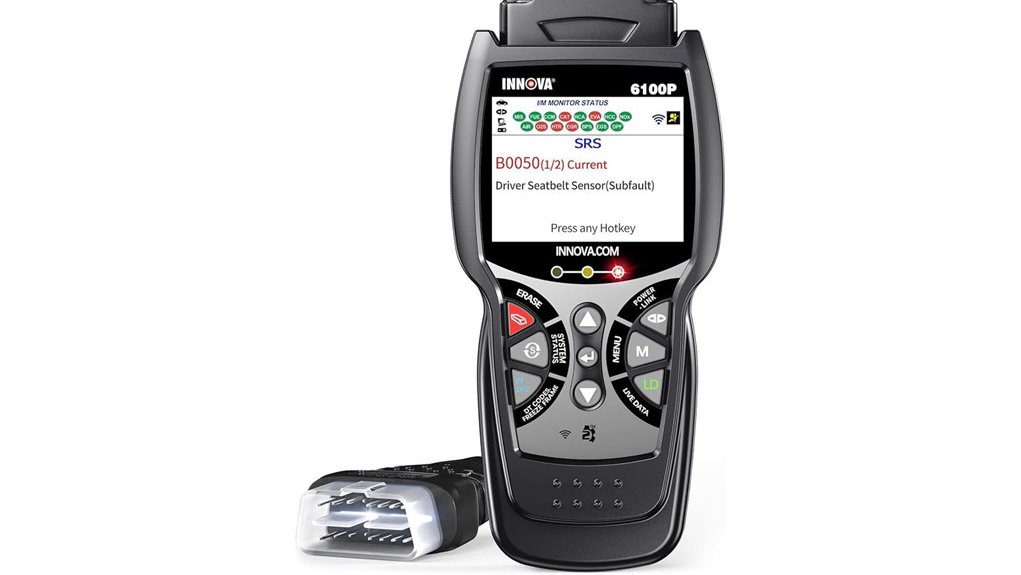
The INNOVA 6100P OBD2 Scanner is a strong choice for drivers who need a dependable, easy-to-use diagnostic tool with broader fault coverage, especially those working with Ford, Chevy, Dodge, and GM vehicles. It reads and clears engine, ABS, SRS, and transmission codes, while Code Severity Levels help identify urgent faults. The scanner also tracks oil life, supports reset procedures, and monitors alternator performance across many vehicle types. Live data and logging improve diagnosis, and ASE certified technical support adds practical value. Developed in the US, it reflects Innova’s emphasis on accessible, reliable automotive diagnostics.
Best For: Drivers who want a reliable, easy-to-use OBD2 scanner with enhanced coverage for engine, ABS, SRS, and transmission codes, especially for Ford, Chevy, Dodge, and GM vehicles.
Pros:
- Reads and clears multiple system codes, including engine, ABS, SRS, and transmission
- Code Severity Levels help prioritize urgent issues
- Includes live data, logging, reset functions, and ASE certified technical support
Cons:
- Best features are most useful on supported vehicle makes, especially domestic brands
- Not as advanced as full professional shop-grade diagnostic tools
- Battery and alternator testing may not cover every diagnostic need for all users
MOTOPOWER OBD2 Scanner Code Reader (MP69033)
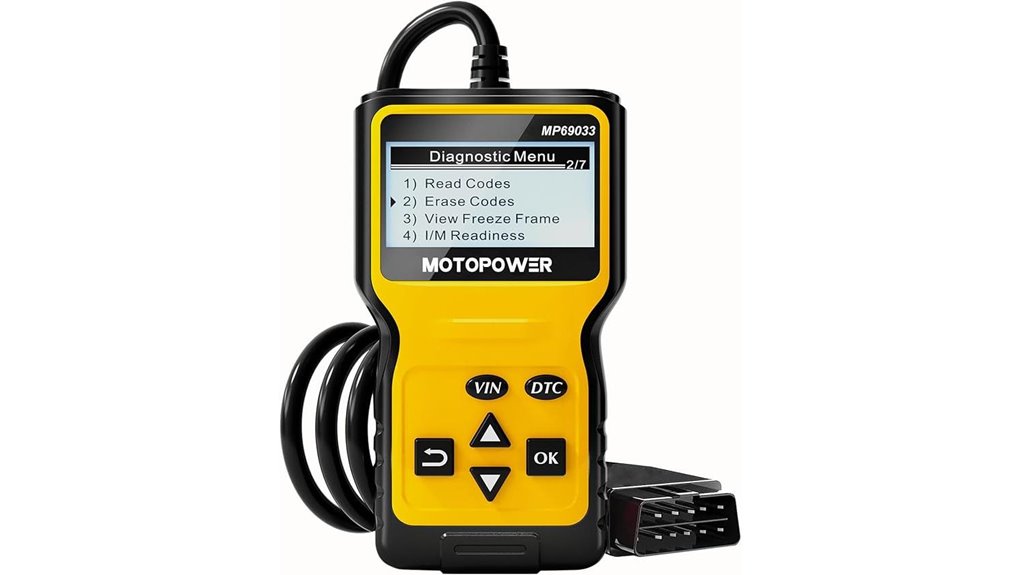
MOTOPOWER’s MP69033 suits drivers who want simple fault-code reads without extra complexity. This yellow OBD2 code reader works with all OBD II protocol cars from 1996 onward and supports nine common protocols for many US, European, and Asian vehicles. It reads and erases codes, shows freeze-frame data, I/M readiness, live data, VIN, and engine metrics such as coolant temperature and RPM. A 2.8-inch backlit LCD and six-button layout keep operation straightforward. It is powered through the port, but it cannot access ABS, airbag, or oil-service codes.
Best For: Drivers who want an easy-to-use, budget-friendly OBD2 scanner for reading and clearing engine fault codes, checking live data, and viewing basic vehicle information on 1996+ OBD II vehicles.
Pros:
- Supports all OBD II protocol cars from 1996 onward and many US, European, and Asian vehicles
- Reads and erases codes, shows freeze-frame data, I/M readiness, VIN, and live engine metrics
- Simple setup with a backlit 2.8-inch display, six-button navigation, and no battery required
Cons:
- Cannot read or clear ABS, airbag, or oil service light codes
- No advanced diagnostics beyond standard OBD2 functions
- Small screen and basic interface may feel limited for users wanting more features
TOPDON ArtiDiag Pro Bidirectional Scan Tool with ECU Coding, 35+ Services
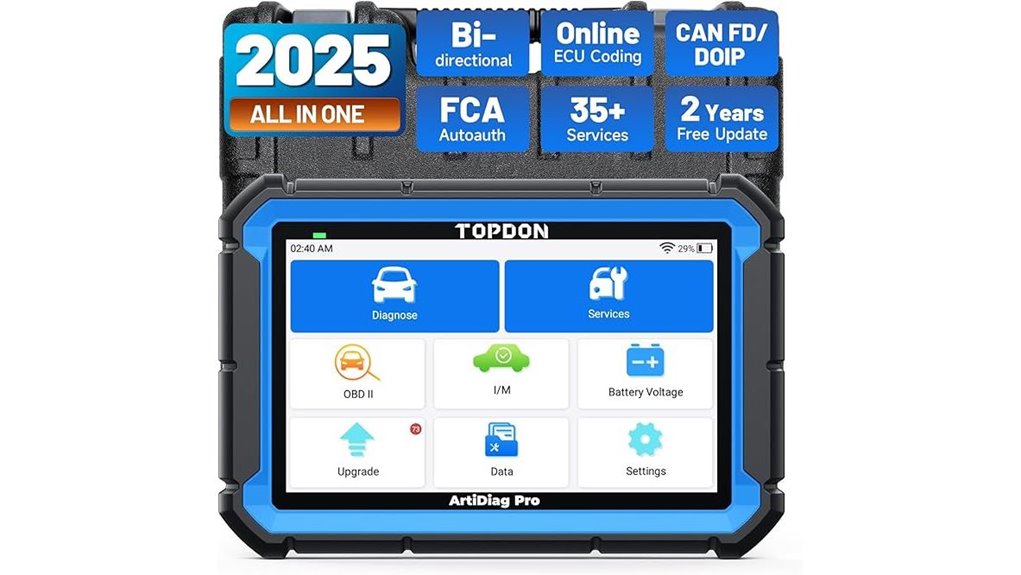
TOPDON ArtiDiag Pro suits technicians who need bidirectional testing and ECU coding in one tool. It works with VW, AUDI, SKODA, SEAT, BENZ, and other makes, letting users uncover hidden features, disable functions, and code retrofitted parts. Its bidirectional control tests actuators such as lights, locks, fuel systems, coolant systems, windows, wipers, and EVAP components, helping narrow faults faster. The tool also offers 35+ service functions, including oil reset, EPB reset, and steering angle calibration. FCA AutoAuth support covers newer Chrysler, Jeep, Dodge, Fiat, Renault, and more.
Best For: Technicians and advanced DIY users who want bidirectional diagnostics, ECU coding, and broad service functions in one scan tool.
Pros:
- Supports bidirectional testing to quickly diagnose actuators like lights, locks, windows, wipers, and fuel systems.
- Offers ECU coding for uncovering hidden features, disabling functions, and coding retrofitted components on select vehicles.
- Includes 35+ service resets such as oil, EPB, and steering angle calibration, plus FCA AutoAuth support.
Cons:
- May be more advanced than casual users need, with a learning curve for full feature use.
- Vehicle compatibility and coding capabilities can vary by make, model, and year.
- Premium features like ECU coding and bidirectional control may not work on every vehicle system.
BlueDriver OBD2 Scanner Bluetooth, No Subscription, ABS SRS TPMS
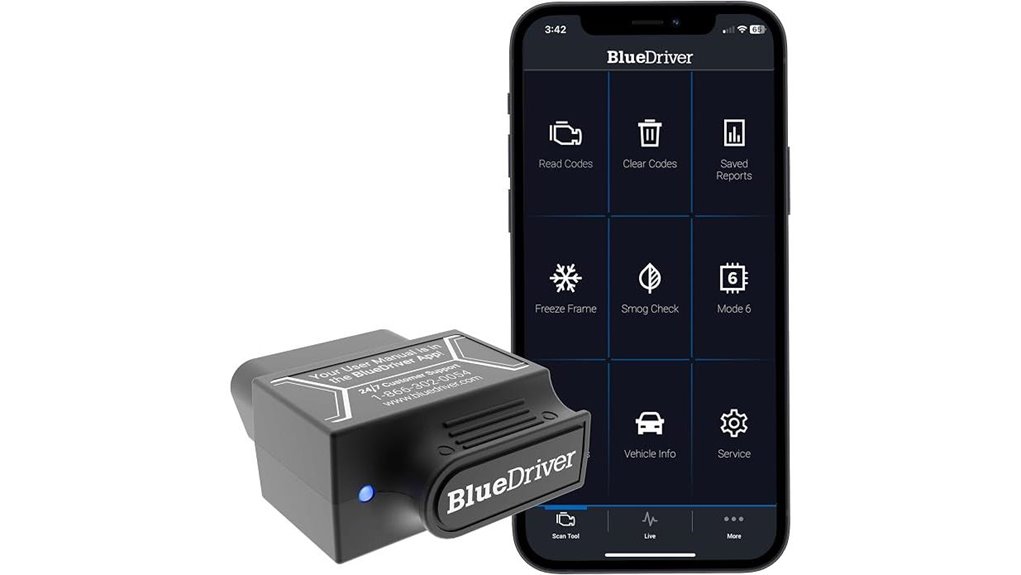
BlueDriver suits drivers who want professional diagnostics without subscription fees. It is a Bluetooth OBD2 scanner designed for 1996+ gas vehicles in North America, with strong coverage for GM, Ford, Stellantis, Toyota, Honda, Nissan, Mazda, Subaru, Hyundai, Mercedes-Benz, BMW, and VW. It reads and clears enhanced codes for Check Engine, ABS, SRS, airbag, TPMS, and transmission faults. The app shows live data, freeze frames, smog readiness, and Mode 6 results. Verified repair reports matched to the VIN add practical guidance. A one-time purchase, 24/7 support, and iOS and Android compatibility strengthen its value.
Best For: Drivers in North America who want a wireless, professional-grade OBD2 scanner with broad vehicle coverage, enhanced diagnostics, and no subscription fees.
Pros:
- Reads and clears enhanced codes for Check Engine, ABS, SRS, airbag, TPMS, and transmission issues.
- Includes live data, freeze frame, smog readiness, Mode 6 results, and VIN-matched verified repair reports.
- One-time purchase with Bluetooth connectivity, iOS/Android app support, and 24/7 North American support.
Cons:
- Works only with 1996+ gas vehicles in North America, so compatibility is limited.
- Requires a smartphone or tablet to use the app-based interface.
- May be more feature-rich than casual users need, making it less necessary for basic code reads.
Factors to Consider When Choosing OBD2 Scanners 2026: Diagnose Car Faults Yourself
Choosing an OBD2 scanner in 2026 starts with vehicle compatibility and the breadth of code coverage, since not every tool supports every make, model, or fault system. Special reset functions and live data access can also determine whether a scanner only reads codes or helps with deeper diagnosis and basic repairs. The choice between wireless and wired models then depends on how much convenience, speed, and reliability are needed for everyday use.
Vehicle Compatibility
Vehicle compatibility is one of the most important factors when selecting an OBD2 scanner in 2026, because the best tool is only useful if it works with the vehicles being serviced. A scanner should support all OBD II protocol vehicles, especially models built since 1996, to guarantee broad coverage across many makes and models. It is also important to check support for common protocols such as CAN, ISO, and J1850, since these remain widely used in modern cars. Owners of both domestic and foreign vehicles should confirm cross-regional support before buying. Some scanners also offer enhanced diagnostics for specific brands, which can improve performance on certain manufacturers. Compatibility with multiple systems, including engine, ABS, and SRS, further increases practical usefulness during routine fault diagnosis.
Code Coverage
Code coverage determines how much of a vehicle’s fault data an OBD2 scanner can actually access, from basic engine codes to more complete diagnostics for ABS, SRS, and transmission systems. Entry-level models often read and clear only powertrain faults, while broader coverage improves visibility into safety and drivability systems. Some scanners also provide make-specific diagnostics, which can matter when a manufacturer uses unique modules or fault logic. Code severity levels help distinguish urgent problems from minor ones, so troubleshooting can begin with the most critical issues. A strong DTC database adds value by listing definitions, likely causes, and confirmed fixes. Broader protocol support further increases usefulness, allowing the scanner to work across most vehicles sold since 1996 and across many brands and models.
Special Reset Functions
Special reset functions can make an OBD2 scanner far more useful after routine maintenance or component replacement, with oil reset and EPB reset among the most common examples. These services help clear reminders and restore systems after brake work, battery changes, or filter service. More advanced scanners also support steering angle reset, which matters after suspension repairs, and ABS or SRS resets for brake and airbag fault codes. Some tools add bidirectional control, letting users activate actuators and verify repairs without guesswork. A scanner with broad service coverage can handle up to 90% of common maintenance tasks, reducing shop visits. For buyers, the key is matching reset functions to the vehicle and repair needs, since capability varies widely across models.
Live Data Access
Live data access is a key feature for anyone choosing an OBD2 scanner in 2026, because it shows real-time vehicle parameters such as RPM, speed, and oil temperature. This capability improves diagnostic accuracy by revealing how a vehicle behaves while it runs, rather than only after a fault code appears. Many scanners stream data continuously, helping users spot immediate changes in engine or sensor performance. Advanced models also record data, allowing later review of trends and comparison across drives. That is useful for intermittent faults that do not always trigger warning lights. Some scanners present values in graphs, which simplifies analysis of complex patterns and makes abnormal behavior easier to identify.
Wireless Vs Wired
When comparing wireless and wired OBD2 scanners, the main trade-off is convenience versus reliability. Wireless models, often Bluetooth based, connect to smartphones or tablets, remove cable clutter, and improve portability. They usually require an app download and pairing before use, but they can be limited by transmission range, speed, or occasional disconnections. Battery life also matters, since they depend on their own power source. Wired scanners plug directly into the vehicle’s OBDII port, making setup simple and immediate. They are generally more stable, draw power from the car, and are often favored for longer diagnostic sessions. Many professional mechanics prefer them because their connection is dependable and their diagnostic coverage is often broader.
Display And Usability
A scanner’s display can make the difference between quick diagnosis and frustrating guesswork. A clear, bright screen with backlighting helps read codes and live data in garages, daylight, or dim interiors. Larger displays improve menu browsing and make real-time readings easier to track during testing. Usability also depends on navigation: well-placed buttons or responsive touch controls reduce confusion and speed up fault-finding for beginners and experienced users alike. Contrast adjustment adds another practical advantage, letting the display suit different eyes and environments. Multi-language support broadens access, especially when diagnostic terms must be understood quickly. Together, these features shape how efficiently a scanner can be used, turning technical information into something readable, manageable, and useful during everyday vehicle diagnostics.
Update And Support
Update and support are critical because an OBD2 scanner can only stay useful if its software keeps pace with newer vehicle systems, protocols, and fault codes. A strong choice should include lifetime software updates, since evolving cars quickly outgrow static diagnostic tools. Regular improvements to diagnostic coverage help maintain compatibility with newer models, modules, and emissions systems. Reliable customer support also matters, especially when live assistance is available for troubleshooting difficult issues. Some scanners add value through technician-verified repair databases and fault-fix reports, which can sharpen diagnostic confidence. A user-friendly app with ongoing updates and real-time data analysis further improves long-term usefulness, helping owners interpret results and respond to faults with greater accuracy as vehicle technology advances.
Price And Value
Price and value should be judged by how much diagnostic capability a scanner delivers for the money, especially whether it can read and clear engine, ABS, and SRS codes. Buyers should compare cost against features such as live data monitoring and vehicle health reports, since these tools improve fault detection and maintenance planning. A higher price may still be justified if the device offers a clear display, simple controls, and fast navigation, because usability reduces diagnostic time. Warranty length and customer support also matter, as stronger coverage can lower long-term ownership costs. Compatibility deserves close attention too; broader make and model support increases usefulness across multiple vehicles and protects the purchase as the garage changes.
Frequently Asked Questions
How Often Should I Update My OBD2 Scanner Software?
OBD2 scanner software should be updated whenever the manufacturer releases a significant patch, new vehicle coverage, or bug fix, typically a few times per year. In a detached view, older scanners may need updates less often if they function well, while professional users benefit from checking monthly. Regular updates help maintain compatibility with newer cars, improve diagnostic accuracy, and reduce communication errors. If updates are free and available, installing them promptly is usually sensible.
Can OBD2 Scanners Work on Hybrid and Electric Vehicles?
Yes, OBD2 scanners can work on many hybrid and electric vehicles, but their usefulness varies by model, protocol, and manufacturer support. They can read generic trouble codes, monitor battery systems, and access some powertrain data; they cannot always reach specialized EV modules, high-voltage diagnostics, or brand-specific functions. For full coverage, a scanner with hybrid and EV compatibility, updated software, and advanced diagnostics is often required.
Do All Scanners Read Manufacturer-Specific Fault Codes?
No, not all scanners read manufacturer-specific fault codes. Many basic OBD2 tools only access generic powertrain codes required by the standard, while advanced or brand-specific scanners can interpret enhanced codes for systems such as ABS, airbag, transmission, and hybrid modules. Support varies by vehicle make, model, year, and scanner software. A buyer should verify compatibility before purchase, especially when detailed diagnostics are needed beyond standard emissions-related faults.
How Do I Clear a Check Engine Light Safely?
A check engine light should be cleared safely only after the underlying fault is repaired; otherwise, the light will usually return. Studies suggest nearly 20% of illuminated warnings are caused by loose gas caps, making a quick inspection worthwhile. A scanner can erase the code, but a battery disconnect is less ideal and may reset other settings. If the light flashes, driving should stop until the problem is diagnosed.
Can One Scanner Diagnose Issues in Multiple Car Brands?
Yes, one scanner can diagnose issues across multiple car brands, provided it supports universal OBD2 protocols and, ideally, brand-specific software. It can read common fault codes, live data, and emissions-related problems on many vehicles. However, deeper diagnostics, special functions, and manufacturer modules often require a scan tool tailored to each brand. Compatibility should be checked before purchase, since some scanners cover only basic engine faults.
Conclusion
Ultimately, the four “best” OBD2 scanners for 2027 reveal a familiar truth: diagnosing a car fault is now as much about buying the right device as understanding the car itself. INNOVA and TOPDON cater to those who want near-professional control, MOTOPOWER serves the simple-mindedly practical, and BlueDriver turns a phone into a mechanic’s sidekick. Ironically, the more advanced the scanner, the less it seems to encourage the most basic repair skill of all—thinking.