
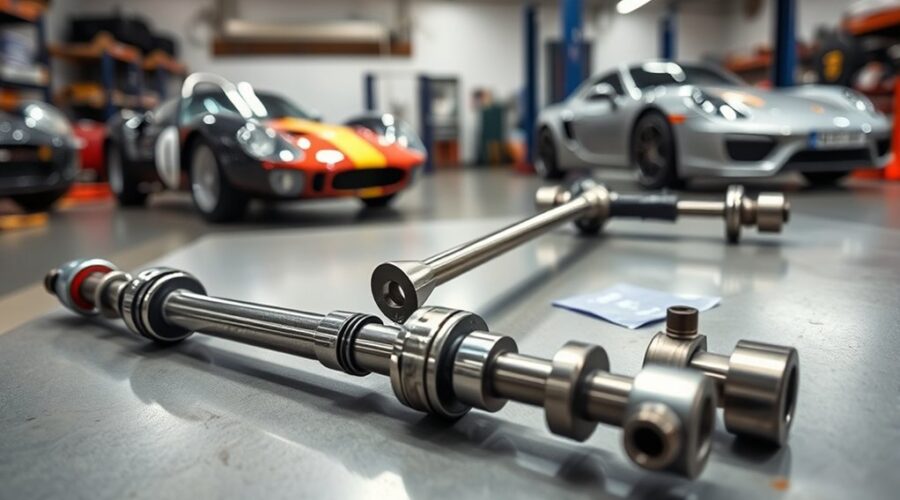
An anti-roll sway bar, also called a sway bar or stabilizer bar, links the left and right sides of one axle and resists unequal suspension movement. Its main job is to reduce body roll in corners, but its stiffness also affects steering balance, tire loading, ride behavior on uneven roads, and how independently the two wheels can move.
Quick Answer
An anti-roll sway bar works as a torsion spring between the left and right suspension. It twists when the wheels move by different amounts, increasing roll stiffness and reducing body lean. Bar diameter, lever-arm length, front-to-rear stiffness balance, bushings, and adjustment all affect how the vehicle responds.
What Is an Anti-Roll Sway Bar?
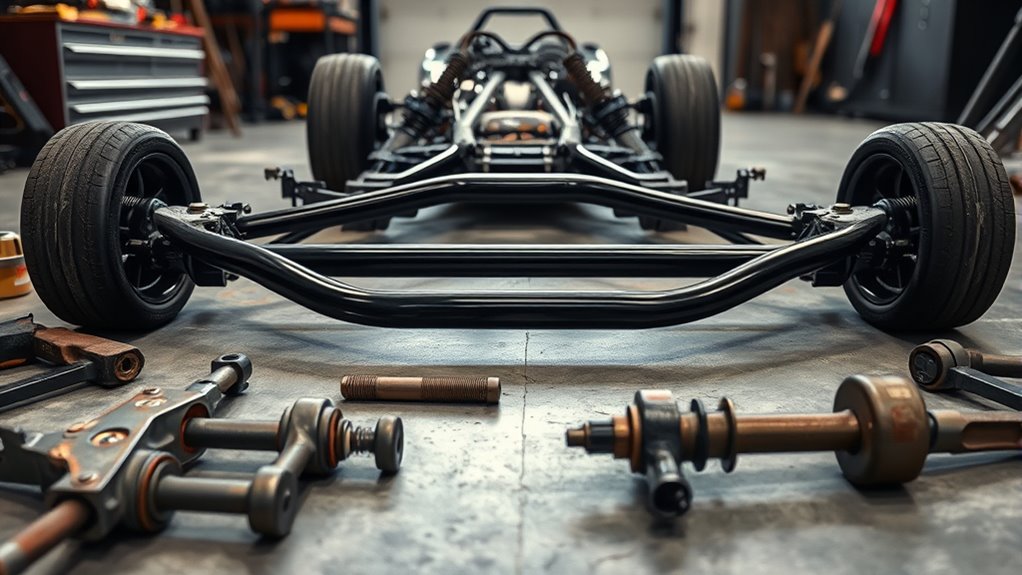
An anti-roll bar is a spring-like suspension component that connects the left and right sides of the same axle. Unlike the main coil or leaf springs, it is intended primarily to resist differences in wheel travel from one side to the other.
Most conventional designs use a steel bar running across the vehicle. The center portion is supported by chassis or subframe bushings, while each end connects to the suspension through an end link. When one end moves relative to the other, the bar twists.
That twisting resistance adds roll stiffness, which is the suspension’s resistance to the body leaning during a turn. When both wheels on an axle rise or fall together by the same amount, a conventional bar mainly rotates in its mounts instead of twisting, so it contributes little or no additional spring force. High Performance Academy’s anti-roll-bar suspension explanation describes this distinction between roll motion and equal wheel travel.
The concept has existed for more than a century. Stephen L. Chauncey Coleman filed a vehicle-suspension patent in 1916, and the related U.S. patent US1289398A was published on December 31, 1918.
How a Sway Bar Reduces Body Roll
A sway bar reduces body roll by resisting the difference between the outside and inside suspension positions during a turn. As the vehicle leans, one side of the bar is driven relative to the other, twisting the bar and creating a restoring torque.
The important distinction is that a sway bar does not simply remove cornering load transfer. Instead, it adds roll stiffness and changes how the suspension distributes part of the lateral load transfer between the front and rear axles.
Torsion Spring Action
During cornering, the outside suspension normally compresses while the inside suspension extends. The end links rotate the bar’s arms in opposite directions, twisting its center section.
Because the steel resists that twist, the bar pushes back through both links. This reduces the difference in suspension travel and therefore reduces the amount the body leans.
The effect is different from installing stiffer main springs. Coil springs react to many forms of wheel movement, including bump, pitch, and roll. A conventional sway bar contributes most strongly when the two sides move differently, which lets engineers add roll resistance without increasing the basic spring rate for equal wheel movement.
There is still a tradeoff. A very stiff bar couples the two sides more strongly. When only one tire encounters a pothole, curb, or uneven surface, more of that disturbance can influence the opposite side.
Load Transfer Control
A sway bar changes lateral load-transfer distribution rather than making cornering load transfer disappear. Increasing roll stiffness at one axle makes that axle carry a greater share of the suspension’s elastic lateral load transfer.
This distinction matters because tire grip does not rise in perfect proportion to vertical load. As one tire becomes more heavily loaded and the other unloads, the combined grip available from that axle can change. SAE research also describes anti-roll-bar stiffness as influencing wheel load transfer and body roll in cornering.
The main relationships can be summarized this way:
| Factor | Effect |
|---|---|
| Vehicle mass and lateral acceleration | Increase the cornering forces associated with lateral load transfer |
| Higher center of gravity | Increases the tendency for lateral load transfer and body roll |
| Wider track | Generally reduces lateral load transfer for the same other conditions |
| Front-to-rear roll stiffness | Changes how elastic load transfer is divided between the axles |
That is why changing a sway bar can alter handling even when the car feels flatter. Less visible body movement does not automatically mean the tires have more available grip.
Anti-Roll Bar Parts and Design
A typical anti-roll-bar system consists of the bar itself, chassis mounting bushings, brackets, and end links. Their combined stiffness and geometry determine how much of the bar’s theoretical torsional rate actually reaches the wheels.
Designers can change bar diameter, wall thickness, material, bends, arm length, mounting position, and suspension motion ratio. An SAE technical paper on anti-roll-bar stiffness confirms that multiple structural parameters influence stiffness rather than diameter alone.
Core Bar Structure
The common road-car design is a bent round bar with a transverse center section and lever arms at each end. Solid and hollow bars are both used.
A hollow design can reduce mass while retaining substantial torsional stiffness because material farther from the center of a round section contributes more strongly to its resistance to twisting. However, outside diameter alone cannot tell you whether one hollow bar is stiffer than another solid bar.
Bends and packaging also matter. Production bars often curve around exhaust, drivetrain, steering, or chassis components, so a real bar rarely behaves exactly like a simple straight laboratory torsion rod.
Bushings And End Links
Sway bar bushings locate the bar on the chassis or subframe while allowing it to rotate. Rubber is common because it also isolates noise and vibration, while firmer bushing materials can reduce compliance at the cost of transmitting more noise or harshness.
End links connect the bar arms to a control arm, strut, axle, or another suspension point. They transmit suspension motion into the bar, so looseness or wear can reduce the system’s effectiveness.
Common reasons to inspect the system include:
- Clunking or rattling over uneven pavement.
- Visible cracking or deterioration in a mounting bushing.
- Play in an end-link joint.
- A sudden increase in body roll compared with the vehicle’s normal behavior.
Those symptoms are not unique to a sway bar, so they should be confirmed with a suspension inspection rather than diagnosed by sound alone.
Fixed Versus Adjustable Bars
A fixed sway bar has one effective geometry and therefore one basic setup. An adjustable bar normally uses several end-link mounting holes or another mechanical adjustment to change leverage without replacing the bar.
Most multi-hole adjustable bars are manually adjusted while the vehicle is stationary. They should not be confused with an active anti-roll system that can change its response while the vehicle is moving.
| Type | Strength | Tradeoff |
|---|---|---|
| Fixed | Simple, consistent calibration | No mechanical stiffness adjustment |
| Adjustable | Lets you tune effective leverage | Requires correct setup and testing |
| Active | Can vary roll control while driving | More components, controls, and complexity |
With a common multi-hole bar, moving the end link closer to the bar’s pivot axis shortens the effective lever arm and makes the system act stiffer. Moving it farther outward generally makes the effective setting softer.
How Sway Bar Thickness Changes Handling
A thicker sway bar can be dramatically stiffer than a thinner one when the material and geometry are otherwise the same. For a simple solid round torsion section, torsional stiffness varies approximately with the fourth power of diameter.
That relationship means small diameter changes can have large effects. High Performance Academy gives the example of changing an otherwise equivalent solid U-shaped bar from 20 mm to 22 mm, which produces roughly 1.5 times the stiffness.
However, you cannot reliably compare two real sway bars by diameter alone. Effective stiffness also depends on:
- Whether the bar is solid or hollow.
- Inside diameter or wall thickness on a hollow bar.
- Length of the torsion section.
- Lever-arm length.
- Bends and overall shape.
- End-link mounting position.
- Suspension motion ratio.
- Bushing, bracket, and chassis compliance.
A stiffer bar generally produces a flatter response and can make initial steering feel more immediate. But excessive stiffness can also reduce independent wheel movement, unload the inside tire more heavily, and reduce grip on rough pavement.
How Front and Rear Sway Bar Stiffness Changes Handling Balance
Front and rear sway bars do not affect handling in exactly the same way. Changing the proportion of roll stiffness at one axle changes that axle’s share of lateral load transfer, so the vehicle’s understeer or oversteer balance can shift.
As a general tuning rule, more front roll stiffness relative to the rear tends to move the vehicle toward understeer. More rear roll stiffness relative to the front tends to reduce understeer and can move the vehicle toward oversteer.
High Performance Academy’s anti-roll-bar tuning guidance describes softening the front or stiffening the rear as possible responses to mid-corner understeer, with the opposite changes used for mid-corner oversteer.
These are general tendencies, not guarantees. Tires, alignment, suspension geometry, springs, dampers, drivetrain layout, differential behavior, aerodynamics, and road surface all contribute to the final result.
Pro Tip: If you have an adjustable setup, change one variable at a time and record what happens. A flatter car is not automatically a faster or safer car if the change also creates unwanted understeer, oversteer, or loss of traction.
Adjustable and Active Sway Bar Systems
Adjustable and active systems try to give the suspension more roll control when it is useful and more wheel independence when it is not. They achieve that goal in different ways.
A conventional adjustable bar changes mechanical leverage through mounting positions or, on some competition designs, adjustable blades. Once set, a normal multi-hole road-car bar stays at that setting until it is physically readjusted.
An active system can change the force connecting the two sides while driving. For example, BMW states that the XM’s Active Roll Stabilisation uses a 48-volt electric motor between two halves of the anti-roll bar at both axles. The system can counter body roll while also decoupling the conventional bar connection during straight-line driving.
Toyota’s Electronic Kinetic Dynamic Suspension System, or E-KDSS, electronically controls the front and rear stabilizers independently. That allows the suspension to support on-road roll control while permitting greater wheel articulation off-road.
A different approach is a true disconnect. The current Jeep Wrangler Rubicon Electronic Sway Bar Disconnect can disconnect the front sway bar so the front wheels have more freedom to compress and droop over difficult terrain.
These systems demonstrate why maximum stiffness is not always desirable. A connected, stiff system helps control roll on pavement, while reduced coupling can be valuable when individual wheels need to follow uneven terrain.
How to Choose the Right Sway Bar
Choose a sway bar by first identifying the problem you are trying to solve. A daily driver with worn bushings needs a different solution from a track car that needs mid-corner balance changes or an off-road vehicle that needs more articulation.
Warning: Changing sway-bar stiffness can alter understeer, oversteer, emergency handling, and traction. Use components designed for the exact vehicle and follow the part and vehicle manufacturers’ installation and adjustment instructions.
For a normal road car, consider these points before changing bar stiffness:
- Confirm the existing system is healthy. Worn end links or bushings can create noise and excess movement that an upgrade will not properly fix.
- Define the handling goal. Decide whether you want less body roll, a different front-to-rear balance, or both.
- Consider the whole suspension. Springs, dampers, tires, alignment, ride height, and suspension geometry affect how a bar change feels.
- Compare complete specifications. Diameter alone is not enough if the bars differ in hollow construction, arm length, bends, or mounting geometry.
- Use adjustability gradually. Start from a known baseline and change one setting at a time.
- Check installation at normal ride height. Adjustable links should be set correctly so the system is not unintentionally preloaded when the vehicle is sitting level.
A larger aftermarket bar can be useful, but the best setup is not automatically the stiffest one. The goal is a predictable balance between roll control, tire grip, ride quality, and wheel independence.
Frequently Asked Questions
What Are the Downsides of Using Anti-Roll Bars?
Anti-roll bars can reduce wheel independence on one-wheel bumps and can shift grip balance if they are too stiff at one axle. A very stiff setup may make rough-road traction and ride quality worse, and it can increase the tendency for the inside wheel to unload during hard cornering.
What Is the Main Purpose of an Anti-Roll Bar?
The main purpose is to add roll stiffness so the body leans less when left and right suspension travel differs, especially in corners. The bar also gives engineers and tuners a way to change how lateral load transfer is distributed between the front and rear axles.
Are Anti-Roll Bars and Sway Bars the Same Thing?
Yes. Anti-roll bar, sway bar, anti-sway bar, and stabilizer bar are common names for the same basic suspension component. Terminology varies by manufacturer and region, but the component links the left and right sides of one axle and resists unequal suspension movement.
Can I Drive Without an Anti-Roll Bar?
A normal road vehicle should not be treated as safe for routine driving with a missing or disconnected anti-roll bar unless the manufacturer specifically designed and permits that condition. Handling and emergency response can change noticeably. Factory off-road disconnect systems are different because they operate within defined modes and conditions.
Does a Stiffer Sway Bar Always Improve Grip?
No. A stiffer sway bar reduces roll at that axle, but it also increases that axle’s share of elastic lateral load transfer. If stiffness goes too far, available grip can fall, the inside tire can unload more, and the vehicle can move toward understeer or oversteer depending on which axle was stiffened.
What Are Common Signs of Worn Sway Bar Links or Bushings?
Common signs include clunking or rattling over uneven roads, visible play in an end link, cracked or deteriorated bushings, and more body roll than the vehicle normally has. These symptoms can overlap with other suspension faults, so inspection is better than replacing parts based on noise alone.
Related reading: learn about grip limits and overdriving, see how an adjustable suspension system appears on the Toyota 4Runner off-road, or look at the setup of a Nissan 350Z drift car.
Sources
- High Performance Academy — Anti-Roll Bars: Torsion behavior, equal versus unequal wheel travel, diameter effects, lever-arm adjustment, and wheel independence.
- High Performance Academy — Choosing and Tuning Anti-Roll Bars: Front/rear stiffness changes and their effects on mid-corner balance.
- SAE International: Structural parameters that influence anti-roll-bar stiffness.
- Google Patents — US1289398A: Stephen L. Chauncey Coleman’s vehicle-suspension patent filing and publication dates.
- BMW Group: 48-volt electromechanical Active Roll Stabilisation used by the BMW XM.
- Toyota Motor Corporation: Electronic Kinetic Dynamic Suspension System and independent front/rear stabilizer control.
- Jeep: Electronic Sway Bar Disconnect and its effect on front-wheel articulation.


