

The best car jack depends on the job: a low-profile floor jack suits lowered cars, a scissor jack is a compact trunk backup, a trolley jack and stand combo is the better starting point for home maintenance, and a bottle jack suits taller trucks and SUVs. Whichever you buy, a jack only lifts a vehicle; it should never be what holds it while you work underneath.
Disclosure: As an Amazon Associate we earn from qualifying purchases. If you buy through links on this page we may earn a commission at no extra cost to you.
This guide is based on manufacturer specs and listing information, not hands-on testing. Check the jack’s rated capacity against your vehicle’s weight and use the jack points in your owner’s manual.
Quick Comparison
| Jack | Type | Rated capacity (per listing) |
|---|---|---|
| LiftMaster 3 Ton Ultra Low Profile | Low-profile floor jack | 3 tons |
| BIG RED Torin T10152 | Scissor jack | 1.5 tons |
| TCE Torin AT82001U combo | Floor jack with two stands | 2 tons |
| Powerbuilt 640912 | Bottle jack and stand combo | 3 tons |
| Powerbuilt 620422E | Triple-lift floor jack | 2 tons |
LiftMaster 3 Ton Ultra Low Profile Floor Jack

A steel floor jack with a very low starting height (the listing says about 3 inches) for lowered cars and vehicles with deep front air dams. It has a dual-pump system for faster lifting and a foam bumper to protect the vehicle. It is a heavy jack, which helps stability but makes it less portable.
Best for: Owners of lowered or low-clearance cars.
Pros
- Low starting height
- Dual-pump for fewer strokes
- Padded saddle
Limitations
- Heavy and bulky
- Low profile is unnecessary on tall vehicles
- Needs jack stands for any work underneath
BIG RED Torin T10152 Steel Scissor Jack

A 1.5-ton scissor jack that folds flat for the trunk. Torin lists a lifting range of about 4-1/8 to 15-1/8 inches. It is a roadside emergency jack, not a garage tool, so use it on flat ground and carefully.
Best for: Trunk backup for a flat tire.
Pros
- Compact and light
- Wide base for its size
- Low cost
Limitations
- Manual and slower than a hydraulic jack
- Limited lift range
- Not for regular garage work
TCE Torin Hydraulic Trolley Jack Combo with Stands (AT82001U)

A 2-ton hydraulic floor jack sold with two matching jack stands, with listed ratings and lift ranges for both. The bundle makes it a good starting point for brakes, wheel swaps and oil changes because the stands come in the box. Check your vehicle weight against the 2-ton rating, and always use the stands under the vehicle.
Best for: First-time DIY owners of cars and small crossovers.
Pros
- Includes the jack stands you need
- Safety bypass valve, per the listing
- Weighs about 31 lb, per the listing
Limitations
- 2-ton rating limits heavier vehicles
- Modest lift range
- Not low-profile
Powerbuilt 3 Ton Bottle Jack and Jackstand Combo (640912)
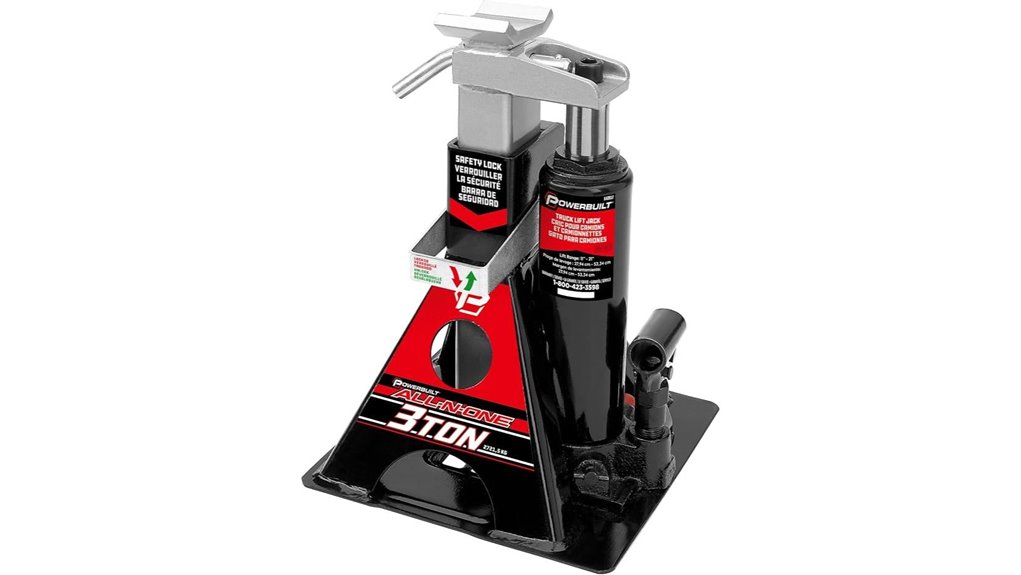
A bottle jack combined with a locking jackstand. Powerbuilt says it suits trucks, SUVs, RVs and trailers and is not intended for sedans. Its lifting range is large, so it works for taller vehicles. Treat any stand as a support only after you have set it on a solid surface.
Best for: Trucks, SUVs and trailers with higher ground clearance.
Pros
- Large lift range
- Locking safety bar for support
- Single, compact unit
Limitations
- Not for sedans
- Heavy and bulky
- Warranty is limited, per the listing
Powerbuilt 2 Ton Triple Lift Floor Jack (620422E)
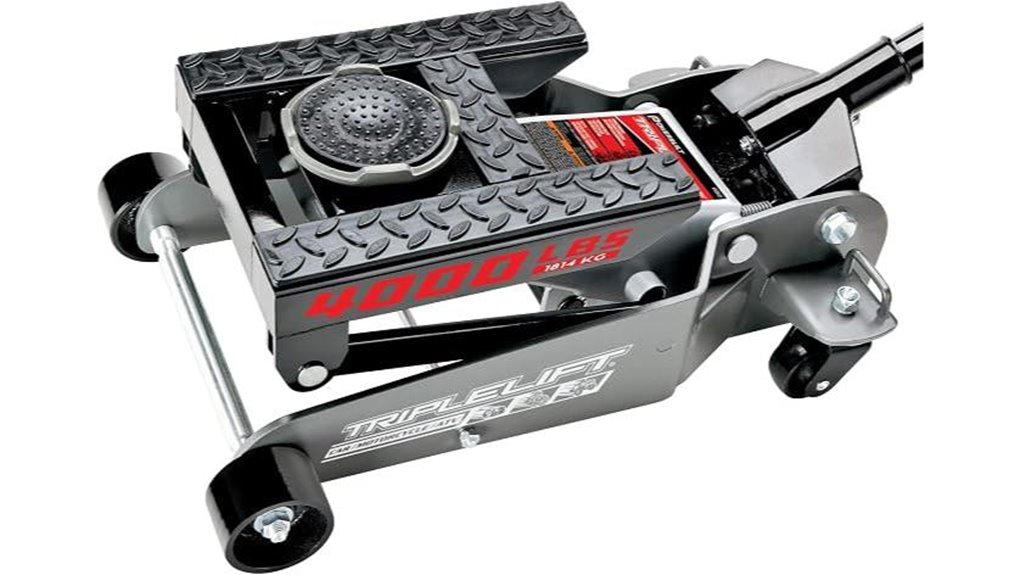
A larger floor jack with a three-stage lift. The listing quotes a minimum height of about 5.5 inches and a maximum of 17.5 inches, a weight of around 79 lb, a locking safety bar and tie-down loops. It is meant to handle cars, trucks, motorcycles and other equipment, but the weight makes it a garage-only tool.
Best for: Garages that lift trucks, ATVs and other equipment.
Pros
- Wide lift range
- Safety lock bar
- Handles several vehicle types
Limitations
- Very heavy
- Too tall for very low cars
- Large to store
How to Choose a Car Jack

- Capacity: choose a jack rated above your vehicle’s weight; 2 tons is common for cars and 3 tons or more for trucks and SUVs.
- Lift range: check the minimum height under your car and the maximum height you need.
- Jack type: floor jacks are stable in a garage, scissor jacks are for emergencies, bottle jacks suit tall vehicles.
- Safety features: a bypass valve and a wide base help, but they do not replace stands.
Safe lifting steps
- Park on flat, solid ground, set the parking brake and chock the other wheels.
- Find the jacking points in the owner’s manual.
- Lift only as high as needed.
- Set jack stands under the frame before going under the vehicle.
- Lower slowly, and tighten wheel nuts with a torque wrench.
Never rely on a jack alone, and do not use one on soft ground. For wheel changes, carry a portable tire inflator. If you want a full-time setup, see our home garage lift guide.
Frequently Asked Questions
How often should I inspect my car jack?
Check it before each use and after any drop, looking for leaks, bent parts, rust and damaged saddles. Replace or repair a jack that feels spongy or unstable.
Can I use a car jack on uneven ground?
No. Use a flat, solid surface, chock the wheels and use stands. Move the car if you cannot find level ground.
What jack fits a low-clearance sports car?
A low-profile floor jack with a minimum height lower than your car’s lift point, and a padded saddle. Check the listed minimum height against your car.
Do hydraulic jacks need fluid changes?
They rarely need regular changes, but should be checked for leaks and low fluid. Follow the manufacturer instructions if the jack feels spongy.
How should I store a jack?
Keep it dry, wipe it down after use and store it upright in a dry place. A light coat of rust inhibitor helps on exposed joints.





[…] Inspect cables, locks and hydraulics regularly. If you only need basic wheel and brake jobs, a good car jack and jack stands are far cheaper. Add bright garage lights and a torque wrench for lug […]