
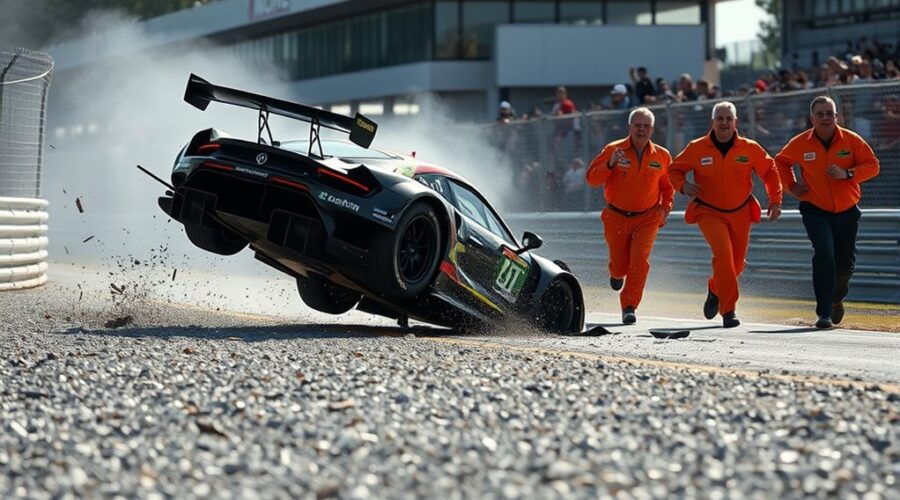
Jann Mardenborough’s Nürburgring crash in 2015 became one of motorsport’s most disturbing incidents. His Nissan GT3 Nismo went airborne at the Flugplatz section of the Nordschleife, cleared the barrier, and entered the spectator area. One spectator was killed and two others injured, forcing an immediate stoppage. The sequence raised sharp questions about circuit design, debris protection, and driver safety, with several details still central to later scrutiny.
What Happened in the Jann Mardenborough Crash?

The crash occurred during the 2015 VLN Endurance Championship at the Nürburgring Nordschleife, when Jann Mardenborough’s Nissan GT3 Nismo became airborne at the Flugplatz section, flipped, and left the track.
The Mardenborough crash unfolded as the car vaulted the barrier line and entered the spectator area, where one person, Andy Gehrmann, was killed and two others were injured.
Race control stopped the event immediately, and it was not restarted. Mardenborough was reported to be distressed after the incident, underwent medical checks, and was released from the hospital soon after.
Nissan and VLN organizers described the event as a tragedy and supported the response measures. An investigation was opened to determine the cause and assess broader safety risks tied to airborne vehicles and exposed spectator zones.
The crash highlighted how quickly a high-speed racing incident can become fatal, strengthening demands for safer circuit design and stricter protections for spectators.
Where the Nürburgring Crash Took Place
The crash occurred at the Flugplatz section of the Nürburgring Nordschleife, a high-speed segment within the circuit’s demanding 14-mile layout.
This area combines rapid turns, elevation changes, and limited margin for error, increasing the severity of incidents.
In this case, the vehicle crossed trackside fencing and entered a spectator area, highlighting the safety risks present at the venue.
Flugplatz Section
Flugplatz is one of the Nürburgring Nordschleife’s most demanding high-speed sections, defined by rapid elevation changes, a slight uphill gradient, and fast sweeping corners.
In the Flugplatz section, Jann Mardenborough encountered a critical loss of control in 2015 while driving a Nissan GT3 Nismo during the opening VLN Endurance Championship race. The car became unstable at speed, left the track, and flipped through the spectator fencing.
The area sits before Aremberg and combines fast turns with a rising surface, increasing the risk of airborne motion after a mistake. Its layout has long drawn safety concern because vehicles can travel from the racing line toward nearby spectators with little margin for recovery, especially during high-speed running.
Nordschleife Layout
Stretching roughly 14 miles through Germany’s Eifel mountains, the Nürburgring Nordschleife is a circuit defined by more than 150 corners, major elevation changes, and limited room for error. Its design rewards precision and punishes hesitation.
- Nicknamed “The Green Hell”
- Demands constant technical control
- Combines speed with blind crests
- Tests driver judgment at every turn
- Keeps safety under scrutiny
The Nürburgring’s long, uneven layout has made it a benchmark for motorsport skill and a persistent concern for safety planners.
The track’s history includes the end of Formula One racing there in 1976, reflecting the difficulty of managing risk on such a public, high-speed venue.
In this setting, the Nordschleife remains a place where freedom and danger are tightly linked.
Spectator Area Impact
At Flugplatz on the Nürburgring Nordschleife, Jann Mardenborough’s Nissan GT3 Nismo left the circuit at high speed, overturned through the spectator fencing, and entered a nearby viewing area.
The impact occurred in a section defined by fast curves and rapid elevation shifts, where the track runs close to public access. In this spectator area, one spectator was killed and two injured spectators were reported.
The incident demonstrated the physical exposure created by minimal separation between racing surface and audience space. Race control stopped the event immediately and did not restart it.
The Nordschleife’s long-standing safety debate centers on this exact configuration: speed, limited runoff, and spectators positioned near the line of travel.
The crash underscored how quickly a closed circuit can generate consequences beyond the track.
How the Jann Mardenborough Crash Unfolded
During the 2015 VLN Endurance Championship at the Nürburgring Nordschleife, Jann Mardenborough’s Nissan GTR Nismo lost control at the Flugplatz section.
The car overturned, passed through the trackside fencing, and came to rest in a spectator area, causing one fatality and injuries to two others.
The race was stopped immediately, rescue crews responded on site, and the incident renewed scrutiny of spectator safety at the circuit.
Crash At Flugplatz
The crash unfolded at the Flugplatz section of the Nürburgring Nordschleife during the 2015 VLN Endurance Championship, when Jann Mardenborough’s Nissan GT-R Nismo lost control at high speed. The car’s trajectory shifted abruptly, and the crash followed a brief aerodynamic lift.
- The vehicle rotated and overturned.
- It crossed the barrier line.
- Trackside fencing was breached.
- The car entered a spectator area.
- One spectator died, and two others were injured.
The sequence exposed how quickly speed can overwhelm margin on an open circuit. The incident also underscored persistent tension between racing freedom and spectator protection.
In technical terms, Flugplatz combined elevation change and velocity, creating a critical instability point. The crash became a focal event in ongoing scrutiny of safety design at the Nordschleife.
Immediate Aftermath And Response
In the immediate aftermath, race control stopped the event and did not restart it, underscoring the severity of the crash. Emergency medical crews reached the scene quickly and treated injured spectators while officials secured the area.
The response confirmed that the crash had caused acute risk beyond the track boundary. One spectator later died from injuries, and several others were hospitalized for further care.
Nissan issued a statement expressing shock and sadness, and reaffirmed its commitment to safety in motorsport. VLN organizers also conveyed condolences to the victims’ families and friends, acknowledging the event’s lasting impact on the motorsport community.
The sequence of actions reflected a controlled emergency response, yet the outcome remained tragic and irreversible for those affected.
Who Was Hurt in the Nürburgring Accident?
At the Flugplatz section of the Nürburgring during the VLN Endurance Championship, Jann Mardenborough’s Nissan GT3 Nismo left the track and entered a spectator area, killing spectator Andy Gehrmann and injuring two others.
The incident centered on a spectator zone, not the driver alone. Medical teams treated the injured immediately, while investigators documented the scene. Mardenborough later underwent routine checks and was released from hospital, indicating no critical driver injury.
Nissan Nismo issued condolences, acknowledging the loss and harm as a tragic outcome of high-speed competition.
- Andy Gehrmann died at the scene
- Two additional spectators were hurt
- Jann Mardenborough was medically cleared
- The car was a Nissan GT3 Nismo
- The crash occurred during VLN competition
The available facts identify the harmed parties clearly: one fatality and two injured spectators.
This record remains central to understanding the human cost of the Nürburgring accident and the limits of trackside protection.
Why the Nürburgring Crash Was So Deadly
Mardenborough’s Nürburgring accident became fatal because the car left the track at Flugplatz, became airborne, and crossed a spectator fence before landing upside down in a viewing area. At the Nürburgring Nordschleife, this sequence was especially lethal because the circuit’s fast elevation changes place spectator zones close to high-speed runoff. The Nissan GT3 Nismo struck the barrier with enough energy to clear it, turning a racing error into an impact event outside the track perimeter.
| Factor | Effect |
|---|---|
| High speed | Increased airborne distance |
| Flugplatz crest | Promoted lift |
| Fence proximity | Exposed spectator area |
| Roof landing | Intensified impact |
| Open viewing zone | Raised casualty risk |
The result was one spectator dead and two injured. Such layouts demonstrate how limited separation at the Nürburgring can convert loss of control into severe harm, prompting safety review.
How Mardenborough Responded After the Crash
Following the Nürburgring crash, Jann Mardenborough described profound distress over the incident and its fatal consequences, underscoring the emotional strain of coping with the aftermath.
Mardenborough, after hospital evaluation, was released once medical checks confirmed his immediate physical condition. His response centered on frank acknowledgment of trauma rather than denial. He identified mental health as a critical issue in motorsport, where high-speed risk can leave lasting psychological effects.
- Expressed deep distress
- Recognized the fatal outcome
- Underwent medical checks
- Left hospital after evaluation
- Stressed resilience and mental health
This stance presented a measured, technical account of recovery: physical clearance did not equate to emotional resolution.
Mardenborough’s remarks indicated an effort to process grief, maintain agency, and continue forward without minimizing the event. For observers seeking liberation from silence around injury, his response showed that confronting mental health is part of survival, not weakness.
What the Crash Changed for Nürburgring Safety
The 2015 Nürburgring crash intensified scrutiny of spectator safety, after Jann Mardenborough’s car left the track, became airborne, and struck a crowd, killing one person and injuring several others.
The incident exposed weaknesses in trackside protection and forced a technical review of the circuit’s safety architecture. Race organizers examined fencing height, barrier placement, and the distance between vehicles and spectators, with attention on whether existing systems could stop an airborne car before impact.
The resulting discussion pushed for stronger safety standards at motorsport venues, especially at circuits with complex layouts and narrow margins.
At the Nürburgring, the crash accelerated calls for redesigning spectator zones and improving barrier effectiveness to reduce exposure to high-energy incidents.
The case became a reference point for future planning, emphasizing that freedom to compete must be matched by robust safety measures that protect the public from avoidable harm.
How Gran Turismo Portrayed the Crash
*Gran Turismo* presents the Jann Mardenborough crash as a major turning point in his racing story, but it relocates the event to the 2013 Le Mans timeline rather than its actual occurrence in 2015 at the Nürburgring. The film shows Mardenborough competed under intense pressure, then uses the impact as a narrative hinge.
- The crash is staged as a dramatic catalyst.
- The timeline is compressed for screenplay structure.
- Mardenborough consented to its inclusion.
- The portrayal reflects his request for emotional honesty.
- Critics call the omission of the victim’s name a disservice for the audience.
That choice creates a clear cinematic arc, yet it also blurs chronology and the event’s real consequences. The scene emphasizes trauma, mental health, and motorsport fallout, but it can also be read as exploiting tragedy for momentum.
The result is technically effective, though ethically contested, and it leaves the historical record less exact than the film’s energy suggests.
Frequently Asked Questions
What Caused the Accident Involving Jann Mardenborough?
He lost control after a high-speed maneuver at Flugplatz on the Nürburgring Nordschleife. The Nissan GT3 Nismo became airborne and crossed fencing, exposing race safety flaws and underscoring limits of driver training under extreme conditions.
What Happened to Jann Mardenborough After the Crash?
A brief aftershock followed: he underwent routine hospital checks, was released physically unharmed, then entered a recovery process marked by emotional distress. Media reactions were intense, while his team cooperated with investigators and offered support.
Why Did Jann Mardenborough’s Car Go Airborne?
It went airborne because a high-speed bump at Flugplatz upset aerodynamics factors and car stability. The Nissan GT-R Nismo lost traction, lifted, then was launched over the curb and fencing into the spectator area.
What Was the Track That Jann Mardenborough Crashed On?
He crashed on the Nürburgring Nordschleife. For example, one misjudged crest can end a race instantly. The 14-mile “Green Hell” demands constant attention to track conditions, and its race safety record remains deeply scrutinized.
Conclusion
The Jann Mardenborough crash at the Nürburgring demonstrated how a high-speed launch at a blind crest can produce catastrophic consequences when a car leaves the circuit boundary. In this case, the Nissan GT3 Nismo became airborne at Flugplatz and entered the spectator area, killing Andy Gehrmann and injuring two others. For example, even a small elevation change at 150 mph can transform a race incident into a severe public-safety event, reinforcing the need for stricter circuit protection.