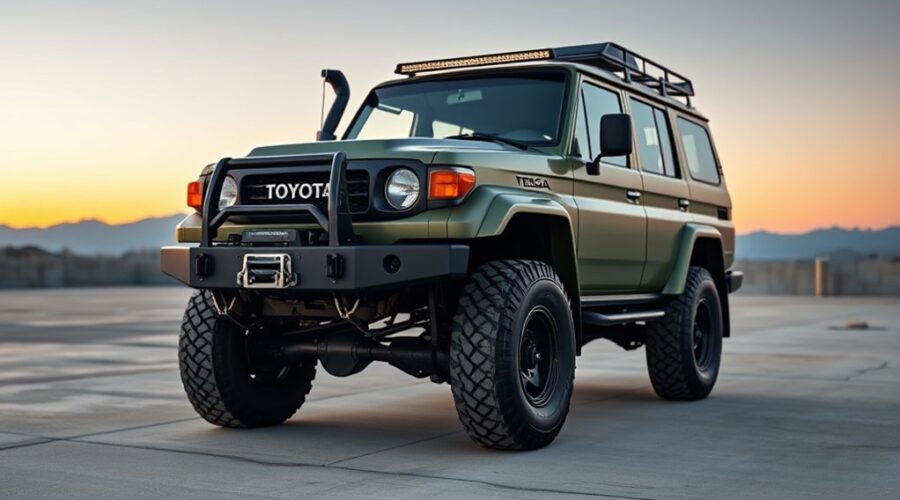
The Toyota Mega Cruiser pairs a 4.1-liter turbo-diesel inline-four with a four-speed automatic, producing 153 horsepower and 282 lb-ft of torque. It measures 200.4 inches long and 85.4 inches wide, with a curb weight of 6,395 pounds and a 1,323-pound payload rating. Full-time four-wheel drive, triple-lock differentials, and portal axles define its off-road capability, but its full set of strengths and compromises becomes clearer beyond the basic figures.
Key Takeaways
- The Toyota Mega Cruiser uses a 4.1-liter turbo-diesel inline-four 15B-FTE engine with 153 hp and 282 lb-ft of torque.
- It pairs with a four-speed Aisin-Warner automatic transmission and full-time four-wheel drive for controlled off-road mobility.
- Performance is modest, with roughly a 20.6-second 0-60 mph time and about 22 mpg at 40 mph.
- Dimensions are 200.4 inches long, 85.4 inches wide, 81.7 inches tall, with a 133.7-inch wheelbase and 16.5 inches of clearance.
- It weighs about 6,395 lbs, has a 1,323-lb payload, and features triple-lock differentials, portal axles, CTIS, and four-wheel steering.
Toyota Mega Cruiser Specs and Powertrain

The Toyota Mega Cruiser is powered by a 4.1-liter turbo-diesel inline-four 15B-FTE engine that produces 153 horsepower and 282 lb-ft of torque, paired with a four-speed Aisin-Warner automatic transmission and a full-time four-wheel-drive system.
This powertrain emphasizes low-speed control and durable traction over rapid acceleration, matching the vehicle’s role in demanding environments. The turbo diesel setup supports steady torque delivery, while the gearing and driveline help distribute power with consistency on loose ground and steep surfaces.
With a curb weight of about 6,395 lbs, the Mega Cruiser carries a maximum payload of 1,323 lbs without sacrificing basic mobility. Its 37-inch tires and central tire inflation system further improve grip and adaptability.
Performance figures remain modest, with 0-60 mph taking roughly 20.6 seconds, yet fuel efficiency reaches about 22 mpg at 40 mph, a result that compares favorably with many military counterparts and supports practical autonomy.
Toyota Mega Cruiser Overview
Launched in 1995, Toyota’s Mega Cruiser was a purpose-built heavy-duty SUV designed for demanding military and utility roles rather than conventional road use.
The Toyota Mega Cruiser paired a 4.1-liter turbo-diesel inline-4 with a robust chassis, delivering 153 horsepower and 282 lb-ft of torque for sustained load carrying. Its curb weight of about 6,395 lbs and GVWR of 8,445 lbs reflected a platform built for durable service and self-reliant mobility.
Measuring 200.4 inches long, 85.4 inches wide, and 81.7 inches tall, it offered a commanding footprint and interior volume larger than the Humvee. A 16.5-inch ground clearance and full-time four-wheel drive with locking differentials supported movement across rough terrain.
Production remained limited, with roughly 3,000 military units and fewer than 150 civilian examples built before discontinuation in 2001, reinforcing its rarity and specialized mission.
Toyota Mega Cruiser On-Road and Trail Performance
Powered by Toyota’s 4.1-liter turbo-diesel inline-4 15B-FTE, the Mega Cruiser delivers 153 horsepower and 282 lb-ft of torque, enough to support steady progress on pavement while prioritizing low-speed control in demanding terrain.
Powered by Toyota’s 4.1-liter turbo-diesel inline-4, the Mega Cruiser balances steady road progress with low-speed off-road control.
Its full-time four-wheel-drive system and triple locking differentials help distribute traction evenly, allowing the vehicle to move with confidence on loose, uneven, or slippery surfaces.
On-road behavior is shaped by a four-wheel steering system, which can improve maneuverability at low speeds and reduce the effort needed in confined spaces.
The independent suspension adds articulation and stability, helping each wheel remain engaged when the ground becomes broken or irregular.
Large 37-inch tires and a central tire inflation system further expand its range, letting pressure be adjusted for sand, rock, or mud.
The result is a machine aimed at controlled mobility, where capability serves the driver’s freedom rather than limiting it.
Toyota Mega Cruiser Dimensions and Weight
Measured against its mechanical capability, the Toyota Mega Cruiser’s physical size helps explain both its stability and its obstacle-clearing ability. Its dimensions are substantial: 200.4 inches long, 85.4 inches wide, and 81.7 inches tall. That footprint gives the vehicle a commanding presence while preserving balanced proportions for demanding terrain.
The 133.7-inch wheelbase supports composure and structural confidence, especially when the vehicle is carrying equipment or passengers across uneven ground.
Its curb weight of 6,395 lbs, or about 2,900 kg, reflects a heavily built platform intended for durability rather than lightness. Even so, the Mega Cruiser still offers a useful payload capacity of 1,323 lbs, equal to 600 kg, which expands its practical value for work or expedition use.
Ground clearance measures 16.5 inches, or 420 mm, further reinforcing its ability to move freely over rough surfaces. In total, the size and weight profile points to a vehicle engineered for autonomy, utility, and controlled movement in harsh environments.
Toyota Mega Cruiser Off-Road Features
The Toyota Mega Cruiser’s off-road capability is anchored by triple-locked differentials, which distribute power for maximum traction and stability on difficult terrain.
Portal axles increase ground clearance by raising the differential housing, helping the vehicle clear obstacles more effectively.
A Central Tire Inflation System allows tire pressures to be adjusted on the move, improving grip across changing surfaces.
Triple-Lock Traction
Triple-lock differentials give the Toyota Mega Cruiser a major advantage in difficult terrain, allowing the front, center, and rear axles to be locked simultaneously for maximum traction.
This triple-lock differentials setup supports controlled progress across mud, rock, and sand, helping the vehicle maintain forward motion where lesser rigs stall.
A central tire inflation system lets the driver alter pressure on the move, matching grip to the surface.
Its independent suspension improves articulation and stability, while large 37-inch tires further strengthen contact with uneven ground.
The portal axles work with the drivetrain to support off-road capability and reinforce the Mega Cruiser’s rugged design.
Together, these features give drivers practical freedom to move through remote landscapes with confidence, precision, and minimal compromise.
Portal Axle Clearance
Portal axles further strengthen the Toyota Mega Cruiser’s off-road ability by raising differential housing above the axles and increasing ground clearance where it matters most.
This layout gives the vehicle 16.5 inches (420 mm) of ground clearance, helping it clear rocks, ruts, and deep trail obstacles with less risk of contact. The elevated driveline also supports a 49-degree approach angle and a 45-degree departure angle, useful when terrain changes abruptly.
By reducing unsprung weight, the portal axles improve stability and traction on uneven surfaces. They also make room for 37-inch tires, which add more grip and enhance rock-crawling capability.
Together, these features give the Mega Cruiser a practical advantage in demanding off-road environments, where movement should remain unrestrained.
Central Tire Inflation
A Central Tire Inflation System (CTIS) further expands the Toyota Mega Cruiser’s off-road capability by allowing tire pressures to be adjusted on the move for changing terrain.
This Central Tire Inflation setup lets the driver lower pressures for sand, mud, and other soft ground, increasing contact patch and traction, or raise them for harder surfaces to improve rolling efficiency and fuel economy.
Adjustments are made from within the cabin, reducing the need for manual intervention and preserving momentum in difficult conditions.
Paired with the vehicle’s portal axles, the system complements its ground clearance and approach angles, reinforcing strong off-road capabilities.
The result is a purposeful mobility solution that serves military use and demanding recreational travel, where control, adaptability, and terrain independence matter most.
Toyota Mega Cruiser History and Rare Variants
The Toyota Mega Cruiser began as the BXD10 prototype shown at the 1993 Tokyo Motor Show and entered production in 1995 with a primary role in military transport, where it was known as the High Mobility Vehicle.
A limited civilian BXD20 version was later offered, with only about 133 units built for the Japanese market before production ended in 2001.
Among the rarest variants are the few left-hand drive examples and other special-purpose builds, which have drawn strong interest from collectors.
Military Origins
Designed as the BXD10, the Toyota Mega Cruiser originated as a military vehicle built for utility rather than civilian comfort, with proportions and capability often compared to the Hummer H1. Its military origins centered on a High Mobility Vehicle role, moving personnel and equipment across difficult terrain with disciplined efficiency.
| Variant | Role | Notable detail |
|---|---|---|
| BXD10 | Military transport | Base platform |
| HMV | Personnel and cargo | Utility-focused |
| Missile carrier | Air defense support | Type 93 system |
Between 1995 and 2001, about 3,000 units were produced, yet only around 133 reached civilian buyers. Approximately 12 left-hand drive examples were built, making them exceptionally scarce. These figures show a machine shaped by service needs, with rare derivatives reflecting specialized defense demands and limited access.
Civilian BXD20
Civilian BXD20 production marked the Toyota Mega Cruiser’s rare shift from military utility to limited public use, with fewer than 150 examples sold primarily in Japan. The BXD20 kept the platform’s rugged character while adding a more accessible role for private owners and agencies. It used a 4.1L turbo diesel engine rated at 153 hp and 280 lb-ft of torque, preserving serious off-road ability.
- Low and high roof versions expanded practical choice.
- Civilian trim balanced durability with everyday function.
- Some units served prefectural police and fire departments.
- Today, collectors value the BXD20 for scarcity and purpose.
Its limited release reinforced independence through mechanical capability, offering freedom beyond paved roads.
Rare Special Variants
Among the rarest Toyota Mega Cruiser variants, the BXD10 military High Mobility Vehicle formed the core of JSDF service use, with roughly 3,000 units built before production ended in 2001. These rare special variants prioritized transport, yet one modified BXD10 carried a Type 93 Surface-to-air missile, proving unusual mission flexibility.
| Variant | Use | Rarity |
|---|---|---|
| BXD10 HMV | JSDF transport | High |
| Missile-modified BXD10 | Air defense | Very high |
| BXD20 LHD | Civilian export | Extreme |
The civilian BXD20 appeared in low- and high-roof forms, but only 133 reached buyers. About 12 left-hand drive units added further scarcity, while some BXD20s served prefectural police and fire departments. Together, these versions show a rugged platform adapted for state and civilian service alike.
Frequently Asked Questions
What Are the Key Features of the Toyota Mega Cruiser?
Key features include formidable Off road capabilities, Military modifications, a 4.1-liter turbo-diesel engine, full-time four-wheel drive, triple locked differentials, 37-inch tires, CTIS, 16.5-inch ground clearance, and compact maneuverability for demanding terrain.
Is the Toyota Mega Cruiser Reliable?
Yes, the Toyota Mega Cruiser appears highly reliable, with Toyota reliability reinforced by durable engineering, military-grade construction, and strong off-road systems. Mega Cruiser performance remains consistent in harsh conditions, though rarity complicates ownership and maintenance.
How Many Toyota Mega Cruisers Were Made?
Around 3,000 Toyota Mega Cruisers were made; production numbers were low, civilian sales were scarce, military use was extensive, and historical significance remains high among collectors seeking mobility, capability, and independence.
Was the Toyota Mega Cruiser Discontinued?
Yes, the Toyota Mega Cruiser was discontinued in 2001, with production ending in 2002. Slow sales, taxes, and urban fit limited civilian appeal. Its Mega Cruiser Legacy endures through Military Applications and collectors.
Conclusion
To sum up, the Toyota Mega Cruiser stands out as a purpose-built utility machine, combining a 4.1-liter turbo-diesel engine, a four-speed automatic, and a robust full-time 4WD system. Its large dimensions, substantial payload capacity, and off-road hardware such as triple-lock differentials and portal axles reflect its mission. Few vehicles blend military-grade toughness with civilian practicality so completely. For enthusiasts of extreme capability, what other truck conjures such an image of unstoppable travel across rough terrain?