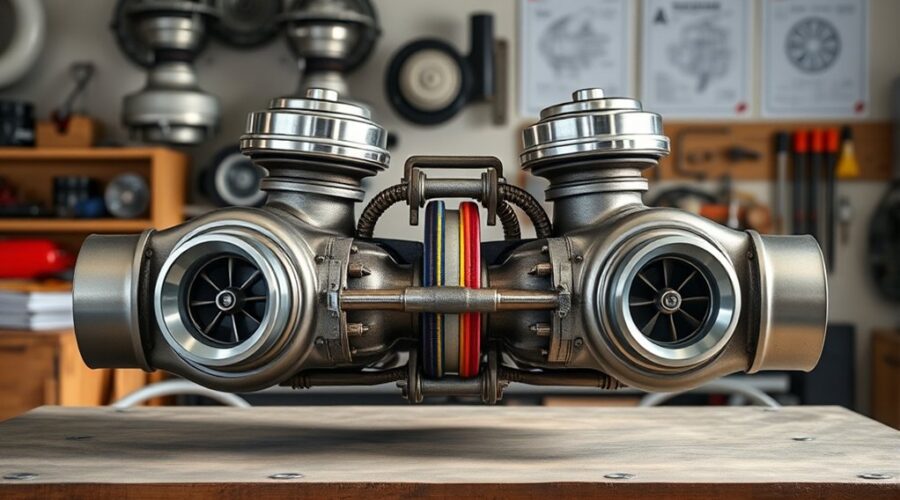
Twin scroll turbocharging emerged as a practical answer to exhaust pulse interference and lag in forced-induction engines. By separating exhaust flow into paired channels, it preserves pulse energy and improves turbine response, especially in the mid-range. The concept has spread from performance models into broader production use, yet its packaging and cost impose clear constraints. The details behind that tradeoff explain why the design still matters.
Key Takeaways
- Twin-scroll turbochargers use one turbine housing with two separate exhaust passages to reduce pulse interference and turbo lag.
- They pair cylinders to preserve exhaust pulse energy, improving boost response, low-end torque, and turbine efficiency.
- Compared with single-scroll turbos, twin-scroll units reach peak boost sooner and deliver stronger midrange power.
- Twin-scroll designs are common in performance gasoline engines, especially 1.5- to 2.5-liter applications.
- Their main drawbacks are higher manufacturing complexity and cost, which limit use in some smaller engines and cylinder layouts.
What Is a Twin Scroll Turbo?
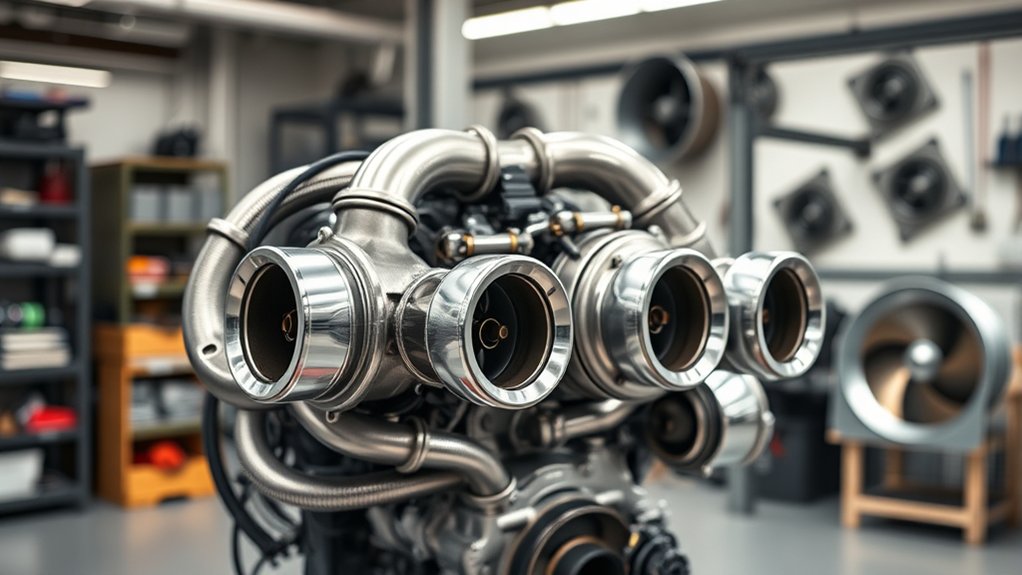
A twin-scroll turbocharger uses a single turbine and housing, but separates the exhaust path into two channels so paired cylinders can feed the turbo more efficiently.
This twin-scroll turbocharger architecture manages exhaust flow by isolating exhaust gases into cylinder pairs, reducing pulse interference and preserving pressure energy. The result is faster boost response, lower turbo lag, and improved turbine efficiency.
By maintaining cleaner pulse timing, the system supports denser charge delivery and stronger engine performance across the rev range. In practice, the design often yields better low-end torque and more consistent output, with gains of up to 8% in efficiency.
Such characteristics make it well suited to high-performance applications, especially in engines around 1.5 to 2.5 liters. Its appeal lies in controlled energy use: less waste, more response, and a mechanical path toward liberated, higher-capacity performance.
How Twin Scroll Turbochargers Work
Twin-scroll turbochargers work by dividing the turbine housing into two separate exhaust passages, so exhaust pulses from paired cylinders reach the turbine in a more controlled sequence.
In a twin scroll turbocharger, the exhaust manifold routes cylinders into two separate scrolls, typically pairing firing orders such as 1 and 4, then 2 and 3 in a four-cylinder layout. This separation limits pulse interference, preserves pulse energy, and improves turbine efficiency.
The result is reduced turbo lag, quicker boost response, and stronger boost at low RPM. By organizing exhaust pulses more precisely, the turbine accelerates earlier, producing broader torque and higher power output across the rev range.
Because scavenging effects are managed more cleanly, the system is less sensitive to overlap and camshaft duration, supporting engine efficiency.
For drivers seeking liberation from delay, the design offers a mechanically disciplined path to earlier spool, firmer midrange delivery, and more immediate control under load.
Twin Scroll Turbo vs. Single Scroll Turbo
Compared with a single-scroll turbo, a twin-scroll unit uses two separate exhaust channels to isolate paired cylinders, reducing pulse interference and improving boost response.
The twin scroll turbo thus cuts turbo lag by preserving exhaust flow energy, while the single scroll turbo merges pulses and tends to soften torque response at low RPM.
In comparative testing, twin-scroll layouts reached peak boost sooner, around 5,100 RPM versus 5,500 RPM, and produced a measured power increase of about 20% between 4,500 and 5,000 RPM.
Peak torque also rose by 50.7 lb-ft at 4,500 RPM, indicating stronger acceleration potential and freer engine efficiency across the rev range.
The design can deliver up to 8% efficiency gains, yet manufacturing complexity and cost remain higher than for a single-scroll turbo.
For engineers seeking liberated, responsive output, the twin-scroll turbo offers a more disciplined balance of flow control, low-end strength, and overall responsiveness.
Twin Scroll Turbo Applications
In practice, twin-scroll turbochargers are most often deployed where pulse separation can be exploited to improve response, especially in high-performance gasoline engines such as the Toyota GT86, Mitsubishi Lancer Evolution, and modern Ford EcoBoost variants.
Twin scroll technology organizes exhaust pulses into separate passages, preserving pulse energy before it reaches the turbine. This arrangement suits turbocharger systems on engine displacements near 1.5 to 2.5 liters, where overlapping exhaust pulses are common and can be managed to improve performance across the rev range.
Twin scroll technology separates exhaust pulses, preserving energy and improving turbo performance across the rev range.
In four-cylinder engines, cylinders 1 and 4 are often paired with 2 and 3, enabling cleaner gas management and stronger low-end torque. The configuration is not usually chosen for three- or five-cylinder layouts, where pulse separation is less efficient.
OEM adoption has expanded because the architecture can reduce turbo lag while supporting stable power delivery in compact, efficient, and high-performance gasoline engines.
Twin Scroll Turbo Benefits and Limits
By separating exhaust flow into distinct passages, twin-scroll turbochargers improve pulse energy retention, reduce turbine interference, and sharpen response, with torque gains that can reach roughly 20% between 4,500 and 5,000 RPM versus single-scroll units.
A twin scroll turbo consequently offers clear benefits in performance, particularly reduced turbo lag and stronger low-end pull. Exhaust pulses are managed more cleanly, improving efficiency by up to 8% and lowering fuel consumption by about 5%. Peak boost may arrive near 5,100 RPM, about 400 RPM earlier than single-scroll layouts, supporting a broader power increase.
- Better pulse separation
- Faster boost response
- Lower fuel consumption
- Higher rev-range efficiency
- Greater complexity and cost
These limitations constrain adoption, especially in smaller engines and some three- or five-cylinder designs. The architecture remains a disciplined compromise: measurable gains in responsiveness and economy, balanced against packaging, cost, and mechanical complexity.
Frequently Asked Questions
What Is the History of the Twin-Scroll Turbo?
The twin-scroll turbocharger evolved in late twentieth-century turbocharger evolution, driven by design innovations for performance enhancements and engine efficiency. Early 2000s racing applications exposed installation challenges, fuel economy gains, thermal management advances, market trends, future developments.
What Are the Downsides of Twin-Scroll Turbos?
Twin-scroll turbos trade turbo lag for tangled technicality: boost pressure gains, engine efficiency, exhaust flow optimization, installation complexity, maintenance challenges, cost implications, heat management, compatibility issues, and performance tuning demands can constrain freedom in custom applications.
What Are the Key Differences Between a Twin-Scroll Turbocharger and a Twin-Turbo Engine?
Twin-scroll turbocharger uses one unit with separated Exhaust Flow; twin-turbo uses two units. Turbocharger Basics affect Engine Performance, Boost Pressure, Turbo Lag, Power Band, Installation Challenges, Engine Compatibility, Fuel Efficiency, and Maintenance Tips.
How Much Horsepower Does a Twincharger Add?
A twincharger can add 100–200 horsepower, sometimes more—an almost unreal leap. Horsepower gains depend on boost pressure, turbocharger design, and performance tuning, improving power delivery, throttle response, engine efficiency, turbo lag, fuel economy, engine reliability.
Conclusion
To summarize, the twin turbo twin scroll layout represents a highly effective compromise between responsiveness, efficiency, and power delivery. By separating exhaust pulses and reducing interference, it sharpens spool characteristics and broadens usable torque across the rev range. Its engineering complexity and cost remain notable constraints, yet its performance advantages have made it a staple in modern high-output engines. In practice, the design can transform turbo response from sluggish to almost telepathic.