
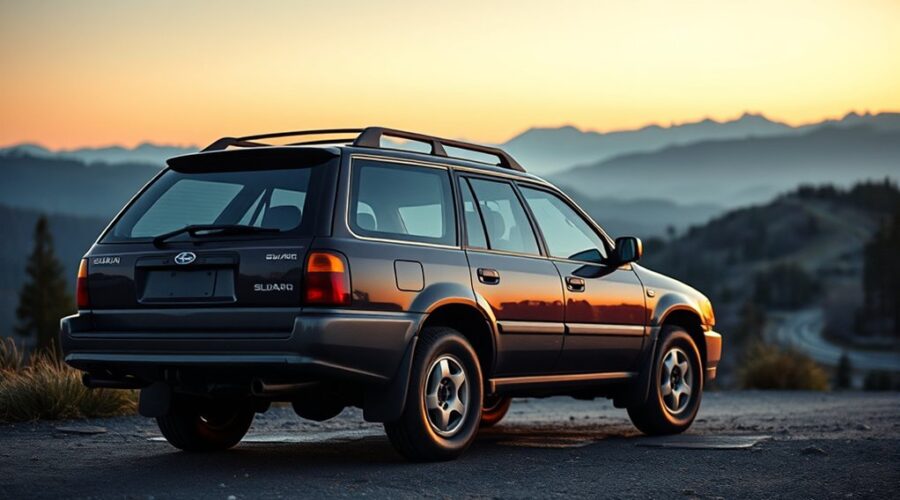
Older Subaru Outback models combined practical wagon proportions with a range of familiar powertrains, including the 2.2-liter EJ22 and 2.5-liter EJ25, plus turbocharged versions that pushed output to 243 hp. Towing capacity reached 2,700 pounds on base trims and 3,500 pounds with turbo power. With a 108.1-inch wheelbase and 191.7-inch length, the platform offered useful space, but its hardware choices and capability changes tell a more specific story.
Key Takeaways
- Early Subaru Outbacks used 2.2L EJ22 or 2.5L EJ25D engines with manual, automatic, or Auto-SportShift transmissions.
- Later models offered a 2.5-liter engine with 165 to 180 hp, plus turbo versions reaching 243 to 260 hp.
- Towing capacity ranged from 2,700 pounds on base models to 3,500 pounds on turbocharged versions.
- Dimensions included a 108.1-inch wheelbase, 191.7-inch length, 112.3 cubic feet of passenger space, and 80.5 cubic feet of cargo space.
- Older Outbacks featured standard AWD, up to 8.7 inches of ground clearance, and strong safety scores with EyeSight driver aids.
Older Subaru Outback Specs at a Glance
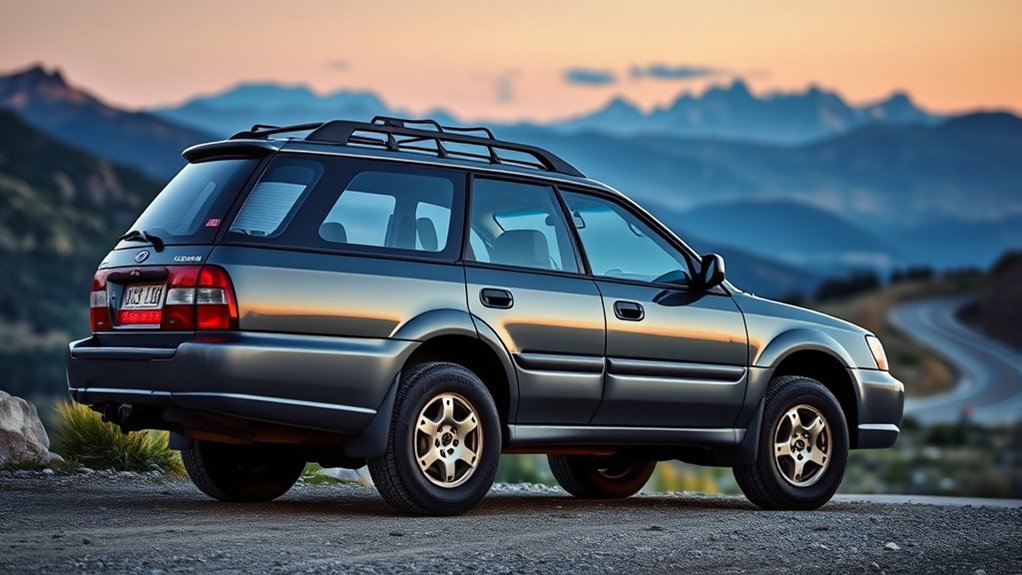
Older Subaru Outback models, particularly those from the 2000s, were typically equipped with a 2.5-liter flat-four engine producing about 165 horsepower and 166 lb-ft of torque, with later turbocharged trims offering up to 243 horsepower.
Outback dimensions were practical for independent use, with 7.8 to 8.5 inches of ground clearance, about 58 cubic feet of passenger volume, and up to 73 cubic feet of cargo space with the rear seats folded flat.
Across trim levels, the model balanced utility and comfort without excess. The engine layout supported steady traction in snow and on rough roads, helping drivers move with confidence in demanding conditions.
Key safety features included three-point seat belts for all passengers, front and rear airbags, and, in later generations, EyeSight driver assist technology.
These older Outback specs show a vehicle designed for self-reliant travel, adaptable storage, and dependable winter performance, appealing to drivers who value practical freedom over ornament.
Subaru Outback Engine Options
The Subaru Outback has been offered with a range of engine options designed to balance everyday efficiency with all-weather capability. Early Outback models used the 2.2 L EJ22 SOHC H4 and the 2.5 L EJ25D DOHC H4, both part of Subaru’s horizontally opposed layout. A standard four-cylinder engine later delivered 165 horsepower and 166 lb-ft of torque, giving the Outback practical response for daily use.
| Engine | Output |
|---|---|
| 2.2 L EJ22 SOHC H4 | Early Outback power |
| 2.5 L EJ25D DOHC H4 | Early Outback power |
| 2.5 L EJ255 turbocharged engine | 243 hp in XT |
The turbocharged engine in the Outback XT raised performance to 243 horsepower, adding a stronger character without abandoning the model’s versatile identity. Transmission choices included a 4-speed automatic, a 5-speed manual, and a 5-speed Auto-SportShift, allowing drivers to select a setup that matched their own road freedom.
Performance, Towing, and Fuel Economy
The Subaru Outback’s towing capacity depends on engine choice, with the base model rated for up to 2,700 pounds and turbocharged versions capable of 3,500 pounds.
Its fuel economy is rated at 21 mpg city, 29 mpg highway, and 24 mpg combined, supporting an estimated 520-mile highway range.
These figures place the Outback as a practical option for drivers balancing utility and efficiency.
Towing Capacity
Towing capability is one of the Subaru Outback’s practical strengths, with base models rated at 2,700 pounds and turbocharged versions able to tow up to 3,500 pounds. This towing capacity gives the wagon genuine utility without excess complexity.
The standard 2.5-liter engine supplies 180 horsepower and 178 lb-ft of torque, while turbocharged models use a 2.4-liter engine with 260 horsepower and 277 lb-ft, supporting heavier loads more confidently.
Subaru’s all-wheel drive system adds traction, and 8.7 inches of ground clearance helps maintain stability on uneven roads or remote access routes. The result is a vehicle suited to independent hauling, light recreation, and practical travel needs.
Its setup favors control, balance, and capability over unnecessary strain, reinforcing everyday freedom.
Fuel Economy
Efficiency is a major part of the Subaru Outback’s appeal, with the standard 2.5-liter engine rated at 24 mpg combined and the turbocharged 2.4-liter option balancing stronger performance with respectable economy.
The BOXER engine layout supports a low center of gravity, while the AWD system and automatic transmission work with the CVT to manage fuel economy across varying terrain.
On the highway, the Outback can return about 29 mpg at 75 mph, enabling a range near 520 miles for longer, self-directed travel.
City driving can reduce observed mileage to roughly 19 mpg, showing how habits shape results.
The turbo model preserves efficiency better under load, and its added output complements towing needs without abandoning practical economy for everyday freedom.
Dimensions and Cargo Space
With a wheelbase of 108.1 inches and an overall length of 191.7 inches, the Subaru Outback is sized to provide generous interior space without feeling unwieldy. Its dimensions support a roomy cabin, while the 74-inch width gives the front seats a broader, more open feel.
Passenger volume reaches 112.3 cubic feet, reflecting an interior built for comfort and freedom. The raised roofline also helps preserve headroom and usability.
Passenger volume reaches 112.3 cubic feet, creating a spacious cabin built for comfort, freedom, and everyday usability.
- Front headroom measures 41 inches.
- Rear headroom measures 40.5 inches.
- Cargo space measures 34.6 cubic feet with the rear seats upright.
- Folding the rear seats expands cargo space to 80.5 cubic feet.
These figures show how the Outback balances daily practicality with adaptable storage. The cabin layout favors flexibility, making room for passengers, gear, and longer trips without sacrificing ease of use.
Ground Clearance and AWD Capability
The Subaru Outback’s standard 8.7 inches of ground clearance supports everyday driving and light off-road use, while the Wilderness trim increases that figure to 9.5 inches for tougher terrain.
X-Mode adds off-road assist by optimizing throttle, traction, and braking response on low-grip surfaces.
Symmetrical All-Wheel Drive supplies power to all four wheels for steady traction and control on wet, snowy, or uneven roads.
Ground Clearance Figures
Ground clearance gives the Subaru Outback a clear advantage on rough roads and in mixed driving conditions. Its standard 8.7 inches of ground clearance supports confident travel over uneven pavement, gravel, and mild trails.
The Wilderness trim raises that figure to 9.5 inches, strengthening off-road capability for drivers seeking more freedom from strict road limits.
- Standard ground clearance: 8.7 inches
- Wilderness trim ground clearance: 9.5 inches
- Symmetrical AWD in every model
- Lineartronic CVT supports steady traction
Together with raised roof rails and skid plates on off-road versions, the Subaru Outback presents a practical, capable layout.
The result is a vehicle shaped for stability, useful clearance, and access beyond ordinary urban routes, without losing composure.
X-Mode Off-Road Assist
Beyond ground clearance alone, the Subaru Outback adds X-MODE off-road assist to make its all-wheel-drive capability more effective on loose or low-traction surfaces. The system adjusts engine output and transmission behavior to help maintain traction on mud, snow, and gravel, giving the driver more control when conditions turn uneven.
Standard Symmetrical AWD works with this calibration to support stable movement across rough terrain. With 8.7 inches of ground clearance on most trims, or 9.5 inches on the Wilderness trim, the Subaru Outback is set up to move over obstacles with confidence.
Hill Descent Control further expands capability by managing steep downhill grades without constant brake input. The result is a practical, freedom-oriented design for drivers seeking access beyond pavement.
AWD Traction Advantages
Standard Symmetrical All-Wheel Drive gives the Subaru Outback a clear traction advantage on snow, mud, and other low-grip surfaces by distributing power to all four wheels for improved control and stability. This AWD layout supports confident movement when pavement ends, helping the driver maintain freedom to travel with less compromise.
- 8.7 inches of ground clearance on standard models
- 9.5 inches on the Wilderness trim
- Enhanced off-road capability over rough terrain
- X-MODE and Hill Descent Control assist steep grades
Together, the AWD system and raised ground clearance improve traction, obstacle clearance, and stability. The result is a versatile wagon built for outdoor routes, adverse weather, and roads that reward independence beyond the city grid.
Safety Features and Ratings
The Subaru Outback has consistently earned strong safety recognition, including IIHS Top Safety Pick+ awards and five-star NHTSA Overall Safety Ratings across multiple model years. Those results reflect a broad set of safety features, from front and rear airbags to child-safety-seat anchors and three-point seat belts for every seat.
The EyeSight suite added another layer of protection, pairing Adaptive Cruise Control, Lane Keep Assist, Automatic Emergency Steering, lane departure warnings, and earlier driver-assist functions that support alert, autonomous-minded driving.
In crash test evaluations, the Outback has repeatedly posted solid results with the Insurance Institute for Highway Safety, reinforcing its reputation for occupant protection and structural integrity. EyeSight’s 2008 debut marked a notable step in active safety, helping older models deliver more confidence on daily roads.
What Changed in Older Outback Models
Initially launched in 1995 as a trim package on the Legacy wagon, the first-generation Outback introduced protective plastic side cladding and a raised roof to improve cargo versatility. In each model year, changes refined utility and stance, giving drivers more room to move with less compromise.
By 1996, the body adopted more aggressive styling and larger driving lamps, while the Outback Sport variant widened the lineup.
- Early powertrain choices centered on the 2.2 L EJ22 engine.
- Later models added a turbocharged 2.5 L EJ255 with 243 hp.
- Ground clearance rose to 8.5 inches, improving performance on rough roads.
- EyeSight arrived in 2008, adding key safety features such as lane departure warnings and distance maintenance.
These updates show a steady shift from wagon-based practicality to a more capable, independent identity. The result was a vehicle that offered broader capability without surrendering everyday freedom.
Frequently Asked Questions
What Year to Stay Away From a Subaru Outback?
They should stay away from 2008–2011 Outbacks, especially 2010, plus 2015. Common issues include head gaskets, transmission, and oil use. Reliability ratings suffer, resale value drops, so maintenance tips and inspection are essential.
Which Subaru Outback Engine Is Best?
The turbocharged 2.4-liter engine is generally best, balancing strong acceleration with respectable fuel efficiency. Engine comparisons favor its power, while reliability ratings and maintenance costs remain acceptable, though the 2.5-liter suits simpler, cheaper ownership.
Is the Subaru Outback a Fast Car?
No, it is not a fast car; like a steady river rather than a lightning bolt. Its acceleration capabilities depend on engine options, shaping the driving experience, while performance ratings place it above average, not sporty.
What Year Did the Subaru Outback Get Bigger?
The Outback got bigger in 2005, with the third generation’s longer wheelbase marking clear Outback size evolution. Design changes in later model year comparisons show continued growth, supporting market segment analysis and greater spatial freedom.
Conclusion
Older Subaru Outback models stand as a steady bridge between wagon practicality and SUV confidence. Their EJ22 and EJ25 powertrains, along with turbocharged variants, gave the platform a confident heartbeat, while towing strength and generous dimensions added real-world usefulness. With capable all-wheel drive and respectable ground clearance, the Outback moved like a sure-footed climber on rough terrain. In retrospect, it remains a durable compass for drivers seeking balance, utility, and understated endurance.