
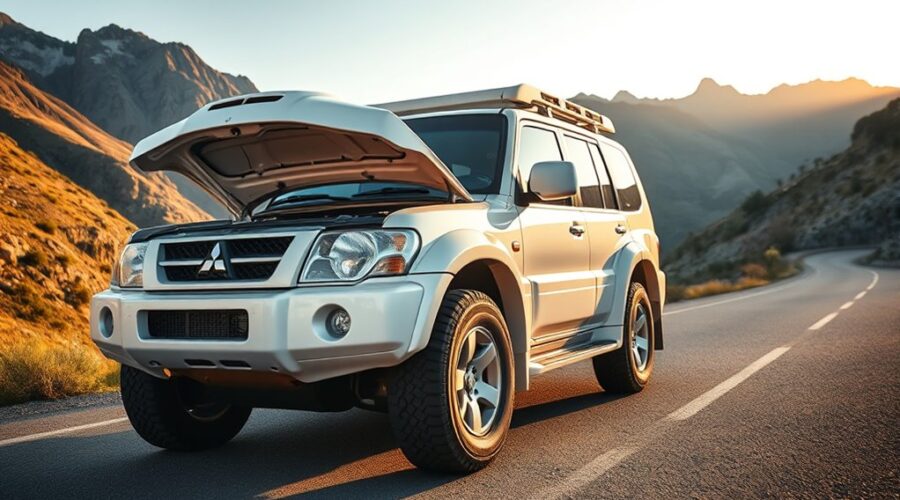
The Mitsubishi Pajero Evolution specs in short: a road-legal Dakar homologation special sold from 1997 to 1999 as the V55W, with a 3.5-liter MIVEC V6 rated at 280 PS, wide-track bodywork, four-wheel independent suspension and Mitsubishi’s Super Select 4WD. It is related to, but not the same vehicle as, the 1998 Dakar-winning T2 rally car and the later prototype Pajero Evolutions.
Quick Answer
The Mitsubishi Pajero Evolution V55W was a 1997–1999 homologation SUV created for Mitsubishi’s production-based Dakar program. Its naturally aspirated 3.5-liter 6G74 MIVEC V6 made 280 PS, and buyers could choose a 5-speed manual or 5-speed automatic. Its rarity, specialized chassis, and direct motorsport connection now make it highly collectible.
Specifications are the Japanese-market factory figures; export cars and later competition machines differ.
Mitsubishi Pajero Evolution Specs and Background
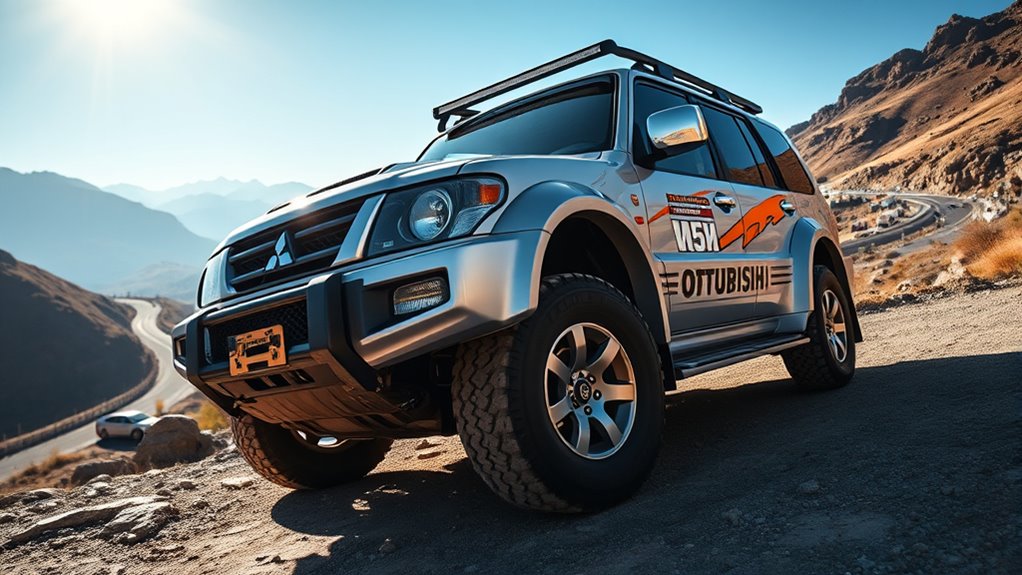
The Mitsubishi Pajero Evolution is the high-performance V55W version of the second-generation Pajero. Mitsubishi introduced it in 1997 in response to changing Dakar regulations, giving the production vehicle a dedicated MIVEC engine, wider body, stronger and lighter construction, and four-wheel independent suspension.
Mitsubishi Motors’ vehicle history describes the Pajero Evolution as a response to Dakar regulation changes and confirms its 3.5-liter MIVEC engine, widened overfenders, increased body rigidity, weight reduction, and independent suspension.
Unlike an ordinary appearance package, these changes affected the chassis, drivetrain, suspension, cooling, and body. The three-door V55W therefore sits much closer to the traditional meaning of a homologation special: a production vehicle created so competition engineers could race a closely related design under production-based rules.
It should not be confused with every competition vehicle later called Pajero or Montero Evolution. Mitsubishi continued developing Dakar machines after the V55W road car disappeared, and later Super Production Evolutions became far more specialized racing prototypes.
Pajero Evolution Engine and Drivetrain
The road-going Pajero Evolution uses Mitsubishi’s naturally aspirated 3,496 cc 6G74 V6 with DOHC 24-valve heads and MIVEC variable valve timing. The Japanese specification is 280 PS (206 kW) at 6,500 rpm and 348.1 Nm at 3,000 rpm, roughly 276 hp and 257 lb-ft.
The GAZOO V55W catalog specification also lists premium unleaded fuel, a 75-liter fuel tank, and a 5-speed manual for the manual version. Mitsubishi offered a separate 5-speed automatic version as well, so describing every Pajero Evolution as an automatic is incorrect.
The drivetrain is based around Mitsubishi’s Super Select 4WD concept, which combines road-friendly four-wheel-drive operation with selectable modes for different surfaces and low-range use. This makes the V55W different from a simple permanent-AWD performance SUV: it was expected to operate on pavement, gravel, sand, and slower technical terrain.
Its mechanical specification also includes limited-slip differential hardware and a much more specialized chassis than a normal short-wheelbase Pajero. The result is not simply more engine power. The Evo was engineered to put that power down while maintaining control over broken, loose surfaces.
Mitsubishi Pajero Evolution Dimensions
The Mitsubishi Pajero Evolution is short but unusually wide for a three-door 1990s SUV. Its compact 2,420 mm wheelbase helps explain its proportions, while the 1,875 mm width reflects the heavily widened track and bodywork.
| Specification | V55W Pajero Evolution |
|---|---|
| Length | 4,075 mm |
| Width | 1,875 mm |
| Height | 1,915 mm |
| Wheelbase | 2,420 mm |
| Front/rear track | 1,590 / 1,590 mm |
| Ground clearance | 245 mm |
| Curb weight, 5MT | 1,970 kg |
| Curb weight, 5AT | 1,990 kg |
| Tires | 265/70R16 |
| Seating | 5 |
The wide 1,590 mm front and rear tracks support lateral stability, while 245 mm of ground clearance leaves useful space beneath the vehicle. The standard 265/70R16 tires also give it considerably more sidewall than a modern road-focused performance SUV.
The weight distinction matters when comparing specifications. The frequently repeated 1,970 kg figure is for the 5-speed manual; the 5-speed automatic is listed at 1,990 kg.
How the Pajero Evo Drives
The Pajero Evolution was designed to feel more controlled at speed over rough terrain than a normal ladder-frame SUV of its era. Its wide track, short wheelbase, independent suspension, and naturally aspirated V6 create a very different character from a soft road-biased crossover or a slow rock-crawling 4×4.
The front suspension uses double wishbones with coil springs. At the rear, Mitsubishi fitted an independent multi-link double-wishbone arrangement rather than the conventional solid rear axle used by regular second-generation Pajeros.
That engineering gives each wheel more freedom to follow uneven terrain. At the same time, the widened stance helps manage body movement during faster directional changes.
The engine also suits this purpose. With maximum power arriving at 6,500 rpm and peak torque at 3,000 rpm, the MIVEC V6 is designed to rev more freely than the lower-output engines fitted to ordinary Pajero variants.
It is still an SUV weighing close to two tonnes, so it should not be judged like a Lancer Evolution. The appeal is the combination of rally-style response, substantial suspension travel, usable ground clearance, and a drivetrain designed for changing surfaces.
Why Mitsubishi Built the Pajero Evolution
Mitsubishi built the Pajero Evolution because Dakar regulations pushed manufacturer teams toward production-based machinery. The company needed a road vehicle that could support a more competitive T2 rally specification while remaining recognizable as a production Pajero.
This timing is important. Mitsubishi won the 1997 Dakar with Kenjiro Shinozuka in a T2 Pajero, but that January victory occurred before the road-going V55W Evolution was launched later in 1997.
For the 1998 Dakar, Mitsubishi’s official archive specifically states that the modified-production Pajero/Montero evolved into the Evolution model. The road-going Pajero/Montero Evolution had gone on sale in 1997 and became the base for the competition car.
The changes were functional. Mitsubishi widened the track, adopted independent rear suspension, increased front suspension travel, fitted overfenders and an aluminum hood with an air scoop, and developed the 6G74 MIVEC engine.
That is why the V55W matters beyond rarity. Its unusual specifications were driven directly by competition requirements rather than simply by a desire to create a higher trim level.
Street-Legal V55W Specs
The street-legal V55W packages the Dakar-inspired engineering into a three-door, five-seat SUV. Its main specifications are a 3.5-liter MIVEC V6, selectable four-wheel-drive hardware, independent suspension at all four corners, and either a 5-speed manual or 5-speed automatic.
Factory catalog figures also show ventilated disc brakes front and rear, 16-inch wheels, a 5.3-meter turning radius, dual front airbags, ABS, automatic climate control, and a split-folding rear seat.
V55W Engine Specs
The V55W engine is a special version of Mitsubishi’s 6G74 3.5-liter V6. It uses four overhead camshafts, 24 valves, MIVEC, electronic multi-point fuel injection, and no turbocharger or supercharger.
- Displacement: 3,496 cc
- Configuration: naturally aspirated V6, DOHC, 24 valves
- Maximum output: 280 PS (206 kW) at 6,500 rpm
- Maximum torque: 348.1 Nm at 3,000 rpm
- Fuel: premium unleaded gasoline
- Fuel tank: 75 liters
- Transmission choices: 5-speed manual or 5-speed automatic
The combination is significant because the Evolution was not merely a regular 3.5-liter Pajero with wider bodywork. Mitsubishi paired its higher-output MIVEC engine with substantial suspension and chassis revisions.
Homologation Production Numbers
The Pajero Evolution was produced in very small numbers compared with an ordinary Pajero, but the exact total deserves qualification. The homologation series is commonly described as approximately 2,500 road cars, while a figure of roughly 2,693 is also widely repeated in secondary model databases and collector references.
Mitsubishi’s public history material confirms the V55W’s 1997 introduction and purpose but does not state a final factory production total. Treating about 2,500 to 2,693 as the published range is more defensible than presenting 2,693 as an undisputed factory-confirmed number.
Regardless of which total is used, production was extremely limited. The specialized body panels, suspension components, drivetrain parts, and interior trim also make originality important when evaluating a surviving car.
Dakar Rally History and Wins
The Pajero Evolution belongs to Mitsubishi’s much larger Dakar story, but the street V55W should not be credited with every Pajero victory. Mitsubishi first entered the Dakar with the Pajero in 1983 and achieved its first overall victory in 1985.
The distinction becomes especially important after 1999. Mitsubishi continued racing Pajero/Montero models and later used the Evolution name for increasingly specialized Super Production machinery that was not the same vehicle as the 1997–1999 road car.
Dakar Debut And Development
The competition-specification Pajero/Montero Evolution made its key T2 appearance at the 1998 Dakar. Jean-Pierre Fontenay won overall, while Mitsubishi occupied the first four positions for the second consecutive year.
The earlier 1997 victory belonged to the preceding T2 Pajero configuration. Mitsubishi’s own 1998 account explains that tighter regulations led it to develop the Pajero/Montero Evolution, place its base road model on sale in 1997, and use that vehicle as the basis for the new competition car.
- 1983: Mitsubishi first entered the Dakar with the Pajero.
- 1985: Pajero achieved Mitsubishi’s first overall Dakar victory.
- 1997: Kenjiro Shinozuka won in the pre-Evolution T2 Pajero.
- 1997: the V55W Pajero Evolution road car went on sale.
- 1998: the T2 Pajero/Montero Evolution won the Dakar with Jean-Pierre Fontenay.
This sequence removes a common source of confusion: the name Pajero Evolution is often applied retrospectively to Mitsubishi’s earlier rally cars even though the V55W-based Evolution arrived later.
Victory Timeline And Milestones
Mitsubishi’s Dakar achievements stretch well beyond the production V55W. The most useful timeline separates the street homologation model from the broader Pajero/Montero competition program.
| Year/Span | Milestone |
|---|---|
| 1983 | Mitsubishi first entered Dakar with the Pajero |
| 1985 | First Mitsubishi overall Dakar victory |
| 1997 | Shinozuka won overall in the pre-Evolution T2 Pajero; V55W road Evolution launched later that year |
| 1998 | T2 Pajero/Montero Evolution won overall and Mitsubishi swept the top four |
| 1999 | T2 Evolutions competed; Mitsubishi lost the overall win but a Pajero Evolution won the modified-production class |
| 2001–2007 | Mitsubishi recorded seven consecutive overall victories with later Pajero/Montero competition generations |
| 1985–2007 | 12 Mitsubishi overall Dakar victories in total |
At the 1999 Dakar, Mitsubishi entered three T2 Pajero/Montero Evolutions. Jean-Louis Schlesser won overall, while Mitsubishi’s entries remained highly competitive and Luc Alphand won the modified-production category in a Pajero/Montero Evolution.
Rally Legacy And Records
Mitsubishi’s broader Pajero/Montero program achieved 12 overall Dakar victories between 1985 and 2007. That is the correct context for the famous 12-win figure; it does not mean the 1997–1999 V55W road model itself accumulated 12 overall wins.
Mitsubishi’s Dakar history records the company’s first participation in 1983, first victory in 1985, 12 overall wins, and seven consecutive victories. Guinness World Records also lists Mitsubishi with 12 Dakar car-category wins from 1985 through 2007.
The V55W’s place in that history is narrower but especially interesting to collectors. It represents the short period when Mitsubishi translated its production-based Dakar strategy into a radical street-legal SUV that buyers could actually register and drive.
Production Numbers and Collector Appeal
Rarity, motorsport provenance, unusual engineering, and unmistakable bodywork drive the Pajero Evolution’s collector appeal. Original examples are especially desirable because several components were unique to the V55W and cannot simply be replaced with ordinary second-generation Pajero parts.
Collector values also vary sharply with transmission, mileage, rust, accident history, originality, documentation, and location. Modified off-road examples can be excellent vehicles, but collectors often place more value on intact factory bodywork, suspension, interior trim, and drivetrain components.
Collector values vary widely, so a blanket statement that every Pajero Evolution is a six-figure vehicle would be misleading. Condition, mileage, originality and documentation matter more than rarity alone; check recent auction results and sold listings for comparable cars rather than relying on a single average.
Buying a Pajero Evolution: Common Issues
Buying a Pajero Evolution requires more than checking the mileage. These vehicles are approaching three decades old, many have lived in climates that encourage corrosion, and damage to Evolution-specific parts can be much harder to repair than equivalent damage on a standard Pajero.
Warning: Structural rust should be treated as more than a cosmetic problem. Inspect the chassis, body mounts, suspension mounting areas, sills, wheel arches, and underbody carefully before buying, preferably with the vehicle raised on a lift.
- Confirm the identity. Verify that the chassis plate and V55W identification match the paperwork. Check that Evolution-specific panels, trim, seats, suspension, and drivetrain hardware have not been replaced with ordinary Pajero parts.
- Inspect for corrosion. Look underneath, around the wheel arches, along seams, at mounting points, and behind exterior trim. Fresh undercoating can hide previous repairs, so documentation matters.
- Review timing-belt and engine service. The 6G74 is belt-driven. Ask for invoices showing when major belt-related service was completed rather than relying on verbal assurances.
- Check for oil and coolant leaks. Inspect the engine when cold and again after a proper test drive. Confirm that temperature remains stable and that warning lights and gauges behave normally.
- Test both transmission and 4WD operation. The gearbox should engage cleanly, while the selectable four-wheel-drive and low-range functions should operate without abnormal noises or warning indications.
- Listen to the suspension and driveline. Knocks, clunks, vibration, differential noise, or uneven tire wear can point to worn joints, bushings, bearings, alignment problems, or previous off-road damage.
- Inspect the body for accident repair. Wide fenders, spoilers, hood pieces, bumpers, and other Evo-specific items may be expensive or difficult to replace correctly.
- Check import and registration paperwork. Requirements vary by country and region, so confirm the vehicle can be legally registered where you intend to use it before paying a deposit.
Pro Tip: Pay for a pre-purchase inspection by a workshop familiar with older Mitsubishi 4WDs. On a rare homologation model, identifying missing original parts before purchase can be just as important as finding ordinary mechanical wear.
A documented, structurally sound example can be a compelling collector 4×4. A cheap car with rust, accident damage, missing Evolution parts, or an unhealthy drivetrain can become much more expensive once restoration begins.
For the standard model, see our Mitsubishi Pajero specs. Other rally-bred road cars are covered in the Audi Quattro rally car specs and the Lancia Delta specs.
Frequently Asked Questions
Which Engine Does the Pajero Evolution Use?
The Pajero Evolution uses the naturally aspirated 3,496 cc 6G74 V6 with DOHC 24-valve heads and MIVEC. Mitsubishi rated the Japanese-market V55W at 280 PS at 6,500 rpm and 348.1 Nm of torque at 3,000 rpm.
Is the Pajero Evolution Related to the Lancer Evolution?
The Pajero Evolution and Lancer Evolution share Mitsubishi’s Evolution naming and motorsport-driven philosophy, but they are different vehicle families. The V55W Pajero Evolution uses a 3.5-liter 6G74 V6, while Lancer Evolution models use different four-cylinder performance engines.
How Many Mitsubishi Pajero Evolutions Were Made?
Published figures generally place production at roughly 2,500 to 2,693 road-going V55W examples. Mitsubishi’s public history material does not give a definitive final production total.
Did the Pajero Evolution Win the 1997 Dakar Rally?
No, the 1997 overall victory came in the preceding T2 Pajero before the road-going V55W Evolution was launched later that year. The T2 Pajero/Montero Evolution appeared in Mitsubishi’s 1998 Dakar program and won the event with Jean-Pierre Fontenay.
How much does a Mitsubishi Pajero Evolution weigh?
Published curb weights are 1,970 kg for the 5-speed manual and 1,990 kg for the 5-speed automatic.
What are the dimensions of the Mitsubishi Pajero Evolution?
The V55W is about 4,075 mm long, 1,875 mm wide and 1,915 mm tall on a 2,420 mm wheelbase, with 245 mm of ground clearance.
Conclusion
The Mitsubishi Pajero Evolution is significant because its unusual specification came directly from Mitsubishi’s production-based Dakar strategy. The V55W combines a 280 PS MIVEC V6, specialized suspension, wide body, serious 4WD hardware, and very limited production. If you are buying one today, originality, corrosion, maintenance history, and the condition of Evolution-specific parts matter more than mileage alone.
Sources
- Mitsubishi Motors vehicle history: Pajero Evolution introduction, MIVEC engine, widened body, chassis changes, and independent suspension.
- GAZOO Mitsubishi Pajero Evolution catalog: V55W engine, dimensions, manual curb weight, suspension, brakes, tires, and equipment.
- Mitsubishi Motors 1998 Dakar archive: development of the Pajero/Montero Evolution and its 1998 Dakar victory.
- Mitsubishi Motors 1999 Dakar archive: 1999 T2 Pajero/Montero Evolution entries and modified-production-class result.
- Mitsubishi Motors Dakar history: Mitsubishi’s Dakar participation, first victory, total victories, and winning streak.
- Guinness World Records: Mitsubishi’s 12 Dakar car-category victories between 1985 and 2007.




[…] Mitsubishi Pajero Evolution Specs: V55W Engine and Size […]