🔧 Expert automotive guides trusted by 250,000+ Canadian drivers every month
SUVs & Crossovers

Mitsubishi Pajero Specs: Powertrain, Performance, Dimensions, and Key Facts

mitsubishi pajero specifications overview

The Mitsubishi Pajero has long been known as a full-size SUV built for serious off-road use, but its specifications reveal more than rugged intent. From its 2.4-liter turbo-diesel powertrain and Super Select 4WD-II system to its seven-seat layout and large footprint, it combines utility with capability. The details behind its performance, fuel use, and market status are more revealing than they first appear.

Mitsubishi Pajero Overview

durable capable off road suv

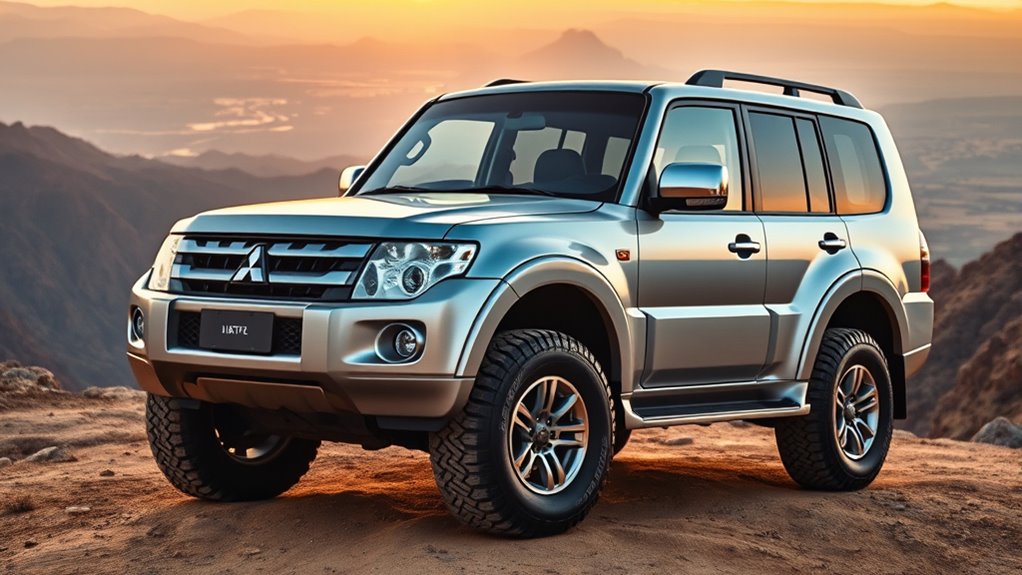
The Mitsubishi Pajero is a full-size SUV that has been in production since 1981, earning a reputation for off-road capability, durability, and reliability, with more than 3.3 million units sold worldwide.

A proven full-size SUV since 1981, the Mitsubishi Pajero is known for durability, reliability, and off-road capability.

Built for demanding terrain, the Mitsubishi Pajero combines practical utility with engineered traction, making it suitable for drivers seeking mechanical autonomy in varied conditions.

Its off-road credibility is reinforced by 12 overall Dakar Rally victories, a record that signals tested performance rather than marketing claims.

The model’s latest form is configured with a 2.4-liter turbo-diesel powertrain, 8-speed automatic transmission, and Super Select 4WD-II system, supporting controlled torque delivery.

Advanced systems such as Active Yaw Control and Active Stability and Traction Control further improve stability on loose or uneven surfaces.

With a seven-passenger, three-row cabin, the Mitsubishi Pajero remains a technically capable SUV positioned for utility, endurance, and confident movement beyond paved roads.

Pajero Generations and Key Changes

The Mitsubishi Pajero spans five generations since its 1981 debut, with each update reflecting changes in design, technology, and drivetrain capability.

A major shift arrived with the 1991 second generation, which added the Super Select 4WD system and electronic shock absorbers.

Meanwhile, the 2006–2018 fourth generation offered multiple engines and a fixed 4900 x 1875 mm body size.

Special edition variants have also contributed to its lineup as the model evolved toward the 2027 fifth generation, which is expected to use a 2.4-liter turbo-diesel engine and advanced four-wheel-drive technology.

Generation Timeline

Since its 1981 debut, the Mitsubishi Pajero has progressed through five generations, each marked by measurable advances in design, powertrain choice, and off-road capability.

The Pajero timeline begins with a utilitarian first series, then expands in 1991 with Super Select 4WD, enabling four drive modes for greater terrain control.

  • 1981: launch of the original Pajero
  • 1991: second generation adds Super Select 4WD
  • 2006-2018: fourth generation spans 4900 x 1875 x 1890 mm
  • Late 2026: fifth generation targets 204 Hp diesel output

Across its production span, the Pajero earned 12 Dakar Rally overall titles, reinforcing a record of durability, reliability, and performance.

Major Model Updates

Across its major revisions, the Mitsubishi Pajero evolved through distinct engineering updates that steadily improved performance, traction management, and market positioning.

Pajero II, launched in 1991, marked a decisive shift with the Super Select 4WD system, enabling four drive modes and adding turbocharged diesel capability for broader terrain control.

The third generation, built from 2000 to 2006, expanded engine choices and output to 115 to 202 horsepower, reflecting stronger drivetrains and refined efficiency.

From 2006 to 2018, the Pajero IV raised power further, ranging from 165 to 250 horsepower depending on configuration.

A compact Pajero Mini appeared in 1994 with 53 to 64 horsepower, targeting urban utility.

The forthcoming fifth generation is expected to pair a 2.4-liter turbo-diesel with advanced driver-assistance systems.

Special Edition Variants

Several special edition Pajero variants highlighted Mitsubishi’s off-road engineering and market-specific positioning.

The Pajero II produced the Pajero Evolution, a Dakar Rally homologation model with T2-class compliance and sharpened performance.

Camel Trophy editions used mustard yellow finishes and limited production to reinforce rugged credibility.

The 2015 Pajero IV facelift added updated styling and technology while retaining 190 Hp and core trail capability.

Pajero Sport, derived from the Triton, modernized the lineage without sharing the original underpinnings.

Special editions often added power steering, luxury equipment, and regional design cues, broadening appeal while preserving mechanical freedom.

  • Pajero Evolution: rally-focused engineering
  • Camel Trophy: limited mustard yellow trim
  • Pajero IV: facelifted, 190 Hp
  • Pajero Sport: separate, modern platform

Pajero Engines and Powertrains

The Mitsubishi Pajero has been equipped with a broad mix of petrol and diesel engines, ranging from compact 0.7-liter units to larger 3.8-liter and 3.2-liter configurations across different generations.

Transmission choices and drivetrain systems, including the latest 8-speed automatic and Super Select 4WD-II, support varied on-road and off-road performance requirements.

Output figures have spanned from 53 horsepower in early models to 288 horsepower in later versions, reflecting the model’s wide powertrain range.

Engine Options Overview

Mitsubishi Pajero engine choices span a broad range of petrol and diesel configurations, with petrol units from 0.7 to 3.8 liters and diesel variants from 2.3 to 3.2 liters.

This engine options overview shows a platform built for varied duty cycles, from urban mobility to remote travel, while preserving mechanical independence through multiple outputs.

  • 1998 Pajero II: 3.5-liter MIVEC, up to 288 horsepower
  • 2027 Pajero: 2.4-liter turbo-diesel, 204 horsepower, 480 Nm
  • Diesel focus: stronger low-end torque and better efficiency
  • Petrol range: wider displacement spread for broader performance tuning

These specifications indicate an adaptable powertrain family shaped for drivers seeking capability, range, and self-directed movement.

Transmission and Drivetrain

Beyond engine choice, the Pajero’s drivetrain determines how that power is delivered across varying terrain and load conditions. Its transmission range includes a 5-speed manual, a 4-speed automatic, and, on the latest fifth generation, an 8-speed automatic for finer ratio spacing and improved control. The system is paired with Super Select 4WD and Super Select 4WD-II, giving selectable modes for road, snow, mud, and sand. This flexibility supports drivers seeking technical autonomy over traction.

Feature Specification
Transmission 5-speed manual
Transmission 4-speed automatic
Drivetrain Super Select 4WD-II

A 52/48 front-rear weight split further steadies the chassis, while the 2027 2.4-liter turbo diesel adds strong pulling response.

Power Output Range

Power output across the Pajero range spans a wide 53 to 288 horsepower, reflecting the model’s evolution from the compact Pajero Mini to the high-output 1998 Pajero II MIVEC EVO.

This power output range covers petrol and diesel configurations, each tuned for distinct demands of terrain, load, and autonomy.

  • Petrol engines run from 0.7 liters to 3.8 liters.
  • Diesel engines range from 2.3 liters to 3.2 liters.
  • Pajero IV facelift 2012 delivers 197 horsepower.
  • Pajero IV facelift 2015 delivers 190 horsepower; the 2027 2.4-liter turbo diesel reaches 204 horsepower and 480 Nm.

Transmission choices, including 5-speed manual and 8-speed automatic, support efficient delivery.

How Much Horsepower Does the Pajero Have?

Horsepower in the Pajero varies widely by generation and engine setup, ranging from 53 to 288 horsepower across the model line.

At the low end, the Pajero Mini delivers 53 to 64 horsepower, showing how compact variants prioritize light-duty mobility over sheer output.

The Pajero III moves upward with engines rated from 115 to 202 horsepower, reflecting a broader spread of tuning and displacement choices.

The Pajero III ranges from 115 to 202 horsepower, offering a wider mix of tuning and displacement.

In the Pajero IV, output typically falls between 165 and 250 horsepower, depending on specification. The 2012 facelift is rated at 197 horsepower, while the 2015 Pajero IV facelift is listed at 190 horsepower.

The strongest factory figure appears in the 1998 Pajero II 3.5i MIVEC EVO, which produced 288 horsepower.

Taken together, these figures show a model family engineered for varied drivers, from practical urban use to freer, more demanding off-road performance.

Pajero Fuel Consumption and Tank Size

Mitsubishi Pajero fuel consumption varies widely by model, from about 6 l/100 km in the 1995 Pajero Junior to 14.5 l/100 km in the 1994 Pajero II, with larger engines generally using more fuel.

Fuel tank capacities typically range from 53 to 92 liters, with many versions fitted with tanks around 71 or 75 liters. This capacity supports longer travel distances, which is especially relevant for off-road use where refueling opportunities may be limited.

Fuel Economy Range

Fuel economy in the Pajero line varies widely by generation and engine configuration, with recorded consumption ranging from 6 l/100 km for the 1995 Pajero Junior to 14.5 l/100 km for the 1994 Pajero II.

This fuel economy range reflects powertrain choice, vehicle mass, and drivetrain load. Larger engines generally increase consumption, reducing efficiency but supporting stronger off-road performance and greater freedom in remote travel.

The 2027 Pajero, with a 2.4-liter turbocharged diesel, posts an average of 9.2 l/100 km.

  • Lowest recorded: 6 l/100 km
  • Highest recorded: 14.5 l/100 km
  • 2027 average: 9.2 l/100 km
  • Larger engines usually raise consumption

Tank Capacity Variants

Tank capacity in the Mitsubishi Pajero line typically ranges from 53 to 92 liters, with 71-, 75-, and 88-liter tanks appearing most often across different variants.

These fuel tank capacities vary by model and market, reflecting different chassis and engine configurations. Larger engines generally consume more fuel, so capacity selection affects practical range and efficiency.

The Pajero’s consumption spans from 6 liters per 100 km in the 1995 Pajero Junior to 14.5 liters per 100 km in the 1994 Pajero II, underscoring broad mechanical diversity.

In technical terms, higher-capacity tanks support more flexible operation where refueling access is limited, while smaller tanks reduce carried fuel mass.

The line is often judged inefficient, yet its specifications still serve users seeking mechanical autonomy.

Long-Distance Usability

Although the Mitsubishi Pajero is valued for durability and off-road capability, its long-distance practicality depends heavily on the balance between fuel consumption and tank size. Long-distance usability is strongest where fuel tank capacities offset the vehicle’s modest efficiency.

The 1995 Pajero Junior returns about 6 l/100 km, while other versions may reach 14.5 l/100 km, increasing refueling frequency. Tank sizes span 53 to 92 liters, with common 71-liter and 75-liter layouts; Pajero IV variants often use an 88-liter tank.

  • Low-consumption models extend range
  • Larger tanks reduce interruptions
  • Inefficient variants need planning
  • Off-road travel benefits from capacity

Mitsubishi Pajero Dimensions and Cargo Space

The Mitsubishi Pajero’s proportions underscore its role as a full-size SUV, with the Pajero IV measuring 4,900 mm in length, 1,875 mm in width, and 1,890 mm in height.

The fifth-generation model, due in 2027, grows to 4,920 mm long, 1,925 mm wide, and 1,910 mm high. These dimensions position it above the Pajero Sport in overall scale, supporting a more expansive cabin and stronger cargo packaging.

Up to seven occupants can be accommodated through a three-row layout, giving the vehicle practical flexibility for liberated, multi-purpose use. A flat cargo floor improves loading efficiency and helps keep the rear compartment orderly.

The second row slides 150 mm, allowing the interior to shift between passenger comfort and storage priority. When maximum load space is needed, the third row folds flat, extending usability without complex reconfiguration.

Is the Mitsubishi Pajero All-Wheel Drive?

Yes. The Mitsubishi Pajero is equipped with an advanced all-wheel-drive system, centered on Super Select 4WD-II, which enables switching between 2WD and 4WD for adaptable traction and control.

This configuration supports varied terrain demands while preserving efficient road manners and confident response. Its all-wheel-drive architecture is reinforced by a robust ladder frame, built to maintain stability on uneven surfaces.

Balanced weight distribution, at 52% front and 48% rear, further supports composed handling in all-wheel-drive operation. The fifth-generation model also pairs this setup with an 8-speed automatic transmission, improving drivability and mechanical efficiency.

  • Super Select 4WD-II for flexible traction
  • 2WD and 4WD mode selection
  • Ladder frame for structural stability
  • 52/48 weight balance for composed handling

Pajero Off-Road Modes and Systems

Equipped for varied terrain, the Mitsubishi Pajero uses Super Select 4WD-II to provide multiple drive modes, including Normal, Eco, Gravel, Snow, Mud, Sand, and Rock, allowing the drivetrain to be matched to surface conditions with precision.

This system supports seamless changes between 2WD and 4WD, giving the driver direct control over traction strategy without compromising momentum.

Active Yaw Control further refines power delivery by routing torque to the wheels with the highest grip, improving stability on loose or uneven ground.

A rugged ladder frame adds structural resilience, while purposeful approach angles help the vehicle clear steep entries and rough obstacles.

The result is an off-road package designed for technical terrain and practical freedom.

Even the Pajero Mini reflects the same engineering logic in smaller form, emphasizing terrain adaptability across the lineup.

Pajero Reliability, Safety, and Comfort

Built for long-term use, the Mitsubishi Pajero has earned a strong reputation for durability and dependable performance across its production run. Pajero reliability is reinforced by a robust mechanical layout and owner reports of consistent off-road capability under demanding conditions.

The body-on-frame structure contributes to rigidity, while active safety systems support controlled handling on varied terrain.

  • Active Stability and Traction Control helps maintain directional control.
  • Rigid ladder frame adds occupant protection and structural strength.
  • Spacious cabin layout supports fatigue-free long-distance travel.
  • Premium seating improves comfort for extended journeys.

Comfort remains a core attribute, with generous interior room and travel-oriented features designed for practical, independent movement.

Comfort stays central, with spacious cabin design and travel-friendly features for relaxed, independent journeys.

Some owners note higher running costs, largely tied to maintenance and parts pricing, yet the overall package remains compelling for those seeking a capable, secure, and comfortable utility vehicle.

Was the Mitsubishi Pajero Discontinued?

Yes, the Mitsubishi Pajero was officially discontinued in 2021 after more than 35 years of production, ending the fourth-generation model run. The decision reflected shifting market demand, tighter competition, and a segment moving toward lighter, more urban SUVs.

Over its lifecycle, the model sold more than 3.3 million units worldwide, confirming its relevance in global off-road and utility markets. Even after retirement, the Pajero’s reputation remains strong because of its durable engineering, proven traction systems, and multiple Dakar Rally victories.

That legacy also helped define related Mitsubishi models, including the Pajero IO, which shared the nameplate’s rugged association. Despite the pause in production, the nameplate is expected to return with a fifth generation in late 2026, following a five-year hiatus.

In technical terms, the discontinuation closed one chapter, but it did not erase the vehicle’s status as a benchmark for capability, reliability, and driver autonomy.

Frequently Asked Questions

Which Is the Best Pajero Engine?

The 3.2-liter diesel often emerges as the best Pajero engine in Engine Comparison, balancing torque, efficiency, and durability. For liberation-minded drivers seeking dependable off-road capability, it offers the strongest practical all-rounder performance.

What Are the Key Features of the Mitsubishi Pajero?

Its key features include a turbo diesel powertrain, Super Select 4WD-II, rugged styling, seven-seat Interior Comfort, leather-trimmed cabin, and safety systems with stability control and driver-assistance technology, delivering capable, liberating off-road and highway performance.

What Are Common Problems With Pajeros?

Common Pajero problems include costly maintenance, transmission faults in some 2006–2011 automatics, rust on earlier models, electrical glitches, and overheating. Maintenance Tips: regular servicing, fluid checks, corrosion treatment, and cooling-system inspection reduce failure risk.

What Is the 0 to 100 Speed of a Mitsubishi Pajero Sport?

It reaches 0–100 km/h in about 10.2 seconds. These Acceleration Metrics reflect a 2.4-liter turbo diesel, 8-speed automatic, and balanced chassis, delivering controlled thrust and confident progress across road and off-road conditions.

Conclusion

To conclude, the Mitsubishi Pajero stands as a durable bridge between old-school ruggedness and modern SUV engineering. Its turbo-diesel power, advanced Super Select 4WD-II system, and adaptable off-road modes give it a toolkit built for demanding terrain. With a seven-seat cabin and substantial dimensions, it balances utility with comfort. Though its production has ended, the Pajero’s legacy remains like a well-worn compass: dependable, purposeful, and still highly respected in the four-wheel-drive segment.

Vance Ashford

Vance brings extensive knowledge in tire specifications, auto accessories, and parts reviews, helping you find the right gear for your vehicle’s safety and performance.

Leave a Comment

Your email address will not be published. Required fields are marked *