The search for the best police scanners in 2027 centers on range, digital support, and ease of use. Some models favor handheld portability, while others are built for base or mobile setups. Features like APCO P25, weather alerts, and broad frequency coverage can make a real difference. With five contenders standing out, the question becomes which one fits a specific monitoring need best.
Uniden Bearcat BC125AT Handheld Scanner, 500 Channels
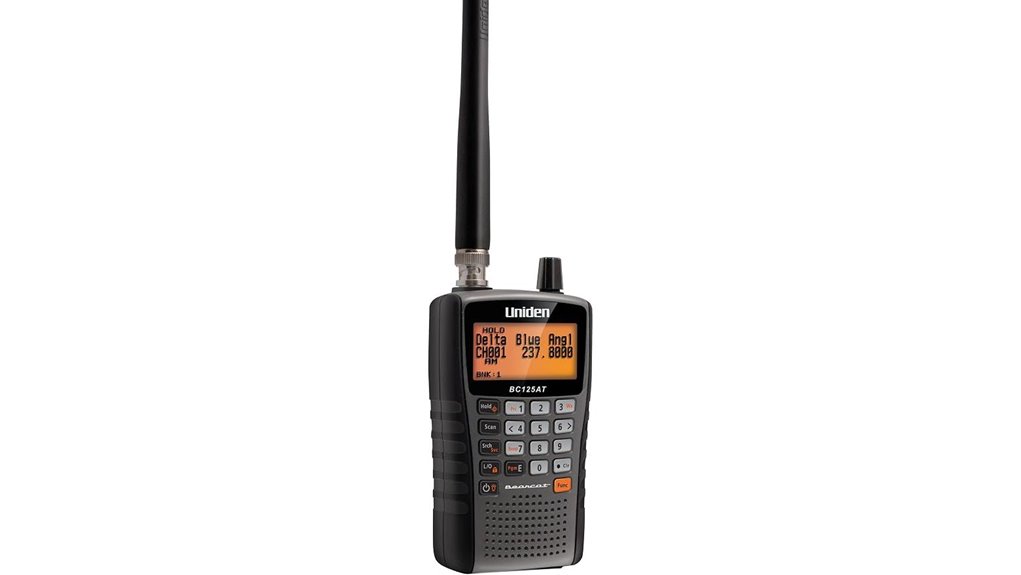
The Uniden Bearcat BC125AT is a strong fit for listeners who want a compact, easy-to-carry scanner with broad analog coverage and simple channel organization. It stores 500 alpha-tagged channels across 10 banks, making it easy to separate police, fire, marine, rail, and aviation traffic. Close Call technology can lock onto nearby signals quickly, while Do Not Disturb helps avoid interruptions. Its orange backlit display aids low-light use, and two AA batteries provide about 10 hours of runtime. It receives analog bands only, so digital systems such as P25, DMR, and NXDN remain out of reach.
Best For: Users who want a compact, easy-to-use analog scanner for organized monitoring of police, fire, marine, rail, and aviation channels.
Pros:
- Stores 500 alpha-tagged channels across 10 banks for easy organization
- Close Call technology quickly finds nearby signals, with Do Not Disturb mode to reduce interruptions
- Orange backlit display and lightweight design make it convenient for portable, low-light use
Cons:
- Does not support digital systems like P25, DMR, or NXDN
- Receive-only scanner, so it cannot be used for two-way communication
- Battery life is limited to about 10 hours on two AA batteries
Whistler WS1010 Handheld Scanner with Weather Alerts
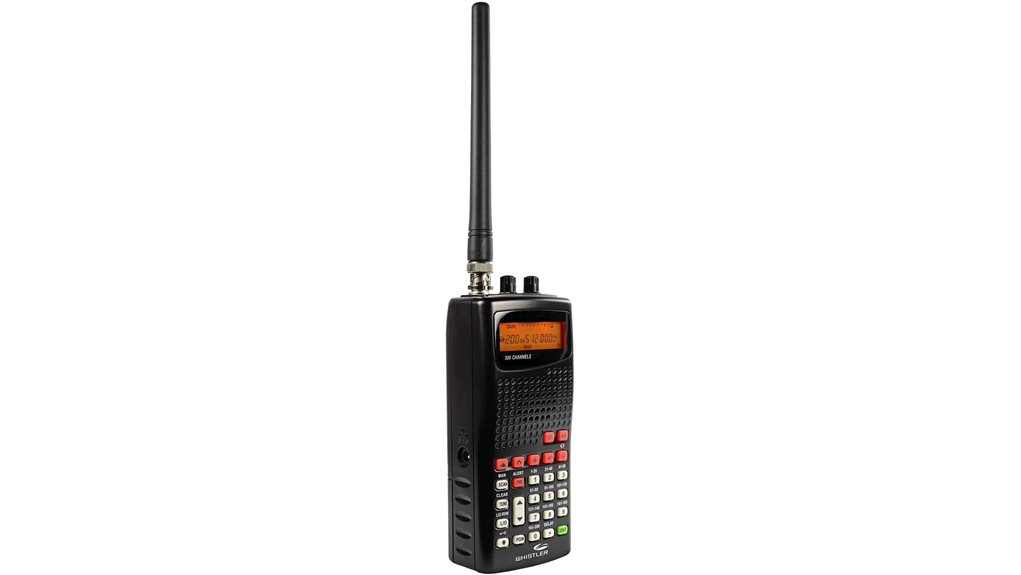
With 400 channels and weather alerts, the Whistler WS1010 suits users who want broad emergency monitoring. Its memory stores frequencies across 10 banks, supporting organized access to police, fire, marine, aircraft, ham, and weather services. SAME and All Hazards alerts can identify county-specific weather events, while Skywarn access supports storm spotter monitoring. Spectrum Sweeper helps locate nearby transmissions quickly. PC programming allows backups and database updates through compatible software and a PCIF cable. Finished in black, the handheld scanner offers practical coverage for users seeking a versatile receiver for public safety and weather monitoring.
Best For: Users who want a versatile handheld scanner for monitoring police, fire, marine, aircraft, ham, and weather alerts, especially for emergency and storm awareness.
Pros:
- 400-channel memory across 10 banks for organized storage
- SAME and All Hazards weather alerts plus Skywarn storm spotter access
- Spectrum Sweeper and service banks make finding transmissions easy
Cons:
- PC programming requires a separate PCIF cable and third-party software
- No mention of rechargeable battery or advanced digital trunking support
- May be more feature-rich than needed for casual users
Uniden BC365CRS Scanner Alarm Clock with Weather Alerts
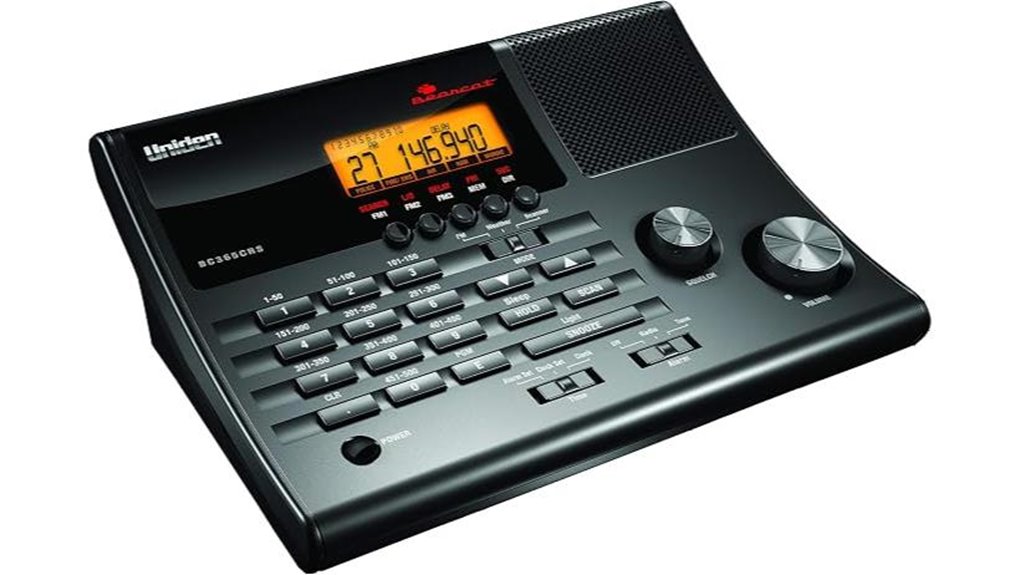
Uniden’s BC365CRS suits listeners who want a simple scanner with built-in alarm clock convenience. This desktop unit combines a 500-channel conventional analog scanner with FM radio and a clear backlit LCD. It includes presets for non-digital police, fire, weather, marine, aircraft, railroad, and amateur radio services, plus priority scanning for key channels every two seconds. The alarm can wake users to a scan, weather broadcast, or FM station, with snooze and sleep functions. Its easy button layout helps in low light. However, it cannot decode digital systems like P25, DMR, or NXDN.
Best For: People who want a simple, desktop scanner alarm clock with FM radio for listening to analog public safety, weather, marine, aircraft, railroad, and amateur radio channels at home.
Pros:
- Combines a 500-channel analog scanner, FM radio, and alarm clock in one convenient desktop unit.
- Includes useful presets and priority scanning for important channels every two seconds.
- Easy-to-use layout with a clear backlit display, plus snooze and sleep alarm functions.
Cons:
- Does not receive digital communications such as P25, DMR, or NXDN.
- Not suitable for agencies or areas that have moved to digital trunking systems.
- Limited to conventional analog scanning rather than modern digital monitoring.
Uniden BearTracker Scanner (BCT15X) Base/Mobile Black
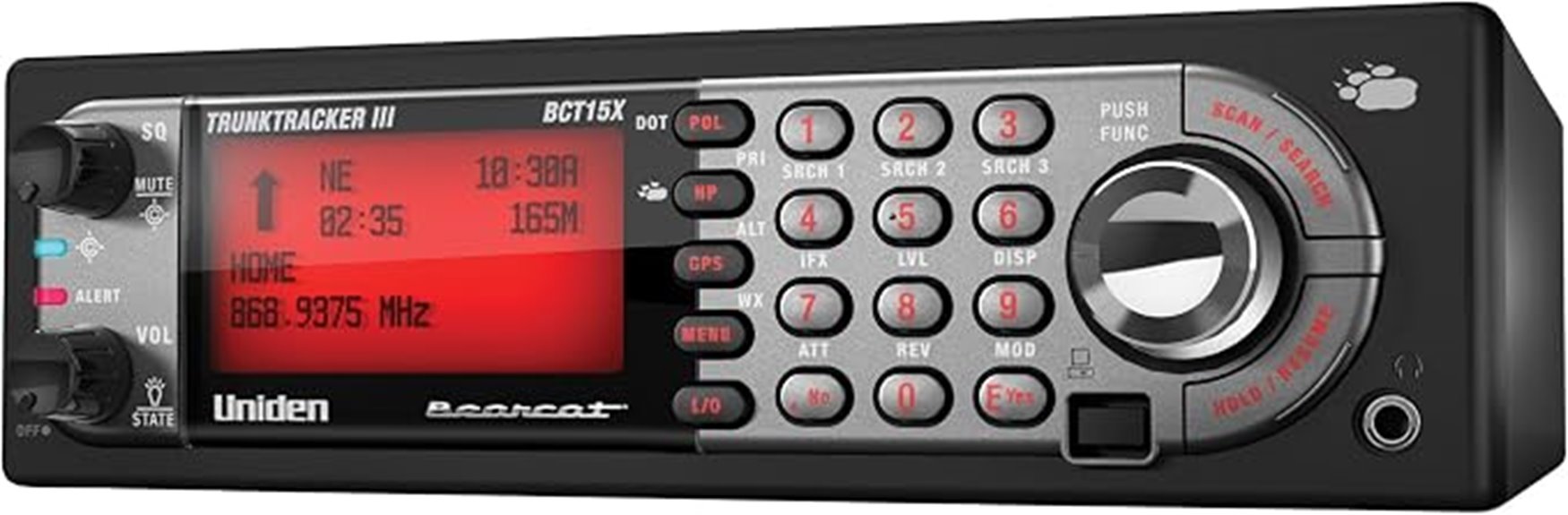
Covering 9,000 channels, the Uniden BearTracker BCT15X suits travelers and serious scanner users alike. Its mobile base design and black finish give it a straightforward, utilitarian profile. The dynamic memory system supports continuous coverage from 25MHz to 1.3GHz, excluding UHF TV and cellular bands. TrunkTracker III handles Motorola, EDACS, and LTR systems, while Close Call RF Capture helps locate nearby signals. With compatible GPS, location-based scanning becomes possible. Alpha tagging, individual volume offset, and 100 Quick Keys improve control. Preprogrammed state channels reduce setup time.
Best For: Travelers, hobbyist scanner listeners, and serious monitoring enthusiasts who want wide frequency coverage, trunking support, and easy-to-use preprogrammed channels.
Pros:
- 9,000-channel capacity with an advanced dynamic memory system
- TrunkTracker III, Close Call RF Capture, and GPS-based location scanning support
- Preprogrammed state-by-state channels plus alpha tagging and quick key control
Cons:
- No support for UHF TV and cellular bands
- May be more feature-rich than casual users need
- Best functionality with GPS requires a compatible receiver
Whistler TRX-1 Handheld Digital Police Scanner Radio
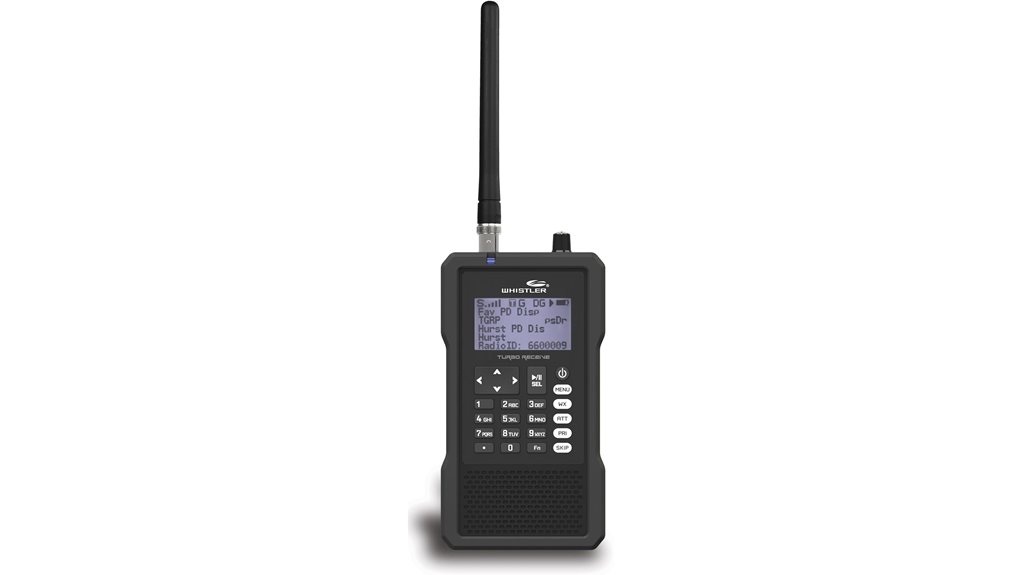
The Whistler TRX-1 suits users who want deep trunked-system monitoring and extensive scanlist control. This portable scanner covers 25-54 MHz, 108-174 MHz, 216-512 MHz, 764-960 MHz excluding cellular, and 1240-1300 MHz, while supporting APCO P25 Phase I and II, DMR, and NXDN through the USA and Canada database. It manages up to 200 scanlists, records 50 hours of traffic, and includes programmable alerts with a tri-color LED. Compact and rugged, it supports one-handed use, NOAA weather, and V-Scanner II backups.
Best For: Enthusiasts and professionals who need a rugged handheld scanner for deep trunked-system monitoring, customizable scanlists, and broad digital radio compatibility.
Pros:
- Supports APCO P25 Phase I/II, DMR, and NXDN, plus a wide frequency range and USA/Canada database
- Up to 200 customizable scanlists, with V-Scanner II backups and PC-based configuration management
- Records up to 50 hours of traffic and includes programmable alerts, NOAA weather reception, and one-handed operation
Cons:
- Can be complex to set up and fully use for beginners
- Uses a 2GB MicroSD card for recording, which may feel limited by modern storage standards
- Best suited for dedicated scanner users, so it may be more than casual listeners need
Factors to Consider When Choosing Police Scanners 2026: Top Picks for Every Frequency
Selecting a police scanner in 2026 starts with matching the scanner type to the intended use, since handheld and desktop models serve different needs. Digital support, channel capacity, frequency coverage, and alert features also shape how well a unit can track varied transmissions and keep up with active channels. These factors help narrow the field to top picks suited for every frequency range.
Scanner Type Matters
Scanner type can make or break a police scanner purchase, especially as agencies continue shifting from analog to digital systems. Analog models suit conventional transmissions, but digital-capable scanners are built for APCO P25, DMR, and NXDN systems now common in public safety. Capacity also matters: entry models may handle 400 to 500 channels, while advanced units store thousands, such as 9,000, enabling broader monitoring. Frequency coverage should be checked closely, since some scanners span 25 MHz to 1.3 GHz and can follow police, fire, and emergency traffic. Programmable models with PC support simplify updates and frequency management. Useful extras such as Close Call, weather alerts, and scan list tools improve responsiveness and make daily operation more efficient.
Digital Support
Digital support should be a top priority because many agencies now rely on APCO P25 Phase I and II, DMR, and NXDN systems for day-to-day communications. A scanner without these formats may miss important public safety traffic as departments migrate to newer networks. Wide frequency coverage, ideally from 25 MHz to 1.3 GHz, helps maintain compatibility across local, state, and regional bands. Models with TrunkTracker III can better follow trunked systems used by law enforcement and emergency services, improving monitoring reliability. Programmable alerts and notifications add another layer of usefulness by flagging urgent transmissions in real time. A clear interface and USB firmware updates further support long-term value, allowing easier operation and access to ongoing feature improvements.
Channel Capacity
Channel capacity matters because it determines how many frequencies a police scanner can store and organize for quick access. Capacity typically ranges from 400 to 9,000 channels, giving buyers a broad choice between basic and highly expandable units. Larger capacities help separate police, fire, and emergency services into banks or lists, making scanning faster and more orderly. Models with 500 channels or more usually handle multiple service types without frequent reprogramming, which suits active monitoring. Advanced scanners may use dynamic memory, letting them track many entries while managing specialized services efficiently. Still, capacity should match the listener’s goals. Casual users who only follow local police traffic may not need extensive storage, while frequent monitors gain flexibility from additional channels.
Frequency Coverage
Beyond how many channels a unit can hold, frequency coverage determines what it can actually hear, making it a key factor in choosing a police scanner for 2026. A scanner may span roughly 25 MHz to 1.3 GHz, but the useful range depends on which bands it supports. UHF and VHF remain important, while modern public-safety monitoring often requires APCO P25, DMR, and NXDN compatibility. Broader coverage and multi-protocol decoding allow a single radio to follow police, fire, and emergency traffic across different systems. Preprogrammed service banks can simplify access to common local channels, reducing setup time. GPS integration can also matter for travelers, since location-based scanning helps the receiver switch to relevant frequencies as coverage areas change.
Alert Features
Alert features can make a police scanner far more useful in real-world use by adding timely weather warnings, emergency notifications, and other programmable alarms. Weather alert support, including SAME, helps the scanner flag local hazards and emergency conditions without constant monitoring. Custom audible tones and visual indicators can mark selected transmissions, making important activity easier to notice at a glance. Some advanced units add a tri-color LED that provides a fast, recognizable signal for urgent alerts. Skywarn storm spotter capability also strengthens severe-weather awareness by linking to reporting frequencies used during storms. Programmable alerts are equally valuable, since they can be assigned to specific channels or bands. That flexibility lets users prioritize the traffic most relevant to their needs while reducing distraction from less important activity.
Portability Needs
Portability is a key consideration for users who want to monitor police communications while traveling, working outdoors, or moving between locations. Lightweight, compact scanners are better suited to these situations because they can be carried comfortably throughout the day. Many handheld models weigh less than a pound, reducing strain during extended use and making them practical for fieldwork or travel. Battery life also matters, since portable scanners commonly provide about 10 hours of operation on standard batteries, supporting long sessions away from charging sources. Features such as Close Call Technology further improve mobility by helping users quickly lock onto nearby signals. A compact design with a straightforward interface also supports fast access to channels and settings in active environments.
Programming Ease
Programming ease can make a scanner far more practical for everyday use, especially for users who want quick setup and minimal guesswork. Models with PC programming support let users update, clone, and back up frequency databases with compatible software and cables. Preprogrammed options for common services reduce setup time and help users reach important channels faster. Customizable scanlists also matter, since they allow channels to be grouped and prioritized by interest or location. An intuitive interface improves navigation through menus, memory banks, and settings, which is especially valuable for beginners. Scanners with dynamic memory systems offer another advantage by managing channels efficiently and reducing manual organization. Together, these features make a scanner easier to configure, maintain, and use consistently in changing conditions.
Frequently Asked Questions
Which Scanner Works Best for Encrypted Police Communications?
No scanner works best for encrypted police communications, because encryption prevents normal receivers from decoding the audio. A scanner can still monitor unencrypted analog, P25 Phase I, or some non-encrypted digital channels, but encrypted talkgroups remain inaccessible by design. For lawful listening, he or she should verify local system types and purchase a scanner that supports them, then expect encrypted traffic to stay silent.
Are Police Scanners Legal to Use Everywhere?
They are not legal everywhere; the answer shifts like weather across borders. Laws often permit receiving unencrypted public transmissions, yet prohibit interception of encrypted, cellular, or private communications. Some places restrict scanners in vehicles, near crime scenes, or during traffic stops. A scanner’s legality depends on local statutes, licensing, and intended use. He or she should check regional regulations before listening, because one small device can carry hidden legal risk.
How Often Do Scanner Frequency Databases Need Updates?
Scanner frequency databases need updates whenever local agencies change channels, encryption settings, or system affiliations, which can happen monthly or even weekly in active regions. Most national databases are reviewed continuously, with formal edits often appearing within days of confirmed changes. Because public safety systems evolve unpredictably, users should check for updates regularly rather than assuming long intervals. In practice, frequent monitoring keeps scanner information reliable and usable.
Can Scanners Receive Aviation and Amateur Radio Signals Too?
Yes, many scanners can receive aviation and amateur radio signals if they cover the needed frequency ranges. Airband communications are commonly monitored on VHF, while amateur radio is often received on VHF, UHF, and sometimes HF. However, reception depends on the scanner’s design, antenna, and local signal conditions. Digital modes or trunked systems may require more advanced features than basic models provide, limiting compatibility in some cases.
Do Handheld Scanners Work Well Inside Buildings?
Handheld scanners often work unevenly inside buildings, where concrete, metal, and low-E glass can weaken signals, much like a flashlight dimming in fog. Reception typically improves near windows, upper floors, or with an external antenna. In dense urban interiors, performance can drop noticeably on VHF and UHF. For best results, placement matters as much as the scanner itself, and expectations should remain modest indoors.
Conclusion
In 2027, these scanners stand like vigilant sentinels at the edge of the airwaves, each tuned to a different beat of public safety. From compact handhelds to steadfast base units, they offer a spectrum of listening power for newcomers and seasoned monitors alike. As technology keeps surging forward, the right scanner can feel like a compass in a storm, guiding users through the static toward clarity, readiness, and connection.