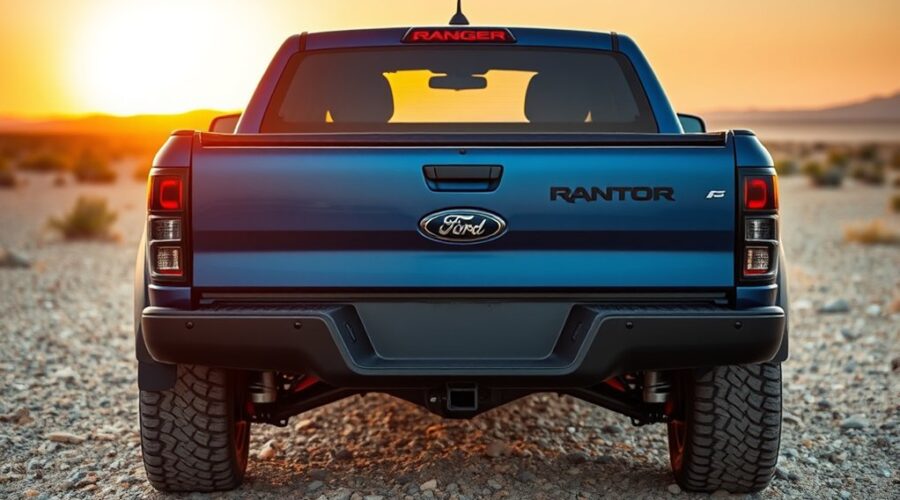
The Ford Ranger Raptor is a midsize performance pickup built for drivers who want trail capability without giving up everyday use. Its 3.0-liter EcoBoost V6 delivers 405 horsepower and 430 lb-ft of torque through a 10-speed automatic, while its size and ground clearance support serious off-road work. Towing, acceleration, and cabin features add more context, but the numbers tell only part of the story.
Key Takeaways
- Ford Ranger Raptor uses a 3.0L twin-turbo EcoBoost V6 with 405 hp and 430 lb-ft of torque.
- It pairs with a 10-speed automatic transmission and delivers estimated 15 mpg city, 18 mpg highway.
- Performance includes 0–60 mph in about 5.2 seconds and a quarter-mile time of 14.1 seconds.
- Dimensions are roughly 211.9 inches long, 79.8 inches wide, and 75.7 inches tall, with a 128.7-inch wheelbase.
- Off-road hardware includes Fox dampers, 9.2–10.4 inches of ground clearance, and 32-degree approach and 27-degree departure angles.
What Is the Ford Ranger Raptor?
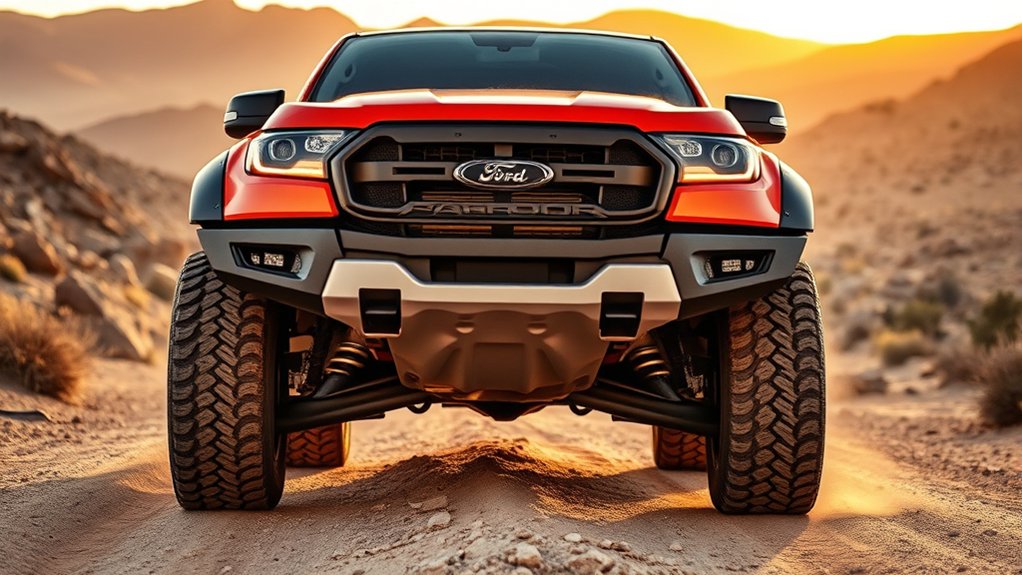
The Ford Ranger Raptor is a mid-size performance pickup built for off-road capability and everyday utility. It combines a Ford Ranger Raptor identity with a powerful engine, specialized suspension, and rugged tires to support confident travel beyond paved routes.
Its Fox dampers and 33-inch BFGoodrich KO3 tires are engineered for stability on rough ground, while its 5,510-pound towing capacity and 1,373-pound payload capacity preserve practical usefulness. The truck’s dimensions, at 210.9 inches long, 79.8 inches wide, and 75.9 inches high, keep it more maneuverable than full-size rivals.
Inside, a 12-inch touchscreen with SYNC 4A and Apple CarPlay supports modern connectivity. Its safety features, including Blind Spot Monitoring and a 360-degree camera system, add awareness in traffic and on trails.
Ford Ranger Raptor Engine Specs and Output
Powered by a 3.0L EcoBoost V6, the Ford Ranger Raptor delivers 405 horsepower and 430 lb-ft of torque, giving it strong acceleration and confident passing power. Its engine specs are centered on a 2956 cc displacement and a 10-speed automatic transmission, a pairing that supports responsive performance without sacrificing control.
| Spec | Value | Notes |
|---|---|---|
| Engine | 3.0L EcoBoost V6 | Twin-turbo powertrain |
| Horsepower | 405 hp | Strong output |
| Torque | 430 lb-ft | Broad pulling force |
| Fuel efficiency | 15/18 mpg | City/highway ratings |
| Top speed | 111 mph | Estimated maximum |
The Ranger Raptor’s fuel efficiency is modest, yet its output reflects a purpose-built truck for drivers seeking capability and liberation from ordinary road limits. In practical use, the powertrain favors strength, traction, and durable performance over economy alone.
How Quick the Ford Ranger Raptor Is
Quickly, the Ford Ranger Raptor establishes itself as one of the faster midsize performance trucks, reaching 0 to 60 mph in about 5.2 seconds. That pace comes from a 3.0L EcoBoost V6 rated at 405 horsepower and 430 lb-ft of torque, giving the truck strong pulling power and immediate response.
Its performance remains consistent beyond the launch, with a quarter-mile run of 14.1 seconds at 97 mph and a top speed near 111 mph. The Ranger Raptor’s acceleration feels composed rather than frantic, supported by responsive steering and a chassis tuned for control.
In everyday driving, that combination provides useful volume in acceleration without sacrificing refinement. The maximum towing capacity is not the focus here, but the available torque gives the truck broad utility.
A rear differential helps manage traction during harder driving, reinforcing a balanced, liberated driving character that favors speed, confidence, and precision.
Ford Ranger Raptor Dimensions and Off-Road Hardware
Measuring 211.9 inches long, 79.8 inches wide, and 75.7 inches tall, the Ford Ranger Raptor presents a substantial footprint that supports its off-road intent without making the truck feel unwieldy.
Measuring 211.9 inches long, 79.8 inches wide, and 75.7 inches tall, the Ranger Raptor balances scale with agility.
Its dimensions include an 86.9-inch mirror span, a 128.7-inch wheelbase, and a chassis set high for trail work, with ground clearance from 9.2 to 10.4 inches. That clearance, combined with 32 degrees of approach angle and 27 degrees of departure angle, helps the Raptor climb, descend, and break over rough terrain with composure.
The cargo area sits 20.8 inches high, while the loading floor measures 34.3 to 34.5 inches, keeping gear access practical.
Underneath, specialized Fox dampers give the suspension added control on washboard surfaces, ruts, and rocky tracks. The result is an off-road truck whose hardware supports movement, confidence, and freedom beyond paved roads.
Ford Ranger Raptor Towing, Payload, and MPG
The Ford Ranger Raptor’s towing capacity is rated at 5,510 pounds, a figure that trails the standard Ranger because its off-road tuning places more emphasis on trail performance than maximum hauling ability.
Its payload capacity is 1,373 pounds, which provides useful room for gear and equipment despite the truck’s performance-focused setup.
Fuel economy is modest, with EPA estimates of 16 mpg in the city, 18 mpg on the highway, and 17 mpg combined.
Towing Capacity Tradeoffs
While built for high-speed off-road performance, the Ford Ranger Raptor makes clear towing tradeoffs: its maximum towing capacity is 5,510 pounds, well below the standard Ranger’s 7,500 pounds, and its 1,373-pound payload rating reflects a similar emphasis on rugged capability over heavy hauling.
This towing capacity and payload capacity suit weekend gear, not demanding worksite loads. The truck’s Fox dampers and revised suspension geometry sharpen performance and off-road capabilities, but they also reduce traditional towing effectiveness.
Its 0-60 mph time of about 5.3 seconds underscores its quick character, yet that same tuning can work against stable trailering.
EPA fuel economy ratings of 16 mpg city and 18 mpg highway further signal a model optimized for freedom through terrain, not maximum utility or efficiency.
Fuel Economy Figures
Fuel economy reflects the Ranger Raptor’s performance-first mission, with EPA estimates of 15 mpg in city driving, 18 mpg on the highway, and 17 mpg combined. These figures place the model year truck below many efficiency-focused midsize pickups, yet they align with its 3.0L EcoBoost V6 and off-road tuning.
Vehicle weight, aggressive tires, and suspension hardware all contribute to the lower rating. Even so, the Ranger Raptor retains practical utility, pairing fuel economy with a maximum towing capacity of 5,510 pounds and a payload capacity of 1,373 pounds.
The figures show a truck built for capability, not compromise, where freedom of movement and trail confidence take priority over maximum efficiency. For buyers, the estimates clarify the tradeoff between power, load handling, and everyday driving economy.
Ford Ranger Raptor Tech and Cabin Features
Inside the Ranger Raptor’s cabin, technology takes a practical, driver-focused role, led by a 12-inch touchscreen with SYNC 4A and support for Apple CarPlay and Android Auto.
The interface centralizes navigation, media, and vehicle settings, reducing distraction while keeping essential controls within easy reach.
Audio is delivered through a premium Bang & Olufsen sound system with 10 speakers, adding clarity and depth for daily drives or long trips.
Safety tech includes Blind Spot Monitoring and Lane-Keeping Assist, both designed to support alert, confident driving.
A 360-degree camera improves visibility when threading through narrow trails or crowded streets.
Active Park Assist further eases maneuvering by managing steering during parallel or perpendicular parking.
Together, these features create a cabin that blends connectivity, convenience, and control without unnecessary complexity, giving the driver more freedom to focus on the road ahead.
Frequently Asked Questions
Is the Ranger Raptor Engine Powerful?
Yes, the Ranger Raptor engine is powerful, delivering strong Engine performance for Off road capabilities and Towing capacity. Fuel efficiency is modest, and Maintenance costs may be higher, yet the package favors capability and freedom.
Which Ford Raptor to Stay Away From?
Pre-2021 Raptors, especially 2017–2018 examples, are the ones to stay away from: Raptor reliability issues, Fuel economy concerns, Maintenance costs comparison, Off road capabilities, Resale value analysis all favor newer models.
Is a Ford Raptor Faster Than a Ram Trx?
No; in Raptor vs TRX, the TRX is faster. This Performance comparison shows stronger Engine specifications, greater Off road capabilities, and higher Towing capacity for the TRX, while the Raptor prioritizes agility and efficiency.
What Is the 0 to 60 Mph Time of the Ford Ranger Raptor?
The Ford Ranger Raptor reaches 0 to 60 mph in about 5.2 seconds. Towing capacity, off road capability, engine options, fuel efficiency, and interior features all support a capable, spirited, freedom-minded driving experience.
Conclusion
The Ford Ranger Raptor blends serious off-road hardware with strong everyday capability, making it a standout in the midsize truck segment. Its 3.0L EcoBoost V6, quick acceleration, and generous ground clearance give it real performance credibility, while towing ability and modern cabin tech add practical value. For drivers wanting a truck that can work hard and play harder, it brings a well-rounded package that truly hits the nail on the head.