
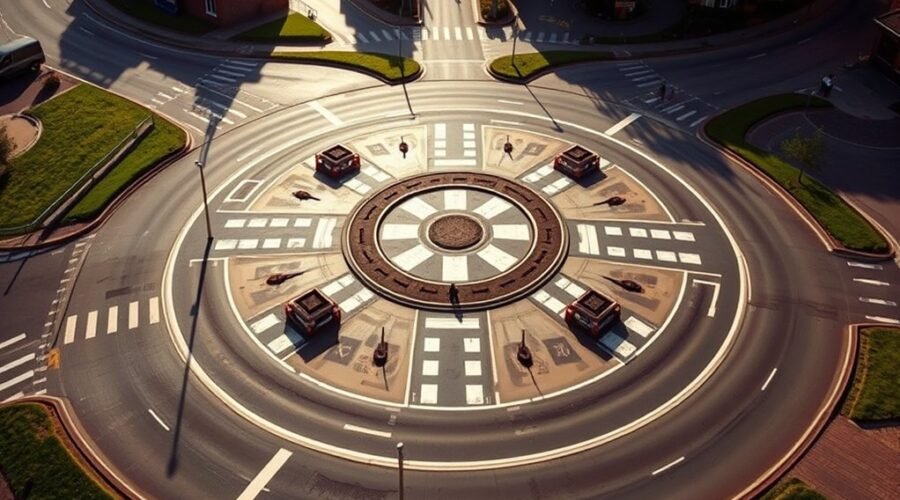
The Magic Roundabout in Swindon, constructed in 1972, represents a significant evolution in traffic management design. Its unique structure, featuring a central roundabout encircled by five smaller ones, allows for unconventional vehicle movement. Initially met with skepticism, the roundabout now processes around 6,200 vehicles per hour with improved efficiency. Understanding its history and technical intricacies reveals not only its functional success but also its cultural implications in urban planning. What factors contribute to its enduring legacy?
Key Takeaways
- The Magic Roundabout in Swindon, UK, was constructed in 1972 to alleviate traffic congestion with a unique design by Frank Blackmore.
- It features a central roundabout operating counter-clockwise, surrounded by five smaller roundabouts functioning clockwise, accommodating versatile vehicle maneuvers.
- Capable of handling approximately 6,200 vehicles per hour, it promotes smoother traffic flow and minimizes congestion compared to traditional intersections.
- Despite initial user apprehension, the roundabout has transformed into a symbol of local pride, appreciated for its efficiency and reduced accident rates.
- Local councillor David Glaholm helped popularize the “Magic Roundabout” name, blending admiration and humor while enhancing tourism in Swindon.
The Fascinating History of the Magic Roundabout
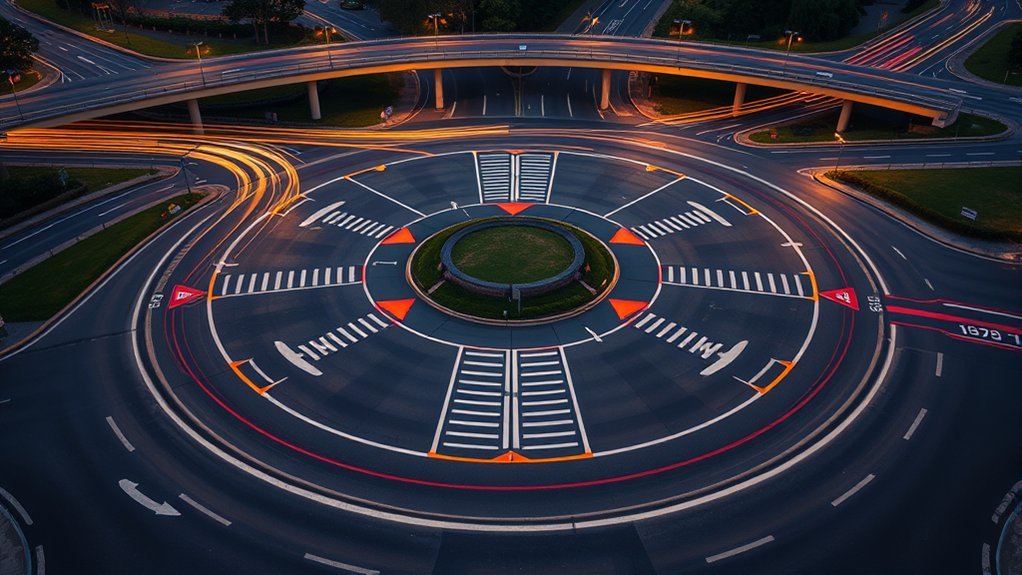
The Magic Roundabout in Swindon, UK, stands as a remarkable example of innovative traffic engineering. Constructed in 1972 under the vision of Frank Blackmore, it was designed to alleviate congestion in a complex traffic area originally known as County Islands. This extraordinary configuration features a central roundabout encircled by five smaller roundabouts, facilitating a unique two-directional flow of vehicles, a concept that challenged conventional norms. Initially, the intricate layout necessitated police presence to manage traffic; however, drivers gradually adapted to its complexities. Despite being dubbed one of the worst roundabouts in public surveys, Swindon’s Magic Roundabout boasts a commendable safety record, with reduced speeds mitigating collision severity. Its whimsical name, inspired by a beloved children’s TV show in the early 1980s, adds a layer of charm to its historical significance, symbolizing both creativity and functional design in urban planning.
Understanding How the Magic Roundabout Works
Understanding the operational dynamics of the Magic Roundabout reveals its intricate design tailored to facilitate efficient traffic flow. This unique configuration consists of a central roundabout operating counter-clockwise, surrounded by five smaller roundabouts that function clockwise, enabling complex multi-directional movement.
Key aspects include:
- Higher Capacity: Capable of handling approximately 6,200 vehicles per hour, it considerably outperforms traditional roundabouts.
- Versatile Maneuvers: U-turns on the outer roundabout and right turns requiring merges enhance navigational options.
- Minimized Congestion: The design allows shorter routes to exits and multiple feeder paths, contributing to better throughput.
This overall configuration effectively reduces congestion, promoting smoother traffic flow. Initially requiring police guidance for drivers to adapt, the Magic Roundabout exemplifies an innovative approach to modern traffic management, embodying liberation from traditional constraints.
User Experiences With the Magic Roundabout
User experiences with the Magic Roundabout illustrate a blend of initial trepidation and eventual adaptability. Many first-time users express apprehension regarding the roundabout’s seemingly complex layout, yet most find that the intricacies become intuitive after several navigations. Observers note that traffic flow is particularly efficient, as vehicles rarely come to a stop, offering a stark contrast to traditional signalized intersections. Long-term users appreciate this efficiency, particularly during peak hours, affirming the roundabout’s effectiveness. However, challenges do arise; some drivers report frustrations when exits are closed, which can complicate navigation. Anecdotes abound, highlighting the humor and confusion often experienced by both locals and visitors alike, further enriching the narrative surrounding the roundabout. Ultimately, user experiences reflect a journey from bewilderment to mastery, underscoring the adaptability required to navigate this unique traffic solution.
What Do People Think: Is It Love or Hate?
How do drivers truly feel about the Magic Roundabout: is it a beloved fixture or a source of frustration? Public sentiment has shifted markedly since its inception, reflecting a complex relationship with this unique junction. Key points include:
- Initially voted the worst junction in a 2005 survey, it incited fear and confusion among drivers.
- Over time, locals have come to appreciate its efficiency, noting reduced congestion and smoother traffic direction.
- The roundabout has inspired humor and anecdotes, often portraying the challenges newcomers face.
Despite its reputation as one of the world’s worst junctions in 2007, many now express love for the Magic Roundabout, viewing it as a quirky symbol of Swindon. This transformation from fear to familiarity illustrates a broader narrative of adaptation, as drivers learn to navigate its complexities and embrace its unique charm.
Safety Record: Why It’s Safer Than You Think
The Magic Roundabout’s safety record reveals a paradox between public perception and actual performance, as evidenced by its low accident incidence despite past criticisms. The roundabout’s design promotes slower vehicle speeds and offers multiple paths, greatly reducing potential conflicts and enhancing overall safety. Additionally, statistical data indicates that such configurations lead to a substantial decrease in accidents compared to traditional intersections, highlighting a need for a reevaluation of driver behavior in this unique traffic environment.
Accident Statistics Overview
Accident statistics reveal a surprisingly positive safety record for the Magic Roundabout, challenging its reputation as one of the UK’s most intimidating junctions. Key insights into its safety performance include:
- Lower Speed Limits: Traffic moves at reduced speeds, decreasing the severity of potential collisions.
- Fewer Accidents: Despite its notorious image, the roundabout experiences fewer accidents compared to traditional traffic signals and roundabouts.
- Reduced Serious Injuries: Its unique design contributes to a lower rate of serious injuries, fostering a safer environment.
The roundabout’s configuration promotes continuous traffic flow, minimizing stop-and-go scenarios that often lead to accidents. This encourages cautious driving, allowing users to navigate safely, even if they initially perceive the layout as complex.
Design Enhancements for Safety
Enhancing safety at the Magic Roundabout involves a strategic blend of innovative design elements that collectively contribute to its impressive safety record. The unique layout promotes low-speed traffic flow, markedly reducing the severity of collisions. With an average throughput of 6,200 cars per hour, the roundabout effectively reduces congestion, diminishing the likelihood of accidents typically caused by stop-and-go scenarios. Additionally, the dual-directional traffic flow—where outer roundabouts operate clockwise and the inner counter-clockwise—prevents head-on collisions while streamlining vehicle movements. Despite initial concerns regarding its complexity, the design enhancements for safety have resulted in a notable reduction in serious accidents over the years, making the Magic Roundabout safer than many conventional junctions.
Driver Behavior Insights
Understanding driver behavior at the Magic Roundabout reveals a fascinating interplay between design and safety. Despite its initial complexity, the roundabout’s favorable safety record can be attributed to several factors:
- Reduced Speed: Traffic moves slowly, lessening collision severity.
- Efficient Flow: The design accommodates more vehicles than traditional traffic lights, minimizing stops.
- Increased Vigilance: The potential for lane change conflicts encourages cautious driving behavior.
Over time, drivers adapt to the layout, leading to a notable decrease in accidents. This adaptation, combined with the roundabout’s unique features, contributes to a sense of liberation in maneuvering through traffic. Ultimately, the Magic Roundabout exemplifies how thoughtful design can enhance safety and transform driver behavior positively.
Cultural References and Recognition of the Magic Roundabout
The Magic Roundabout in Swindon serves as an engaging case study in the intersection of cultural identity and urban design. Named after a beloved children’s television show, it has morphed into a quirky tourist attraction, despite being voted the worst roundabout in the UK in a 2005 survey. This duality reflects its complex relationship with cultural references and traffic management.
| Aspect | Recognition | Cultural Impact |
|---|---|---|
| Tourist Attraction | Draws visitors to Swindon | Represents quirky British charm |
| Public Perception | Known for confusion | Inspiration for online humor |
| Traffic Efficiency | Effective despite challenges | Discussed in road design debates |
Local councillor David Glaholm’s efforts to popularize the “Magic Roundabout” name further solidified its unique identity, making it a focal point in urban design discussions. Its presence symbolizes both innovation and the public’s ambivalence toward modern traffic systems.
Related Reading
Frequently Asked Questions
What Was the Controversy Surrounding the Magic Roundabout?
The controversy surrounding the roundabout design centered on traffic safety concerns, as urban planning decisions prioritized innovative layouts over driver education, leading to confusion and accidents, despite its surprisingly low collision rate over time.
What Is the Hardest Roundabout in the World?
The hardest roundabout in the world, often likened to a swirling vortex of engineering challenges, exemplifies advanced traffic management. Its design incorporates robust safety measures, transforming chaos into efficiency amidst the global landscape of complex intersections.
What’s so Special About the Magic Roundabout?
The Magic Roundabout’s unique design enhances traffic flow through its counter-clockwise central roundabout and surrounding clockwise loops. Despite mixed public perception, its safety features contribute to surprisingly low accident rates, making it an intriguing traffic solution.
Did Emma Thompson’s Dad Create the Magic Roundabout?
Emma Thompson’s father did not create the Magic Roundabout; he was behind an animated series that captivated audiences. The roundabout’s origins lie elsewhere, yet both share a profound cultural impact, intertwining their legacies.
Conclusion
To conclude, the Magic Roundabout stands as a delightful tribute to innovative urban design, embracing complexity while enchanting visitors with its whimsical charm. Though initially met with trepidation, it has gracefully evolved into a beloved feature of Swindon’s landscape, inviting both admiration and spirited debate. Its remarkable safety record and unique functionality continue to captivate the curious, solidifying its status as a cherished symbol of British ingenuity and an enduring topic of conversation among locals and tourists alike.