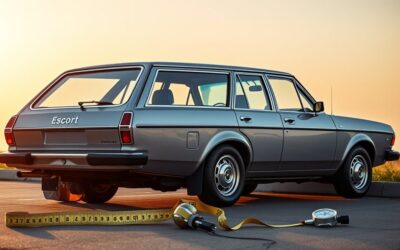
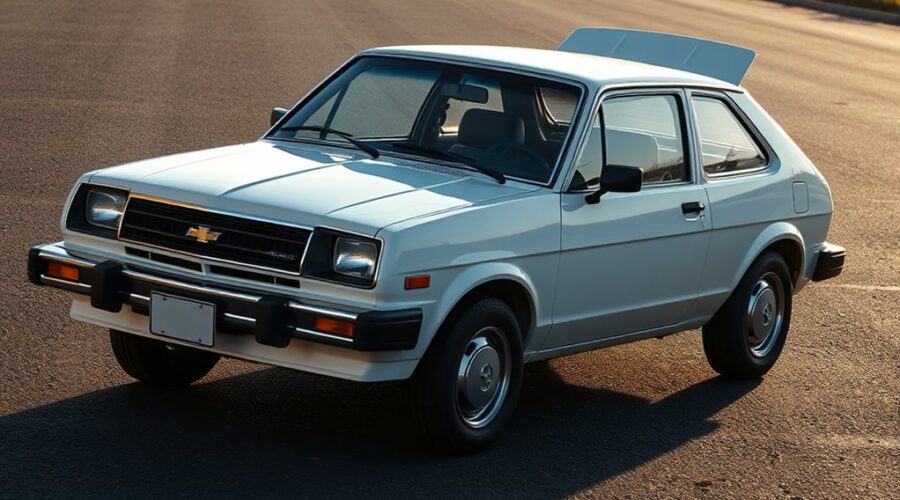
The Chevrolet Chevette Hatchback, built from 1976 to 1987, used a front-engine, rear-wheel-drive layout with a 1.6-liter inline-four rated at 65 horsepower and a five-speed manual transmission. It returned 24 mpg city and 33 mpg highway, while its 2,046-pound curb weight and 94.2-inch wheelbase supported easy handling. The hatchback body added usable cargo space, but its spec sheet changed in ways that shaped the car’s place in the market.
Chevrolet Chevette Hatchback Overview
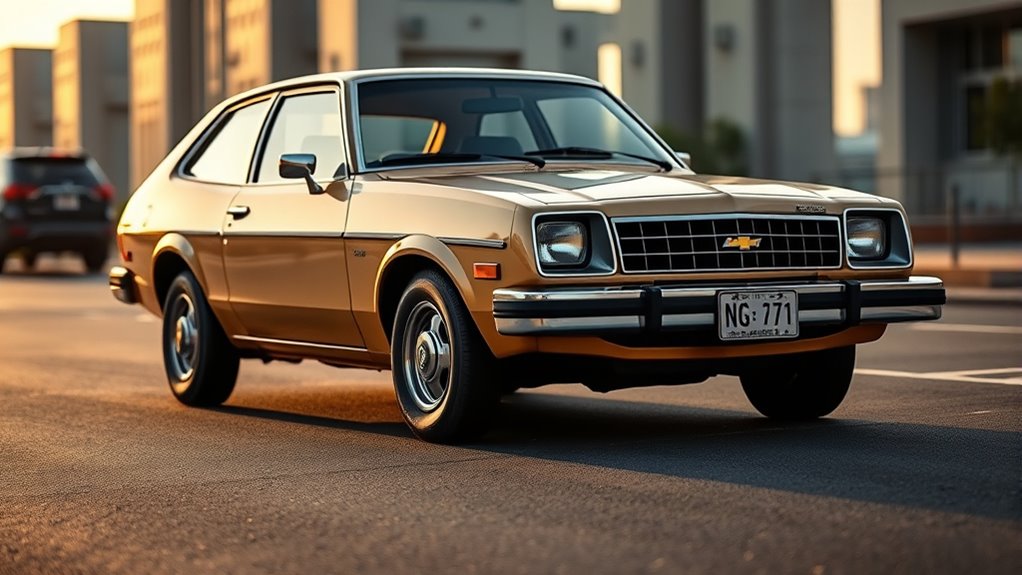
The Chevrolet Chevette hatchback, produced from 1976 to 1987, used a front-engine, rear-wheel-drive layout and was offered in three-door and five-door body styles.
Chevrolet positioned the Chevette as a compact hatchback with a simple powertrain package, modest performance, and restrained dimensions suited to urban use. Its rear-drive chassis and short 94.2-inch wheelbase supported predictable handling and a manageable footprint, while the 2,046-pound curb weight kept operating demands low.
Early production models delivered strong fuel efficiency, rated at 28 mpg city and 40 mpg highway, reinforcing its value proposition.
Over the course of production, the Chevette reached 2.8 million sales, a figure that made it the best-selling small car in the United States for 1979 and 1980.
Within Chevrolet’s lineup, the Chevette represented practical mobility and accessible ownership.
Engine and Transmission
Under the hood, the Chevrolet Chevette uses a 1.6-liter naturally aspirated inline-four rated at 65 horsepower, paired with a standard five-speed manual transmission that helps balance drivability and fuel economy. This powertrain is built around a lightweight engine, weighing 59 lbs less than the Vega’s aluminum-block unit, reducing unnecessary mass and supporting responsive control. The drivetrain’s essential components deliver reliable power transfer, helping the Chevrolet Chevette remain predictable in urban use and on open roads.
| Component | Technical role |
|---|---|
| Engine | 1.6-liter inline-four |
| Transmission | Five-speed manual |
| Output | 65 horsepower |
| Construction | Lightweight design |
| Powertrain | Efficient transfer |
Together, these dimensions of design and hardware reflect a pragmatic performance package. The manual transmission gives the driver direct command, while the engine’s modest output prioritizes mechanical simplicity and fuel efficiency.
MPG and Performance
With a 1.6-liter naturally aspirated inline-four producing 65 horsepower and a 5-speed manual transmission, the 1984 Chevrolet Chevette hatchback emphasizes efficient, modest performance over outright speed. Its 24 mpg city and 33 mpg highway ratings give the car credible fuel economy, while the combined mpg figures suit drivers seeking mobility without excess operating cost.
The lightweight 2,046-lb weight helps the engine respond adequately, improving acceleration feel and preserving usable performance in daily traffic.
The lightweight 2,046-lb weight helps the engine feel more responsive, improving everyday acceleration and city drivability.
- 24 mpg in city use supports economical commuting.
- 33 mpg on the highway extends range and reduces fuel stops.
- The subcompact layout and compact dimensions aid maneuverability.
In the broader subcompact segment, this hatchback reflects a practical balance of engine output, weight, and driving experience.
Its technical setup favors access, efficiency, and self-directed movement rather than speed, offering a restrained but functional car for budget-minded use.
Dimensions and Interior Space
Compact dimensions define the 1984 Chevrolet Chevette’s hatchback packaging, with a 94.2-inch wheelbase supporting urban maneuverability and easy parking. Its 52.0-inch height and 61.0-inch width reinforce a low-profile silhouette that suits tight streets and constrained spaces.
For a subcompact Chevrolet, the layout prioritizes usable interior space over bulk, aligning with economical transport and practical mobility.
Inside, the dimensions deliver 37.0 inches of headroom in both rows, giving occupants adequate vertical clearance despite the compact size. First-row legroom measures 41.0 inches, a remarkably generous figure that supports relaxed front seating.
Second-row legroom is 30.0 inches, which is more limited but consistent with the vehicle’s passenger capacity of two. The hatchback configuration helps maximize cargo and cabin flexibility within the small footprint.
Chevette Hatchback Specs and Model Changes
The Chevrolet Chevette hatchback was offered in three-door and five-door form, using a front-engine, rear-wheel-drive layout and a curb weight of 2,046 lbs to keep the package lightweight and mechanically simple. Its powertrain began with engine options of a 1.4-liter or 1.6-liter inline-four, rated from 52 to 70 hp and matched to a standard four-speed manual.
- 1980 revised fascias sharpened the hatchback’s appearance.
- 1983 cosmetic updates renewed the front and rear treatment.
- The Chevette CS added trim variety without altering core dimensions.
For 1984, model changes included a 1.6-liter engine making 65 hp and a five-speed manual, improving performance and drivability.
That calibration supported broader road use while preserving fuel efficiency, rated at 24 mpg city and 33 mpg highway.
Across its production, the Chevrolet Chevette remained a compact, accessible hatchback whose modest curb weight, simple engineering, and incremental updates favored practical mobility and mechanical freedom.
Frequently Asked Questions
How Many Miles per Gallon Did the Chevette Get?
It got about 24 mpg city and 33 mpg highway, with some Chevette fuel economy figures reaching 29/39. Chevette engine options shaped Chevette driving experience; Chevette maintenance tips, Chevette reliability issues, Chevette model history, Chevette owner reviews, Chevette comparison models, Chevette modifications potential, Chevette resale trends.
How Much Is a Chevette Worth Today?
A Chevrolet Chevette is typically worth $2,000–$5,000, with exceptional examples near $10,000. Chevette market trends, Chevrolet Chevette history, and vintage car valuation reflect condition, while Chevrolet Chevette restoration, classic car insurance, and Chevette ownership costs shape outcomes.
Was the Chevy Chevette a Good Car?
Yes—2.8 million sold suggests broad approval, though Chevette reliability issues, Chevette design evolution, and Chevette comparison models reveal compromises. Chevette owner experiences vary; Chevette performance upgrades, maintenance tips, rarity factors, custom modifications, market trends, historical significance remain technical.
What Are the Key Features of the Chevrolet Chevette?
Key Chevette features include compact Chevette design, economical Chevette history, modest Chevette reviews, practical Chevette comparisons, fair Chevette reliability, simple Chevette maintenance, common Chevette upgrades, accessible Chevette market, and loyal Chevette fanbase.
Conclusion
To summarize, the Chevrolet Chevette Hatchback presents a compact, rear-wheel-drive formula shaped by economy and utility. Its 1.6-liter inline-four, five-speed manual transmission, and modest 65-horsepower output define its performance character, while 24 mpg city and 33 mpg highway support efficient operation. With a 94.2-inch wheelbase, 2,046-pound curb weight, and practical hatchback packaging, it evokes the small-car pragmatism of its era, balancing maneuverability, space, and straightforward mechanical design.