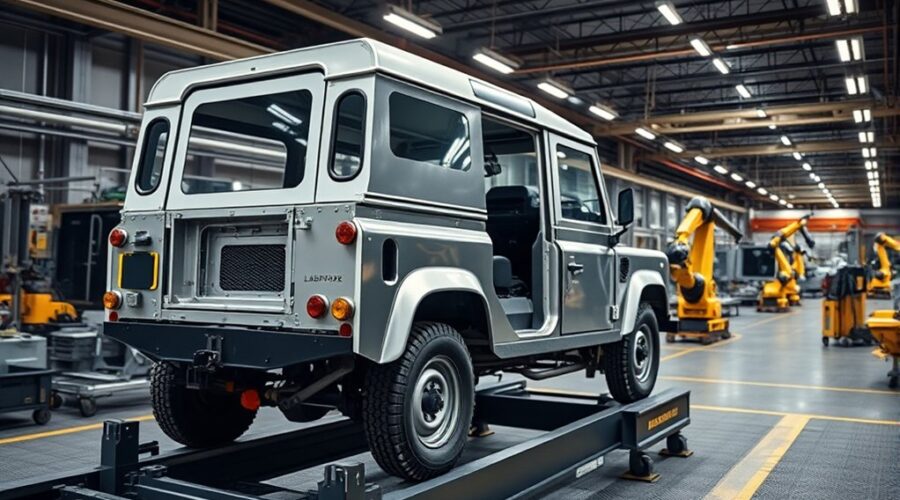
Land Rover began at the Solihull plant in the UK, where the first model appeared in 1948. Early production focused on simple utility and lightweight aluminum construction. Over time, manufacturing spread to other sites and the vehicles gained advanced systems, including Terrain Response and Ingenium engines. The brand’s history is tied to changing factories, new technologies, and global expansion, with more details shaping how it became a modern off-road name.
Key Takeaways
- The first Land Rover was built in 1948 at the Solihull plant in the UK and unveiled at the Amsterdam Motor Show.
- Solihull remains Land Rover’s core manufacturing site, now building premium models like Range Rover, Range Rover Sport, and Velar.
- Production expanded globally after Tata’s 2008 acquisition, including Halewood in the UK, Nitra in Slovakia, and Pune in India.
- Land Rover uses technologies like Terrain Response, lightweight aluminum bodies, monocoque construction, and Ingenium engines for efficiency and capability.
- The brand is known for rugged 4×4 performance, with strong global sales and use in civilian, export, and military applications.
Where Was Land Rover First Built?
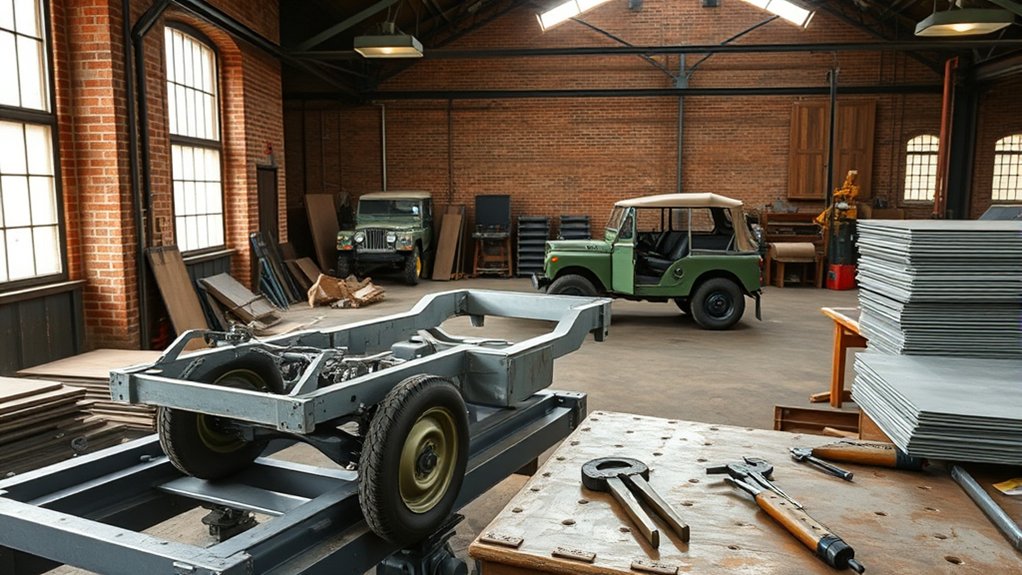
The first Land Rover was built in 1948 at the Solihull plant in the United Kingdom. This site became the brand’s original manufacturing base and remains central to its identity. The vehicle was designed as a practical, utilitarian machine, and its body used aluminum to address post-war steel shortages. In April 1948, the model was officially revealed at the Amsterdam Motor Show, beginning a legacy that would extend far beyond its rugged origins. Solihull has since been expanded and modernized many times, allowing production to move from a single purpose-built vehicle to a wider range that includes luxury SUVs. Even as Land Rover later added plants in Halewood and China, Solihull continued to symbolize the brand’s first step toward durable mobility and industrial independence. Its history reflects resilience, adaptation, and a lasting place in automotive manufacturing.
The Rover Factory and Early Land Rover Production
At Rover Company’s Solihull factory in the United Kingdom, the original Land Rover entered production in 1948, establishing the site as the brand’s manufacturing home. Rover used Solihull as the center of early production, where the vehicle’s practical design was built for work, travel, and independence. The plant later became the main site for the Range Rover and other 4×4 models, reinforcing its role in the company’s history. In 1980, the first 4×4 models moved to a more modern assembly line at Solihull, improving efficiency while keeping production rooted in the same place. The factory also earned a reputation for advanced manufacturing, especially after later upgrades supported new models. Throughout this period, Land Rover’s craftsmanship depended on skilled labor and quality materials sourced locally and globally. That combination gave Rover vehicles durability, purpose, and a lasting identity.
How Land Rover Manufacturing Changed Over Time
Land Rover manufacturing evolved from the brand’s 1948 launch as a utilitarian 4WD vehicle into a more advanced global production system. Early Land Rover production centered on rugged frames and simple assembly, but the evolution of the brand brought major technical change. The fourth-generation Range Rover introduced an aluminum body in 2012, reducing weight and improving efficiency and performance. In 2017, the third-generation Discovery adopted monocoque construction, replacing boxed-section frames and increasing rigidity and safety. After Tata Motors acquired Land Rover in 2008, manufacturing expanded and sales rose, supporting models such as the Range Rover Evoque and Discovery Sport. Solihull remained a key site for the Range Rover and Range Rover Sport, while new capacity was added in Nitra, Slovakia in 2018. Across this evolution, Land Rover manufacturing moved toward lighter structures, stronger bodies, and greater production flexibility.
Where Land Rovers Are Built Today
Today’s Land Rover production is spread across several key facilities. The core of Land Rover manufacturing remains Solihull in the UK, where the Range Rover, Range Rover Sport, and Velar are built. This site carries much of the brand’s premium output and anchors its British identity. In the UK, Halewood also plays a major role, assembling the Discovery Sport and Evoque as compact SUVs for a broad customer base.
Beyond Britain, Land Rover has expanded production to meet demand in the global market. A facility in Nitra, Slovakia, opened in 2018 to add capacity for selected models. In Pune, India, vehicles have been locally assembled since 2011, supporting regional access and supply. The company also works with Chery in China through a joint venture, extending manufacturing reach and reinforcing its international footprint. Together, these sites show a distributed production model.
Land Rover Features and Technologies
Land Rover vehicles feature Terrain Response systems that adjust settings automatically for different driving conditions, improving traction and control across varied terrain. Their lightweight aluminum body construction supports durability while contributing to efficiency. Advanced driver technologies, including Transparent Bonnet and terrain-scanning headlights, further improve visibility and off-road navigation.
Terrain Response Systems
A hallmark of the brand’s modern engineering, Terrain Response® automatically adapts vehicle settings to suit changing driving conditions, improving traction and control across surfaces such as grass, gravel, snow, mud, sand, and rock. Land Rover uses Terrain Response to expand off-road capabilities with measured freedom. Sensors read the ground, then adjust throttle response, suspension, and traction control in real time. Since its 2005 debut on the Range Rover Sport, it has become a defining feature of the marque.
| Mode | Purpose |
|---|---|
| Grass/Gravel/Snow | Stable progress |
| Mud and Ruts | Deep grip |
| Sand | Forward momentum |
| Rock Crawl | Precise control |
The system reflects innovation and craftsmanship, pairing modern intelligence with rugged intent.
Lightweight Body Construction
Building on intelligent systems like Terrain Response®, Land Rover also advances performance through lightweight aluminum body construction. This lightweight design improves vehicle efficiency by reducing mass, which supports better fuel economy and lower CO2 emissions, while preserving durability for demanding use. Aluminum panels and structures help maintain strength without excess weight, aiding performance on-road and off-road. In manufacturing, advanced 3D imaging and virtual reality guide precise design and engineering of these components. The result is a body optimized for Terrain Response conditions, with off-road capabilities shaped by careful material choice. Aluminum also supports sustainability through recyclability and reduced production impact. For Land Rover, lightweight construction is not cosmetic; it is a practical engineering choice that expands freedom of movement across varied terrain.
Advanced Driver Technologies
Advanced driver technologies help Land Rover vehicles adapt intelligently to changing conditions and complex terrain. Terrain Response technology automatically adjusts vehicle settings for performance optimization across shifting driving conditions. The Transparent Bonnet projects a live terrain view beneath the vehicle, supporting precise placement and advanced navigation. | Feature | Function |
| — | — |
|---|---|
| Terrain Response technology | Adjusts vehicle settings |
| Transparent Bonnet | Reveals hidden ground |
| laser terrain scanning | Detects obstacles ahead |
Laser terrain scanning headlights improve path awareness by highlighting obstacles before impact. The Ingenium engine, introduced in 2015, adds efficiency and refined output. Remote control technology, shown in the Discovery Vision Concept, lets a driver maneuver the vehicle from outside with a smartphone app. These systems expand control, reduce uncertainty, and support independent movement across demanding routes.
How Land Rover Became an Icon
Founded in 1948 by the Rover Company as a utilitarian 4WD vehicle, Land Rover became an icon through a rare combination of toughness, innovation, and adventure. Its early Land Rover models proved that practical design could deliver serious off-road capabilities, giving drivers more freedom on difficult ground. The 1970 Range Rover deepened that legacy, turning the brand into a luxury SUV reference point without losing rugged purpose. Later, innovation such as Terrain Response refined control across changing surfaces, reinforcing confidence beyond paved roads. The 1955 Overland Expedition from London to Singapore added proof that the vehicle was built for distance, uncertainty, and discovery. Over time, the brand’s image solidified around independence, endurance, and exploration. That reputation, often summarized as the best 4x4xFar, kept Land Rover iconic for drivers who valued mobility, capability, and a clear path beyond limits.
Land Rover Sales, Models, and Global Use
Land Rover sales expanded sharply worldwide, tripling from 2008/09 to 2014/15 and reaching a peak of 385,000 units. Europe remained a major market, while China became the largest single market after 2012. The brand’s lineup and global use also reflected broad appeal, from best-selling models such as the Freelander and Discovery Sport to military and hybrid applications.
Global Sales Growth
Sales expanded sharply across the Land Rover range in the 2010s, with worldwide annual volume tripling from 2008/09 to 2014/15 and peaking at about 385,000 units. This global sales growth reflected changing consumer preferences and a broader model lineup that helped Land Rover reach more buyers. Europe remained central, accounting for roughly 40% to 50% of sales, while China became the largest single-country market from 2012. In 2018, the Discovery Sport was the best-selling model, with 95,520 units sold globally, followed by the Range Rover Sport at 77,847. Earlier, the Freelander led Europe for five straight years after 1997, showing how regional demand shaped the brand’s ascent.
Model Range Worldwide
By the mid-2010s, Land Rover’s model range had become a global business as well as a diverse product line, with annual sales peaking at about 385,000 units in 2014/15 and Europe still contributing 40% to 50% of volume while China became the largest single-country market after 2012. The Discovery Sport and Range Rover anchored global sales, while the Freelander earlier led Europe for five years from 1997. Manufacturing was split between the Halewood plant, which built the Discovery Sport and Evoque, and the Solihull plant, which produced the Range Rover, Range Rover Sport, and Velar. This spread reflected Land Rover’s versatility in road use, export markets, and military use, including the Snatch Land Rover and Perenti for British and Australian forces.
Related Reading
Frequently Asked Questions
Which Land Rover Is Considered the Best Ever?
The 1970 Range Rover is widely seen as the Best Land Rover, praised among Iconic Models for Off Road Performance, Luxury Features, and Historical Impact, while Reliability Ratings, Design Evolution, Customer Preferences, Global Markets, and Future Innovations vary.
Are Land Rover Engines Made by Ford?
Not entirely; the theory merits scrutiny. Ford partnership once influenced some Land Rover engine types, yet design evolution later shifted manufacturing process in-house. Engine performance, reliability issues, off road capabilities, market competition, model comparisons, aftermarket modifications varied.
Where Are Land Rovers Originally Made?
Land Rover originally made at Solihull, England, shaping brand heritage. Factory history traces early models, production timeline, design evolution, and manufacturing techniques, before global expansion. The original location helped define iconic features and enduring appeal.
Was Land Rover Made by Toyota?
No; Land Rover was not made by Toyota. Like parallel rivers, Land Rover vs. Toyota reflects Brand Rivalry, differing Off Road Capabilities, Engine Performance, Design Philosophy, History Comparison, Market Positioning, Consumer Perception, Innovation Trends, Ownership Changes.
Conclusion
To sum up, Land Rover’s story begins at Solihull, where the first model was built in 1948, and continues through a manufacturing network that now includes sites such as Halewood and Nitra. Over time, the brand evolved from simple aluminum utility vehicles to advanced SUVs with modern body construction, Ingenium engines, and Terrain Response systems. Its global growth reflects the adage that progress is built one step at a time, and Land Rover has followed that path well.