
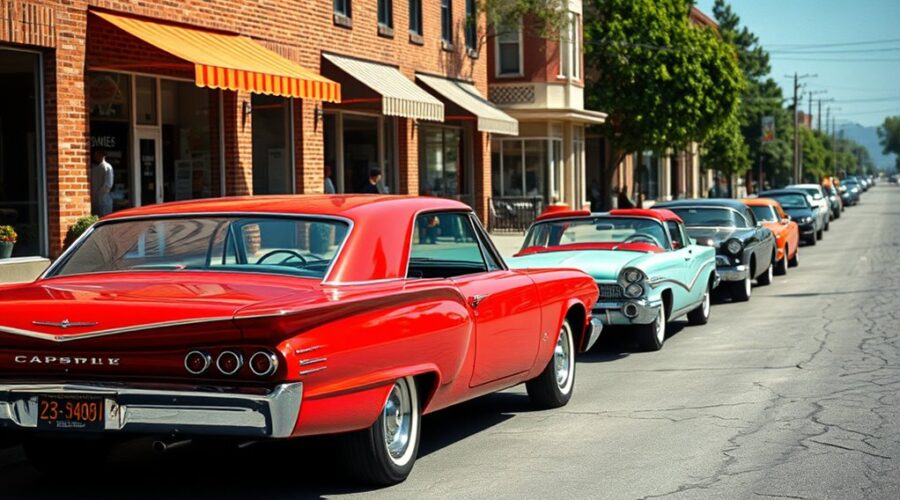
The 1960s reshaped the automobile into both machine and statement, where Detroit’s big-block muscle cars met Europe’s taut sports coupes and Japan’s first serious global contenders. Designers traded excess ornament for sharper lines, lower roofs, and a growing concern for speed, safety, and aerodynamics. Chrome still gleamed, but space-age cues and new proportions hinted at a decade in motion, with more than one quiet revolution waiting underneath.
What Defined 1960s Car Design?
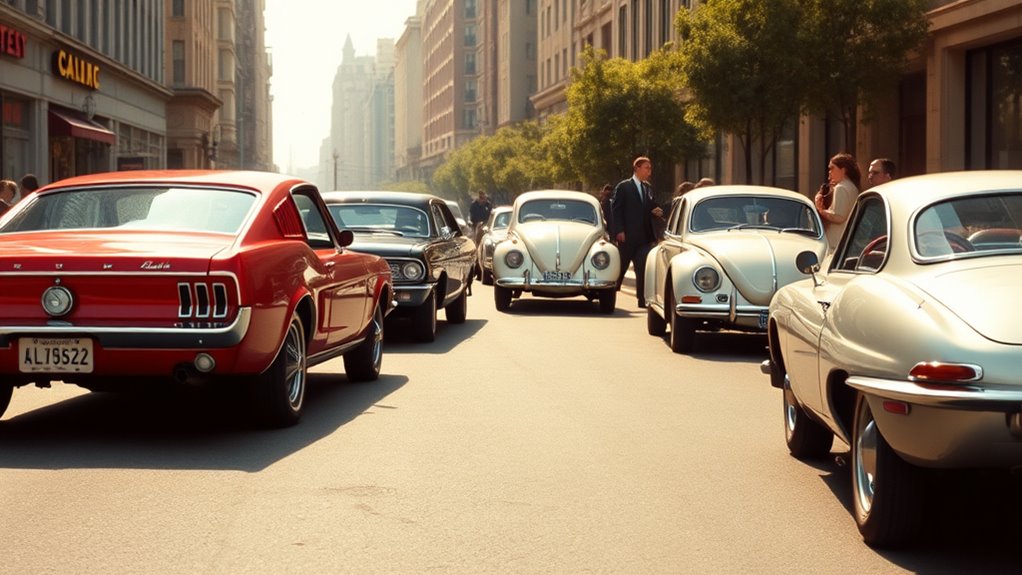
In the 1960s, car design was shaped by the Space Age, with angular profiles, sharp creases, and bold lines giving vehicles a distinctly futuristic look. This 1960s car design reflected a culture keen to move beyond postwar restraint, translating optimism into form.
Iconic models such as the Ford Mustang and Chevrolet Camaro emerged from this atmosphere, helping define the pony car ideal and widening access to expressive motoring. At the same time, lightweight materials, including fiberglass, supported lighter bodies and more inventive shaping.
Safety features also gained visibility, as seat belts and crumple zones entered the design conversation, signaling a new concern for driver protection. Even high-performance sports cars like the Porsche 911 showed how style and engineering could coexist.
In automotive history, the decade stands as a turning point, when design, freedom, and technical progress aligned.
Big-Block Muscle Cars
Thunder arrived on four wheels as big-block muscle cars took hold in the 1960s, their engines—typically displacing more than 400 cubic inches—delivering the kind of raw horsepower that turned straight-line speed into a cultural statement.
These big-block muscle cars paired powerful engines with aggressive styling, and iconic models such as the Chevrolet Chevelle SS 396, Ford Mustang Boss 429, and Dodge Charger R/T became benchmarks of the era.
Big-block muscle cars fused brute horsepower with bold styling, setting the benchmark for an unforgettable performance era.
Their V8 torque gave drivers startling acceleration, high top speeds, and a new vocabulary of performance that shaped drag strips and showroom floors alike.
Within American automotive culture, they came to signify freedom, rebellion, and escape, amplified by films and popular media that cast them as rolling emblems of youthful defiance.
Rising insurance costs and fuel pressures in the early 1970s would soon curb production, but the legacy remained: a brief, thunderous chapter in which speed and self-determination were welded together.
European Sports Cars Lead the Way
European sports cars in the 1960s set a high standard through racing-bred performance, with models such as the Ferrari 250 GTO, Jaguar E-Type, and Porsche 911 pairing speed with engineering rigor.
Their lightweight construction and restrained, aerodynamic styling gave form to a new ideal in which beauty and function were closely aligned.
From Maranello to Stuttgart and Coventry, their design principles spread across Europe and helped define the era’s lasting automotive language.
Racing-Bred Performance
Racing transformed the European sports car into a symbol of engineering seriousness during the 1960s, as makers such as Ferrari and Porsche refined cars for both the road and the track.
In racing, performance became the defining measure of design, and European sports cars answered with disciplined power, balanced handling, and unmistakable purpose.
The Ferrari 250 GTO, built in only 39 examples from 1962 to 1964, fused speed with elegant form, while the Porsche 911, launched in 1964, introduced a rear-engine layout that reshaped expectations.
Across endurance contests such as Le Mans, these machines proved that speed could serve freedom, not ornament.
Engines like the Ford Cosworth DFV V8 further advanced automotive history, turning competition into a laboratory for modern performance.
Lightweight Styling
By the 1960s, European sports cars were increasingly judged not by bulk but by how efficiently they translated lightness into speed, grip, and responsiveness. Lightweight styling became a defining principle of automotive design, with iconic models such as the Lotus Elan, Porsche 911, and Jaguar E-Type proving that restraint could enhance performance.
- Lotus Elan: under 1,500 pounds, built for agility
- Porsche 911: compact body, rear-engine innovation
- Ferrari 246 Dino: aluminum and fiberglass reduced weight
The Ferrari 246 Dino and similar machines showed how material innovation could preserve structure while improving speed and fuel efficiency.
The E-Type’s aerodynamic form and moderate weight added visual freedom to technical purpose. Across the decade, these cars established performance benchmarks that reshaped expectations, making liberation through motion a central ideal of modern motoring.
Design Influence Across Europe
Across the 1960s, design influence radiated outward from Europe’s sports car makers, where models such as the Ferrari 250 GTO and Porsche 911 established new standards for proportion, efficiency, and engineering sophistication.
These iconic cars shaped the automotive world through disciplined design features: low profiles, curved lines, and sculpted bodies that married beauty to performance.
The Lotus Elan advanced lightweight construction and agile handling, while Aston Martin’s DB5 translated sporting intent into refined luxury.
Racing culture, especially Formula One, supplied advanced technology that manufacturers adapted for road use, reinforcing speed, control, and purpose.
European builders privileged craftsmanship over excess, producing compact machines that offered spirited motion and a sense of liberation.
Their influence spread widely, defining the era’s enduring sports car vocabulary.
Japanese Cars Start Standing Out
During the 1960s, Japanese automakers such as Toyota and Nissan gained rising export appeal as overseas buyers began to notice their dependable, affordable cars.
Their reputation for performance and reliability was reinforced by models like the Toyota 2000GT and Nissan’s Datsun 240Z, which matched technical ambition with everyday practicality.
At the same time, these cars developed a distinctive styling identity, helping establish Japanese vehicles as credible competitors in global markets.
Rising Export Appeal
As the 1960s progressed, Japanese automakers such as Toyota, Nissan, and Honda began exporting steadily to the United States, introducing a new competitive force into a market long dominated by larger domestic models. This rising export appeal reshaped the automotive market landscape, as Japanese manufacturers offered compact cars aligned with changing consumer preferences and urban realities.
- Smaller footprints suited crowded streets
- Fuel efficiency answered rising costs
- Practical styling projected modern independence
The Toyota Corolla, launched in 1966, signaled the scale of this shift, pairing affordability with accessible design.
By the late decade, the Datsun 240Z broadened the image further, showing that Japanese exports could also attract enthusiasts.
Together, these arrivals altered expectations, expanding choice and quietly loosening the hold of traditional American automotive norms.
Performance And Reliability
Beyond their growing appeal as imports, Japanese cars in the 1960s began to stand out for qualities that went beyond price and size. Toyota and Nissan advanced performance with models such as the Toyota 2000GT, whose engineering signaled new ambitions in automotive history.
Reliability became a defining strength, matched by fuel efficiency at a moment when rising fuel costs made dependable motoring a practical form of freedom. The Datsun 240Z, introduced in 1969, reinforced this reputation by pairing accessible performance with strong mechanical durability.
Lightweight materials and innovative suspension systems improved handling, while helping Japanese cars challenge established assumptions in global markets. By decade’s end, these achievements had secured an American foothold and influenced design trends toward compact, efficient vehicles that broadened consumer choice.
Distinctive Styling Identity
By the 1960s, Japanese automobiles were developing a distinct visual identity, one shaped by compact proportions, restrained ornament, and forms that differed sharply from the larger American and European cars of the period. This distinctive styling gave Japanese cars a visible presence beyond mere utility, and it helped broaden their automotive reputation.
- Toyota 2000GT: sleek roofline, long hood, global prestige
- Nissan Skyline GT-R: assertive stance, racing intent, performance capabilities
- Practical sedans: clean surfaces, efficient packaging, export appeal
As reliability and affordability won buyers in the United States and elsewhere, design trends shifted toward innovation without excess.
Aerodynamics Shape Sixties Styling
Aerodynamics became a defining force in 1960s car styling as manufacturers responded to rising fuel costs and the growing demand for performance and efficiency. Designers pursued cleaner lines, longer hoods, and fastback roofs, turning speed into a visual language of modern freedom. Iconic models such as the Ford Mustang and Chevrolet Corvette showed how aerodynamics and design could merge with public desire for agile, open-road mobility.
| Feature | Effect | Example |
|---|---|---|
| Fastback profile | Reduced drag | Mustang |
| Lightweight materials | Lower mass | Fiberglass, aluminum |
| Wind tunnel testing | Refined airflow | Corvette |
These innovations were not decorative alone. Lightweight materials helped reduce weight, while wind tunnel testing gave engineers measurable control over stability at speed. The decade’s sleek forms promised mobility less bound by waste and excess, and they set a durable precedent for later automotive design, where function and style advanced together.
1960s Cars That Still Shape Design
The 1960s turned automotive design toward a Space Age vocabulary, with long, low profiles, crisp edges, and glassy surfaces that echoed the era’s fascination with speed and modernity.
At the same time, the muscle car formula, exemplified by the Mustang and Camaro, fused oversized V8 power with bold proportions and a confrontational stance that still defines American performance.
Together, these strands established a design legacy in which futuristic optimism and raw mechanical presence remain central reference points.
Space Age Styling
During the 1960s, Space Age styling gave automobiles sharper profiles, long horizontal lines, and dramatic chrome detailing that echoed the era’s fascination with rockets, satellites, and modern engineering.
In the space age era, automotive design embraced liberation through futuristic design elements, visible in the Chrysler Turbine Car and the Ford Mustang, where chrome accents and unusual rooflines suggested motion before ignition.
- Fiberglass bodies reduced weight and broadened practical freedom.
- Retractable headlights and advanced suspension sharpened form and function.
- High-performance engines and innovations in automotive design made cars feel both modern and commanding.
These machines translated optimism into steel, offering drivers a visual and mechanical escape from older conventions.
The result influenced decades of styling, proving that progress could be both elegant and assertive.
Muscle Car Legacy
Muscle car legacy took shape in the 1960s, when the Ford Mustang and Chevrolet Camaro turned affordable performance into a national obsession.
The Mustang’s 1964 debut created the pony car class, and rivals quickly answered. These iconic American machines paired large V8 muscle with compact proportions, giving drivers speed, style, and a sense of release.
Long hoods, short rear decks, and bold grilles became defining design elements, setting a template for performance-oriented vehicles that endures in automotive history. Their appeal reached beyond engineering: films, street culture, and youth rebellion made them symbols of autonomy.
Lightweight materials and stronger engines improved acceleration while shaping later sports-car design. Even now, their influence remains visible wherever aggressive stance and accessible power matter.
Chrome, Color, and Trim Trends
By the 1960s, American automakers had turned chrome into a defining visual language, covering bumpers, grilles, and side trim with bright metallic finishes that signaled luxury and modern flair, as seen on cars such as the Cadillac Eldorado.
This chrome, color, design, trim, aesthetics formula reshaped showroom appeal, pairing spectacle with social aspiration and a sharper sense of freedom.
- Cherry Red and Lemon Yellow broadened the palette.
- Two-tone paint sharpened body lines on the Ford Mustang.
- Fender skirts and chrome accents refined the Buick Electra.
Bold color choices answered a public keen to break from the restraint of the 1950s.
Sunset Orange, vivid whites, and deep blues gave each model a more personal identity, while contrasting trim emphasized fins, rooflines, and proportions.
On the Pontiac Bonneville and Chevrolet Impala, decorative details became part of the design itself, producing a vibrant automotive identity that captured the decade’s confidence and restless energy.
Early Safety Features in the 1960s
Amid the chrome, color, and trim that defined 1960s styling, automakers also began giving greater attention to occupant protection. Early safety features emerged as seat belts became common, while engineers tested stronger cabins and softer contact points. | Feature | Significance |
| — | — |
|---|---|
| Seat belts | Improved passenger protection |
| Shoulder harnesses | Added restraint in the Ford Mustang |
| Reinforced compartment | Strengthened the Chevrolet Corvette |
| Energy-absorbing column | Reduced steering impact |
| Padded dashboard | Lessened injury risk |
In this decade, automotive safety moved from afterthought to design principle. The Ford Mustang, launched in 1964, offered optional shoulder harnesses, signaling broader concern for restraint systems. The Chevrolet Corvette adopted a reinforced passenger compartment in the mid-1960s, reflecting rising expectations for structural integrity. By the late 1960s, energy-absorbing steering columns and padded dashboards appeared more often, anticipating stricter crash testing and eventual federal regulation. These changes did not end danger, but they marked a measurable advance in passenger protection, aligning engineering with a growing public demand for safer, more liberating driving.
Space Age Concept Cars
Space Age concept cars in the 1960s captured a decade’s fascination with aerodynamics, speed, and the promise of a futuristic automobile. In an era marked by technological advancements, these concept cars translated optimism into automotive design through sleek profiles, jet-inspired noses, and imaginative proportions. Their futuristic design suggested mobility freed from older limits.
- Buick Centurion: wraparound windshield, aircraft-like stance
- Ford Mustang II: compact performance with style
- Chevrolet Astro II: retractable headlights, fiberglass body
Such vehicles often used plastics and aluminum to reduce weight and improve efficiency, revealing how engineers and stylists pursued modernity together. The result was not mere spectacle, but a rolling laboratory for liberation from convention.
Why 1960s Cars Still Inspire Designers
The same inventive spirit that animated 1960s concept cars continued into production models, where designers found a lasting template for proportion, performance, and identity.
In 1960s cars, long hoods, short rear decks, and crisp surfaces gave shape to speed, as seen in the Ford Mustang and Chevrolet Corvette. Iconic muscle cars such as the Pontiac GTO and Dodge Charger added V8 force and assertive stance, proving that car design could signal freedom as forcefully as it delivered acceleration.
Lightweight materials and improved aerodynamics broadened the technical vocabulary of automotive history, linking elegance to efficiency. The Volkswagen Beetle and Ferrari 250 GTO demonstrated how distinct silhouettes could outlast their era, encouraging modern cars to borrow nostalgia without surrendering innovation.
Lightweight forms and sleek aerodynamics linked beauty to efficiency, proving distinctive silhouettes can outlast their era.
That decade also normalized bold colors, custom trim, and personal expression, leaving designers with a durable lesson: style becomes enduring when it grants drivers visible individuality and mechanical purpose.
Frequently Asked Questions
What Are the Top Three Trends in the Automotive Industry?
The top three trends are electric vehicles, autonomous driving, and fuel efficiency. Safety innovations and vintage restorations also shape the industry, as engineers and enthusiasts pursue cleaner mobility, greater protection, and liberated personal expression.
What Truck Will Last 500,000 Miles?
Toyota Tundra or Ford Super Duty can often reach 500,000 miles; mileage records prove it. Durability Factors, Maintenance Tips, Engine Longevity, Best Brands matter, and disciplined care can free owners from premature mechanical dependence.
What Color Car Is the Hardest to Sell?
Brown is generally the hardest car color to sell. Car color psychology, resale value factors, market demand shifts, collector preferences, and seasonal sales trends all favor neutrals, while brown’s subdued appeal suppresses buyer interest and price.
What Are the Latest Trends in Car Design?
Coincidentally, today’s car design trends favor electric vehicles, sustainable materials, aerodynamic shapes, retro styling, and tech integration. Designers pair efficiency with liberation from clutter, embedding advanced interfaces while recalling past forms and prioritizing environmental responsibility.
Conclusion
The 1960s left automotive design with a distinctly memorable silhouette: long hoods, crisp edges, generous chrome, and colors that seemed to catch the light like lacquered showpieces. Muscle cars thundered through American streets, while European and Japanese entrants quietly refined elegance, efficiency, and proportion. In retrospect, the decade appears less a passing fashion than a measured ascent, its innovations gently folding into modern practice, where the era’s most expressive forms still seem to linger.