
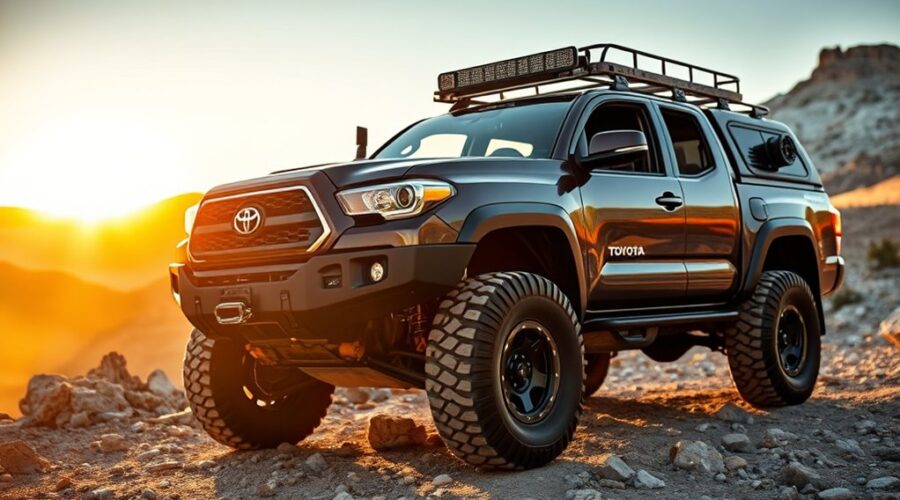
The 2025 Toyota 4Runner Trailhunter is built for buyers who want off-road hardware with practical utility. Its standard i-FORCE engine produces 278 horsepower and 317 lb.-ft. of torque, while the i-FORCE MAX hybrid raises output to 326 horsepower and 465 lb.-ft. of torque. With 6,000 pounds of towing capacity, 82.6 cubic feet of cargo space, and a 112.2-inch wheelbase, the key numbers only begin to explain what it is capable of.
Key Takeaways
- The 2025 Toyota 4Runner Trailhunter is an overland-focused TNGA-F truck built for remote travel and rough terrain.
- It offers a standard 2.4-liter i-FORCE engine with 278 hp and 317 lb.-ft. of torque, or i-FORCE MAX with 326 hp and 465 lb.-ft.
- An eight-speed automatic, Multi-Terrain Select, CRAWL Control, and an available rear locker support off-road traction and control.
- It can tow up to 6,000 pounds, with a 5,000-pound dead-weight hitch rating, 500-pound tongue weight, and 6,505-pound GVWR.
- Dimensions include a 112.2-inch wheelbase, 194.9-inch length, 79.9-inch width, and 82.6 cubic feet of cargo space.
What Is the 2025 Toyota 4Runner Trailhunter?
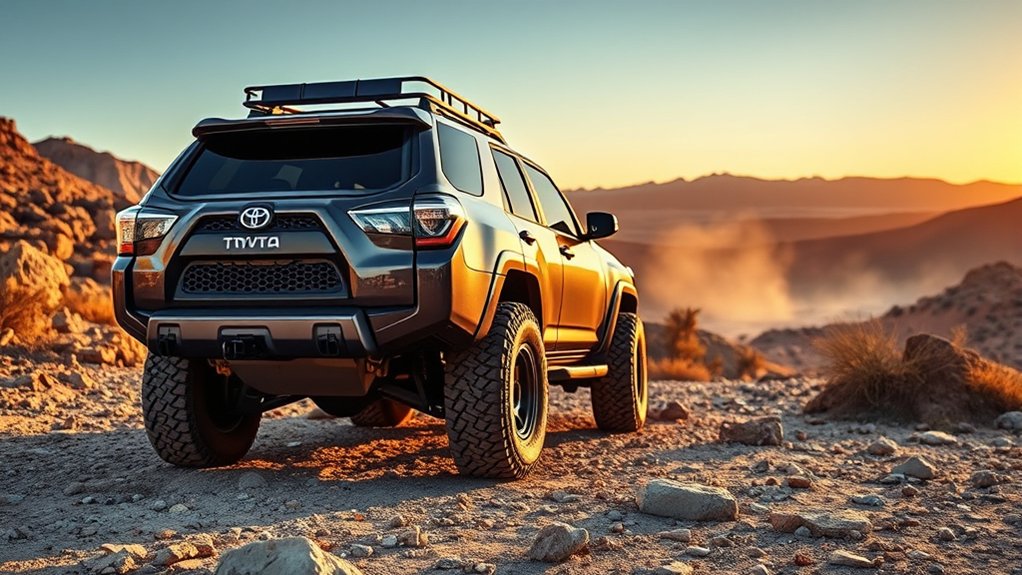
The 2025 Toyota 4Runner Trailhunter is an overland-focused trim built on Toyota’s TNGA-F global truck platform, a foundation designed to improve structural durability and off-road performance.
In this configuration, the Trailhunter is positioned as a purpose-built Toyota for remote travel, rough terrain, and self-reliant exploration. Its chassis architecture supports demanding use while preserving control and stability across uneven surfaces.
The model is equipped with the Multi-Terrain Select system and an available electronic locking rear differential, tools that help distribute traction where freedom requires it most.
Multi-Terrain Select and an available electronic locking rear differential help distribute traction across challenging ground.
Toyota Safety Sense 3.0 adds driver-assist technology for added protection during long-distance off-road use.
The Trailhunter designation signals a factory-prepared platform rather than a cosmetic package, emphasizing capability, endurance, and practical independence.
With its technical focus and rugged engineering, the 4Runner Trailhunter targets drivers who need a vehicle ready for difficult routes without sacrificing confidence or safety.
2025 Toyota 4Runner Trailhunter Powertrain Specs
Powertrain options for the 2025 Toyota 4Runner Trailhunter center on two turbocharged 2.4-liter four-cylinder setups, starting with the standard i-FORCE engine rated at 278 horsepower and 317 lb.-ft. of torque.
The available i-FORCE MAX powertrain raises output to 326 horsepower and 465 lb.-ft. of torque, giving the Trailhunter a more assertive mechanical reserve for demanding terrain.
- Standard output: 278 horsepower, 317 lb.-ft. of torque
- Hybrid output: 326 horsepower, 465 lb.-ft. of torque
- Driveline support: eight-speed automatic transmission
An eight-speed automatic transmission is standard, helping manage power delivery with measured precision.
Multi-Terrain Select allows calibration for varied surfaces, while an electronic locking rear differential, offered on select grades, improves traction when stability is needed.
Together, these systems support a free-moving off-road character with technical control and capability.
2025 Toyota 4Runner Trailhunter Hybrid Performance
The 2025 Toyota 4Runner Trailhunter Hybrid uses the turbocharged 2.4-liter i-FORCE MAX system to produce 326 horsepower and 465 lb.-ft. of torque, giving it strong acceleration and load capability.
Its eight-speed automatic transmission and hybrid torque delivery support controlled performance across varied terrain, while Multi-Terrain Select helps calibrate traction for changing surface conditions.
Off-road capability is further reinforced by a multi-link rear and double wishbone front suspension, along with a 6,000-pound towing rating for demanding trail use.
i-Force Max Power
Toyota’s turbocharged 2.4-liter i-FORCE MAX hybrid powertrain gives the 2025 4Runner Trailhunter a substantial output of 326 horsepower and 465 lb.-ft. of torque, providing strong low-end force for both pavement and trail use. The hybrid powertrain is matched with an eight-speed automatic transmission for smooth, controlled delivery.
- Output supports confident acceleration.
- Estimated fuel efficiency reaches 24 mpg.
- Multi-Terrain Select and CRAWL Control reinforce off-road capabilities.
This calibration favors practical freedom, allowing drivers to move beyond paved limits with measured mechanical authority. The system also contributes to a 6,000-pound towing capacity, extending utility for trailers and gear.
Real-world efficiency may vary, but the package remains technically balanced, blending efficiency, strength, and terrain management in one liberated, purpose-built setup.
Trail-Ready Hybrid Torque
Trailhunter’s hybrid torque delivery builds directly on the i-FORCE MAX output, with the turbocharged 2.4-liter system generating 326 horsepower and 465 lb.-ft. of torque for controlled low-speed traction and strong climbing ability.
This trail-ready hybrid torque is routed through an eight-speed automatic transmission, supporting smooth shifts and measured power delivery.
The Multi-Terrain Select system adjusts torque behavior for varying surfaces, helping maintain grip when conditions are loose or uneven.
With a towing capacity of 6,000 pounds, the powertrain also supports utility beyond the trail.
Robust underbody protection shields critical components, while the advanced suspension system contributes to stability and composure.
Together, these elements present a technical package aimed at drivers seeking capability and freedom over restrictive terrain.
Off-Road Performance Upgrades
Among the most significant off-road upgrades, the 2024 Toyota 4Runner Trailhunter pairs a 2.4-liter turbocharged hybrid powertrain with 326 horsepower and 465 lb.-ft. of torque, giving it strong low-speed control on demanding terrain.
The Toyota 4Runner Trailhunter adds ARB Old Man Emu suspension with 2.5-inch forged shocks for composure across washboards, rocks, and ruts.
- Multi-Terrain Select calibrates throttle and traction for varied surfaces.
- An electronic locking rear differential distributes power with precision on loose climbs.
- A high-strength boxed steel ladder frame and revised angles improve clearance and obstacle approach.
Together, these systems support off-road performance that feels capable, controlled, and unapologetically free on remote trails.
2025 Toyota 4Runner Trailhunter Suspension and Clearance
The 2025 Toyota 4Runner Trailhunter uses a multi-link coil rear suspension and a double wishbone front suspension, a hardware setup designed to balance ride comfort with control on uneven surfaces. This suspension package supports freer movement over broken ground while preserving steering precision on technical trails.
The 2025 Toyota 4Runner Trailhunter balances ride comfort and control with multi-link rear and double wishbone front suspension.
Ground clearance is elevated, helping the SUV clear rocks, ruts, and washouts with less risk of underbody contact. An approach angle of up to 32 degrees and a departure angle of 24 degrees further support confident obstacle negotiation, giving the chassis more latitude when climbing or descending steep terrain.
Built on Toyota’s TNGA-F platform with a boxed steel ladder frame, the Trailhunter gains structural rigidity that complements the suspension geometry. The Stabilizer Bar Disconnect Mechanism increases articulation, allowing each wheel to follow terrain more independently.
Together, these elements strengthen off-road capabilities without sacrificing composure on pavement.
2025 Toyota 4Runner Trailhunter Dimensions
Supporting its suspension and clearance hardware, the 2025 Toyota 4Runner Trailhunter also relies on dimensions that favor stability and trail practicality. Its 112.2-inch wheelbase gives the mid-size SUV a composed stance on uneven ground, while the 194.9-inch length and 79.9-inch width, excluding mirrors, create a broad footprint for controlled positioning.
Compared with the Tacoma-derived Trailhunter hardware and the TRD Off-Road trim, the packaging is tuned for a freer, more deliberate off-road experience. Old Man Emu components sit within a body that preserves the 4Runner’s rugged proportions.
- Wheelbase: 112.2 inches for steadier tracking.
- Length and width: 194.9 inches by 79.9 inches for confident maneuvering.
- Cargo area: 82.6 cubic feet behind the first row, supporting extended travel.
The elevated stance further aids obstacle clearance, even as exact height figures remain unspecified. Overall, the dimensions reinforce utility, load space, and liberation-oriented exploration.
2025 Toyota 4Runner Trailhunter Towing Capacity
The 2025 Toyota 4Runner Trailhunter carries a maximum tow rating of 6,000 pounds, establishing its capability for trailers and expedition equipment.
Its hitch limits and tongue weight requirements are supported by the i-FORCE MAX hybrid powertrain, which delivers 326 horsepower and 465 lb.-ft. of torque for load management.
Stability under towing is further reinforced by the boxed steel ladder frame, Multi-Terrain Select, and the electronic locking rear differential.
Trailhunter Tow Rating
Trail capability is anchored by the 2025 Toyota 4Runner Trailhunter’s 6,000-pound maximum towing capacity, allowing it to handle small-to-midsize trailers and recreational gear with confidence.
The trailhunter towing capacity is supported by the i-FORCE MAX hybrid system, which delivers 326 horsepower and 465 lb.-ft. of torque for controlled pull. Its 6,505-pound GVWR helps maintain composure under load, while the high-strength boxed steel ladder frame adds structural rigidity.
The electronic locking rear differential further improves traction when surfaces become loose or uneven.
- Power delivery remains responsive.
- Load management stays predictable.
- Traction support broadens capability.
Together, these systems create a technically capable tow package that serves drivers seeking freedom beyond pavement without sacrificing measured control or durability.
Hitch Limits
With a dead weight hitch, the 2025 Toyota 4Runner Trailhunter is rated to tow up to 5,000 pounds and carry a maximum tongue weight of 500 pounds, defining a practical boundary for heavier trailer setups while preserving stability.
These hitch limits sit below the model’s full towing capacity of 6,000 pounds, reflecting the constraints of a conventional setup. The maximum trailer weight remains adequate for utility trailers, compact campers, and expedition gear.
Backing this capability, the i-FORCE MAX hybrid powertrain delivers 326 horsepower and 465 lb.-ft. of torque, supporting towing performance with strong low-speed control.
A high-strength boxed steel ladder frame and advanced suspension further enhance composure, letting the Trailhunter manage demanding routes with disciplined response and mechanical confidence.
Weight And Tongue Specs
Rated at a maximum towing capacity of 6,000 pounds, the 2025 Toyota 4Runner Trailhunter also specifies 5,000 pounds of trailer weight when equipped with a dead weight hitch, along with a 500-pound maximum tongue weight. These figures define the weight envelope for controlled hauling, balancing utility with mechanical margin.
- Curb weight: 5,500 pounds, indicating a substantial base mass.
- Gross vehicle weight rating: 6,505 pounds, leaving room for passengers and cargo.
- Tongue weight: capped to preserve stability and braking consistency.
This towing capacity supports practical freedom for trailers, equipment, and overland gear.
The combination of trailer weight limits, hitch specification, and structural weight ratings reflects an engineering approach centered on composure, confidence, and load management under demanding conditions.
2025 Toyota 4Runner Trailhunter Interior and Cargo Space
The 2025 Toyota 4Runner Trailhunter cabin is designed to support long-range off-road travel with a more refined fit and finish than prior models, while preserving the rugged utility expected of the nameplate.
Its interior dimensions provide 39.7 inches of front headroom and 41.8 inches of front legroom, giving the driver and passenger a practical seating envelope for extended terrain changes.
The multimedia experience centers on an 8-inch or available 14-inch touchscreen with wireless Apple CarPlay and Android Auto, improving interface access without added cable clutter.
The multimedia experience centers on an 8-inch or available 14-inch touchscreen with wireless Apple CarPlay and Android Auto.
Behind the first row, the cargo area offers 82.6 cubic feet of volume, sufficient for recovery equipment, camping supplies, and expedition luggage.
The cabin layout also supports customization, allowing accessories to integrate cleanly with the vehicle’s structure.
2025 Toyota 4Runner Trailhunter Features and Gear
Powered by a turbocharged 2.4-liter four-cylinder i-FORCE MAX hybrid system, the 2025 Toyota 4Runner Trailhunter produces 326 horsepower and 465 lb.-ft. of torque, giving it substantial low-end output for technical off-road driving and heavy-load travel.
Built on a high-strength boxed steel ladder frame, it pairs durability with improved suspension tuning for controlled movement over broken ground.
The Trailhunter’s gear package is focused and functional:
- Multi-Terrain Select calibrates traction responses for sand, mud, rock, and other surfaces.
- An electronic locking rear differential helps maintain drive force when grip becomes uneven.
- Toyota Safety Sense 3.0 adds Pre-Collision Detection and Lane Departure Alert for added support on remote routes.
This equipment set supports off-road performance without unnecessary complexity. The result is a trail-ready SUV that emphasizes mechanical capability, rider confidence, and the freedom to move beyond paved limits with measured precision.
Frequently Asked Questions
What Are the Key Features of the Toyota Trailhunter?
The Toyota Trailhunter emphasizes Trailhunter Technology, Off Road Capability, Interior Comfort, Fuel Efficiency, Safety Features, and Customization Options, with turbo-hybrid power, ARB suspension, 33-inch tires, locking differential, Multi-Terrain Select, armor, and rugged adventure readiness.
Which Is Better, the Toyota 4runner Trailhunter or the Land Cruiser?
The Land Cruiser appears the more polished choice, though the 4runner comparison favors value seekers. Land cruiser performance, off road capabilities, durability features, interior comfort, and resale value all tilt toward Toyota’s pricier, more capable flagship.
Is the Tacoma Trailhunter Worth It?
Yes; the Tacoma Trailhunter appears worth it for buyers prioritizing Tacoma advantages, Off road capability, Fuel efficiency, Interior comfort, Safety features, and Resale value, though its premium pricing suits liberated users seeking technical, purpose-built capability.
Which 4runner Has the Best Engine?
The i-FORCE MAX hybrid is the best 4Runner engine; engine comparison favors its performance ratings, torque specifications, and horsepower differences. Reliability factors and fuel efficiency remain strong, while the standard i-FORCE prioritizes simplicity and lower output.
Conclusion
In theory, the 2025 Toyota 4Runner Trailhunter should be the most capable factory overlanding trim in the lineup, and its specifications largely support that claim. The standard i-FORCE engine, available i-FORCE MAX hybrid, 6,000-pound towing rating, and 82.6 cubic feet of cargo space point to real utility, not just image. Combined with its 112.2-inch wheelbase and off-road hardware, the Trailhunter appears engineered to translate rugged intent into measurable capability.